Forbes Riley: Pitch Like a Pro! Sales Secrets That Get People to Say Yes | Sales | E409
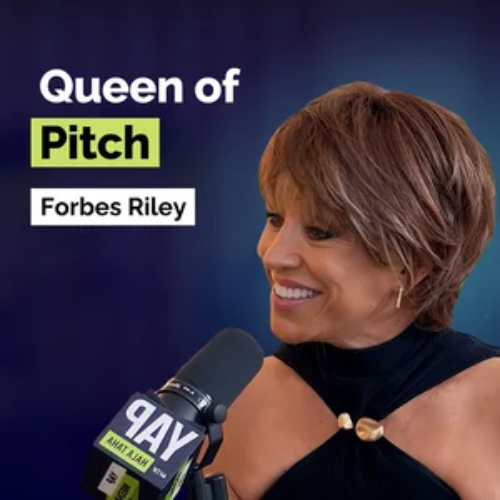
Having generated over $2.5 billion in product sales, hosted nearly 200 infomercials, and built a multimillion-dollar online business, Forbes Riley has spent decades mastering the psychology of getting people to say “yes,” earning her the title “Queen of Pitch.” In this episode, Forbes shares the Ultimate Pitch Formula that helped her make billions, teaching entrepreneurs how to confidently communicate their value, build instant credibility, and win people over in seconds.
In this episode, Hala and Forbes will discuss:
(00:00) Introduction
(01:10) Pitching Mistakes That Keep Entrepreneurs Broke
(08:42) How to Speak With Confidence and Credibility
(27:23) The Elevator Pitch That Opens Powerful Doors
(33:34) Forbes’ Pitch Formula and Storytelling Secrets
(41:48) The Difference Between Selling and Pitching
(48:01) How to Build Real Confidence Before You Pitch
(1:02:35) The Power of Writing Down Your Goals
(1:12:15) Creating the Best First Impression
(1:15:22) Why Demonstrating Value Drives Up Sales
(1:30:23) How Childhood Struggles Shaped Forbes’ Success
Forbes Riley is an entrepreneur, author, communication expert, and sales strategist. Known as the “Queen of Pitch,” she has hosted 197 national infomercials, and her work has generated more than $2.5 billion in product sales. Her new book, Pitch Secrets A to Z, helps readers strengthen their confidence, messaging, persuasion, and negotiation skills so they can get more people to say yes.
Sponsored By:
Indeed – Get a $75 sponsored job credit to boost your job’s visibility at Indeed.com/profiting
Shopify – Start your $1/month trial at Shopify.com/profiting.
Northwest Registered Agent – Get a complete business identity with Northwest. Visit northwestregisteredagent.com/YAPFree and start using free resources to build something amazing.
Mindstone – Master practical AI skills without the complexity with Mindstone’s AI Competency Programme. Head to experience.mindstone.com/yap and get 10% off.
AT&T – Stay connected with reliable, secure internet built for entrepreneurs. Switch to AT&T Business at business.att.com.
Quince – Make your summer wardrobe feel easier. Go to Quince.com/profiting for free shipping on your order and 365-day returns. Now available in Canada, too.
Resources Mentioned:
Forbes’s Book, Pitch Secrets A to Z: bit.ly/PitchSecret
Forbes’s Free Weekly Training: pitchsecretstraining.com
Forbes’s Website: forbesriley.com
Forbes’s Instagram: instagram.com/forbes_riley
Forbes’s YouTube: youtube.com/forbesriley
Active Deals – youngandprofiting.com/deals
Key YAP Links
Reviews – ratethispodcast.com/yap
YouTube – youtube.com/c/YoungandProfiting
Newsletter – youngandprofiting.co/newsletter
LinkedIn – linkedin.com/in/htaha/
Instagram – instagram.com/yapwithhala/
Social + Podcast Services: yapmedia.com
Transcripts – youngandprofiting.com/episodes-new
Entrepreneurship, Entrepreneurship Podcast, Business, Business Podcast, Self Improvement, Self-Improvement, Personal Development, Starting a Business, Strategy, Investing, Sales, Selling, Psychology, Productivity, Entrepreneurs, AI, Artificial Intelligence, Technology, Marketing, Negotiation, Money, Finance, Side Hustle, Startup, Mental Health, Career, Leadership, Mindset, Health, Growth Mindset, Economics, E-commerce, Ecommerce, Prospecting, Inbound, Value Selling, Account Management, Sales Strategies, Business Growth, Scale, Scaling, Sales Podcast
Forbes Riley: [00:00:00] 55% of how you show up for somebody else in their brain is visual. 38% is the tone of your voice, and only 7% are the words that you use. Yet everybody who comes to me only cares about the words. Most founders make this mistake.
Hala Taha: Forbes Riley. She's the queen of pitching, a best-selling author, TV host, entrepreneur, and pitch expert who has generated over $2.5 billion in product sales.
Forbes Riley: There's never been an inventor who's pitched their own product. In fact, they sucked at pitching. You know why? Because they know so much about the product, they wanna tell the backstory and the this. That's not what sells your product.
Hala Taha: What is something that entrepreneurs say where you immediately hear it, and you're like, "Ugh, if you keep saying it like that, you're gonna be broke forever."
Forbes Riley: If you're a network marketer, I can oust you in about 30 seconds, and you don't have to say the name of your company. It's the way network marketers are told to speak. It's horrible. "Hi, what do you do?" "I help so-and-so transform and do this and do that." You missed the point.
Hala Taha: Mm-hmm.
Forbes Riley: The point of the what do you do at a networking event is I don't really care what [00:01:00] you do, I care what you-
Hala Taha: How do we go about believing more in ourselves?
Like, what are some of the things that we can do to get more confidence before we go on and pitch?
Forbes Riley: This is what I want for everybody out there. So-
Hala Taha: Forbes, welcome to Young and Profiting podcast.
Forbes Riley: I'm very excited to be here. I flew all the way to Austin just to talk to you and be here for your audience.
Hala Taha: I am so honored that you came out here, and I'm so excited to talk to you about pitching.
You are the pitch queen.
Forbes Riley: Mm, I've got the crown and everything.
Hala Taha: Yeah.
Forbes Riley: And I have the new book about it.
Hala Taha: You do. So apparently, I am the queen of pitch. You've got all the pitch secrets, and us Young and Profiters, we wanna find those out. So my first question to you is what is something that entrepreneurs say where you immediately hear it, and you're like, "Ugh, if you keep saying it like that, you're gonna be broke forever"?
Forbes Riley: As an entrepreneur, having now trained people every single week, over 200,000 of them, for six years, you open your mouth and I can tell you don't know what you're doing. You say words like actually, basically, like, you know- Mm-hmm ... um, and everyone does these words. Yeah. They play it [00:02:00] sh- they play small. When I ask somebody, "What do you..."
Somebody asks you, "What do you do?" What do you say?
Hala Taha: I'm a top 100 podcaster, and I'm an entrepreneur with an eight-figure production agency and podcast network.
Forbes Riley: You know what you just did that you don't realize? And is it okay if I coach you?
Hala Taha: Yeah. You
Forbes Riley: just, you started to shake your head no. Isn't that funny?
Hala Taha: Mm, I did. I did stutter a little. You made me nervous 'cause you're the pitch queen. I
Forbes Riley: know I made her nervous. Well, here's what most, here's what most of you guys do. You start going, "Hi," "What do you do?" "I help so-and-so transform and do this and do that." I'm like, I'm sorry, you missed the point.
Hala Taha: Mm-hmm.
Forbes Riley: The point of the what do you do at a networking event is I don't really care what you do, I care what you can do for me.
Mm. What we could do together, what the opportunity is. And if you're so busy literally throwing up words, "Well, I'm an ent-..." And here's the next thing. If you say words that don't mean anything. Here's what doesn't mean anything: "Hi, I'm a speaker, author, entrepreneur."
Hala Taha: Yeah.
Forbes Riley: Did I say anything?
Hala Taha: No.
Forbes Riley: You don't know what I wrote, what I speak about, or what business I've built.
And you have such a beautiful opportunity in those first few seconds to connect with somebody, but you have to be really unselfish about it.
Hala Taha: Mm.
Forbes Riley: You have to go, [00:03:00] "Okay, I'm looking at you and I'm gonna make an assumption. Who are you? What do you do?" And if you say, "Well, you know, we're a top 100 podcaster," I might say, "You know, as someone who's on a new book tour, I might consider being on your podcast.
Would that work?" And if you can get a, "Yes, tell me more"- And that yes thing comes from me being a magician. Yeah. I know that sounds crazy, but my dad was a magician. I've been doing magic tricks my whole life.
Hala Taha: I didn't know that.
Forbes Riley: Yeah. And y- my daughter does them as well. You ... So you don't walk up to somebody and go, "Hi, can I show you a magic trick?"
No, I'll be at dinner, and I'll make something magically appear, and people are like, "Wait, what just happened?"
Hala Taha: Hmm.
Forbes Riley: And then they'll say something like, "Wow, you're amazing." So all of a sudden, I have strangers at a dinner table telling me I'm amazing. That was one of my goals all along. Mm-hmm. And most people never live in this rarefied space of how do you control a conversation, how do you get what you want, and how do you be human?
You know, in a, in the age of AI, really listening to somebody-
Hala Taha: Yep ...
Forbes Riley: and connecting to them is the most human thing that we can do.
Hala Taha: Well, you just said a lot, and I've got a lot of follow-up questions. Of course, uh, one of the things that you mentioned is, like, you wanna amaze [00:04:00] people. You want that wow factor.
If we've got a business that's not necessarily very exciting, uh ... For me, podcasting I think is, like, a really exciting space. It's easy to get excited- Mm-hmm ... about it and get people energized about- Yep ... that topic. But if you're a bookkeeper or, you know, you've got some boring business like a recruitment company- Well, wait, now wait a second
how do you make it exciting?
Forbes Riley: Let's not call bookkeepers and recruitment people boring. They're liable to go, "What did she say?" If you're doing it, it excites you on some level. So f- in fact, I was a bookkeeper. Why don't you drill down, why are you the best bookkeeper? You don't have the biggest company, but you know what?
Y- uh, as a, as a bookkeeper, I come from a long line of bookkeepers, and I've discovered they are the backbone of every entrepreneur's business. Hmm. Do you have a good one?
Hala Taha: Yeah.
Forbes Riley: Great. And I'm, I'm glad that you do. So I'm also very skilled, and if you got recommendations for me, I would love that. Oh, all of a sudden they're like, "Oh, okay.
You seem like a really nice person. I'd refer you." But you had the moment where you, you call to action.
Hala Taha: Hmm.
Forbes Riley: And I do think there's something very exciting about what everybody [00:05:00] does. Now, it may not be a right fit for us, but you're always out there. If you're networking, you're pitching for some reason. Ask me what I do.
Hala Taha: What do you do?
Forbes Riley: I own a dog-walking company. And you know what? I take puppies like yours who's so busy, right? Do... Is your little baby loved on when you're not home?
Hala Taha: No, he's sad.
Forbes Riley: Oh, guys, I've got a whole crew of, of young people that I've trained. Your dog's gonna, he's gonna love you, because during the day he won't be lonely anymore.
Hala Taha: Hmm.
Forbes Riley: All of a sudden, that sounds like the greatest job in the world.
Hala Taha: Yeah.
Forbes Riley: The other thing I do is I have a fitness company. I don't know if you know that.
Hala Taha: Mm-hmm.
Forbes Riley: And so when people ask me what I do, ask me again.
Hala Taha: What do you do?
Forbes Riley: I created the greatest fitness product on the planet. You wanna see it?
Hala Taha: Sure.
Forbes Riley: Oh, really?
Hala Taha: Yeah.
Forbes Riley: See, then I would do this. I would, Lydia, push your microphone in. Come here. I know this sounds crazy. Give me your thumbs. Okay. And this is what I would do at a party. All of a sudden she's like, "Yes." Here, come here for a second so you don't hit that.
Hala Taha: Okay.
Forbes Riley: And I, you, I know you've never felt this before, but here- Okay
give me one thumb and two thumbs. Thumbs up.
Hala Taha: Okay.
Forbes Riley: One and two. Pull your belly button in, hold it, and make a fist. We'll put the thing there. And I want you to go 10, nine, eight. Eight. Go seven, six. [00:06:00] How does that feel? Isn't that kind of interesting?
Hala Taha: Yeah, it's pretty cool.
Forbes Riley: I know, right? So w- now we're at a party.
All of a sudden you're playing with me-
Hala Taha: Yeah ...
Forbes Riley: and we're having fun, and it's not boring even though I sell fitness products.
Hala Taha: So you do so many things, right? You're an author, you're a speaker. How do you decide in the moment which one line you're gonna use on someone? '
Forbes Riley: Cause I look at the person, I look at the scenario, and figure out what is it that I want.
What was my intention going into this networking event? I don't need more pitching clients. I do really, really well. But I also offer a free training every Sunday. So I might say, you know, "As an entrepreneur, if you're looking to up-level and pitching makes you nervous at all-
Hala Taha: Yeah ...
Forbes Riley: I've got a free Sunday training.
If you're interested, I'll give you a card." Boom. That's a great thing. If I'm... When I'm on vacation, ask me what I do.
Hala Taha: What do you do?
Forbes Riley: I'm a brain surgeon. It's tough work. Please don't talk to me about it. I really have to focus on enjoying myself. Because I don't wanna always say what I do. Yeah. Is that funny?
Hala Taha: Yeah.
Forbes Riley: It's not always the right time, and if you're in a networking event with hundreds of people, what's your goal? What's your intention? And mine is to meet lots of people, get lots of cards. [00:07:00] Mm-hmm. And saying, now here's another little phrase that I love, and it's a great takeaway for you guys. Rather than say, "I am" or "I help," say, "As someone who."
Mm-hmm. Now look, now what did you do before this, before you podcasted?
Hala Taha: I used to work in corporate, and I used to work in radio.
Forbes Riley: Great. Hey, you know, as someone who worked in corporate, saw the burnout factor there, moved to radio and realized podcasting's even bigger, I have the ability to take your program or your business and put it online.
Ooh. So all of a sudden, this as someone who thing is a really powerful statement.
Hala Taha: Mm.
Forbes Riley: So as someone who's generated over $2.5 billion in sales, I now coach entrepreneurs to ma- to master their message.
Hala Taha: Mm. So it's a way to, like, give your credibility.
Forbes Riley: Right, in one sentence, because I live by a phrase that says, "Less words, more impact."
Hala Taha: A lot of people tuning in are really afraid of bragging about themselves. I teach a lot about personal branding, and one of the things that I get from my students often is like, "Well, I don't wanna sound like I'm bragging. I don't, I don't wanna brag." How do you feel about that?
Forbes Riley: I would ask them to unpack, first of all, we're not in, in, we're not in fourth grade.[00:08:00]
We don't brag.
Hala Taha: Yeah.
Forbes Riley: Giving your credibility and attaining certain levels of excellence is not bragging. That is a very young way of thinking about life. 'Cause by the way, if you don't talk about yourself and say what you do, who's going to? So when I started saying 2.5 billion, which is what my infomercials and TV s- added up to, it's like, wow, that was an impressive number.
And I say that like a, just like a magic trick. When I say that number, what's your reaction to that? It's like, wow, you must- Yeah ... know what you're talking about. Yeah. So there's no bragging. What I'm doing is I'm instilling a sense of authority in you when you look at me going, "Wow, if she's that good, maybe she can help me."
So you gotta really reframe why you're saying what you're saying, and then literally reframe the words you're saying.
Hala Taha: Let's talk about confidence and how to be more confident. So you mentioned, like, you don't wanna say kind of, I don't know, I think. Really drill deep and tell us, like, what are the words that we should avoid, and w- how should we replace those words?
What, what should we say instead? Well,
Forbes Riley: you said two things that are interesting. You said what i- what is confidence, do you think? [00:09:00]
Hala Taha: What is confidence? I think confidence is competence, being an expert and really knowing your stuff and believing in yourself.
Forbes Riley: Right. So if you go to my book and you go to letter B, 'cause every word is a letter, B is belief.
Hala Taha: Mm-hmm.
Forbes Riley: And inside of belief is the word lie. And so there's a thing, when you first start out, you are not that successful. You don't have thousand hours to be an expert. You have all these reasons to believe that you're an imposter. I would love everyone just to take a breath and go, look, you have to build the illusion to achieve the dream.
And it's a funny thing about steps. Confidence comes over time. I don't think it's something that you're born with. I think we as a society like to chip away your confidence by saying you're not pretty enough, you're not thin enough, you're not tall. And when you start to hear all those things, because I have, I have this vision in my head, there were three voices that we have to deal with.
Hala Taha: Okay.
Forbes Riley: One is the inherited voice. That is your mom, your dad, anyone who raised you, a bully, a teacher, who stuck things in your head going, "Well, you can't do that," or, "You can do that," depending on who they are. But it's usually the negative ones people hold onto.
Hala Taha: Mm.
Forbes Riley: Then there's the other voice. This is [00:10:00] the four-year-old voice.
This is the one that's gonna protect you. So they said I can't do it, so we're not gonna be able to do it, and then you find evidence to prove you can't do it. And it's this voice that's protecting you, but keeps you playing small. Literally- Mm ... playing small, 'cause it's safer to play small. And then there's the future voice, and this voice whispers going, "You can do it.
Go dance like no one's watching. Start that business." The problem is which one are most people listening to? The loudest voice. Mm-hmm. The historical voice that's not serving them. And so one of the ways to get better and more confident is to take those risks, is to jump off a cliff and build a parachute on the way down-
Hala Taha: Yeah
Forbes Riley: and to firmly believe that life happens for you, not to you. There are gonna be really bad times.
Hala Taha: Yeah.
Forbes Riley: If you choose to live this life fully, you're gonna experience massive heartbreak, pain, death, and.
Hala Taha: Yeah.
Forbes Riley: And what I've learned is that when you're down in those times, it's when you just pull yourself up by the bootstraps and go, "Look, it's my movie."
Hala Taha: Mm-hmm.
Forbes Riley: And in every movie, doesn't the hero go through some really bad stuff?
Hala Taha: Yeah.
Forbes Riley: The question is- It
Hala Taha: makes the
Forbes Riley: character ... right. [00:11:00] The question is, do you learn from it?
Hala Taha: Mm.
Forbes Riley: What do you learn? And take a moment to go, "Wow, don't wanna experience that again."
Hala Taha: Yeah. "
Forbes Riley: What did I learn?"
Hala Taha: YAP fam, if I had a dollar for every time a business leader came on the show and told me, "Hala, hiring the right people is everything," I'd probably be retired by now.
And guys, they're right. Hiring gives you leverage, but the wrong hire can weigh down your entire team, and I've seen this in my own business, YAP Media. So when I need to hire, and right now at YAP Media we've got five open US roles, I use Indeed Sponsored Jobs. Sponsored Jobs posted directly on Indeed are 95% more likely to report a hire than non-sponsored jobs.
95%, YAP fam. That's the difference between hoping the right person sees your post and actually reaching the quality candidates that you need for your business. With Sponsored Jobs, your post is boosted in the search results so you can reach people who match what you're looking for, whether that's skills, experience, certifications, or location.
Spend less time [00:12:00] searching and more time actually interviewing candidates who check all your boxes. Less stress, less time, more results. When you need the right person to cut through the chaos, this is a job for Indeed Sponsored Jobs. And listeners of this show will get a $75 Sponsored Job credit to help give your jobs the premium status it deserves at indeed.com/podcast.
Just go to indeed.com/podcast right now and support our show, Young and Profiting, by saying you heard about Indeed on this podcast. Indeed.com/podcast. Terms and conditions apply. Need a hiring hero? This is a job for Indeed Sponsored Jobs. YAP fam, attention is not income. I learned that the hard way. Before YAP, I had the sorority of hip hop.
Over 100 female bloggers, a buzzing site, MTV interested in a reality TV show twice, but I didn't get to turn that attention into an offer that people could easily buy. So when I launched my LinkedIn Secrets Masterclass, I did it differently. I needed a storefront that looked credible, [00:13:00] explained the offer, took payments, and made checkout simple.
That's where Shopify comes in. Shopify is a commerce platform that gives you your own online store, checkout payments, and business tools all in one place. What I love is how fast my Yap Academy storefront felt real. It wasn't coding or duct-taping tools together. I could just focus on the course content and the marketing and helping my students.
Shopify's templates and AI tools help you launch fast. Shopify Checkout helps buyers move with less friction, including one-click checkout for returning shoppers, and Sidekick is Shopify's built-in AI assistant for questions while you're building. That course went on to generate nearly half a million dollars, and Shopify made it simple for people to buy.
Young Profiters, your skill is not a business until somebody can pay for it. Start at shopify.com/profiting. All you need is the idea. Shopify handles the rest. Start your free trial at shopify.com/profiting. Again, that's shopify.com/profiting. [00:14:00] Go to shopify.com/profiting and start building your dream business today.
I meet a lot of young entrepreneurs that are, like, really sold on, like, some specific outcome, and, like, they really want some specific business or dream to work, even though it's not necessarily working. So for me, for example, I wanted to be a singer, and I was a great singer my whole life, and I recorded albums and, like, really took it seriously until one day, you know, or through my experiences, I started experiencing radio, and I realized I can have a very similar outcome if I go the radio podcasting route And it would be easier to achieve, and I thought that I could, you know, achieve something big in that space rather than keep trying to do singing when nothing was really working out for me.
Right. And it worked. I became a top 100 podcaster. I have my dream company. And I kind of switched the outcome. You wanted to be an actress, and you did a lot of, you did a lot of acting. Ooh, she's going there,
Forbes Riley: isn't she? Yeah. Yes.
Hala Taha: You had a very successful acting career, but ultimately you sort of [00:15:00] pivoted, right?
Forbes Riley: Oh, I didn't sort of pivot. Uh, and this is really interesting. Yeah. I loved acting. Acting was all that I wanted to do. Uh, in fact, you guys can see a movie I just played the bad girl in, uh, called Black Creek. Oh. Oh, cool. It's on Amazon Prime- Cool ... and Apple TV right now because I'm not giving up the dream.
But it's all I wanted to do, and two things happened. One, the story goes that I went to an audition, a sell me the pen moment. Mm-hmm. And I got a very lucrative, interesting job to pitch products when that was not even a, a job description. And Body by Jake had created this network for cable television, and I went on to sell 1,500 different products.
We sold that network for $500 million- Wow ... in 1993. That really worked. And I hadn't given up my acting career at the time. I was still balancing everything. And I was convinced in my naivete that you really could ride two horses in different directions and be just fine. And everyone said, "Oh, you have to focus," but I didn't.
I'm an actress and a TV host and I didn't wanna have to choose. Well, the universe chose for me, and I don't know how your singing career ended. My acting career ended really abruptly.
Hala Taha: Hmm. [00:16:00]
Forbes Riley: I had the lead in a TV series. It's called Fashion House. Okay. And if you go to YouTube, you can see the pilot. I was really good in this.
I was the slightly bitchy, cranky Devil Wears Prada with all of these beautiful models, and I... It was 65 one-hour episodes. I don't think I could've been happier. Hmm. I had two little three-year-olds. I got the dream job. We shoot the pilot, and I'm ugh. Now, two things happened. One, we all had a big meeting with the Fox executives.
And I'm not gonna name names, but there was a gentleman who showed up who was rather big and slightly slovenly and couldn't wait to touch all my cute little models on the knee and got very- Hmm ... and when I said something about it, I had a feeling that nobody wanted to stand up, and I did And I could feel the energy, something shifted.
A couple days later, I get a call going, "Hey, um, you know, we love you, and you did really well, but we're gonna give your role ... You're not f- your name is not famous enough to bank the whole series on. We're gonna give this role to Bo Derek."
Hala Taha: Oh, man.
Forbes Riley: And Bo Derek, as wonderful as she is, she's not a strong, that kind of a female [00:17:00] character.
Yeah. Well-known actress, and she did end up playing the role. You can see it. Uh, and I'm not quite sure if it's that I stood up for myself and all the other women on the set, or that that was, in fact, my name wasn't famous enough, and I got, it was very, I was so sad. I was shattered.
Hala Taha: Yeah.
Forbes Riley: And then I went into my agent's office, a guy that I'd fought so hard to get to, was an A-minus agent, but really powerful, and he looks at me, and he says, "We're gonna let you go."
And I'm like- Oh, no ... "Go? Where am I going?" He, and then, you know, they play this cards, and I don't think it was the truth as I'm hearing it later years. He said, "Oh, well, you know, you're already 40. You've got two kids. You know, it's kinda old in Hollywood, and my son's taking over the business. He doesn't want anyone over the age of 20.
Good luck to you."
Hala Taha: Oh, my gosh.
Forbes Riley: Now, I don't know if the people from the network called him and said, "Look, we're not gonna have her around." Uh, but I walked out of the door, and I said to myself, and I had a little conversation with the guy upstairs, and I'm like, "I'm not gonna act for a while, aren't I?" I said okay.
My marriage was falling apart at the moment because I'd raised a little boy from South Central who was murdered, [00:18:00] and my husband and both took it very, it was very hard. Yeah. It's hard to overcome that. Um, and he's the father of both my children. And I picked up my babies, I left Los Angeles, went all the way to Florida where HSN was, where I was beginning to grow a...
It was, to me it was my side hustle- Mm ... selling products on TV. It was never the thing I wanted. It was the thing that I did anyway.
Hala Taha: Yeah.
Forbes Riley: And I got down there, and the irony is that's when I developed my own fitness product for the first time. I'd always sold other people's products.
Hala Taha: Yeah.
Forbes Riley: You know, one of the things about pitching that you really should get good at, most founders make this mistake.
Mm-hmm. They cannot wait to have their own product. Mm-hmm. My own course, my own training. I went through trauma, I'm now a life coach. Well, back up for a second. There's never been an inventor of a prod- of a company that I worked with who s- pitched their own product. In fact, they sucked at pitching. You know why?
Because they know so much about the product, they wanna tell the backstory and the this. That's not what sells your product. And so I was brought in, in fact, if you look in the book here-
Hala Taha: Mm-hmm ...
Forbes Riley: I hosted 197 [00:19:00] infomercials, some of them to the tune of hundreds of millions of dollars, and what these represent is I am the original influencer.
All of... It's like you-
Hala Taha: Yeah, you are.
Forbes Riley: Right. All of those companies came to me to be the spokesperson for their product. Oh,
Hala Taha: that's such an interesting reframe. I didn't think about
Forbes Riley: it that way. Right. And we shot infomercials- Mm-hmm ... and I would take them on Home Shopping, and your product became my livelihood.
Hala Taha: Yeah.
Forbes Riley: That's what influencers do. Mm-hmm. Well, there was nobody doing that back then, especially as women, when I started in that industry. And so it was fascinating to think, "Stop pitching your own product. Learn how to pitch first."
Hala Taha: Mm-hmm.
Forbes Riley: And it's easier to pitch something that you're not emotionally attached to.
So I got really good at pitching because they weren't my products. I just looked at the product and I came up with a formula that I'm happy to share with you in a minute. But there was a moment when I realized that I wasn't gonna get to act for a while. Mm-hmm. I also said I love doing theater. I've done Broadway, I've done Lily Tomlin let me do her one-woman show.
I've had the most blessed... And I'm talented enough to do those things. I love this. But I thought, "You know, in theater, [00:20:00] you go to work at like 6:00, and you don't come home till 11:30." I wanted my two beautiful babies. Are you a mom?
Hala Taha: Not yet, no.
Forbes Riley: I'm gonna tell you, the coolest thing I ever did, and I didn't have them till I was 42, and I found myself making a deal with myself.
I said, "Look, you need to tuck these little ones into bed-
Hala Taha: Mm ...
Forbes Riley: every night. It's not a nanny's job. If you said you wanted them this much, enjoy them to no end." And I haven't been back on stage in a play in 23 years. Mm. And I'm thinking, "Hmm, Broadway show? I could do this."
Hala Taha: Don't you feel fulfilled? 'Cause you're still using very similar skills that you would have used as an actress.
Forbes Riley: Yes and no. Speaking has done that for me. I have been so blessed. I've stood on stage at the 10X Convention, spoke in front of 10,000 people.
Hala Taha: Yeah.
Forbes Riley: I speak on platforms all the time, and I love speaking, and it comes really close- You get your ideas out, you get to stand up there and speak. I'm about ready to do my third TEDx.
Hala Taha: Wow.
Forbes Riley: But it's not q- there's something about acting, I gotta tell you, this is [00:21:00] not quite like singing, is it? When you get up and you perform something that's yours. Mm-hmm. I am gonna look very much forward to fulfilling a little bit more of the acting bug for me. It mattered so much when I went through so many trauma- traumatic times in my life.
Hala Taha: Yeah.
Forbes Riley: But I have a very fulfilled life. I wouldn't, I wouldn't trade the journey for anything.
Hala Taha: Yeah.
Forbes Riley: But you mentioned earlier about your entrepreneurs. Let's get real.
Hala Taha: Yeah.
Forbes Riley: There is no destination.
Hala Taha: Yeah.
Forbes Riley: You don't win. When my daughter came downstairs during COVID, she was 17 years old. She'd already been online, she did a drop shipping business, and she was working with some of my celebrity friends behind the scenes building their YouTube channels, building their online presence.
I had no idea. Mm-hmm. And she said, "Mom, let's start a business," because when COVID hit, everything slowed down for me. And I'm like, "Start a business? Uh, could you just get an A in English?" That's all I wanted.
Hala Taha: Yeah.
Forbes Riley: And she's like, "Mom, I've been coding and I've been doing a lot of this, and I already have a bank account."
And she showed me a six-figure bank account. Mm. I'm like, she's 17. Wow. I'm like, "Where did you get this money?" She said, "Mom, you're the only one who doesn't believe in me."
Hala Taha: Aw.
Forbes Riley: I said, "No, no, that's not true, baby girl. I'm, I believe in you more than [00:22:00] anything, but I'm also the only one who's responsible for you getting an A in English and graduating high school."
Hala Taha: Yeah.
Forbes Riley: And we sat in a room for three weeks and we put together the very first webinar I ever did. Do you remember those days, like in the early 2020, you and I were talking about Clubhouse? Yeah. When the world was just kind of different, right?
Hala Taha: Yep.
Forbes Riley: And I'd always looked at my funnel account, and I always had zero.
I made pretty funnels, but I never launched them.
Hala Taha: Mm.
Forbes Riley: I wasn't really good on the internet. And she said, "I'll f- I'm gonna fix all that." First night I do my first webinar, we have 25 people on Zoom, and nobody knew what Zoom was back then. And I created a $1,000 program, four-week training with me live using my ultimate pitch formula.
I said, "Guys, I've generated two and a half billion. I'm gonna get you to add a zero to your income. Watch me do this with you."
Hala Taha: Mm-hmm.
Forbes Riley: And the next morning I call my daughter 'cause I looked at our account and I had to say, "What was the, what does the K stand for?" She said, "What do you mean, Mommy?" I said, "Well, it's always said zero.
Now it says 25K. What's the K?" She's like, "Mom, you made $25,000 last night." I'm like, "What, we, we did what?" [00:23:00] Then we did it for four consecutive weeks with just 25 people in each class, and all of a sudden we had a six-figure business in four weeks.
Hala Taha: Amazing.
Forbes Riley: Nine months later, got our first Two Comma Club award, and two weeks ago I got a notification we just got our 10 million Two Comma Club award.
Hala Taha: Wow.
Forbes Riley: A 17-year-old and a 16-year-old who couldn't figure out the internet. So my, my goal in coming on here and talking to you guys is that to offer this crazy level of inspiration, 'cause we really did it.
Hala Taha: Yeah.
Forbes Riley: I grew up with nothing. I've created millions in my career, billions in my career. I didn't give it to my daughter.
I made her have to go out and fight for it. Mm-hmm. She did, and now we're writing the most amazing story.
Hala Taha: YAP gang, I built an app in 15 minutes, and before you ask, I did not suddenly become a software engineer. I've actually never written a line of code. This all happened through Mindstone, an AI transformation company that helps close the gap between having access to AI and actually getting value from it.
I attended their AI breakthrough weekend, and I had no [00:24:00] idea what to expect. I was completely blown away, and this weekend was life-transforming. I left that weekend thinking about how I need to implement AI across my company, thinking about all the training that I need to implement. I used to use AI for one-off tasks: draft this email, summarize this doc, give me a few ideas here and there, and that's not the right way to use AI in 2026.
There's so much more that you can do. I now use AI as a second brain. AI is going through all of my emails, is going through all of my call transcripts, is going through my Slack messages, and knows everything about me, every article that I've ever written, every webinar that I've ever wrote. Mindstone gives you these tools, but first you've gotta actually do the training so that you know how to use AI appropriately, and that's their AI competency program.
That's where most people start. It's a four-week online program, no code. It's totally hands-on. This is what I put my whole company through, so [00:25:00] all 60 of my employees just got this four-week program, and they learned so much about how to prompt AI, how to use AI correctly, make sure that you're giving AI enough context, and then how to actually use their Mindstone platform, which you get access to.
It's called Rebel. I use Rebel every single day, and it's helped me become so much more productive, and it's helped my whole company become more efficient that we've actually froze hiring. So if you guys wanna learn how to use AI in your company, if you wanna roll out AI and you don't know where to start, this is a great program.
It's really affordable, and it's something that I highly recommend that everybody do for their teams. You can get 10% off the AI competency program. Head to experience.mindstone.com/yap to start. That's experience.mindstone.com/yap to get 10% off the four-week AI competency program. You've come so far, and you've done so much, and you're such an inspiration to young women, and I'm just so [00:26:00] proud of everything that you've accomplished.
Forbes Riley: I'm gonna get really emotional. You know, you saying that means the world. Mm-hmm. Because... And I'm gonna start to cry. Not k- all kidding aside, it has been such a long- slightly painful journey. A lot of nights where I just cried to sleep in the pillow and going, "What am I supposed to be doing here?"
Hala Taha: Yeah.
Forbes Riley: And so to everybody who is struggling I would make a list of what you want.
Hala Taha: Mm-hmm.
Forbes Riley: I would surround yourself with people who are positive thinkers. You gotta kick the negative people out. Yeah. I don't care if they're your mom or your spouse, but you gotta get rid of the garbage because it just clutters your head.
Hala Taha: Yeah.
Forbes Riley: Find amazing mentors, listen to uplifting podcasts, which I do all the time.
'Cause you get to meet a lot of people very quickly- Yeah ... and hear their stories and learn from their stories. Mm-hmm. Because there was a time, I remember when I first met Tony Robbins many years ago, and he talked about modeling.
Hala Taha: Yep.
Forbes Riley: I, I was like, how do you model somebody if you don't know their real story?
Well, now with YouTube, you get to go into people's homes. You can see, you know, Vogue does that. They take you into people's closets. Mm-hmm. You can model anyone that you want so you don't feel alone. And when I started, my mentors weren't real. [00:27:00] Yeah. My mentors were Jane Fonda, Barbara Walters. I just looked at their careers- Yeah
and went, okay, connect the dots. What did they do? What didn't they do? But nowadays, you guys, you have an instant roadmap.
Hala Taha: Yeah.
Forbes Riley: You can Google any of us and find our histories, our books, our Instagram. There's so many ways to do it that I never had access to. But to have a beautiful young woman with a hit podcast be proud of me means the world.
Hala Taha: Well, you got there also by pitching yourself, right? Yeah. You weren't afraid of asking for what you wanted. A great story that I came across in your book was when you, uh, basically asked Grant Cardone if you could join the 10X stage. I'd love for you to tell us that story.
Forbes Riley: Well, so that, that's a great story.
I'll, I'll reframe that a little bit. I have a thing called elevator pitch. I would get very nervous when I would meet new people-
Hala Taha: Mm-hmm ...
Forbes Riley: and throw up on them. Ask me what I do, I'm like, "Oh, well, I'm an actress and a TV host, and I'm getting very excited. I wanna do," blah, blah, blah, blah, blah. And I would leave 'cause I'd see their eyes go...
I would. And I'm like, "What did I just do?"
Hala Taha: Yeah.
Forbes Riley: And there there's another little famous goofy story I have. [00:28:00] George Clooney, many, many years ago- Mm-hmm ... he was standing at a party when I first got to LA, and I walked into this party, and he was just... And I remember standing there. I don't drink, and so I walk into a party, and I'm like starstruck.
I'm like... And I couldn't say anything. I couldn't move. I didn't do anything, and then I realized every girl that he dated ended up on Dancing With the Stars. I'm like, "Damn, I just should have said hello." That's a fun example of missed opportunities that I had. Mm-hmm. So I created this elevator pitch, and it's a very step-by-step system to allow people who are shy or introverted or just confused about how to p- position themselves to say hi.
Hala Taha: Yeah.
Forbes Riley: And so I had heard about Grant Cardone. He was supposed to speak on a platform with me, and he didn't show up for this, and I thought, "I, I need to... This guy seems to be moving and grooving." It was like 2018. Yeah. And I heard that he was gonna be in Vegas. I was there, and I tracked him down. I'm in a hallway, and I see him at the very end of the hallway with a whole entourage.
Now I've got 20 seconds to put something together.
Hala Taha: Yeah.
Forbes Riley: Before I give you my answer, and I think this will help everybody else, if somebody that you wanna meet is in the elevator [00:29:00] with you-
Hala Taha: Mm-hmm ...
Forbes Riley: who might that be? Who do you wanna meet?
Hala Taha: I've met a lot of people that I wanna meet, but, like, Elon Musk is somebody I, who I'd like to meet and have a- Okay.
Let's put Elon Musk in the elevator. Okay. What do you say to him?
I would invite him on my podcast
Forbes Riley: But how would you do that? So you stand next to him, you got 20 seconds, go.
Hala Taha: I would let him know, "Hey, um, I have a top 100 podcasts. I've got, you know, millions of entrepreneurs who listen to me every single month, and I'd love to have you on the show so you could share some of your wisdom."
Forbes Riley: Okay, that was gr- that was good, and I would coach that just a little bit-
Hala Taha: Yeah ... '
Forbes Riley: cause he doesn't need to share his wisdom. I would give him something he wants.
Hala Taha: Mm.
Forbes Riley: So what you did that's great, and because you have met so many famous people, what most of you guys don't do is that person's in the elevator, "Oh my God, I love you.
You're so wonderful. Can I- You know what? I follow you. I've been..." And the next thing you know, they're gone.
Hala Taha: Yeah.
Forbes Riley: And you, they got, you got nothing.
Hala Taha: Mm-hmm.
Forbes Riley: So what's really smart about what you're doing and why you're who you are-
Hala Taha: Yeah ...
Forbes Riley: is that you thought to formulate a question, an ask, and credibility, all within 10 seconds.
You know, when I do that to most people, you know what the reaction is? Hmm. "Oh, I don't know." [00:30:00] You guys, you don't have time in life for that moment at all. Hmm. And one of the reasons that we not only teach pitch, but we train, you get to practice and implement what we do. That's part of the training.
Hala Taha: Yeah.
Forbes Riley: I see Grant.
One, I believe in research. Second, I believe in strategy, and third, I believe in leverage. Those are my three key core pillars. And so as I walked up to Grant, my thought was, when one woman walks up to somebody else's husband, 'cause I knew who Elena was by my research-
Hala Taha: Yeah ...
Forbes Riley: never met them, don't walk up to the husband 'cause it's not a good energy.
And so I walk right up to her, and I said- Hi ... "Elena, hi. Um, you may recognize me, Forbes rally, been on television, $2.5 billion in sales. I make people billionaires. I think through an infomercial, your husband could earn an extra billion. Would that be okay?"
Hala Taha: Hmm.
Forbes Riley: What do you say to that? She's like- Of course. She turns to Grant and says, "You need..."
Now, she said this. She said, "You need to meet this woman." It, chapter O is called an open door. She literally opened the door. Now, for busy men, you get 20 seconds. Hmm. And I know that's how his brain works. I'm like, "Hey, Grant, nice to meet you. I'm, am [00:31:00] friends with Kevin Harrington." I dropped a name that we both know very well.
I said, "I've generated over two and a half billion. I'd like to see if I can make you an extra billion." I already know he's a billionaire, so that's credibility and authority and loving on him-
Hala Taha: Yep ...
Forbes Riley: doing an infomercial. He looked at me and said, "Great, I'm doing a party in two nights. You're my, you're my special guest."
It was that- Wow ... literally. The whole thing was maybe 30 seconds And then we, you know, pursued each other. When I got to his party, he knew exactly who I was. He was big on research, too. He didn't initially invite me on the 10X stage. I don't know if you know, but something really tragic happened that night of that party, and we don't all talk about it very much, but it was October 1st, 2018, I think it was '18, when the Las Vegas shooting was happening.
Hala Taha: Hmm.
Forbes Riley: Grant came over to me, Kevin Harrington was at that party from Shark Tank, and said, "Hey, do you wanna go downstairs and play poker?" And I said, "I'd love to, but I wanna walk out to that balcony. I've just met what I think is the love of my life," and turns out he is. Aw. It's nine, it's nine years ago.
Hala Taha: Wow.
Forbes Riley: "And I would like to take a picture on the strip," you know? Of, we're Mandalay Bay sign. We walk out with my iPhone [00:32:00] and we hear pop, pop, pop, pop, pop, pop, and we're thinking it's the fireworks. And then we look down across the street, and some very strange things. People seem to be running or not running or what's going on, and what happened was the guy 10 floors below us is shooting and killing people at the country music concert.
Oh my God. And it's all on my iPhone. And if you Google Las Vegas and Forbes Riley, you'll see that for 11 hours we were locked down in that room, watching and waiting for all of that to unfold. And so now Grant, he was downstairs with Elena in, in downs- I mean, they thought there were terrorists everywhere.
It was a very scattered, insane experience. And so we recapped all this. Him and I and Elena got on the phone and had a really in-depth conversation, 'cause I was a little PTSD'd.
Hala Taha: Yeah.
Forbes Riley: And Grant said, "Well, I'd love to invite you to come to my 10X convention." I thought, that's great. I looked at the lineup-
Hala Taha: Mm-hmm
Forbes Riley: and it was all men. And I said to him there's no women." And he said, "Do you wanna speak on Saturday?"
Hala Taha: He's like, "Oops."
Forbes Riley: And that's truly how it [00:33:00] happened. And I've done that a couple of times because I love being a, a, a trailblazer.
Hala Taha: Yeah. But
Forbes Riley: women have not-
Hala Taha: That's
Forbes Riley: so
Hala Taha: smart ... been given- That's so smart to, to pull that card, you know?
Like...
Forbes Riley: It made sense in the moment. Yeah. It's what I wanted all along.
Hala Taha: Mm-hmm.
Forbes Riley: And it seemed to be the leverage thing that got him to say yes.
Hala Taha: Yeah.
Forbes Riley: Because I didn't have a bestselling book at the time, I was just- it was, that's nine years ago.
Hala Taha: Mm-hmm.
Forbes Riley: So I was just beginning to find my ground as a speaker, as a teacher, and from that stage, I sold over $280,000 worth of pitching.
Hala Taha: Well, I feel like we just learned a lot from your storytelling, and storytelling is so important when it comes to a pitch. So walk us through what we need to know about storytelling and, and from an entrepreneurship mindset, we're usually selling our own products and services. So, so how should we think about storytelling?
Forbes Riley: I, I have eight steps in this formula. The f- one of the steps that's really important-
Hala Taha: And this is your ultimate pitch
Forbes Riley: framework? My ultimate pitch formula. Okay. I'm not gonna give it all to you, but I'm gonna tease you enough that you're gonna wanna come... Because I'll tell you what, even if I gave you each one of the [00:34:00] steps, it's actionable and implementation that gets you good at it.
Hala Taha: Mm.
Forbes Riley: One of the steps that's really important that no one's allowed to do anymore is assumptions. Are you allowed to make assumptions about people?
Hala Taha: I feel like people do, even if let's... Are you saying, like, you shouldn't make assumptions about people?
Forbes Riley: Oh, I'm saying you should at all times.
Hala Taha: Mm.
Forbes Riley: And here's the funny thing.
We're told to be very polite in 2026. Yeah. I can't assume if you're a man or a woman, if you're tall or short- Mm ... but I can kinda look at you and get a couple of ideas.
Hala Taha: Yeah.
Forbes Riley: Right. Well, but that's an important thing to know. You don't say the assumptions out loud, but there's a lot of things I can tell about you.
I can tell the fact that you're wearing a short skirt and high heels, that you seem athletic, that you work out. Now, I may or may not be tr- be right. That's,
Hala Taha: yeah, that's right.
Forbes Riley: But those are things that I'm getting. Yeah. The way you've done your hair, the way you... I've all kind of assumptions about you. Now, if I'm talking to a woman who's 90 years old, I might talk to her differently because my assumption is she's an older woman.
She is not as, as aggressive, as interested in her future as you are. So if I've got an insurance product, I might sell it different to you than I would to her. And then if I've got a kid, I'm [00:35:00] not gonna be selling at all to... In fact, I'll- let me show you something really interesting.
Hala Taha: Yeah. '
Forbes Riley: Cause assumptions goes to avatars.
You all need a, what, ideal avatar? Mm-hmm. We've heard that?
Hala Taha: Yeah, yeah, like your ideal customer.
Forbes Riley: Yeah. That cust- yeah. So I had an MBA student team come and say, "You know what, Forbes? The ideal customer for your spin gym is 45 years old. Her name is Sheila. She walks a Labradoodle, drives a Lexus, not a Tesla, and likes hot yoga."
And I was like All right. Good for you. I said, "You know what, guys? I'm gonna outsell you. I don't believe in avatars. I believe that everybody in front of me can be turned into an avatar." And they were like, "What?" And it's why I've grossed billions of dollars. So yeah, let me take a seven-year-old girl. And a seven-year-old girl, I'm gonna look at her, and she's in gymnastics class, and I'm gonna say, "You know, you need really strong shoulders, but you're too little to go to the gym.
This comes in hot pink. It works your arms five minutes a day, and your mom's got your credit card." Then I'm gonna find two TikTokers who are sitting there like this and going, "Hey, guys, you know what? I'm watching people dance like you do. They're not like this. They've got big open chests. You want more followers.
Give them what they want. This will do [00:36:00] that for you." She buys one in purple. He got one in silver. And then I'm looking at Grandpa. He's sitting in his Barcalounger. He's got this little belly, and his wife's in the kitchen. His grandkids are playing, and I'm like, "Let me ask you a question. How long you wanna be around?
You gotta get rid of this." Hmm. "I know you want the rest of your life to be the best of your life. Give me a couple of minutes. She's gonna even find you sexier." Hmm. "And you get to play with the grandkids." So now I've sold... He bought one for his wife. I bought one, two... I've sold five Spin gyms, and none of them were named Sheila So I have a very different take on how to find customers-
Hala Taha: Yeah
Forbes Riley: before we even get to the storytelling part.
Hala Taha: Mm-hmm.
Forbes Riley: And so the assumptions are when you walk onto a set or you walk into a meeting, look at who you're talking to. Most people pitch everybody the same way.
Hala Taha: Mm-hmm.
Forbes Riley: There's no such thing as a perfect pitch, but there is a really skilled perfect pitcher.
Hala Taha: Mm-hmm.
Forbes Riley: And when you're this good, you have the ability to change what you're pitching-
Hala Taha: Yeah ...
Forbes Riley: but most people don't. That's the most embarrassing thing I find of entrepreneurs. Like, "All right, I've got my pitch, [00:37:00] Forbes. Do I
Hala Taha: do my pitch for you?" Yeah, they say the same thing every single time, and they don't think about who they're actually pitching to and what that person is desiring.
Forbes Riley: And that's how you close people. The next thing is when it comes to closing, don't wait till the end. How about you start with the closing? What do you mean? Well, begin with the end in mind. What is it that I want you to do? Well, I'm gonna look at you and say, "You know what? You're very busy, and you don't have a whole lot of time to go to the gym, but you look great.
You wanna keep that going. I'm gonna tell you, give me five minutes a day, and this is gonna give you sexy tone, amazing arms." And so now in our whole conversation, I'll get to the stories, I'll talk about... But you're like, "I want sexy arms."
Hala Taha: Mm-hmm.
Forbes Riley: And so when I finally say, "Hey, would you want pink or silver?"
You're like, "All right, I'll take one of each." I've already closed you at the beginning of the conversation because I structured it that way.
Hala Taha: Yeah.
Forbes Riley: So I think what my pitching training does and why we're so successful is we take the guesswork out of, out of your dream.
Hala Taha: Mm-hmm.
Forbes Riley: And it gets into somebody else's hands.
They become a customer, a partner, an investor, and you're always [00:38:00] pitching. Do you know that?
Hala Taha: Yeah.
Forbes Riley: I wake up in the morning, "Honey, could you rub my neck?" And he does. That's a pitch. I win.
Hala Taha: Mm-hmm.
Forbes Riley: So pitching is a win-win environment. It's not selling. When you... You know, when my team, when you pitch each other to be on the show, 'cause we're not selling each other-
Hala Taha: Mm-hmm
Forbes Riley: but we did get a yes. So I have a little secret that I do.
Hala Taha: Yeah.
Forbes Riley: If I ask you the question, you wanna see something cool, what do you say?
Hala Taha: Yeah. Everybody wants to see something cool.
Forbes Riley: Great. So ask a question you know the answer to. I love getting yeses.
Hala Taha: Hmm.
Forbes Riley: Yeses are a game changer. Most people, especially you guys, when you pitch, you don't think about getting a yes.
Hala Taha: Hmm. So like a yes ladder you're talking about.
Forbes Riley: Oh, a yes ladder. Yeah. Oh, I never thought about that. Yes.
Hala Taha: So basically s- getting them in the mindset of saying yes, so at the end when you make the big ask, they say yes.
Forbes Riley: Well, yeah. And then again, I wouldn't wait till the big ask till the end.
Hala Taha: Mm.
Forbes Riley: I would set it up, because that's the problem, and people wait till the end.
W- w- Sam, have you been pitched something lately? Have you bought a high-ticket item of some sort?
Hala Taha: I mean, yeah, I buy stuff all the time. Right. So I, I guess [00:39:00] I bought, uh... I buy a lot of clothes. I bought a pink Porsche.
Forbes Riley: You bought a pink Porsche. Now, did you go in thinking you wanted a pink Porsche?
Hala Taha: Yeah, I wanted it.
Forbes Riley: Okay. So the sales g- salesman's got a pretty easy answer.
Hala Taha: Yeah, very easy
Forbes Riley: job. Did you have a good salesperson or a bad salesperson?
Hala Taha: Well, maybe this is a bad example, 'cause I just bought it over the phone. Oh, that's so- I called, and they drove it to me from Dallas, so.
Forbes Riley: Somebody must have been very, very
Hala Taha: happy.
Yeah, it was a very easy sale. Well, but- That's maybe a bad example ...
Forbes Riley: well, I'll unpack that for you. Okay. Because you pitched yourself.
Hala Taha: Mm.
Forbes Riley: And that's a very interesting thing. That's, you know, my, my next TEDx talk is about permission. You, did you grow up with money?
Hala Taha: My dad was a surgeon. Okay. So I grew up with some money, but he gave a lot of his money away.
He grew up very poor. Okay. He was from Palestine, and, like, basically grew up in poverty and became rich, and then we gave all our money away. So I wasn't, like, poor, but I wasn't very spoiled.
Forbes Riley: Good, and I love that.
Hala Taha: Yeah.
Forbes Riley: So at some point you said, "Hey, you know what? I've worked really hard," and this is the pitch and the permission you gave yourself.
Hala Taha: Yeah.
Forbes Riley: Because nobody needs a Porsche. I have one. Nobody needs one. Nobody needs a pink Po- car, right? At [00:40:00] all. But you said, "You know, wait, let me unpack this. Why would it be good for my business, for my image, for my brand, and maybe I just want to enjoy it?" And so you gave yourself permissions along the way, and you literally pitched yourself.
Hala Taha: Mm-hmm.
Forbes Riley: Did you have other car options in mind?
Hala Taha: Uh, yeah, there was other options in
Forbes Riley: mind. Right, and then somehow this one said, you know, this is... And it, it checked off a box for you.
Hala Taha: Mm-hmm.
Forbes Riley: And then you're like, "Well, what color?" It was like, "Wait a second, I'm gonna make a statement-
Hala Taha: Mm-hmm ...
Forbes Riley: and so now I want this."
And it's the funny thing about pitching yourself, because all of a sudden when you do, you stop playing small. And it's the funniest thing. Did anyone say you, "No, you can't do that?"
Hala Taha: It's not their business, not their money.
Forbes Riley: Oh. But see, it took you a while to... You know, you're a great role model for that.
Hala Taha: Yeah.
Forbes Riley: Because I didn't grow up with money either, and it took me a long time to figure out that I could enjoy all my hard work.
Hala Taha: Mm-hmm. It was a, it was a symbol of me being like, "I'm finally buying something really, like, out there. I've been making money for a while and I'm gonna treat myself." It was like, it was a present.
It was a birthday present to myself.
Forbes Riley: And I'll tell you what, two things happened. One, you pitched yourself, 'cause you have to go through that whole checklist. [00:41:00] Now, if somebody were in the store, if you walked into a Porsche dealership and they were trying to sell you, and here's why this might have gone wrong and you might have walked out, because that person, m- probably most car salesmen, men or women-
Hala Taha: Yeah,
Forbes Riley: men
a lot of men, might have said, "Pink? Really? You want pink?"
Hala Taha: Mm.
Forbes Riley: And what would you have said? "
Hala Taha: Yeah, pink represents me. I, I like pink."
Forbes Riley: But notice how he's now not selling you. Isn't that funny?
Hala Taha: Mm.
Forbes Riley: It'd be interesting to see... I, I almost wanna do that as an exercise, to walk into a dealership and to find somebody who's not good at his job, who would probably talk you out of that for all kind of reasons.
I've had that happen. Yeah. Where I, I walked out going, "That was such a... I'm not buying anything 'cause they were terrible." Yeah, 'cause
Hala Taha: I don't like him. Right. It's important to actually like the salesperson, right?
Forbes Riley: That's what I was talking about, yes.
Hala Taha: Yeah. When it comes to likeability and being a good... I know you, you don't, you don't call, call it selling, right?
You don't even like calling it
Forbes Riley: selling. No, in fact, I teach that selling and pitching are very different.
Hala Taha: Yeah.
Forbes Riley: So selling is about having quotas, and selling is a thing. Mm-hmm. There is sales trainings, there are sales objections, there's getting a [00:42:00] transaction and it's done. I don't do that. See, when you are pitching, when you understand the concept the way I present it, you realize that your product, your service, or even your idea is a solution to somebody's problem Now that's a different way.
I'm not selling you that.
Hala Taha: Yeah.
Forbes Riley: What I wanna do is I wanna find out, I've got this product, right? Give me a, give me an arbitrary product. Any product or, or-
Hala Taha: A water bottle ...
Forbes Riley: a water bottle. Okay. A, a
Hala Taha: Stanley Cup type thing, yeah.
Forbes Riley: Okay, so let's say I sell a water bottle. Now this particular water bottle that I've decided to sell, because I only sell things I like, this one has got special insulation.
It keeps cold for 24 hours, it keeps hot for 24 hours. Mm. So I love that. Now, as I'm thinking about this, what's the biggest problem somebody has to have who wants this bottle?
Hala Taha: They're dehydrated.
Forbes Riley: Well, one is they're dehydrated, but that's not quite the biggest problem. That means you could just have a glass of any water.
Hala Taha: Mm.
Forbes Riley: Drill down even deeper. Why would you want a container that keeps- If
Hala Taha: you travel a lot.
Forbes Riley: Oh, bingo. All right. You're somebody who travels. You're somebody who doesn't like diluted ice cubes in your tea or your soda. Mm-hmm. Or you're somebody who [00:43:00] wants your coffee hot the entire day. So now I've got three problems that this would be the answer to.
I'm not even gonna show you this.
Hala Taha: Mm.
Forbes Riley: I'm gonna do what I call a question flip, which is step number two, and go, "Well, let me ask you a question. You travel a lot, right?"
Hala Taha: Yeah. "
Forbes Riley: Do you love hot coffee?"
Hala Taha: Yes. "
Forbes Riley: Doesn't it really annoy you after, like, 20 minutes and it's lu- lukewarm and you don't have a, a microwave?"
Hala Taha: Yes, and you're getting me to say yes.
Forbes Riley: Aren't I, though?
Hala Taha: Mm-hmm.
Forbes Riley: What if I told you I've got the newest Himalayan r- rock-embedded insulation, keeps cold, ice cold, 24 hours. Mm. Hot 20... You can put this in your bag, you can go out to the tennis court, and it's like water from a freezer. That's how cold it is.
Hala Taha: I'd love that.
Forbes Riley: You'd love it, and I made a sale for a product I haven't even made yet.
Hala Taha: Mm.
Forbes Riley: But isn't that funny? All I did, it's a very specific technique, you guys. It's got nothing to do with your product or service, which is why I said in the beginning that as a founder, you're so close to this that you wanna start telling stories and stuff.
Mm-hmm. Stories don't come into the pitch until a little bit down the road. Because a story would, and I call it springboard stories.
Hala Taha: Yeah.
Forbes Riley: I want a story that does [00:44:00] a little bit, goes down, gets you emotional, and comes right back off of it. I'm not here to tell you why I created my product or why I'm passionate about it.
I should only be caring, why do you wanna buy it?
Hala Taha: Yeah. So talk to us about what that question flip exactly was. So what part of that was the question flip?
Forbes Riley: Okay. And then I'm gonna throw in something else, too.
Hala Taha: Yeah.
Forbes Riley: I'm gonna throw in a story into this. So now I've got this product, okay? This is what I call the hub.
Okay. The beginning of any product, you should figure out your research. What is it? Why do you love it? Why are you connected to it? And do all of that, and then don't talk about that just yet.
Hala Taha: Okay.
Forbes Riley: But now you look at your product or service or whatever it is that you're doing, and it's, it- I know people are like, "But I have a massage therapy business."
It works for everything.
Hala Taha: Mm.
Forbes Riley: Your massage therapy business- Yep ... not, is a solution to somebody's problem.
Hala Taha: Their pain, their back pain.
Forbes Riley: Get, but drill down. Be very intentional. What does your massage business do? You love working on releasing myofascial, right?
Hala Taha: Mm-hmm.
Forbes Riley: So you do something other typical massage people don't do.
So you're, the problem you're solving is somebody who's got a knot in their neck that [00:45:00] just won't go away, a lower back pain that has been throbbing. They've tried medication, okay? That's what I've determined I solve. All I do is flip it. "Hey," in my marketing, "are you somebody who's tried everything? You're tired of the pills.
You've been to the chiropractor. They're telling you you need surgery. Nothing's working. Before you make that investment, come see me. I have a track record second to none."
Hala Taha: Mm.
Forbes Riley: That was a question flip. Now, go back to the insulated water bottle. So now I've figured out you are someone who, we want someone who travels- Mm-hmm
who loves their beverage hot or cold, and likes it for a long time, also doesn't want typical aluminum. Another one, they might be health-conscious guys. Yeah. There's no aluminum. There's no plastics. Mm-hmm. So all of those things now I know I'm gonna say to you to get you go, "Oh, yeah, I've been thinking about that.
I don't want plastic water bottles anymore." Great. This is that. Now, once I've got you that excited and you're going, "Yes, I want it," now I'm gonna throw in my springboard story. I'm gonna say, "You know, the crazy thing about this, why I'm so, why I'm so passionate about it, is a couple years ago I wasn't drinking [00:46:00] enough water.
I had water bottles. They would get hot. They would break. I ended up with a kidney stone in the emergency room and almost died- Mm ... because I wasn't drinking enough water Wow. All of a sudden you're like, "This, she's really passionate about this." Yeah. So what did I do? I dipped into a story, and now I'm gonna say, "And this bottle comes in pink, goes with your car."
Hala Taha: How do you get them to not feel sorry for you, and why is that important?
Forbes Riley: Don't stay there too long. And it's okay if you do feel sorry for me, but that's not the point. It's the way you tell a story. And guys, that is practice. Most of you have never had any practice telling stories.
Hala Taha: Hmm.
Forbes Riley: I mean, y- as a singer, would you...
Even if somebody really has a good voice, would you ever expect someone to cut an album that never had any kind of coaching training at all?
Hala Taha: No.
Forbes Riley: Right. But people tell stories like they think they know what they're doing. By the way, you know that. Come the holidays and you sit around the table and people tell stories that have no ending- Mm-hmm
or no point.
Hala Taha: Yeah.
Forbes Riley: I firmly say to every one of my students, "Every story has a point, and every point has a story."
Hala Taha: Some people are so bad at tell- I always tell my sister, like, "What [00:47:00] is the point of your story?"
Forbes Riley: Well, because they weren't trained to tell stories.
Hala Taha: Yeah.
Forbes Riley: People think because they can just talk.
Now, here's a funny thing. I give speeches all over the world. My formula applies to speech giving as well. Because when I'm, before I'm ready to g- I know what the speech is, I know what I wanna be talking about, we agreed on the topic, but here's a phenomenon. Who am I talking to?
Hala Taha: Mm-hmm.
Forbes Riley: When I walk into an arena, and I usually show up the night before, I wanna know is it men or women or young or old or successful or not.
All of those indicators, I'm gonna go back and reframe my entire speech based on what I think that audience wants to hear. Yeah. Not always what I wanna talk about. And
Hala Taha: you're thinking through, like, what problems do they have- Yes ... that I wanna solve- Mm-hmm ... so I can make them feel like this is relatable.
And what stories do I have that are relatable to them?
Forbes Riley: Isn't it funny how pitching now also became storytelling and speech giving?
Hala Taha: Mm-hmm.
Forbes Riley: But I think it's the same thing. I think when you learn this formula, I think life gets more fun.
Hala Taha: Mm-hmm.
Forbes Riley: You're not guessing as much.
Hala Taha: Now, for a lot of [00:48:00] founders, like, for instance, I have a podcast network and I get people sponsorships, and the reason why I do that is 'cause I was really good at getting myself sponsorships.
So I've got this social proof and credibility, and when I'm pitching people, just me telling my story or explaining how much I make on my podcast c- and comparing that to what they're making, I feel like they start to trust me more 'cause they're like, "Okay, she's done it herself."
Forbes Riley: Right.
Hala Taha: What's the importance or how should we go about talking about what we've already done for ourselves?
Forbes Riley: Okay, so that goes back to the whole bragging thing. Give me a sponsor, a name of a sponsor, kind of a sponsor.
Hala Taha: Shopify, Indeed, LinkedIn.
Forbes Riley: Okay. So Shopify. Why would Shopify want a sponsor? So the first thing I would think about is I would do my research. I learn all about Shopify. I have a Shopify platform, and I love it.
Mm-hmm. But you have to figure out, okay, what is it, why is it, and what is it looking for? And so when you conclude, give me one thing you think Shopify is looking for.
Hala Taha: They want, uh, audiences with new founders, like people who want to start businesses.
Forbes Riley: I love that. So they're looking for audiences with new founders.[00:49:00]
Question is when you're doing your podcast or somebody, are you attracting those kind of people for them?
Hala Taha: Mm-hmm.
Forbes Riley: And based on your age and the kind of guests that you've got and the credibility, the numbers you have, I would lay all that out. And when I went to Shopify, I would say, "Guys, you know what?"
'Cause you're only there to help them. You do wanna talk about you, but not until they want you.
Hala Taha: Hmm.
Forbes Riley: So, "Hey, you know, I know that it would help build your platform if you had young founders who are starting companies that really don't quite, haven't really s- you know, begun yet." Funny thing, my audience is made up of those people.
And why do they like me? Because I'm young and I'm fresh. I've had these 10 guests on. We've done these numbers. And then we have another little piece of the formula called FEBIT.
Hala Taha: Oh.
Forbes Riley: Feature benefit.
Hala Taha: Okay.
Forbes Riley: And most people just list feature, feature, feature. Mm-hmm. They don't list, they don't tie it to anything.
So if I say this water bottle that I talked about before is pink, it insulates, and it sells for $19.99, you're like, "Okay." But now there's benefits to those things. If I just list the benefits, you're like, "Okay." But watch what happens if I do feature [00:50:00] benefit. "Hey, this water bottle comes in pink. I heard you got a Porsche.
It's gonna look great in your car."
Hala Taha: Hmm.
Forbes Riley: That's a yes. This keeps hot drinks hot for 24 hours, and I promise you, that's gonna solve the problem of you having to constantly get up and go to the coffee maker.
Hala Taha: Hmm.
Forbes Riley: So feature benefit equals a yes. You get three yeses, you don't have to wait till the end to sell somebody.
They're already sold.
Hala Taha: Yeah.
Forbes Riley: And I don't know if you've ever experienced this, but when you do this formula well enough, halfway through what you think your pitch is, the other person's like, "Okay, I'm ready.
Hala Taha: I want it." They're already, they're already ready.
Forbes Riley: Yeah. I usually don't have to... That's what selling is.
Selling is, well, I wait till the very end, and then I give you the big boom. Yeah. Don't do that.
Hala Taha: Yeah.
Forbes Riley: People want what I have long before... In fact, the crazy thing about SpinGym, I say very few words. People put it in their hands like you did. They start to feel it, and they sell me. They literally are, "Oh my God, I can feel this."
Hala Taha: How much does this cost? Where can I get it?
Forbes Riley: Yep, that's exactly what they say. That's the craziest thing. So I don't feel like I'm selling at all. When you've got a solution to somebody's problem- They want it.
Hala Taha: [00:51:00] Mm-hmm.
Forbes Riley: Why wouldn't they?
Hala Taha: So when I was asking that question, I was more alluding to, so I've got a podcast network.
I, I recruit podcasters.
Forbes Riley: Okay.
Hala Taha: When I was reading your book, one of the things that really s- um, was eye-opening to me, people want to know that the person they're buying from, like, has done it before.
Forbes Riley: It does help in certain cases, yes.
Hala Taha: It does help. So for me, I was thinking, okay, in the beginning of my pitch, I'm gonna let people know how much money I make on my podcast because I feel like it should inspire them and trust me more because I've done it myself.
Where usually I don't... Maybe they'll find out later on, but I don't really, like, tell them, like, "Hey, I make $2 million a year in sponsorships," or whatever.
Forbes Riley: Well, so if you started with the as someone who, talking to Shava, "Hey, Shava, you know, as somebody who's generating $2 million a year just from my podcast alone, I'm now blah, blah...
You say it like it's not even- Mm ... a thing. You know what they just heard? "She makes $2 million on her podcast? We should seriously take her seriously."
Hala Taha: Yeah.
Forbes Riley: So that as someone who Without putting a lot of energy on it allows you to state your [00:52:00] credibility and not sound like you're bragging.
Hala Taha: Mm. I love
Forbes Riley: that tip.
Hala Taha: It's just a fact. I love that tip.
Forbes Riley: You know, as someone who's now got 22 other podcasters who are all generating X, Y, and Z- Mm-hmm ... we're coming to you because we think that we can serve your audience that fast.
Hala Taha: Yeah.
Forbes Riley: If someone- This is great for interviews too. Oh my gosh, my son called me after he had his interview for college.
Hala Taha: Mm-hmm.
Forbes Riley: And he literally said, he was 18 years old, he's like, "Mom, I just pitched the interviewer. I'm getting into the school of my choice." I love that. "Thank you." And I'm like, "Wait, what did you do?" He said, "Well, I sat there and realized when they say tell me about you, they didn't care about me, they cared what I could do for their school."
Hala Taha: Mm. "
Forbes Riley: And I found myself saying, as the head of the school stool newspaper and somebody who played, you know, quarterback on the football team, I really believe in school spirit." Mm-hmm. "And I became blah, blah, blah, blah, blah, and I think using that in for your college would be an awesome use of my time and energy."
And they were like, "Yeah, we, dude, we want you."
Hala Taha: Yeah.
Forbes Riley: Nobody does this.
Hala Taha: Yeah.
Forbes Riley: Because they think the question is tell me about you.
Hala Taha: Mm-hmm.
Forbes Riley: And then they get in lost... I did this last night. I had a big training. I had [00:53:00] 1,500 people online.
Hala Taha: Oh, wow.
Forbes Riley: And this woman- We do that every week now. I mean, we're doing, knock on wood, pretty amazing as a company.
And I asked one of my students, I said, "So how was your week?" Mm-hmm. She just started my Pitch Like a Pro, and I was hoping that she would tie the conversation to her pitch challenge. She didn't. Mm. She gets on, she's like, "Well, you know, so I got lost a little bit and my kids had a little problem." She started going down this rabbit hole and I had to stop her.
I'm like, "I asked you about your weekend, but there's 1,500 people listening who don't know you."
Hala Taha: Yeah. "
Forbes Riley: Do you really think-
Hala Taha: They
Forbes Riley: care ... they care?" Yeah. They don't care. And I didn't mean to be rude, and she's like, "Oh, well, okay, but the end of it was that I pitched so-and-so and I got a free something." And I'm like-
that's the part they wanted to hear.
Hala Taha: Yeah. So before we go on a pitch, there's probably a lot of things that we need to prepare for. First of all, we need to believe in ourselves.
Forbes Riley: Yes.
Hala Taha: How do we go about believing more in ourselves? Like, what are some of the things that we can do to get more confidence before we go on and pitch?
Forbes Riley: Well, I tell you what, not that I'm gonna pitch my book. But I mean, no, I'm gonna share something with you. I put so much... By the way, this is not the ultimate pitch [00:54:00] formula. That I only teach live.
Hala Taha: Mm.
Forbes Riley: That I teach it's... This book was, one, it was brought out in full color, and I'm very excited about that, and I had to fight everybody for this.
Nobody wanted to do a book in full color. It's more expensive-
Hala Taha: Mm-hmm ...
Forbes Riley: and I didn't care, so I make less money per book. What was the point? But I don't see life in black and white, and if you're gonna have people like Kim Kardashian and Jake Seinfeld and Mario Lopez in your book, it should be that color photo if you've got pictures with all of them.
Hala Taha: Yeah.
Forbes Riley: But then the book is literally one word per letter.
Hala Taha: Yeah.
Forbes Riley: So the first one is A.
Hala Taha: Attitude, right?
Forbes Riley: Yes. But that's not... You know, it's funny, I can write a whole book now on different A words. Mm. Apparently between ask and audience and ambition, there's a lot... And awesomeness. Yeah. There's a lot of A words.
Hala Taha: Yeah.
Forbes Riley: But attitude is the first step in all of this. Mm-hmm. And how do you increase your attitude? It's not walking around just saying affirmations all day long. But it, and I, I put it in here. I literally put an actionable thing about called the PPA, the positive pitch attitude system-
Hala Taha: Oh, okay ...
Forbes Riley: is a bonus.
It's free. I have a lot of free bonuses in here. I invite you to scan this. I have thousands of dollars. I created a school community. We have 2,000 people. [00:55:00] We've only been on-
Hala Taha: Oh, amazing.
Forbes Riley: I only launched this two weeks ago, by the way.
Hala Taha: Wow.
Forbes Riley: 12,000 units sold in the pre-launch. USA Today bestseller. And you go, "How did you do that?"
Pitch. I know that sounds like an obvious concept, but when you understand what I know about getting into other people's hands, and so attitude's the first thing. You know, when you walk into a room, you can- your engineer, we walked into the podcast. If he was kind of grumpy over his computer, bad attitude.
Hala Taha: Yeah.
Forbes Riley: But if he perked up because you're here, better attitude.
Hala Taha: Mm-hmm.
Forbes Riley: When you, and you can monitor your own attitude, and there is a little bit of fake it till you make it. But I learned a long time ago from one of my first mentors, my acting professor, he said, "Look," he said, "Attitude monitors talent. At the end of the day, most people don't care how good you are.
They really don't."
Hala Taha: Mm-hmm. "
Forbes Riley: If you're not nice to be around, life's too short."
Hala Taha: Yeah.
Forbes Riley: And I learned that lesson, and I've always managed to, to carry that with me. The word belief leads into everything else. Part of it is giving yourself permission to fail.
Hala Taha: Mm-hmm.
Forbes Riley: Part of it is giving yourself permission to stop labeling yourself.
Hala Taha: Mm. "
Forbes Riley: I am a procrastinator." And [00:56:00] people will say this, you know, Forbes, "I, I'm s- I'm a procrastinator." And I look at them going, "I don't even know what that word means." And they're like, "What do you mean?" I said, "There's no such word. You made that up." And they're like, "Well, no, I put things off." I said, "Well, why do you put them off?
You put them off because you didn't have a consequence." And they're like, "Wait, what?" Okay, let me share something with you. Did you ever hit the snooze on your alarm?
Hala Taha: Of course.
Forbes Riley: Because it didn't matter if you snoozed a little bit, right? But would you do that if you were coming to do a podcast with a famous guest?
Hala Taha: No.
Forbes Riley: Because that would not reflect very good on you. Mm-hmm. If the house is on fire, you're not hitting the snooze alarm. So you're not a procrastinator, you just didn't have the right consequences. So I have a consequence story that I don't, that's not in the book, but it is, and I'm gonna share it because I think your audience- Yeah
will get a kick out of this. I have been somebody who fought my weight my entire life. And not that I was big and heavy. My mom was big and heavy. She was 260 pounds my whole life. But I, let's assume, is this a fat glass of water? No, it's just a- No, I
Hala Taha: don't think so, no.
Forbes Riley: Right. But if you put it next to a finger, it looks [00:57:00] fat now, doesn't it?
Hala Taha: Yeah.
Forbes Riley: Yeah. Aw, poor glass of water. Well, that was me my entire acting career. I was about 15, 20 pounds overweight, which is normal now, but I was working with Julianne Moore and Meg Ryan and people who were literally tiny, and I was like this. Mm. And so my entire acting career, people always put me on a diet.
I was on Broadway, they sent me to Overeaters Anonymous. It was always like, "Your thighs are too big, and you're a little too chunky." Okay, I heard this my whole life. At some point, I don't care anymore, right? Mm-hmm. Because now I turned 60. I built a business. And my husband, bless him, he is a bodybuilder.
Have you seen a picture of my husband?
Hala Taha: Your husband's, yeah, very-
Forbes Riley: He's a, he's pretty fit, yeah.
Hala Taha: Yeah.
Forbes Riley: And he loves me no matter what. But we had our body fat scan done at the beginning, two years ago in January, and I was 33% body fat. And I crossed over the 60 mark, and I'm like, "I, I don't really care anymore."
And I do care, but I didn't And then we were in a really bad car accident- Mm ... in March of that year. And luckily, I didn't become a little byline that you read in Facebook. It says, "Oh, yeah, she and her family perished." Aw. But I was living what I [00:58:00] call a James Bond moment. We were literally snowmobiling on a glacier.
My twins, my husband having the best time ever. We get in the van to go home, and as we hit the road, we ran into a patch of ice. The bus goes flying through the air, and it crashes down on my side of the bus. Oh
Hala Taha: my God.
Forbes Riley: I'm right behind the driver. And I wake up, there's glass everywhere. My face is on the street.
Um, but here's what I know to be true. I didn't lose my cheek or my eye or my face or my life, and we all crawled out the top of the van. And by the way, it was a little harrowing when, you know, the people who were strapped in the seat belts above, next to me were now dangling from the thing. Oh my gosh.
People got hurt. I tore my shoulder, but nobody died.
Hala Taha: Yeah.
Forbes Riley: And as we're leaving Iceland, my husband turned to me and he said, "You know, there's a bodybuilding competition in our hometown for the first time ever, and I need to be a part of it for, to qualify for the Arnold Classic." And I'm like, "Good for you."
"Good for them." He said, "There's a category for women over 60." I'm like, "Good for them." "Why are you telling me this?" And again, I had a little PTSD, and I don't [00:59:00] quite know what happened. I've watched my husband do bodybuilding competitions for the last eight years. Nothing personal, honey, I love you, but they're-
boring as all get-out. You s- I mean, literally, people parade all day long, and they only get, like, a couple minutes on stage, do your posing, and you're done. Mm-hmm. Took you a year of eating only protein and training every day to get to that moment, and they wear little bikinis. I don't own a bikini. Mm-hmm.
Because I was molested when I was 15 in a bikini, and I just never owned a bikini. So we're flying home, and have you ever heard a voice talk to you?
Hala Taha: Yeah.
Forbes Riley: See, I thought I was crazy. You really, you guys, have you heard voices? So I'm flying home, and this little voice says, "Go for it." I'm like, "Go for what?" "Go for it."
And I'm like, "Oh, no. No, no, no," "no, no." No, you guys, see, I'm 33% body fat. The competition is in 99 days. It was June 29th, and I'm thinking about this in March. And I'm like, and I've never done anything like this. And then we came home, and I found myself, I took a picture of me in my bra and panties in the, in the bathroom, and I looked at the image and [01:00:00] I thought, "Who's that chunky old lady?"
Hala Taha: Mm-hmm.
Forbes Riley: And I really was really sad. And my husband would ask me to go work out with him every day. And I'm like, "Honey, I don't have time. I'm building a company." And he'd come back, and I'm still sitting there, and I didn't have time. Well, that was an excuse. Mm-hmm. Because apparently there's a time on the clock called 5:00 AM.
I'd only seen it once- I'd only seen it once when I came home from college after a night out. 'Cause I would start work at 7:00, 8:00. You know, that's what I would do. And something said, "Go for it." And I went online. When I got home that night, I had a mastermind in front of 300 people, and for some odd reason I said, "Hey guys, we survived this accident, and in 99 days I'm gonna be in a bodybuilding competition.
Wish me luck." And I turned off the camera and thought, "Oh my God. What
Hala Taha: am I doing?" What did I do? Wait, why
Forbes Riley: did you do that?
Hala Taha: Yeah.
Forbes Riley: So now I have a consequence.
Hala Taha: Mm-hmm.
Forbes Riley: I cannot be embarrassed in front of all my students and people who believe in me. And I went to YouTube the next day and I said, "How do you train to do this?"
I found a woman [01:01:00] online on, on Instagram, love you Julia, who had lost weight, and she, in her late 60s, became a bodybuilder. Hmm. She did exactly what I think I was gonna be doing, and I, I reached out to her, but I did it on my own. I found this great carnivore diet. I went to the gym every day for two hours.
I used my husband's training system. He's got a very intense kind of weight training thing. I'd never really done weights before.
Hala Taha: Mm.
Forbes Riley: And 99 days later, and the crazy thing about that journey, that's one part of it. I got on stage and I ended up getting a medal. Mm. And I made a movie about this because it was a very interesting experience that I think everyone should, everyone should go for some outrageous delusional dream at some point.
Hala Taha: Mm-hmm.
Forbes Riley: The other dream I had, you know when you go out in the grocery store? Mm-hmm. I've seen this, this magazine forever, right?
Hala Taha: Yeah.
Forbes Riley: And for 20 years all my friends have been on the cover. Denise Austin and Jane Fonda and all these other actresses that I've known. I'm like I wanna be on the cover of- Yeah.
Women's World. And so this year I told my story, I launched my book. I am on the cover last week.
Hala Taha: [01:02:00] Aw.
Forbes Riley: It says my age, and it literally says, "How I lost half my body fat in 99 days." And then they gave me a, a centerfold. I'm literally a centerfold.
Hala Taha: I love that.
Forbes Riley: I, I'm, I could not be happier of my story. Wow. Not my pitching, not my movies, but my weight loss story, so that at 66 I am the fittest I've ever been in my life-
Hala Taha: That's incredible
Forbes Riley: because I set out to have a consequence.
Hala Taha: Mm.
Forbes Riley: If you don't put a consequence on a wish, it's just a dream-
Hala Taha: Mm ...
Forbes Riley: and you don't achieve it.
Hala Taha: That's an awesome story. Speaking of, you know, making things solid or real, you often talk about how if you don't write things down, they often don't come to fruition. How do we actually make sure that we execute our goals?
So you mentioned one thing, which is make it real, have a consequence- Mm-hmm ... announce it to the world, right? Yeah. What else?
Forbes Riley: Well, well, okay, so that's the first thing. Decide on something that you want. What's the next thing that you want? What's a real big, hairy, scary dream for you?
Hala Taha: I'm writing a [01:03:00] book. So I, I just started the process of I have an agent, and, uh, started writing books.
I wanna put out a book, and it should be coming out in a couple years. It's gonna take a while.
Forbes Riley: Why?
Hala Taha: Publishers. Um, they, my agents say it usually takes a year to two years.
Forbes Riley: Yeah. But- That was the part that I couldn't handle, which is why I ended up- Self-publishing ... doing the, I did a self- Yeah ... I did a hybrid self-publishing because I decided that I was gonna get this out when I wanted to.
Hala Taha: Yeah.
Forbes Riley: And I think then I do have a deal to do a book, and they just, doesn't seem to take that long. Um, but I would really write down what is it that you want from the book.
Hala Taha: Yeah. For me, it's a, it's not necessarily, like, leads for my business or anything. It's more of, like, a brand building, um, and also to honestly get my thoughts really clear, understand my perspective, have original content.
Uh, I go on podcasts all the time, and I always find, like, when I have written something down, I do a better job because I have, like, my clear ideas and messaging that I wanna say, so.
Forbes Riley: There is a beautiful phenomenon that happens when you take a pen and you put it, or a pencil, and you put on a piece of paper [01:04:00] and you commit words to it.
Something is very magical. And I'm gonna tell you that whether you believe or not, it's kind of like here, I don't believe in gravity, right? I don't believe in gravity. It works whether I believe in gravity or not.
Hala Taha: Mm-hmm.
Forbes Riley: So whether you believe that this works or not, I would do it. Through the ages it has been proven that when you write something down...
So one of the things that I would recommend to everybody out there is to write down a list of what you want, and to write it to the point that your hand wants to fall off.
Hala Taha: Mm.
Forbes Riley: Because it's not the three, I, I wanna be prettier, I wanna be more successful, I want more money. No, no, no. Write down all of those things and spend pages writing all the things that you want, ever you've wanted.
Hala Taha: Mm-hmm.
Forbes Riley: And you'd be surprised what comes out of that. So the first time I did this exercise, it was many, many years ago, and what came out was I wrote, "I want to inspire somebody every day." I'd never thought about that in my life before. I was an actress. I didn't really need to inspire anybody. But when I wrote that and I looked at it, I thought, "Well, what does that mean to inspire somebody?"
And then I took that one sentence and I drilled that down. It means that you have to have something worth talking about. [01:05:00]
Hala Taha: Mm.
Forbes Riley: You have to have life experiences. You have to have a mission. When I drilled on that one, it was like, ooh, so you just did that. I wanna write a book. Now I'd write down all the things you want your book to do.
Who do you want to have read the book? What do you want the reaction to be? I will very clearly tell you that I stated this book is a USA Today bestseller. That is hard to get. Yeah. It's not Amazon bestseller. And my goal next with my next book is a New York Times bestseller. Mm-hmm. That means you've gotta have some really profound stories to tell, do great diligence, and when you write a book, for example, you're not writing it for you, you're writing it for the people who are reading it.
Hala Taha: Mm-hmm.
Forbes Riley: And so that's... E- even when I wanted my man, okay, are you involved?
Hala Taha: Yeah.
Forbes Riley: And is it somebody that you wanted?
Hala Taha: Yeah.
Forbes Riley: But you kinda knew that, right? Did you make a list at all?
Hala Taha: Yeah, I did make a list, 'cause I was, um, I was really trying to find, like, my forever person, and so I was very, very picky about the person I would Be in the next relationship with.
So I did have a list.
Forbes Riley: Isn't that funny? So now she hears voices, she has a list. She's my best student ever. And [01:06:00] I'm gonna say that this is what I want for everybody out there. So I'd always made lists, I'd always written down things, and this particular time, uh, when I, my husband and I s- officially split up, which was really challenging for the kids and kinda hard, I spent 10 years without anybody.
Hala Taha: Mm.
Forbes Riley: I made another decision to myself that said as much as I'd selfishly like to find a partner, I really wanna be mom. And so I devoted a number of years to taking them on vacations, and we went to dude ranches, and we traveled to China. We did all kinds of crazy things, the three of us, because that was really important.
And I will tell you, I'm in business with both my kids. Both my kids really like me, and that was time, and energy, and investment. I never stopped my career, but I never stopped investing in them. And I did a couple things that I think every mom should do. One, I never told my kids to go away when I was doing business.
Hala Taha: Mm.
Forbes Riley: So I signed one of my biggest deals in New York City with my daughter playing tic-tac-toe in one hand and signing the contract with the other. And I told the people in the room, I said, "Look, as much as I love all the things that we're doing, we can make a lot of money together. No matter how much money I have in the bank at the end of my life, you're not gonna be at [01:07:00] my deathbed.
She will if I do this right. And if I screw it up, I can't not have them there." And that was one of my philosophies on how to, how to make my kids. What I wanted at one point, oh my gosh, we were at a dude ranch.
Hala Taha: Mm-hmm.
Forbes Riley: And there were 36 cabins, and all- they were all couples except for me. My kids were playing.
We had the best day ever. They go to sleep, and I'm sitting there at night in this little rocking chair thinking, "I am so unhappy right now."
Hala Taha: Aw.
Forbes Riley: Why am I so unhappy? And I realized I was just really lonely.
Hala Taha: Yeah.
Forbes Riley: My daughter said to me, "Mom, don't we make you happy?" I'm like, "Oh, you guys make me happier than you'll ever know, but you are so little, you don't realize that as an adult, you don't wanna go to...
I didn't wanna go to bed alone anymore."
Hala Taha: Mm.
Forbes Riley: I wanted that partner with me. And so I began to make this forever list, and it was very in-depth, in-depth to the point where I wrote down some of the things I wanted him to say to me. And I wrote, "I want someone who, in the morning, looks at me with mascara down my face, my hair all frizzy, my mouth smelling like ass, and says, 'I love you.'"
Hala Taha: Hmm.
Forbes Riley: Well, I'm gonna tell you something. When [01:08:00] Joshua did that, I about fell off the bed. I'm lying there one day, and Josh was like, "Come here. Kiss me." And I'm like, "Oh, no, no, I can't. I gotta go scope." And he's like, "Kiss me, beautiful." And I'm like, "Oh my God. You did it." Oh, yes. That was a, that was literally one of the things I'd looked for.
And then the other thing that I'll share with you guys at home, if you look up Joshua Self, S-E-L-F, and yes, that's his real last name, I couldn't believe it, because he's really that handsome. He was a fashion model and a Chippendale. He's got all those looks about him. Like, come on, your last name is Self?
Mrs. Self? And I wrote, I wrote all the things you'd think I wanted, and then I go talk to a girlfriend of mine who's also very big into manifesting. And she said she wrote that she wanted someone who looked like he walked off the cover of a romance novel.
Hala Taha: Mm.
Forbes Riley: And I said, "I'm putting that on top." I said, "I know I'm 57 years old, but I want someone so beautiful that I melt into his eyes."
And that's my man.
Hala Taha: Mm.
Forbes Riley: And I look at him on Instagram, and I look at him in person, and, and it's obviously so [01:09:00] much more to him than that, but that's what I wanted.
Hala Taha: Yeah.
Forbes Riley: And I got it. So the question is, if you could write down what you wanted... Did you get everything you wanted?
Hala Taha: I did. Um, we have something similar.
We, I have a pretty, I have a pretty big age gap with my boyfriend right now. Not that big, but it's six years. I'm six years older than him.
Forbes Riley: Okay.
Hala Taha: And so something I wasn't expecting is that my man would be younger than me. That's, age is not something I actually wrote down.
Forbes Riley: Right.
Hala Taha: Uh, but he turned out to be a great man that I wanna spend my life with, and so the age thing didn't really matter.
Forbes Riley: Baby girl, let me tell you something. Mine is 17 years younger.
Hala Taha: Mm.
Forbes Riley: I didn't write down the age thing either. It didn't even dawn on me that I would ever want to be graduating high school on the day that my lover was born. Um, but he said something to me so romantic after we, shortly after we met, and he came out to visit me in Los Angeles, and he rode out on his motorcycle.
And I told my daughter, "Don't ever date someone on a motorcycle." Screwed that [01:10:00] one up. Um, well, because my cousin lost her leg when we were kids. Mm. And he shows up on a motorcycle. I'm like, "Ooh, I didn't put that on the list either, shouldn't ride a motorcycle." He gets off his bike, l- takes that helmet off, and I'm like, "Oh, my gosh, it's like the Chippendale poster came to life."
And I was such a little girl. And then I realized, "Okay, Forbes, you're being silly. He's that good-looking. He's a player. He only wants to, you know, whatever. He found out who you are." And I had that moment of self-doubt, which is unfortunate that I still am wired that way.
Hala Taha: Mm-hmm.
Forbes Riley: But this hum- this humility, by the way, is not, is very much real.
And he came over, and I just looked at him and I said, "What are you really doing here? 'Cause if you're here just for the weekend, that'll be okay."
Hala Taha: You're like, "I'm cool for a-"
Forbes Riley: Right, I'm cool for a weekend.
Hala Taha: Yeah.
Forbes Riley: But he got down on one knee, grabbed my hand and said, "Look." He said, "I'm not very religious, but something told me you need me."
Huh?
Hala Taha: Wow.
Forbes Riley: I'm s- this man is never going anywhere. He is my... And he wrote on the top of his list, and he wrote a list, [01:11:00] he wanted his best friend.
Hala Taha: Mm.
Forbes Riley: And he'd never had that before. And when he found me, we are, we're like crazy buddies and lovers. And then the funny thing, again, by the way, here's the funny thing about a list.
You don't have to include everything. You're allowed to be surprised. So I knew that he was a 3D graphic artist. He was a top bodybuilder. He was, uh, had been a Chippendale, had been a model, and all that. Was okay, fine. I own a television studio, a really big 5,000 square foot TV studio in St. Pete, Florida. He walks into my space, looks around and says, "I could run this place."
And I'm like- ... "Excuse me?" He said, "Oh, didn't I tell you? I used to work in movies and television, and I do gaffer and grip and lighting and video and photography." And I'm like No, you didn't tell me you did. And then, then he gets so mad at me because I, I sometimes say very inappropriate things. It's kind of my persona.
And, uh, I often say, you know, in today's day and age with all the videos that we do and all the content we need, you have to [01:12:00] travel with your videographer, right? And they're really expensive. So I'd just be, thought it'd be cheaper to sleep with mine.
Hala Taha: I love that. Okay. It sounds like you guys are such a perfect match.
Forbes Riley: I'm just having the time of my life.
Hala Taha: Uh, let's get back to pitching.
Forbes Riley: Okay.
Hala Taha: So one thing that I liked learning about was that you've got, like, a pre-handshake, the actual handshake, the post-handshake. The first impressions are so important when you're, when you're pitching and networking, so- Why
Forbes Riley: do you think that is?
Hala Taha: Well, from my own research, first impressions are, like, what people remember. Even time and time after they met you, your first 15 seconds is what they're gonna remember down the line.
Forbes Riley: There's a very interesting statistic. Do you know that there's three things people judge you on immediately? I mean, we talked about judging people- Mm-hmm
and assumptions. 55% of how you show up for somebody else in their brain is visual. It, does it align? 38% is the tone of your voice.
Hala Taha: Mm.
Forbes Riley: And only 7% are the words that you use, yet everybody comes to me only cares about the words. I, how do I s- what exact words do I say to get them to like me? No, no. First [01:13:00] show up and align who you are, what you're there to do, and when you go to literally shake somebody's hand, understand how to do that.
And what do you want from the relationship? I don't think people stop to think-
Hala Taha: Yeah ...
Forbes Riley: what am I doing here? And you're not gonna make a sale when you shake somebody's hand. It doesn't work that way.
Hala Taha: Mm-hmm. '
Forbes Riley: Cause that would be weird. So what do you want? For me, I want a yes. If they're interesting, I want to either do business, find an opportunity to work together, be on their podcast, have them be on mine, whatever the relationship might be.
At the end of it, and I... Oh, I have this new cool ring. This ring is literally, I touch somebody's phone, and all of my information pops up on your phone. Oh, cool. I just got this two days ago, and I thought, "That makes this process easier," and then you have to follow up. So this pre-handshake is you showing up.
What's your intention? What do you wanna do? Don't sound too salesy either. Mm-hmm. That's the other thing, is even though we're all, you know, I want you to know what I do-
Hala Taha: Yeah ...
Forbes Riley: let's be human. "Hey, what do you do?" "I'm, I'm in this, this business." "That's great. Here's what I do," blah, blah, blah, and then keep talking.
When you meet me, don't walk up to me and give me your pitch.
Hala Taha: Mm.
Forbes Riley: I don't [01:14:00] want your pitch. Isn't that funny? It's like s- it's because your pitch isn't a thing. Unless somebody, maybe you're at a BNI meeting or in a Toastmasters and they say to you, "Would you stand up there for one minute and talk about what you do?"
That's a pitch.
Hala Taha: Okay.
Forbes Riley: When you're in a pitch contest, that's a pitch. When I just meet you, how many sentences do you think you're willing to listen to before you just stop listening?
Hala Taha: A couple.
Forbes Riley: Yeah, and even then, it's like, "Hi, what do you do?" You know, if you say you're a life coach, that's cool. But if you say, "You know, I'm a life coach who likes to transform women because as somebody who went through something really traumatic," I mean, it's like, oh my God, why are you still talking?
Hala Taha: Yeah.
Forbes Riley: So I'm, would love people to practice all the things that I teach so that you don't have to do most of them. Does that make sense?
Hala Taha: Yeah.
Forbes Riley: You understand, you show up a certain way, I can shake your hand, say a few words, boom, we're into it. And then when you leave, the post-handshake, follow up with people.
I've g- I've done an interesting study recently. Do you know that about 85% of people [01:15:00] Do not follow up at all afterwards.
Hala Taha: Mm.
Forbes Riley: They're intimidated, they don't wanna bother the other person. And so this beautiful moment that happened at the networking meeting or during the handshake literally becomes nothing.
Hala Taha: Yeah, results in nothing.
Forbes Riley: Why are you wasting your time?
Hala Taha: Yeah. The way that your book is, is for-
Forbes Riley: I love that you really read the book. I gotta tell you, this could be the coolest interview I've ever done.
Hala Taha: Oh, great. I always read the book. So the way that you've actually designed your book is that it's the ABCs, and every letter stands for something.
Mm-hmm. And you've got D, demonstrate.
Forbes Riley: Yep.
Hala Taha: Now, you used to do infomercials, and obviously, like, that's a very visual thing. How can you make this more real for entrepreneurs? Like, how should we demonstrate if we're, like, on a Zoom call or in person at a meeting? Like, like, how should we actually demonstrate something?
Forbes Riley: Well, I'm gonna say that demonstrate does not exist in an intro conversation. Nobody really wants to see your before and after immediately.
Hala Taha: In the intro conversation it doesn't. The
Forbes Riley: intro conversation- Okay ... is usually to get somebody very excited, that part of the handshake.
Hala Taha: Mm-hmm.
Forbes Riley: When they say these magic words, "This is really cool.
Tell me more."
Hala Taha: Mm-hmm.
Forbes Riley: The tell me more is let's book a meeting, let's go to a [01:16:00] conference room, let's get on a Zoom. And that is the moment now where you're gonna take your pitch to another level because you want something. You want them to enroll, you want them to buy your product.
Hala Taha: Mm.
Forbes Riley: Whatever it happens to be.
And you wanna organize, in your world, given your business, given your solution, what makes somebody see the unseeable? So if you're selling, if you're in doing weight loss-
Hala Taha: Yeah ...
Forbes Riley: it's kinda easy. "Hey, guys, you know what? Let me show you the th- 30,000 people, before and after, before and after." "Oh my god, you got 30,000?
That's impressive number." Maybe you only have two. Then show the two that you've got, but show the amount. "Wow, in six weeks this person went from this to this. Can you imagine," great words to use, "that that happens for you?"
Hala Taha: Yeah. "
Forbes Riley: Oh, well, that's interesting." And I'm gonna tell you at every moment, if you can recalibrate why you're talking...
And I love getting these from people. "Well, I just started my business." That's great. You know what you say to somebody? "As someone who just started, I did this on my own, and it worked, and now I'm looking for 10 women to go through this at the... And maybe at a reduced rate."
Hala Taha: Mm-hmm.
Forbes Riley: Now, if you're someone who's been in [01:17:00] business for 20 years, you have the 30,000 examples.
But what is a demonstration? A demonstration can be how fast can I sell your home? Well, that would be maybe some statistics. "Guys, I had 100 clients last year. 94 of them sold their home for exactly what they wanted, 3% higher, and the other 3% fell off." Wow, I'm in business with a realtor who can do 90%?
Hala Taha: Yeah.
Forbes Riley: What I'm gonna say is demonstrating is having facts behind the myth. Most people say words like, "Well, it's just an incredible product. It's just amazing, and I love it." Those three words don't say anything. In a pitch, credibility is really important. What makes somebody say yes to you? So if you can demonstrate by showing a statistic, by showing a photo, by showing a before and after of anything, you win.
Hala Taha: Yeah.
Forbes Riley: It re- And in infomercials, I learned this, it's like cutting my teeth in elementary school, is that if you could show a stain remover, all you have to do is say, "Look, there's a red stain. Sh- spray this new." Had it and it's gone. Mm-hmm. You don't have to say anything else. [01:18:00] So one of the problems is people over-explain what they do.
Hala Taha: Yeah.
Forbes Riley: Less words, more impact.
Hala Taha: As I'm talking to you, I'm thinking to myself, like, man, like, I need to revamp my discovery deck, right?
Forbes Riley: Okay.
Hala Taha: I need to think through what are, like, the- the new problems that are- that people are facing? What are some of the new case studies that I have? Yeah. What are some of, like, all my different stories depending on who's coming on the call so that I don't say the same story about myself, and I kind of customize it for the person that's on the call.
So I feel like this is a great point for everyone who's tun- tuning in who's an entrepreneur to think about, like, can their sales process be revamped a little bit?
Forbes Riley: Oh my gosh. You know, I also have a mentor. I have somebody who comes in... I said this to somebody the other day. I- I tweaked something and they were like, "Ben, you think I would've learned this already."
I'm like, "No, we never learn this. We're always the coffee and the cup." I had the great pleasure of working with Serena Williams many years ago. Mm. Uh, we were selling a thing called Mission Cool Towels, and she's not good at pitching. She was not good at p- nobody was good at pitching that product. It was a really odd product.
You'd get it wet, you'd [01:19:00] snap it three times, it would get cold because of the evaporation.
Hala Taha: Mm.
Forbes Riley: And in that particular case, it was a demo that sold that. Turns out you can talk about that all you wanted, did nothing. Here's what I did, and it comes from being a magician and a demonstrator. I would take a bowl of really hot water and a heat gun, and the water would be about 200 degrees, really hot.
I would... And my, I ha- was on home shopping, so my host would go, "Ooh, that is hot," so now we know it's real. The heat gun, demonstrating it. We'd put this towel in there. We take it out and go, "Ooh, that's hot, hot." You'd snap it three times. The heat gun would then go from 200 to 150 to 140 to 99 to 57. This thing was now cold.
So the demo for the audience was they saw the number change, then my co-host would go, "Oh my gosh, this feels so cool." Then you go into a springboard story of, "Can you imagine, where would you use this? If your mom is out gardening and it's really hot, or your kids are playing, you know, in the heat, you don't want heatstroke."
All of a sudden, the phones went nuts. Mm-hmm. I did $55 million [01:20:00] worth of sales in cool towels, and nobody could figure it out before that 'cause they didn't use any demonstrating. And then, so Serena got very excited about this and invited me out on the tennis court, and I gotta tell you, I can't hit a ball to save my life.
And they were like... And she taught me two things. One, you have to practice. But two, she had five coaches. She had a fitness coach, a finance coach, a fashion coach, a food coach, and a tennis coach.
Hala Taha: Mm.
Forbes Riley: And I was very naive. This is almost 28 years ago, and I looked at her and I said, "But you're the best in tennis.
Why would you need a coach?" I'm not a real sports person. And she's like, "You're kidding me." I was like, "No. Why would you need a coach?" And she said this, it was so profound. She said, "Look, my coach sits in the stands. She doesn't even play tennis anymore, but she'll walk down from the stands when I'm missing my shot and lift my elbow up," because I was just getting a little tired, a little lazy, and I couldn't see what she could see.
Mm. I was like, oh, man. So does everybody need to revamp a little bit? Yeah. Here's the other thing. When you get really good in this pitching sales world, you start to work on [01:21:00] statistics. I didn't really know how valuable this was until recently- Hmm ... because I run a coaching company. And so if you get free clients into a webinar, what's your closing percentage?
What's your out- your ROAS? What's your return on investment? All of those numbers became very apparent and very interesting and very predictable.
Hala Taha: Hmm.
Forbes Riley: So now it turns out, and you're not gonna buy ads until you do that, but if you're spending $100, and you know that you'll get 2,000 signups-
Hala Taha: Yeah ...
Forbes Riley: but only 50% will ever show up because it's free-
Hala Taha: Yeah
Forbes Riley: and then out of the 1,000 you're selling X amount of dollars, what percentage will you close? I've discovered over the last six years we can tell you what numbers we're gonna do.
Hala Taha: Mm-hmm.
Forbes Riley: Did you always know that?
Hala Taha: It's bottoms up sales forecasting, right? All the different actions, and if you know your percentages, then you can basically calculate if I get, you know, 1,000 signups, I'm gonna make X amount.
On my webinar day
Forbes Riley: Right
Hala Taha: Yeah.
Forbes Riley: It's a very interesting phenomenon. And it's so funny 'cause I took statistics in high school, and now I know why. Yeah. And now you can go back going, "Man, that stuff's good."
Hala Taha: Mm-hmm. The other thing when, when [01:22:00] we're talking about stats that you got me thinking about is, as you do business for a number of years, you start to collect data about, like, have you ever gotten any returns?
How much money... Like, for me, it's like how much money have I made people or, or how often do I sell out shows? Or everybody's got different stats that represents success in their business.
Forbes Riley: Right.
Hala Taha: But you also have to think about that and write them down so that you have those data points to kind of just pull out, uh, during a sales conversation or in your...
like, actually put it in your presentation.
Forbes Riley: Well, that's why I love working with advanced entrepreneurs. I'm having a lot of fun working with businesses because it's predictable, because there is data to look at. And if you're a young entrepreneur, I'm gonna tell you, this is one of the things that you wanna be thinking about.
And if you're not good at this, I'll out myself a little bit, I am a visionary.
Hala Taha: Mm-hmm.
Forbes Riley: And every business has a visionary and an implementer. Which one are you?
Hala Taha: Visionary.
Forbes Riley: Yeah. As a visionary, I can do numbers. I did okay in math class, but I haven't done it in a while. But implementation and or- that kind of organization, not my thing.
I'm not even really good at managing people. I'm great at [01:23:00] teaching, pitching, writing, doing all the things that I do, and I found it's essential for me to have that partner. Have you discovered that?
Hala Taha: Yeah.
Forbes Riley: And who is-
Hala Taha: Kate, on my team.
Forbes Riley: Okay. Oh, and you found someone on your team to do it. That's even better.
Hala Taha: Yeah, she started as an intern, uh, seven years ago. So, but now she's my business partner.
Forbes Riley: There you go.
Hala Taha: Yeah.
Forbes Riley: Isn't that a wonderful environment? Mm-hmm. I, I chose to give birth to mine.
Hala Taha: Oh, I love that.
Forbes Riley: Now I'm going, "I should've had more kids." By the way, it's an interesting thing. I did not know that I was gonna raise a daughter who was that smart, that good an implementer, and the thing for me is that she cares so much about not only me- Yeah
but what we're building.
Hala Taha: Mm-hmm.
Forbes Riley: And it's been six years.
Hala Taha: Amazing.
Forbes Riley: I know, and we built up each other. My daughter is, at 22, had her first TEDx Talk. At 23, runs two multi-million dollar companies.
Hala Taha: So
Forbes Riley: cool. Keeps me in check and allows me to do what I love to do. So if you're a visionary, you gotta find an implementer if you wanna move forward.
Somebody who is looking at those numbers, looking at the bottom line, collecting data, doing KPIs. And in my... The way I view it is you gotta put on your big girl pants.
Hala Taha: So, Forbes, I wanna play a [01:24:00] game. It's called the pitch clinic. You are the pitch queen.
Forbes Riley: I'm the pitch doctor. Watch me do the magic.
Hala Taha: So I'm gonna give you, like, a one-liner, and you tell me what's wrong with it, how would you make it better.
They're really generic, so let's just go, okay? Here we
Forbes Riley: go.
Hala Taha: All right. Number one, the vague founder, and that person says, you say, "What do you do?" And they go, "I help entrepreneurs grow."
Forbes Riley: Really? Like Pinocchio? Do you help them grow their noses? Do you help them grow, like, greenery? What's this so- it's so sad. You know what help, help entrepreneurs grow?
You might wanna start out, "As somebody who's been in business forever, I take burned out women and I help them find their truth in life."
Hala Taha: Hmm.
Forbes Riley: Very different than, "I help entrepreneurs grow."
Hala Taha: Yes. Okay. Number two, the founder that is always, like, feature dumping. So somebody's like, "Our app has dashboards and reminders and templates and AI
Forbes Riley: tools," when you ask them what
Hala Taha: they
Forbes Riley: do.
Congratulations. Good for you. Yeah. And that's a good for you moment. What does it have to do with me?
Hala Taha: Hmm.
Forbes Riley: So as someone who's got a scheduling app, you're in business, right?
Hala Taha: Yeah.
Forbes Riley: What runs your business? Is it a team of people? Is [01:25:00] it online?
Hala Taha: I've got a team of 60 people. We've got lots of different tools and lots of different apps, uh, lots of different systems.
Forbes Riley: We have streamlined. Can you imagine taking all the apps that you probably pay a fortune for? I'll tell you what I'd love to do. Our new app is the streamlined invention of all time. Major companies are using it. Would it be okay if I did an audit of all your apps and see if I can save you money?
Hala Taha: Yes.
Forbes Riley: All you wanna do is get a yes.
That is the goal because that yes becomes a discovery call.
Hala Taha: Yep.
Forbes Riley: You don't know anything about my app. I'm not telling you about my app. I'm just looking at what you've got and seeing if I can find a problem that I can solve.
Hala Taha: A founder that doesn't have traction yet, they just have an idea. So you meet them, and they say, "We don't have traction yet, but everybody loves the idea What could they do differently to sell their idea before they even have done anything with it?
Forbes Riley: Well, everybody loves what idea? See, it's so funny, pitching doesn't exist in the abstract.
Hala Taha: Mm.
Forbes Riley: So you're found- What, what's the idea that you've come up with? Yeah, I'm gonna put you on the spot now.
Hala Taha: Okay. So the idea that I came up with is, this is somebody's, a student once told me she wanted to create a horoscope [01:26:00] app.
Forbes Riley: I love that.
Hala Taha: Yeah.
Forbes Riley: Well, don't call it horoscope, call it astrology. Horror sounds like it's got evil people in there. It's an astrology app. Great. Then I would ask her, "What does it do? What's in the mar-" See, this is where the formula comes in.
Hala Taha: Mm-hmm.
Forbes Riley: What's already in the market that you're competing with?
And here's another thing about competition. When people say to me, "I don't have any competition," number one, they're lying, and number two, they're naive. Yeah. You want competition. Can you imagine that a company opens across the street from McDonald's, the all-time hamburger, milkshake, and french fry mecca?
Well, Burger King did just that.
Hala Taha: Yeah.
Forbes Riley: Why do they exist on the same street corner? Well, because Burger King looked at the first one and said, "You know what? You do A, B, and C. I'm gonna do flame-broiled, not grilled, so it's less fat. You only offer it one way. We're gonna do hamburgers your way." So all of a sudden, the direct competition is excelling.
Yeah. So I would ask her, going, "What app are you close to, like, now? Uh, and why are you better than opening the magazine? And also, what does knowing your horoscope do for somebody?"
Hala Taha: Mm.
Forbes Riley: So hey, as somebody, you know, one of the things, you may or may not believe in horoscopes, [01:27:00] but there is, there's a reality check here, that if you fall into a certain thing and you become comfortable with it, like I say all the time, I'm a Taurus, I'm kind of stubborn, leveraging that for your own good, and also understanding that the sun and the moon and the stars do play energetic roles in you.
Hala Taha: Mm.
Forbes Riley: So again, she's got a great idea, but you can't just g- I wouldn't go out there and say that- Yeah ... until I've done more research. And guys, don't, don't, first of all, don't pitch ideas anyway in a networking environment. Yeah. What's the value? And if you're in Hollywood, where I've spent a lot of time, if you pitch an idea, someone's gonna steal it So drill down on your idea, make it into a business, do your due diligence, find your customers, find your competitors, and then you launch.
Hala Taha: Mm.
Forbes Riley: And also don't... How about you test drive to see if somebody wants what you have?
Hala Taha: Yeah.
Forbes Riley: The worst thing you can do as a new founder- Mm-hmm ... is go, "My idea is so revolutionary, you've never heard of it before." And it turns out to be something we've heard a lot of before.
Hala Taha: Mm.
Forbes Riley: I would be embarrassed, wouldn't you?
Hala Taha: Yeah, totally.
Forbes Riley: Yeah.
Hala Taha: Now, I wanna talk a bit about your story before we go. I know that you grew up, [01:28:00] and you were a bit overweight, and you had some dental issues, some breathing issues. Talk to us about what you were like as a kid, and how that allowed you to become so successful later on because sometimes your, your weakness becomes really your strength.
Forbes Riley: There's, I've told a lot about my mouth and not being able to talk. For three years of my life, I had a thing in my mouth. I couldn't communicate at all. But there's something I haven't talked about.
Hala Taha: Yeah.
Forbes Riley: And it's gonna come out next week- Okay ... for the first time really, uh, that my mom when she was pregnant-
Hala Taha: Mm-hmm
Forbes Riley: way back in the 1960, she used... Do you remember they used to wear curlers in their hair?
Hala Taha: Mm-hmm.
Forbes Riley: She was in a really bad car accident.
Hala Taha: Mm.
Forbes Riley: And her head went through the windshield, but the curlers saved her life. At least this is the story I was told. Uh, I survived, but my twin brother that she was carrying didn't.
Hala Taha: Oh.
Forbes Riley: I've never talked about this. It is... It never seemed to be... I just didn't even wanna go there. I, especially since I have twins.
Hala Taha: Yeah.
Forbes Riley: And I was in an incubator for three months, and we often [01:29:00] joked if my grandmother hadn't paid $3,000, I'd still be there- ... 'cause my parents had no money. And my whole life, I always looked for something, if that makes sense.
And it's dawning on me as I'm getting older that that something might have been this thing that's missing from me. And so not being able to communicate as a kid put me in a really odd state. I don't know many other kids who had this.
Hala Taha: Yeah.
Forbes Riley: So I, because of the way I was born, my teeth went in all different directions, and when I was about seven years old they figured this out, put me in braces.
A lot of people have had braces, but not for eight years. Yeah. Eight years of full silver, and I look at little pictures of me, and I'm not smiling in any of the pictures.
Hala Taha: Mm.
Forbes Riley: And they put this thing in my mouth, and so all of a sudden as a chatty little girl, I couldn't talk at all.
Hala Taha: Aw.
Forbes Riley: I remember once you bring my friend.
I can't figure out what's wrong. And so I was very smart. I was a... I studied all the time, and when I wasn't studying, I was watching TV And there's something goofy about my generation. The television that we watched, think about this, The [01:30:00] Munsters, The Addams Family, we were watching dead people sleep in coffins.
I Dream of Jeannie, a girl who's held captive in a bottle who can... And another one who's a witch who can wiggle her nose and make magic come true. I had some very weird role models when I was a kid, right?
Hala Taha: Yeah.
Forbes Riley: And I remember thinking if they can live those kind of lives, I could do something more extraordinary.
And for me, my role model, my mythical mentor was James Bond.
Hala Taha: Mm.
Forbes Riley: When I first started watching Bond, and not a Bond girl, but this guy who could snow ski and water ski and drive cool cars and wear awesome, awesome outfits and be in espionage and do... Why can't I? And I will tell you through my entire life, I've done some crazy things, a lot of which I haven't thought to tell people.
And I hear everyone goes, "Oh, Forbes, we know your story." I'm like, "No, you don't. You know the story that I told you." But there was things that I hadn't talked about, about again, looking for somebody to... And I think now it's I always wanted to teach people.
Hala Taha: Mm.
Forbes Riley: I think if you can't find the piece of you that's [01:31:00] missing, and that's what I guess I've always felt like, but I never really articulated-
Hala Taha: Yeah
Forbes Riley: I think this is the time where everybody that I'm teaching with my 200,000 plus students are my sisters and brothers, are the part of my family that I didn't have. My mom was an only child. My, I didn't have any aunts and uncles, and my grandparents were all gone. And I'm looking for that. And w- I will say the other night we were talking a big training, I love on people.
And I'm not quite sure who your mentors were, but a lot of the standard mentors are men Motivational speakers were all men to a certain point. And I just realized that with this part of my life, I want it to be about the feminine energy, the nurturing mom, the loving sister, the best friend. I don't need the money.
I, I made a lot of money in my life. So what's the motivation? 'Cause I'm not gonna retire. There's no such word as retire. I don't know what that would possibly be. If you've got a mission, if you've got a reason for being here, and I would advise all of you to find that, and it could be your [01:32:00] grandkids. It doesn't have to be some big thing.
But maybe you've done something in your life that is worth writing about.
Hala Taha: Mm-hmm.
Forbes Riley: That is worth pitching about, that is worth helping other people, and doesn't have to be your motivation, but it certainly is mine. Yeah. I'm excited for you to call me and wish me a happy 100th birthday.
Hala Taha: Well, Forbes, I end my show with two questions I ask all of my guests.
The first one is, what is one actionable thing our young and profiters can do today to become more profitable tomorrow?
Forbes Riley: www.pitchsecretsbook.com. And I'm not kidding. I- it's... I don't need the book sales. You wanna read the book. Mm-hmm. You read the book, and you took a lot of things away from it. Yeah,
Hala Taha: I did.
Forbes Riley: I'm gonna tell you, the reason I'm so successful is in that book. The actionable words, pick a letter. Go to N and find out what NLP is all about. Go to M and do mindset and get my permission card. Go to Z and figure out how to do a much better Zoom presentation. There's so many nuggets in here, and that is something that you can do.
I cannot teach you to be a better pitcher in just one class or in one podcast. I can give you the formula. I can [01:33:00] teach you the formula. You're gonna wanna practice it. Mm. And just truly understand that there is no such thing as an overnight success.
Hala Taha: Mm-hmm.
Forbes Riley: Cakes take how many minutes to bake at a certain temperature with the best ingredients?
If you screw any of those up, you've got nothing.
Hala Taha: And what about those... You were saying you do, like, weekly webinars. How does somebody get involved with that?
Forbes Riley: You know, everything is Pitch Secrets. So pitchsecretstraining.com is a free two-hour training that I do every single Sunday.
Hala Taha: Mm.
Forbes Riley: I've been doing it for six years.
I have over 380 episodes.
Hala Taha: Wow.
Forbes Riley: And I take people from around the world. And here's a crazy thing about being in our world. You know, you can be part, in today's day and age, of different communities for different things.
Hala Taha: Yeah.
Forbes Riley: In our community, we love on people, very passionate about that, that we're supportive.
You need something in our world, I have a, I have a beautifully large, uh, free Facebook group that people come in and just get support, get help, get loved on, and I think that's an important thing to do. Yeah. But keeping in mind that we're not a charity, we are a business.
Hala Taha: Yeah.
Forbes Riley: And I'm here because you want to have that [01:34:00] great dress, eat that nice meal, have a vacation, buy presents, have a roof, and pay your car payments.
So stop giving away your stuff for free. Come and learn that there's a level of self-esteem that we teach people.
Hala Taha: Mm-hmm.
Forbes Riley: We work on clarity and confidence in your messaging, and you're gonna want all of that. And I don't need to be the only mentor you have, but I promise you, there's a level of expertise that's come with my life story-
Hala Taha: Yeah
Forbes Riley: that I just wanna wash over people. And I'm finding, you know, this is a funny thing. We didn't talk about school of hard knocks.
Hala Taha: Yeah.
Forbes Riley: James came to me, the, the kid that you see walking, running up to people, and he did one of those... I have only one-
Hala Taha: Street interviews. He does the street interviews.
Forbes Riley: Street in- Yeah
yeah. And I have one, one valet in my hometown. He said, "Meet me there." Mm-hmm. And when I... We finished, we finished with that one interview, I said, "How did you even know who I was?" He's like, "I didn't really know who you were, but my parents love you."
Hala Taha: Aw.
Forbes Riley: And they're like, "If you're out in Tampa, you need to meet this girl."
And it's one interview that changed my life.
Hala Taha: Oh.
Forbes Riley: Because TikTok has 21 million views. Mm-hmm. Instagram has 12 million. That's 32 million views- They're
Hala Taha: [01:35:00] crushing it ...
Forbes Riley: of 60 seconds. The reason that I'm good at that, it's pitching. Mm. It's this conversation. It's this repetition. It's finally understanding I know what my message is now.
Hala Taha: You were, like, outperforming Tom Cruise, or, like, you, you had one of their most popular videos.
Forbes Riley: Isn't that crazy?
Hala Taha: Yeah.
Forbes Riley: Yeah. Tom has about 5 million. I've got 21 million.
Hala Taha: Look at that.
Forbes Riley: And not that I noticed, and it's because it's not about me. I'm not some mythical character in a movie set. I'm a young girl who grew up with no money, whose dad was in the hospital for three years when I was a kid, who just decided that my life was gonna be worth it.
Hala Taha: Yeah.
Forbes Riley: I was gonna make it matter, and I was gonna do what I could to help other people, and it's exploded. Who knew the word pitch? When I started, people would say, " Ew, that's like a used car salesman."
Hala Taha: Mm.
Forbes Riley: I'm like, "No, you guys, it's how you get someone else to say yes. It's how you get someone to go to the movie of your choice or the dinner or ask someone to marry you.
You want them to say yes. That's a pitch."
Hala Taha: Yeah.
Forbes Riley: And so I am loving that I've finally gotten this word out to people.
Hala Taha: Mm-hmm.
Forbes Riley: And now I'm just gonna keep running around the country and [01:36:00] celebrating with people who are finally getting what they deserve and what they want.
Hala Taha: Yeah, and you were so prepared for that moment, for that 60 seconds, to make sure that you were able to get your point across, and that's what it's all about.
Forbes Riley: It is. It worked.
Hala Taha: Yeah.
Forbes Riley: It really worked, and now I need it to work for you guys.
Hala Taha: Okay, so my final question to you. What is your secret to profiting in life? And this can go beyond business.
Forbes Riley: You know, profiting and wealth Are very interchangeable. Profiting in life, it means that there's a little left over for you after you've paid your taxes and you've paid your bills.
That's the good stuff. That's the time in your life when you get to go get a massage, when you walk on the beach in Bora Bora with your beautiful man and go, "You know, no matter what I've done in life, I love you. You love me. I feel special." I do think that profiting in yourself is a bit of self-care. I watch some of my friends who didn't do what I've done.
I've biohacked my whole life.
Hala Taha: Hmm.
Forbes Riley: I've been doing saunas and massage and red light therapy and eating crazy foods and doing peptides. I could go down the list of all the, the modalities. [01:37:00] Mm-hmm. I lived in an ashram for a while. I ate vegetarian. I ate vegan. I, I did meditations. I've done chanting. I, I feel like I stepped up to the buffet of life and just kept tasting all the different foods, and I'm reminded that my little boy, when he was in the back of the car, he was about nine years old, his name is Ryker, he turned to me, he was so sad.
He's like, "Mommy." I'm like, "What?" He's like, "All the good ideas have been taken." Oh. And I thought, "Oh, you precious, beautiful boy. I can see how you would think that. There are cars and houses and food and Post-It Notes and computers," and then everything comes out again, like, oh, we had Facebook, but oh, now we have Instagram, and now we have TikTok, and now we have AI, and now we have robots.
There is no good idea that's taken.
Hala Taha: Hmm.
Forbes Riley: Which is so important to remember. So to profit, I think, means to flourish.
Hala Taha: Yeah.
Forbes Riley: To be happy, to be loved, and then for me, mm, the last part of this is to be remembered.
Hala Taha: I love that lesson. That was one of the best answers I've heard to that question, the fact that [01:38:00] there's still so much more to be discovered.
There's still so much more opportunity. Don't think that all the good ideas are already taken. And where can everybody learn more about you and everything that you do?
Forbes Riley: Luckily, I've got a very unusual last name, or first name, so Forbes Riley. Type it into Google. Type it into YouTube, but only if you have eight weeks to sit and watch all my YouTube videos.
But so if you go to any of those, go to forbesriley.com. You'll find me. And just to be very clear, as of this recording right now, I still do all my own DMs on my Instagram.
Hala Taha: Hmm.
Forbes Riley: And why do I do that? I really like people.
Hala Taha: Yeah.
Forbes Riley: I wanna meet people. I've been getting a lot of... Since James' thing launched on School of Hard Knocks-
Hala Taha: Mm-hmm
Forbes Riley: I have a lot of 15-year-olds reaching out from all around the world-
Hala Taha: Aw ...
Forbes Riley: saying, "Hey, how do I get started in business? Uh, my hometown has nothing. What do you suggest?" And I'm touring around to a lot of different countries because we need, we need a voice.
Hala Taha: Yeah.
Forbes Riley: We need someone going, "Look, you can do this, and you can do it with no money, just ingenuity and your ability to pitch."
Hala Taha: Well, Forbes, thank you so much for joining us on Young [01:39:00] and Profiting podcast.
Forbes Riley: Thank you so much. You're beautiful. I appreciate it.
Hala Taha: YAP gang, it was so much fun to speak with Forbes today and learn more about the art of pitching. And I think pitching is a skill that every entrepreneur needs to master because no matter how great your product is, people have to understand why it matters to them before they can say yes.
Forbes told us that pitching is not about being pushy or sounding salesy. As she said, pitching is a win-win environment. It's not selling. Here's some of my favorite pieces of wisdom that she broke down today. First, make your pitch about the person in front of you, and feel free to make assumptions.
Forbes reminded us that there's no such thing as one perfect pitch, but there is such a thing as a skilled pitcher. The best communicators and pitchers pay attention. They ask questions. They understand what people care about, and they tailor their message to their situation. Before you pitch, think about who you're talking to, the challenges that they face, and how you can help.
Do that pre-work. Second, stop leading with generic labels. Saying you're a founder, coach, speaker, [01:40:00] or consultant doesn't tell people why they should care. Instead, lead with credibility, context, and the outcome you create. Forbes loves the phrase, "As someone who," because it allows you to establish authority naturally while making your experience relevant to the conversation, and it doesn't sound like you're bragging.
And finally, use stories with intention. Your story should not become a rambling backstory or a pity party. It should build trust, create emotion, and reinforce the value that you bring. So choose stories that prove a point and bring people back to the solution that you offer. So yeah, fam, here's your challenge.
Take a few minutes this week to rethink how you talk about yourself, your one-line pitch, because the opportunities that change your life or business do not arrive with a warning. They often begin with a single conversation, a 60-second elevator ride, and your ability to communicate your value quickly and clearly may determine whether that door opens or closes.
The second thing I want you to do is to rethink your sales process. What presentations do you have? What is your process for calls, and how can you [01:41:00] alter what you say in those conversations to pitch more effectively? Do you've got before-and-after case studies? Do you've got more data points? What do you need to do to improve your sales process based on what you learned in this episode?
And hey, if you enjoyed this episode, make sure you follow and subscribe to Young and Profiting so you never miss an episode. We'd also love it if you dropped us a review or rating. You can watch all of our interviews on YouTube and Spotify Video. You guys can connect with me on social @YapWithHala on Instagram or on LinkedIn.
I'm Hala Taha. If today's conversation inspired you, be sure to check out Forbes's new book, Pitch Secrets A to Z. Until next time, keep learning, keep growing, and keep putting yourself out there. Your next big opportunity may be just one conversation away. This is your host, Hala Taha, AKA The Podcast Princess, signing off.
Episode Transcription
Enter your name and email address below and I'll send you periodic updates about the podcast.

