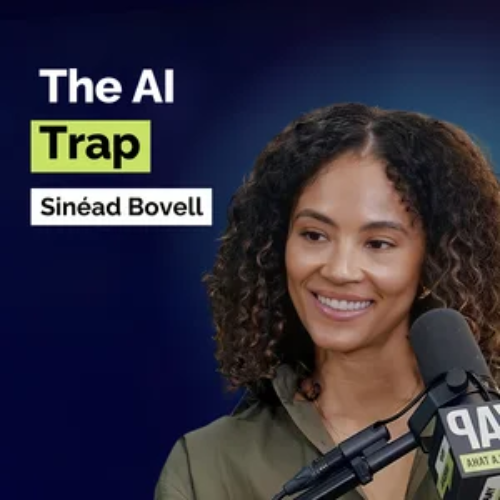
Sinéad Bovell: The Hidden Cost of AI Productivity and How to Protect Your Critical Thinking | Artificial Intelligence | E418
Artificial intelligence is driving unprecedented workplace efficiency, but AI futurist Sinéad Bovell warns that convenience may come at a cost. As professionals outsource more of their reading, research, writing, and decisions to AI, they risk weakening the judgment and critical thinking they need to lead. She believes AI should be a sparring partner, not a replacement for our own thinking. In this episode, Sinéad shares how entrepreneurs can use AI without becoming dependent on it and prepare for how it will reshape work, business, and decision-making.
In this episode, Hala and Sinéad will discuss:
(00:00) Introduction
(00:00) The Hidden Risks of AI Reliance
(03:49) Creating Friction and Using AI Wisely
(13:36) Will AI Make Reading Obsolete?
(18:51) Rethinking Education in the AI Era
(22:53) AI’s Impact on the Future of Work and Careers
(34:28) AI Predictions for Life and Society
(47:00) Can You Trust AI for Information?
(53:57) AI Risks, Environmental Impact, and Regulation
(1:01:03) AI Opportunities for Business and Society
(1:06:19) Betting on the Future of AI
Sinéad Bovell is a futurist and strategic foresight advisor who helps leaders understand how emerging technologies are reshaping economies, business models, work, and society. She is the founder of WAYE, Weekly Advice for Young Entrepreneurs, an organization that educates youth and minority markets on advanced technologies. Sinéad is a 14-time United Nations speaker and has served as an advisor to the United Nations AI Advisory Body. She also hosts I’ve Got Questions with Sinéad Bovell, where she explores artificial intelligence and emerging technologies with leading experts.
Sponsored By:
Indeed – Get a $75 sponsored job credit to boost your job’s visibility at Indeed.com/profiting
Shopify – Start your $1/month trial at Shopify.com/profiting.
Northwest Registered Agent – Get a complete business identity with Northwest. Visit northwestregisteredagent.com/YAPFree and start using free resources to build something amazing.
Mindstone – Master practical AI skills without the complexity with Mindstone’s AI Competency Programme. Head to experience.mindstone.com/yap and get 10% off.
AT&T Business – Stay connected with reliable, secure internet built for entrepreneurs. Switch to AT&T Business at business.att.com.
HoneyLove – Treat yourself to the most advanced bras and shapewear on the market. Save 20% off Honeylove by going to honeylove.com/PROFITING! #honeylovepod
Freshbooks – Manage all your business finances in one place. Right now, my listeners can get FreshBooks for less than $3 a month for your first four months — that’s 90% off. Head to FreshBooks.com/podcast to get started.
Walmart Marketplace – Reach millions of active online shoppers and get ready for holiday demand. Apply to sell today at marketplace.walmart.com/yap.
AG1 – Get a daily health drink that helps maintain energy, support gut health, and support immune health, all in one simple scoop. And for a limited time, save 20% on your first subscription order of AG1 Next Gen or AG1 Pro at DRINKAG1.com/PROFITING.
Resources Mentioned:
Sinéad’s Website: sineadbovell.com
Sinéad’s Instagram: instagram.com/sineadbovell
Sinéad’s LinkedIn: linkedin.com/in/sinead-bovell-89072a34
Sinéad’s Podcast, I’ve Got Questions with Sinéad Bovell: bit.ly/IGQWSN-apple
Active Deals – youngandprofiting.com/deals
Key YAP Links
Reviews – ratethispodcast.com/yap
YouTube – youtube.com/c/YoungandProfiting
Newsletter – youngandprofiting.co/newsletter
LinkedIn – linkedin.com/in/htaha/
Instagram – instagram.com/yapwithhala/
Social + Podcast Services: yapmedia.com
Transcripts – youngandprofiting.com/episodes-new
Entrepreneurship, Entrepreneurship Podcast, Business, Business Podcast, Self Improvement, Self-Improvement, Personal Development, Starting a Business, Strategy, Investing, Sales, Selling, Psychology, Productivity, Entrepreneurs, AI, Artificial Intelligence, Technology, Marketing, Negotiation, Money, Finance, Side Hustle, Startup, Mental Health, Career, Leadership, Mindset, Health, Growth Mindset, ChatGPT, AI Marketing, Prompt, AI in Action, AI in Business, Generative AI, AI for Entrepreneurs, AI Podcast
Hala:All right Sinead, welcome to Young and Profiting [00:01:00] podcast.
Sinéad: Thanks for having me.
Hala: I am really looking forward to this conversation because you've got such an awesome perspective on AI, and you talk about a lot of things that people aren't really talking about right now.
So the conversation is how does AI make me smarter and make me faster? We're outsour- outsourcing our reading, our writing, and everybody's asking the question of how can AI enhance my productivity? How can AI make me smarter? But nobody is asking, is this actually going to hurt the way that I think?
Sinéad: Mm-hmm.
Hala: And so my first question to you is what do you think we're, we're not asking in terms of AI, in terms of, uh, how we think cognitively?
Sinéad: Yeah, I think, um, I mean, we, we tend to think about things quite linearly. So okay, so now I have this technology that can allow me to operate much faster, uh, can allow me to be much more productive.
But we don't think, what is the second [00:02:00] order impact of that trade-off? So I'm obviously bullish on AI. I think it's a technology that's here to stay. But you have to think about the whole ecosystem. So if AI is making you a bit more productive, what are you replacing with that time?
Hala: Mm.
Sinéad: And if that is nothing that stimulated your brain in a similar way or allowed you to nourish the cognitive capacities that you expect to have- Mm-hmm
attention, memory, judgment- Mm-hmm ... making decisions on your own, then you're making a pretty risky bet by giving everything that you, you know, used for your critical thinking to this technology. Yeah. So it's about figuring out that, that optimal balance, and I don't think we do because we're in such a producti- productivity-centric- Yeah
society. And that's all we think about. And that's also how AI is marketed and pitched a lot. This is gonna drive productivity- Mm-hmm ... drive productivity. But we have to think about the entire system we operate in.
Hala: Yeah. So I'll give you an example with myself. So one of the main ways that I use AI is to help me prep for [00:03:00] interviews.
Mm-hmm. And so I have a Replit app where I, like, upload transcripts and, you know, viral reel c- clips and, and all these different, like, raw material, and it gives me a brief. And then I also do the same thing on ChatGPT and, like, Claude, and see what I get and kind of mix it all together, and I'm jumping from AI app to AI app.
And I remember, I, I've been doing this for, like, a year.
Sinéad: Mm-hmm.
Hala: And I remember, like, last month I was interviewing Jim Kwik, and, like, nothing was working. None of my AIs would, like, let me upload anything. And I st- started to panic. And I was like- Hmm ... "Oh my gosh, how am I gonna prep for this interview?" And, like, I had to push back the interview because I was like, "I'm not gonna have time to do this.
I have to do this- Right ... manually." And then I realized- Yeah ... I was like, "Whoa, I've been podcasting for eight years." Yeah. And it was never an issue-
Sinéad: Yeah ...
Hala: to study for... And then suddenly I felt like I was, like, completely handicapped and, like, I can't do this interview. Yeah. And so I, I started changing the way that I actually [00:04:00] research for a podcast 'cause I realized that, like, I can't just, like, outsource everything to AI.
Sinéad: That's the scary part, right? When you- catch yourself in a moment where you feel like, "Oh, I can't make a decision or do the task without this technology." Yeah. And there's certain points where it's reasonable. I mean, I really can't navigate too well without Google Maps, and I'm just, that's just- Yeah ... a trade-off that we've made.
But when it's something that you should be familiar in, this is your game, this is your sport-
Hala: Yeah ...
Sinéad: and then you suddenly feel not confident. And then it's one thing to do that in the day-to-day, but imagine, like, really big decision makers and critical stakeholders, and they're in that position too, where like, "Wow, I have to make a big call that's gonna impact a million people, and I can't do it without this technology."
Yeah. So we have to think a bit wider about it.
Hala: Yeah. Talk to us about why it's so important to, like, create friction-
Sinéad: Mm ...
Hala: with, with the way that we learn a- and, like, our decision-making and, and, like, our [00:05:00] experiences when it co- So, like, we can make sure that, like, we're not actually getting dumber by using AI.
Sinéad: You have to foster the mental capacities that you expect yourself to have. So if you expect yourself to have strong judgment skills, strong critical thinking skills, to be able to follow a complex argument over time, those capacities don't just exist out of nowhere in a silo. They exist because we foster them, we cultivate them.
Mm. So if you're not able to continue to practice that, uh, and you practice that, sometimes it's, you know, it can seem burdensome. Reading is not an activity that everybody loves to do. Yeah. But you do know that it can help you follow an argument over time. It can nourish things like imagination. So by doing things that your brain is forced to engage in, then you're going to create, sometimes it's cognitive friction, um, but at the same time you're, you're gaining or at least preserving some of the mental capacities that you expect yourself to have.
And that's one thing that I ask people, "What skills do [00:06:00] you think you, you possess right now?" Mm. "And then how are you continuing to build them?" Because your cognitive capacity, it's kind of like going to the gym, where you don't just build these faculties by hoping to manifest them. You actually have to engage- Yeah
and do e- productive exercises. Mm-hmm. And there's many different ways that, I mean, for me reading is a source of friction, and so I force myself to do it. But there's puzzles, there's mental math, there's just different things that you can do.
Hala: Yeah.
Sinéad: Uh, and it's tricky because everything about our modern world, or especially the, the most recent era of digital software, is designed to take that friction out, to do it on our behalf.
So we don't really even have to think about what we wanna eat. Mm. Because not only could you order it to your doorstep, the algorithm has already selected the things that it knows you're probably going to pick. Yeah. And that's not an existential crisis that now you're outsourcing to eat pasta or burritos.
Hala: Yeah.
Sinéad: Um, but it's those types of tiny decisions all day.
Hala: Yeah.
Sinéad: Every day.
Hala: Mm-hmm.
Sinéad: Uh, and, and over time it's what else are [00:07:00] we losing as we outsource all of that?
Hala: Yeah. So in terms of like how my process changed with AI is from that point on, I was like, "Okay, like, I can't do this all in AI anymore." And it worked, but I also, like, didn't feel as prepared for my interviews as I used to.
Mm. And I realized, like, this seems faster, but, like, I'm actually not retaining anything. So I made some changes. Number one is I have, like, a separate doc, like, and I actually have my final brief, like, outside of my AI. Mm-hmm. And so it's like I'm actually, like, deciding what questions I want and, like, pulling ideas from AI, but into my final doc.
Also, I'm, instead of just transcribing interviews and uploading them to AI, I do that, but I also listen to, like, the key ones- Mm-hmm ... and, like, write my own notes- Right ... and my own questions. And I feel, like, way more prepared. The, the other thing that I do is, like, once I get any sort of, like, reading material from AI, I listen to it-
Sinéad: Mm
Hala: so that I can, like, really absorb it in multiple ways, 'cause [00:08:00] sometimes, like, just, like, spits out stuff, and, like, you actually don't really absorb it. Right. For me, I, I l- I learn more when I hear it.
Sinéad: It's so interesting, because I'm trying to name this phenomenon that I'm... I feel, I don't know if anybody else does, but sometimes when I'm reading something from AI, I'm in this, like, cognitive haze.
Yeah. It's the only way I can describe it. 'Cause
Hala: there's so much coming at
Sinéad: you. It's so much com- And so I'm like, "I retained some of that, but what did I just read?" And it's kind of like when you, when you watch a video on social media, and then you don't really know what you just watched three videos before.
Hala: Yeah.
Sinéad: Sometimes when I engage with AI, I can f- I feel that way. I read something, and it's not necessarily clicking. So I always say that AI has to be an input into your decision-making, and it can't be the decision.
Hala: Yep.
Sinéad: And again, it's one thing if it's the pasta or the burrito, but if it's a, something that's material in your life, uh, treat it much more like an input.
Yeah. And, and can you operate without it? I mean, I do so much writing in my notebook. Mm-hmm. If I go to a conference and it's something that I really need to pay attention to, I'm writing- Yep ... physical notes constantly. My, my notebooks are [00:09:00] filled. Mm. And if I'm writing something that's important to me, it starts with a pen and paper.
It takes a lot longer. Yeah. And then I'll transcribe to technology. So there's just many different ways that you can continue to create some friction in your life- Mm-hmm ... and it's so important.
Hala: I, I heard you, you say that you use it as a sparring partner.
Sinéad: Mm-hmm, to point out the gaps in my thinking.
Hala: Mm-hmm.
Sinéad: So I do a lot of writing and I do op-eds. And so sometimes I'll give AI a persona and say, "You are this type of character, so maybe you have this type of background or this type of a belief system. What assumptions am I making that this profile will catch?"
Hala: Mm.
Sinéad: Uh, or, "Who might I not be including or seeing in this perspective?"
Or just point holes in my argument.
Hala: Yeah.
Sinéad: And how much that is ex- It's like having a, a private editor.
Hala: Mm.
Sinéad: And how much that has expanded my thinking has been awesome, and that's just one of the ways that I'll use this brain partner. Yeah, but
Hala: to your point, you're doing the initial- Mm-hmm ... thinking. Like, so, so when you think about first drafts-
Sinéad: Mm-hmm
Hala: do you like to do the first draft of everything?
Sinéad: I do. [00:10:00] I mean, I like to... What are... I, I think really deeply about what am I bringing to artificial intelligence in the first place? Mm. Is it just a very half-thought-out idea, and I'm using AI strictly as a creative brainstorming partner, and why? And if I can't justify the decision as to why I think it may be, uh, the perfect match for what I need to kinda fill in that gap, and it's more because I don't wanna think through this choice, then that's a problem.
Hala: Yeah.
Sinéad: Uh, and I try to complete the problem or the question that I'm bringing to AI before I just ask it.
Hala: Mm.
Sinéad: And I think another thing that people don't necessarily think about with AI is, what does a good outcome look like?
Hala: Mm.
Sinéad: So people will just get AI's answer and then try to evaluate it, but before AI spits out an answer, do you have an idea of what would qualify as a good outcome to begin with?
Yeah. Or else you're more susceptible just to trusting something that sounds really smart-
Hala: Mm-hmm ...
Sinéad: but may not be factually correct.
Hala: Yeah. I th- I think you call this, like, the aura of authority.
Sinéad: Mm-hmm, this kind of illusion of the oracle-
Hala: Yeah ...
Sinéad: and this aura of authority, 'cause it [00:11:00] can sound really competent. Uh, and in many ways it, it can get things right or expand your thinking, uh, but it's not necess- it's not built as a fact-finding machine.
It may not be trained on data that's relevant for the specific thing that you're, uh, asking of it. Mm. So if you don't know about, you know, what is its distribution of data, are you going to ask something from this AI system that it's not even the appropriate type of system to be asking?
Hala: Yeah.
Sinéad: Uh, and, and I do worry about this kinda aura of authority.
Yeah. Because something that can sound really intelligent-
Hala: Mm-hmm ...
Sinéad: we're much more susceptible to falling for it.
Hala: And, and it feels so human, when in reality it's not a human. It's, it's not actually, like- Making decisions or, or fact-finding or anything like that
Sinéad: Yeah, and it, and it doesn't have your best interest, and not because it has a malintent, it just has no interest.
And I think that can be hard to see, right? Mm. Because up until [00:12:00] this point, any system that is u- that uses language has been a human, and we're much more wired to try to decipher, is this person on my side? Mm-hmm. Are they an ally? Are they looking at me in a strange way? We miss all of those cues with artificial intelligence, and all we get is language in a box.
Yeah. Uh, and it's been designed to, to flatter you and to not offend you. So all of it seems like these are the cues of something that you can trust But you can't. Mm-hmm. And again, it's not because it's a bad system or it was programmed to be malicious, it just has no interest at all.
Hala: Yeah.
Sinéad: So not to just take what it says and think, "Yes, this, this agrees with me, it's probably right."
Hala: So how should we use it? Because you say AI is not your friend.
Sinéad: No, it's definitely not your friend. Um, 'cause it's a, it's an, a really sophisticated, um, I mean, this is ... It, it's a really incredible technology, but I mean, it's ... Define what a friend is.
Hala: Hmm.
Sinéad: And to me, I think friendship requires reciprocity.
Hala: Yep.
Sinéad: Uh, it requires empathy-
Hala: Mm-hmm ...
Sinéad: [00:13:00] understanding, sometimes there's conflict.
Hala: Yep.
Sinéad: Uh, and those things are just not present in the systems that we have today.
Hala: Mm-hmm.
Sinéad: So I think if you treat it like a friend, I mean, you're much more susceptible to trust it in ways that you probably shouldn't. And we've already seen, I mean, there's been many different cases of examples of people that trust these systems because they believe them-
Hala: Yeah
Sinéad: um, and they think that they have their best interest. And then they, they act in really damaging ways. I mean, people losing their job because they believe the AI is alive-
Hala: Mm-hmm ...
Sinéad: and, you know, leaving marriages and all sorts of things. Um, I mean-
Hala: We're about to get into like a crazy world because, to your point, I think the lines are really blurring- Mm-hmm
and people feel like AI is human. Even when I talk to my AI, I talk to it like it's like a, a human.
Sinéad: Right.
Hala: Like, "Can you read through this?" Or like, you know?
Sinéad: And there's all these little, um, I mean, strange little design kind of tricks. Why does AI say I? Mm-hmm. What does it mean when it says [00:14:00] I? I who? What? The data center?
Who is I in that conversation? Yeah. But those are all sort ... Versus if AI said, you know, replied as it or the machine.
Hala: Yeah.
Sinéad: But because it says I, that is again another biological cue that you are talking to something that has a mind similar to yours.
Hala: Yeah. And in the past, only humans could talk and write-
Sinéad: Yeah.
Yeah ... and
Hala: think.
Sinéad: Yeah. So we have to decouple aspects of cognitive capabilities from consciousness and understanding, because now they are just fundamentally different things.
Hala: Hmm. So I was, like, you know, perusing your podcast. Mm-hmm. And I came across this episode where you were saying you think that we're about to approach a post-literate world.
Hmm. And you think that we might lose the ability to read.
Sinéad: Yeah, the post-literate society. Um, and it's not even just gonna me pontificating about this. There are many different psychologists, academics, [00:15:00] uh, that see that it is possible that reading is just a chapter in human history. Mm. Uh, and the data, I mean, the trend lines already point to us reading less and less, and it's not...
Technology's a big part of it.
Hala: Yeah.
Sinéad: It's not the only part. Since the '70s, schools have moved away from long-form reading and towards short ex- excerpts and passageways, and that's easier to mark, it's easier to standardize. Uh, so we've been slowly, uh, unwinding the muscle of reading as a pastime- Mm ... or reading as something that's a part of academia.
And so when you look at the data, it's quite stunning of h- you know, how less, how little we read compared to decades ago.
Hala: Yeah.
Sinéad: And then when you throw in technology on top of that, we're kind of being surrounded by systems that can do what would've required the reading for us. Uh, and then the final trend on that, and, you know, as a futurist, my whole job is to, to look at the frontier- Yeah
um, is right now we're still in the smartphone-based [00:16:00] economy, uh, the computer-based, the, the hardware around us does require some reading. But we aren't going to stay here.
Hala: Mm.
Sinéad: We're moving to much more of a voiced f- voice first digital era, and that's what's in the pipeline. Uh, so and I mean, when you think about what's the easiest way to converse with someone?
Conversation. Yeah. Where you're just chatting. And AI is a conversation-based technology. So the devices that are coming are going to be not really screen-based.
Hala: Mm-hmm.
Sinéad: They'll just be a voice assistant. Uh, and the same even with using AI on your smartphone. It's much easier just to kind of pick it up and chat to it.
Hala: Yeah.
Sinéad: So all of these kind of micro ways that we start to remove reading from our world. Uh, and I'm personally conflicted about this- Yeah ... because I, I read a lot, multiple books at once. Um, and again, I, I don't necess- I love it, but then I also don't- Mm-hmm ... because it's hard.
Hala: Cognitive
Sinéad: friction, right? It's friction for me.
Yeah. So I force myself to do it, and w- when young parents ask, you know, "What should my kids study? What should they do? They're 10 years old." I s- Just have them read. [00:17:00] That's a g- that's a great set of skills that they're gonna build just from that. I don't know, is reading going to become like Latin, where reading and writing were so foundational to society- Mm
and then yet somehow we're no longer connected to it? And is it because it could go one of two ways? We have figured out the next step that we can take-
Hala: Yeah ...
Sinéad: uh, the same way when writing was invented, and Plato and Socrates thought, "This is gonna be the end of our memory. We're gonna outsource everything to the book.
No one's- everyone's gonna appear wise and know nothing." And it turned out to be okay.
Hala: Yeah.
Sinéad: Is AI in this next kind of voice first chapter going to lead us to something that's actually surprisingly better? Maybe, if we can figure it out, and we can make school and learning more rigorous. Or are we going to lose a lot?
Um, and I'm not sure. So I think the safest bet is to continue to, to read, or to continue... And it- reading's not for [00:18:00] everyone. Some people can get friction in different ways.
Hala: Yeah.
Sinéad: It works for me. Um, but so that's why I always advise, you know, I think it's important that we hold onto this, that maybe I turn out to be wrong in a decade.
Hala: It's so crazy to think about the fact that, like, books were controversial at one point. Really
Sinéad: controversial.
Hala: That the printing press was controversial.
Sinéad: Yeah. And they were somewhat controversial for different reasons. I think, um, the printing press was because it was a monopoly on knowledge- Mm ... and monopoly on intelligence and who could know what.
Mm. And then when you democratize that, suddenly, you know, people have access to different, um, methods of knowing. People can know things that pr- previously only certain powers- Mm ... could hold. Um, and so that just created- So that's
Hala: kind of a good... That was
Sinéad: a good thing-
Hala: That was a good thing ... for, for the masses.
Sinéad: Yep. Yeah. Yeah. There was a bit of chaos in the, in the onset of it. A few, you know, years of war. But eventually we figured it out.
Hala: Mm-hmm.
Sinéad: And then writing was very controversial for a different reason, reading and writing, because books... And it's similar, uh, arguments we hear with AI. You're, are you going to learn anything, or are you just going to parrot what somebody else has [00:19:00] written?
And what's that going to do to, to memory? 'Cause prior to having access to a book, you had to write out everything that you learned, and what you wrote was what you knew. Uh, and now you could just read somebody else's. So these arguments are very similar, and we figured it out, and we... Books actually made, and the printing press, learning much more rigorous because now knowledge could compound-
Hala: Mm-hmm
Sinéad: and it became more complex. So you can't just kind of make up some chemistry formula, because somebody else had printed something a year ago that already showed that that was false. Yeah. So now your idea has to build on top. Mm. So we figured it out as a society, and we got through it, and academic, academia got more rigorous.
Can we do it now? Um, do we have the patience? Do we have the right mindset of what we need and who's making these decisions? I'm not sure.
Hala: Yeah.
Sinéad: But we're definitely at a pivotal moment.
Hala: I know, like, a hot topic that you talk about is how AI should be used in schools- Mm-hmm ... and how AI should be, like, monitored with students.
Um, and I think [00:20:00] you have a really cool perspective on this. I'd love for you to share it.
Sinéad: Yeah, I think, uh, AI in education, and it depends on the age. Mm-hmm. So I don't think that there's any need for a young child to be engaging with a chatbot as a- Yeah ... I don't think that that's just helpful, so we don't really need to be doing that.
It doesn't mean that we shouldn't be educating kids on chatbots so they can use them safely, or if they enga- if they encounter one, they know what it isn't- Mm-hmm ... and what it is. Mm-hmm. So it's like you can talk about these sorts of things with them without actually having kids on chatbots. That's one thing.
Hala: Yeah.
Sinéad: But when it comes to, uh, academic rigor and academic integrity, um, and people are saying, you know, we should probably ban artificial intelligence- Mm-hmm ... or still a s- Lots of
Hala: kids, like, getting, like, expelled for using AI and so.
Sinéad: Yeah, and, and my stance on that is we can't pretend that this technology doesn't exist at home.
It does. Yeah. So maybe what you can control in the classroom is if you think it's better to have oral exams and do that, or written exams, let's go back to that, that's probably harder, [00:21:00] the Socratic method. But you can't assign a- an assignment home that looks the exact same as it did pre-AI, and expect somebody just to not use artificial intelligence.
You'll have a few outlier students that maybe will do that.
Hala: Mm-hmm.
Sinéad: But we are biologically wired to take the path of least resistance- Yeah ... to minimize and conserve energy. So people are, of course, are going to use that technology. Uh, so instead of hoping everything stays the same, and we just ignore this AI thing, I think this is a moment to raise the bar on what we're even asking from students.
So in a world with super computers, what- how does school become harder? Hmm. What different skills do we need to be able to cultivate? Like, raise the bar
Hala: a bit.
Sinéad: Mm-hmm. Yeah, so that means maybe where curricula gets har- more challenging at younger ages because we have these technologies, and maybe it, sometimes it doesn't even mean we're engaging with AI at all.
Uh, maybe it's interdisciplinary thinking. Imagine walking into your English class, and you have to debate the climate policies that you learned in civics based on the chemistry you learned in science, all oral, no AI [00:22:00] involved.
Hala: Hmm.
Sinéad: But somebody who's able to do that well can also use AI probably well because they have strong communication and judgment skills.
But school does need to look different.
Hala: Yeah.
Sinéad: The school system we have today, uh, was largely designed in an industrial era that has come and gone.
Hala: Yeah.
Sinéad: Careers are different. The world we're preparing for is different.
Hala: Yeah.
Sinéad: So you can't have everything about a society change, and one system stay the same.
Hala: Yeah.
Sinéad: Uh, and that goes for many of our institutions. Mm-hmm. Like, everything, nobody's immune, and we can all understand, oh, the accountant's job's going to change. Yeah. And oh, probably this person's job. Um, but why not our institutions? They, everybody, no one's immune to- I feel like it's- ... these transformations
Hala: it's been too late. Mm-hmm. It's been too late, and we've been here before- Mm-hmm ... with calculators.
Sinéad: Yes. So, and calculators, it's an interesting example because, of course, it's not the complexity of an AI system, but what did we do when we got this technology? We all got stuck with harder mathematics- Yeah ... at younger ages because [00:23:00] now we had this device.
Mm-hmm. So we all got calculus dragged into high school- Mm-hmm ... because now you have this, this launch, this kinda springboard called- Mm-hmm ... the calculator. To, if we were to use that as an analogy, and it's not a perfect one, but what would it mean for if AI is now... If what AI can do is the baseline, that is the bare minimum, how do you teach people to think beyond a machine?
Mm-hmm. To think past it? Mm-hmm. What does it mean to outsmart, uh, or to think differently alongside this technology? So I think it's, it's, it's a rewrite for everyone, many industries, education as well. If we get this right, it will be amazing.
Hala: Yeah.
Sinéad: Uh, it's a big if, but if we, if we do figure this out, uh, then it could look great.
Hala: Yeah. We could, we could advance-
Sinéad: Mm-hmm ...
Hala: just like all the other technology before, uh, before AI helped advanced humans. Mm-hmm. Um, okay, so let's talk about careers. Uh, you talk about this, uh, I think era of independence. Mm-hmm. Mm-hmm. How [00:24:00] traditional careers and job titles are going to essentially go away, and we're gonna all act more like entrepreneurs.
Sinéad: Mm-hmm. Yeah, the independence era. The independence era. And this has been in the works for some time, where the tasks within a role s- have started to change much more rapidly that the initial title that that role was supposed to contain no longer makes sense for the tasks that happen within it. Uh, and AI is just going to accelerate this, where what, uh, this technology can do today will be different in six months.
Uh, and it's not just what the person in that role has to do will change. A company's business model is also gonna continue to, to evolve. So this idea of the sticky job container, that is just gonna be a chapter of history-
Hala: Mm ...
Sinéad: where you had one job at one time, and you moved linearly up a career ladder, and the career ladder only made sense because we could stack the container that we called jobs.
And it, and if you were to be in a position for two years, you probably know more than somebody who's [00:25:00] been there for six months, therefore you could probably be more senior than them.
Hala: Mm.
Sinéad: In a world where you have AI changing the types of problems people solve, seniority doesn't necessarily guarantee you're the best person to solve a certain problem at a certain time.
Um, roles are gonna start to be much more fluid. So the whole structure of work starts to change.
Hala: Yeah.
Sinéad: Why I do think we'll probably see more independent based work, and we already are because of the internet- Yeah ... so the internet did decouple, uh, many professions from this kind of linear career path.
Hala: Mm-hmm
Sinéad: But what AI does today will be different in, in seven months, in 20 months, and so what a business needs is going to continue to change. Uh, so what you need from different people will change. I may need a marketer with these skills today, but a totally different set of skills in a year. It's gonna be challenging to hire for that full time when I might need an entirely different thing s- 12 months from now.
So
Hala: if- Let, let's make this practical. So like the w- as you're describing it, what I imagine is it's like, kinda like a freelancer [00:26:00] that works on Upwork that has like digital skills. Maybe they're good at video editing, copywriting, graphic design, and they're like, they put up the fact that they're good at these skills, and then people can hire them based on different skills that they have.
Is that kind of what you're imagining?
Sinéad: Yeah. So I'd say a, a way to think about it is if you, whatever you do in your work right now, forget the job title, what are the skills that you perform under it? Now if you were to think about those skills as a company, that is what you offer. So these are the skills that you are endowed with.
These are the skills that you've cultivated. If you were to offer those to a few different companies at once, so maybe you're really good at understanding where markets are going, uh, in terms of reaching consumers on social media and, you know, whatever comes next. You will probably work for a few different types of companies offering those skills.
And so yeah, you can think about it kind of like the Upworks of the world- Mm ... but with much more knowledge work inside of that. Uh, so a lot of us will be offering our skills to a few different places at any one [00:27:00] time- Mm ... um, and much more of an independent kind of entrepreneurship box.
Hala: Yeah, I mean, we've been hearing about this like job apocalypse for like a really long time, right?
Like since AI came on the scene, like let's say three years ago, everybody's saying jobs are gonna go away. Like not much has changed. Mm. So how has your thoughts evolved in terms of like job disruption? Where do you see it in three years versus like 10 years from now?
Sinéad: Yeah, so I think, um, it's probably not going to be as stark as suddenly we wake up and nobody has a job.
Uh, that doesn't really make sense to me.
Hala: Mm-hmm.
Sinéad: Um, and neither does the idea that an economy goes away. Economies don't disappear, they reconfigure. So I think, I mean, the jobs that you and I do today are comp- were completely unpredictable to somebody 80 years ago.
Hala: Yeah.
Sinéad: Would've made zero sense trying to explain any of it.
So I think we're going to transition [00:28:00] again into something very new and very different. And so maybe in 15 years from now, again, the jobs are just as unrecognizable as they were 100 years ago. The transition does concern me of how do we get from where we are today to what work looks like in 10 to 15 years from now.
Mm-hmm. We'll probably work less, and that's been the trend for the last 150 years. We've worked less and less. Now we have five days. It'll probably go to four or for three. I don't think there's going to be no work. I think it's just going to look different.
Hala: Yeah.
Sinéad: And then I think how we go from today to that chapter, it doesn't have to be bumpy like the Industrial Revolution, but if we aren't making the right decisions about this transition, it will be.
Hala: Yeah. Talk to us about how job disruption isn't necessarily linear.
Sinéad: Mm-hmm.
Hala: Like, let's take, like, lawyers and doctors, for example. Like, how do you think that a, a doctor's job and a lawyer's job will get disrupted? Um, what kind of jobs do you think will go? What kind of opportunities do you think will be [00:29:00] created?
Sinéad: I mean, it de- 'cause this pulls on a lot of economics, so it depends on what part of the lawyer's job, for example, gets automated. So if AI is really good at doing most of the, not just admin, but something that doesn't require fierce judgment, a lawyer powered by artificial intelligence can just do a lot more, so we'll need far fewer of them.
Hala: Hmm.
Sinéad: Um, and y- maybe what they charge i- is cheaper, but they can do a lot more things. If society reconfigures enough to where the system ... I mean, law is kind of built into the infrastructure of what we do embedded in AI, then that kind of changes the n- the needs of the profession.
Hala: Yeah.
Sinéad: But I, I think ... I mean, the, the data is really interesting on, on something like a, a physician.
Hala: Okay.
Sinéad: Because let's say AI gets really good at medical diagnostics. What happens to the role of the doctor? So it pro- it [00:30:00] could branch into two different things. So the doctor becomes something else, so diagnostics goes to maybe AI and the nurse, so that role becomes interesting. And then the doctor can do something much more complex.
So if AI is getting our basic things, predicting our basic illnesses beforehand, the only thing that would reach a doctor is something very complex and very strange because AI has started to get good at the small signals, and maybe it connects to your wearable so you don't get those types of diseases that we maybe have today.
But I don't think the doctor goes away entirely. I think it just transforms into something very different and strange. Yeah. And maybe the doctor is part computer scientist, part synthetic biologist working with quantum computers to model your cells- Mm-hmm ... and then helping you with urgent healthcare needs.
Mm-hmm.
Hala: And, like, maybe people get more, like, private doctors, and private doctors become more accessible.
Sinéad: I think it will probably look more similar to, uh, concierge medicine, where people used to have a doctor that came to you.
Hala: Yeah.
Sinéad: Uh, I think now as, as wear- as you start to wear more of your technologies and things are catching [00:31:00] things earlier, I think just the whole system is going to look different.
Hala: Mm-hmm.
Sinéad: And I think that's something that we're, we're bad at as a species. We see the future as a linear extension of the present. So we hold everything the same, and then we ask, "Okay, well, how will AI make this faster or different?" Mm-hmm. But sometimes the whole system changes. So medicine might be an industry where everything just comes to you.
And that is what the future of medicine looks like. It's just part device-based and part physician that comes to your house- Yeah ... and just does things.
Hala: It's so interesting. Uh, a really great example that I heard on your podcast with lawyers actually is that AI might make it really easy for people to make contracts.
Sinéad: Mm-hmm.
Hala: And so there might be a lot more contracts and a lot more volume of contracts, but we still need that, like, last check of somebody to, like, validate and make sure this contract is good. And so there might be, like, a new role where, like, there needs to be more lawyers who are doing that, like, fact, that last step of- Yeah
fact-checking a contract before it goes out. Yeah. And so jobs can also just, like, [00:32:00] change, or, or the needs change.
Sinéad: The... Totally. The tasks within a job, and, and the legal services is, it's a great one. Because maybe there's also a new type of job where it's someone who can review a contract that isn't a lawyer in how we think about it today- Mm-hmm
but powered by AI, they can learn a certain set of skills, and that's something different and new. Uh, and then the lawyer goes on to do maybe just the highest, most complex style cases, uh, that are just unforeseen, and it's really hard to prepare for them- Mm ... and that's what we ask for from lawyers. So jobs can change, and I think that's...
Nothing is fixed about a role, right? You know, businesses hire people to solve certain problems at a certain point of time. Problems change. Technology changes. Yeah. So the roles that fall in them also change.
Hala: Yeah. And industries can be created, entire industries. So let's take marketing, for example, right?
Yeah. Marketing was created because of, like, digital essentially.
Sinéad: Well, marketing, yeah, the origins- Well,
Hala: maybe not digital, but, like, why was marketing
Sinéad: created? Mar- yeah, and this is one of my favorite examples. Um, and this is when, when people say- [00:33:00] AI is gonna be able to do absolutely everything, and there's no jobs left for anyone.
It's always really interesting because the industries that we do t- that we exist in today were so unforeseeable, and it was only because the invention of certain technologies that then that industry made sense. So marketing is an example of that. With the second industrial revolution, we now have assembly lines.
We're manufacturing all of these goods much cheaply, much more cheap. So now, well, how am I going to sell all of this? I have to generate demand. Before you only just needed a sales rep to try to push the few products that you had. Mm-hmm. Well, now you have 10,000 canned goods, and before you had five.
Hala: Yeah.
Sinéad: Where are those demand signals coming from? I'm gonna need to create something called a brand-
Hala: Mm ...
Sinéad: to actually have an identity. The first brand managers were in the 1930s, and I think it was P&G that, uh, created that role. And the first marketing classes didn't exist until the early 1900s. Wow. And marketing isn't just sales, right?
It's a cross between you have to work with the finance department. You have to work with [00:34:00] advertising. It only happened post-industrial- Yeah ... second industrial revolution. So and that's an entire industry. So I think we're going to see more of those really strange things that it is impossible to predict-
Hala: Yeah
Sinéad: because of where we are today.
Hala: It's, it's, like, super fascinating to think about even just how marketing is going- Mm-hmm ... to evolve in the future. So in the future, there might not even be an internet anymore because AI is going to be doing a lot of tasks that we humans traditionally have done on the internet, where maybe the internet as we know it now isn't gonna be the same.
Maybe there won't be websites anymore. Mm-hmm. And AIs use APIs to get the information that they need, and then suddenly who are we marketing to? The AI agents? And it's like how, how do we actually create brands or create desires?
Sinéad: Yeah. The... It will just have to evolve. How do you reach people, uh, when the...
You don't reach them directly. You probably reach their team of AI systems. Mm-hmm. And so it will probably [00:35:00] require a different type of skill, uh, and a different type of domain, and we probably won't even call it marketing. It will probably be something entirely different.
Hala: Mm.
Sinéad: In the same way we had to figure it out with websites and the world of social media, and then we realized, oh, we can reach people a different way through influencers.
And so all of these different things that we kind of originated based on the technologies at the time. But yeah, the internet is gonna look very different, if we're even gonna be on it-
Hala: Mm ...
Sinéad: in a decade.
Hala: I feel like this is a good place to transition to a game. Actually, this is a game that I played with Gary Vee yesterday.
Okay. I interviewed Gary Vee, and he's big on AI too, and he's great at predictions. So I was like, "Let's do some AI predictions." So I'm gonna throw out one word, and you tell me what is your prediction for this- Okay ... in the next 5, 10 years. How do you think this is gonna evolve, okay?
Sinéad: Okay.
Hala: Uh, the first one is preferences.
Sinéad: How will our preferences evolve? That's a great- Question [00:36:00]
Hala: Like, will AI know what we want better than we know ourselves?
Sinéad: It will, uh, unfortunately, it's possible. I mean, algorithms already have a scary amount of data on us. So hopefully we can figure out the data crisis in a way that's privacy centered. But I think preferences, our preferences may actually get more complex-
Hala: Mm
Sinéad: because AI can handle a lot more of that complexity. So an example is, let's say I want really good skincare.
Hala: Yeah.
Sinéad: And I just know that I want it to be clean, um, and I want it to be a certain price. I only have a certain amount of time that I can look for that, and I only have a certain amount of understanding of ingredients.
But AI has unlimited time-
Hala: Yeah ...
Sinéad: and unlimited access to ingredients. So our preferences may actually be able to become much more nuanced. Mm. And for that price, and for that ingredient, clean, whatever it is that matters to you, you'll have an AI that works 24/7 all day to find that and source it from a particular place.
So I think our [00:37:00] preferences will evolve in really interesting ways.
Hala: That's so interesting. I, I didn't even think about it from that point. I could even imagine where, like, you've got all this health data, and, like, you've got all this data about your skin and what your skin needs. And AI is, like, constantly, like, reflecting that, ordering you new stuff.
Like,
Sinéad: yeah. Yeah. It will be... Like, our preferences will be informed by different types of data. Our internal microbiome, maybe how we slept, and we'll have systems. And again, hopefully we can do this in a way that makes sense with privacy.
Hala: Mm-hmm.
Sinéad: But your preferences are now much more informed, uh, and hopefully accurate or aligned with the goals that you have or the person you're trying to be.
Hala: Mm. Materialism, how do you think that's gonna evolve?
Sinéad: Oof. How might materialism evolve? It depends. So this could go in one of two ways. There's a world in which AI makes access to personalized products, fashion, design clo- whatever it [00:38:00] is, furniture. So you're, so what you think you need or want is less influenced by mass consumerism because it's much cheaper to produce-
Hala: Mm
Sinéad: and manufacture and design. So then, in a world where we're less influenced by just the masses- Yeah ... or how few people we seek influence from, maybe we might not be as material because there's no core person who's everyone's trying to emulate.
Hala: Yep.
Sinéad: Or everyone seeks
Hala: to for certain. And also, like, no, not a lot of adver- if we're not on the internet, like, there's, there's not a lot of ads, there's not a lot of, like, screen t- like scrolling and- Yep
like keeping up with the Joneses, to your
Sinéad: point. So that could... Yes, and I don't think we'll be on social media the way we are or at, on it at all, for that matter. So I think that there's a world in which it can go w- I don't need to compare myself. Like, I truly can manufacture this for 10 bucks on my own.
I don't know what you're wearing. I'm gonna wear what I like. Mm-hmm. There's that world. But then there's also a world in which it depends on what happens with kinda advertising laws and data laws, [00:39:00] that if an AI knows us better than we know ourselves and it's not controlled properly, you're constantly bombarded with advertisements and it knows your insecurities, so it knows the things that you're gonna be susceptible to, then maybe we end up shopping and buying more because we constantly feel like, "Oh, I could be better," and there's more for me to do and to how to evolve.
Mm-hmm. So it can go one of two ways. Yeah. And probably a myriad in between.
Hala: So interesting. Okay, the next one is really, uh, I'd love to get your perspective. Love and relationships
Sinéad: Goodness. Oof. I mean, I don't think We're in the best spot with... I think dating apps had the right intention.
Hala: Mm-hmm.
Sinéad: And it was o- when they first came out, I think when you look at the, the early data of how they transformed love, and people met that would have never met, and all of these interesting things, and then we really went full speed in the gamified economy, and the way you [00:40:00] shop for a dress, food- Yep
makeup, TikTok, and a partner. Yeah. And it all looks the same, uh, in the exact same ecosystem. So I feel like, uh, if we can reroute a different way, then maybe love and relationships... I mean, people are starting to do more things offline- Mm-hmm ... running clubs-
Hala: Mm-hmm ...
Sinéad: and craving more human connection. I hope we can step out of this kind of digital vortex that we're in and do more things in person, and therefore remain connected to one another.
I am really concerned about the companionship with these AI systems, and AI systems filling these kind of superficial-
Hala: Yep ... needs.
Sinéad: Back to
Hala: that, that AI is, is not your friend.
Sinéad: Well, and can it be even more than that? Yeah. Like, people may see it as, I mean, it's flattering me, I can talk to it all night. Mm-hmm.
And if you think about, you know, the dream charact- ch- characteristics of certain, a partner, they understand me, they can laugh at my jokes, we have similar humor, they maybe- I'm intellectually [00:41:00] inspired by them, they don't bother me too mu- Mm-hmm. You can superficially think that that's what an AI can give you.
Hala: Yeah.
Sinéad: So I'm, I am worried that some people are going to just end up in some kind of AI companion ecosystem.
Hala: Yeah.
Sinéad: Um...
Hala: I mean, that's already happening. It
Sinéad: definitely is.
Hala: I think somebody, like, in Asia got married to an-
Sinéad: People all over the world are- ... an AI ... people are leaving marriages for their AI. But maybe it's also a way we could boomerang into a different direction, where people are going back to restaurants and run clubs and doing things- Mm-hmm
and meeting people with common interests in different ways. So I'm curious to see how that nets out. And when you bring the data down to, for example, Gen Alpha, that are engaging with social media in very different ways than Gen Z, or Zed, 'cause I'm Canadian- Yeah ... um, and Millennials, where they're, some of them are on social media even though they're very young, but they're not necessarily contributing to it.
Uh, we're seeing one in 50 phones that are sold is a dumb phone, just some form of a flip phone.
Hala: Mm.
Sinéad: So some of those cords to this hyper-digital [00:42:00] world, your life, your boy- boyfriend, your job, everything is in this device, are getting cut.
Hala: Yeah.
Sinéad: So we might again kind of boomerang into a different way- Mm-hmm
which could be great.
Hala: Yeah, it'd be awesome if AI and technology actually made us more human.
Sinéad: Made us more human, yeah. And I think the linear, again, I really hope... And I think dating apps are already starting to do this, but I hope they don't, where they see, "Okay, how can AI help the dating environment? Oh, AI should just go on dates for you, and then it can do some kind of concierge thing, and then by the time you go to the date, it's already been vetted."
But to me, that's still a linear way of thinking about the future.
Hala: Yeah.
Sinéad: It, it, it's just an extreme ex- automated extension of what we already do that already doesn't work, so you're just kind of piling- another technology on top of something that wasn't working to begin with. I hope people figure out much more innovative ways- Mm
that maybe AI can help, uh, in a way that doesn't make us, yeah, at the gambling store looking for partners.
Hala: Yeah. Oh my gosh, I remember when I, when I was single, um, and I was using dating apps for the first time. It, it's like a [00:43:00] struggle. It's, it's a struggle. It's, it- ... it really, like, will crush your soul. Um, okay, let's, let's talk about taste.
How do you think taste is gonna evolve?
Sinéad: Oof. In a world with AI, what does taste look
Hala: like? Mm-hmm. Is taste gonna be more important?
Sinéad: I mean, I, I hope people can become more creative because they can see so many different types of designs. Mm-hmm. I think taste as a competitive advantage becomes really interesting, somebody who has really great taste.
Mm-hmm. Because when you can... And just from an economics perspective, if things are very cheap to manufacture, cheap to design, and cheap to make, whether that's content, whether that's clothes, whatever it is, uh, if everyone can do that, what becomes scarce? And if it is your, your eye and the way you push thing- put things together in a, in an abundant, kind of a good society, then I do think taste becomes interesting.
Mm-hmm. Uh, and people who have taste could have [00:44:00] some form of a competitive advantage in the future.
Hala: Yeah. Especially because I feel like AI is kind of just, like, spitting out what it gets fed in, and if you're somebody who's creative- Yeah ... that's kind of bringing a new perspective-
Sinéad: Yeah ...
Hala: I think that could be really valuable.
Sinéad: And AI, I mean, it's just kind of the average of all of us, right? Mm-hmm. So it's been trained on all of our stuff, and it's just kind of the average, middle of the road. Just somebody who has a really different way to look at something- Yeah, out of the box thinking or, yeah ...
Hala: mm-hmm,
Sinéad: I think could be really interesting.
Hala: Hm. Purpose, how do you think purpose is going to evolve?
Sinéad: Goodness, I think, um, I think purpose is going to have to evolve. I think we've spent the last 130 years wiring ourselves into a society where you are what you do.
Hala: Mm-hmm.
Sinéad: And we ingrain that in childhood. As young as you can start to put sentences together- Mm
people ask you, "What do you want to be when-" Yeah ... "you grow up?" And it's asked with the best intention, and it can be a [00:45:00] really fun question to ask and to be asked. But then we also tell people, "You are what you do, and your dreams should be tethered to the job you wanna do, not the person you wanna be."
Hala: Yeah.
Sinéad: Uh, and that worked for a certain type of economy and workforce where, unfortunately or fortunately, work became your life and a part of your identity. I think AI's going to force us to decouple it, and again, not because no one's eventually going to work, I'm not in that department, but because we're gonna transition out of this chapter.
Hala: Mm-hmm.
Sinéad: And work will look very different.
Hala: Yeah.
Sinéad: Um, and I don't know if it would be as coupled with identity.
Hala: Mm.
Sinéad: Um, or m- and maybe we're closer to work in ways that we enjoy more, and then that's a good thing. But I think, yeah, we've kind of backed ourselves into this world where you are your job. Yeah. And we all know we hate going to a party and the first thing somebody asks is, "So what do you do?"
Mm-hmm. We... It never has sat right with any of us.
Hala: Yeah.
Sinéad: Uh, so I think AI is gonna decouple some of those strings.
Hala: Yeah. Hopefully not... Hopefully, uh, in the near [00:46:00] term, like I'm thinking the next 20, 30 years, there's still gonna be a lot of problems for us to solve, don't you think? Y-
Sinéad: yeah. I mean, I think we're, we're great at generating problems- Yeah.
and then giving ourselves problems to solve-
Hala: Yeah ...
Sinéad: especially generationally. So I think, yeah, and that's one thing that I, I do say when it comes to kids. I mean, they're very creative and imaginative. Mm-hmm. What problems do, would they wanna solve in the world? What would they wanna bring to life and make possible- Yeah
versus what is some job that you hope to do? Because that job probably won't exist- Mm-hmm ... if we're going to be real.
Hala: Yeah.
Sinéad: And the concept of a job may not even make sense.
Hala: Mm. Okay, last one is trust. How do you think trust will change?
Sinéad: I mean, trust in an AI first environment, it could go again one of two ways. So one, we recognize that a society that has no trust, that can't believe anything, is just gonna be entirely dysfunctional. And we're kinda close to that in the social [00:47:00] media age. Things aren't going so well from a trust capacity- Yeah
from a trust standpoint. Uh, but there is a lot of resources, or there are a lot of resources being poured into, um, something like Provenance where you can see how information moves throughout a digital system. So we might end up in a world where people have built the solutions to solve these trust problems, and then it looks great.
Hala: Mm-hmm.
Sinéad: Or we end up in a world where if we don't figure that out, and is what I'm looking at real or is it not? Is the thing that I'm talking to real or is it not? Uh, then we're in this complete trust deficit. So again, it kind of depends, and I know I, I give us a lot of different types of scenarios- Yeah
but that's what the future is. It's not one way or the other. Mm-hmm. It's decisions that we make that take us to different futures. Mm-hmm. Uh, so it's, you know, what choices are we making today? And I hope we build a world where we can trust things more, but-
Hala: Yeah ...
Sinéad: right now it's, um, kind of a free for all.
Hala: It is.
So something that I wanna get your [00:48:00] perspective on is as we start communicating with AI more and AI really becomes more of our thought partner and maybe the internet becomes less of a thing, and like you mentioned, there might not be, like, physical devices that we're scrolling. And so we don't have social media echo chambers anymore, but we're, we're talking with our AI all the time, and AI is giving us information about the world.
Sinéad: Mm-hmm.
Hala: And maybe even filtering that information based on our preferences, our moods, whatever it is. What kind of a reality- will that end up being? Like, what it, like paint that picture for us.
Sinéad: Yeah, I call this the, the post-reality era. Right now I think we're in a post-truth era where you- but depending on which social media ecosystem you inhabit, you're going to see a slightly different set of facts and, you know, different s- scenarios in the world and so forth.
But at least [00:49:00] theoretically, I could see if you fell into an echo chamber of something, I could probably find the Facebook group or the Twitter group, whatever it is.
Hala: Mm-hmm.
Sinéad: In a world where if the future looks like a world where I just ask my AI, you know, "Tell me about the latest geopolitical crisis in X," or, "Tell me, is the economy, or is the economy going well?"
And AI generates that answer and that reality for me, well, reality becomes something that is AI generated and I decide if it's real or not. And that, and your reality would be very different from my reality- Mm-hmm ... depending on what you ask and depending what the AI knows about you and depending on your data and so forth.
And there's genuinely no overlap because in a world where even if you and I believed very different things about the world, you could theoretically see where somebody, where a post originated and who's saying what when. It's hard, but we can do it.
Hala: Yeah.
Sinéad: In an AI first environment, if we don't have the right type of transparency or the right kind of ground rules, we could end up in an entirely AI generated [00:50:00] reality.
And I actually think this is really important-
Hala: Mm-hmm ...
Sinéad: that, I mean, I talk to national security officials about it because the signals that I see that show we're already moving towards a post-reality era, uh, some people have different perspectives on AI generated music. Mm. So for some people it's, "This is atrocious, this is diabolical.
Where are we heading?" Yeah. And for others it's, "You know what? This song made me feel something though. I felt it saw me as a mom, it saw me as a divorcee," whatever it is. Uh, and so that, that reality, it, it, even if it's AI generated, it worked for me. So when you scale that up and we say, we turn to AI and we say, "Here are my medical records, what does this mean for me?"
Hala: Yeah.
Sinéad: Imagine that times what does this economy mean for me? What does this vice president mean for me if they're to run? Yeah. All of these things become this kind of AI ecosystem. Uh, and so it's something I'm, I'm, I really talk a lot about in national security rooms- Mm-hmm ... because we could just be in complete la la [00:51:00] land.
Hala: And- Private companies own this AI, so they can theoretically be feeding it w- the answers that they want people to hear.
Sinéad: Yeah, and we're already seeing, um, different countries kind of data poison the environment. So AI learns from the data that it's trained on. A lot comes from the internet. And we're already seeing different countries start to pu- kind of produce a bunch of content and blog posts that align with their views, knowing that AI is gonna learn from it- Mm
and then will parrot it. So that's already happening. Uh, and yeah, so some of it, some of these are private companies, so you can't really even inspect where is AI pulling information from, how is it making decisions and trade-offs, uh, and these are questions that we're gonna have to get to the bottom of.
We missed it with social media, and now we're all trying to figure out where did democracy go wrong.
Hala: Yeah.
Sinéad: We don't have to with AI, but we have to be forward-looking Uh, and that's why it's important to, to kind of engage with these scenarios.
Hala: Mm-hmm.
Sinéad: Uh, and it doesn't mean we have to experience them, but if you don't, [00:52:00] if you only wanna see that it's gonna go well, it doesn't actually help society in any way not engaging with, well, what's the worst-case scenario that we don't want?
Yeah. And are we doing anything today? Are we making any decisions that are s- steering towards that?
Hala: Yeah. What are, what do we as individuals do now so that we make sure that, like, we're getting, like, a, a really, like, full worldview and that we're not, like, leaning on AI too heavily for information? Like, what should we be doing?
Sinéad: I mean, I think, um, it depends on the questions that you're asking about AI and how consequential they are to you. So I mean, journalists, I know that there's a, a lack of trust in information for myriad reasons, but there still is some form of rigor that a journalist has to uphold when they report- Yeah
on a story. So if something, if you're trying to learn about something that's really important to you, uh, and you're asking AI for it, maybe it's sufficient, but can you at least double-check it with, uh, maybe a, a institution of [00:53:00] journalism in some way, shape, or form? Mm-hmm. Uh, can you triple-check different sources?
So if AI tells you one answer, can you also k- pull up where did it pull that answer from?
Hala: Yeah.
Sinéad: Uh, and just at least go that, that next step. Uh, and do you have a diversified information environment to begin with? Um, that's why I watch various news stations, not because I agree with all of them. I try to understand, how are different people seeing this, this mess-
Hala: Yeah
Sinéad: so I can understand why we may be in it to begin with.
Hala: Mm.
Sinéad: Um, and so I think that there's just various different things, and then always just think critically about information. What incentive does this platform d- or does this AI system or the, you know, the company behind this have? What is motivating them?
Is it profit? Is it information integrity? Those incentive systems really do matter.
Hala: Yeah, I think it's scary because I think people think that AI, like, truly has all the right answers. Mm-hmm. And they're trying to use AI as, like, a, a f- like-
Sinéad: A fact-checking tool, yeah ... a fa-
Hala: yeah, fact-checking. And they're like, "Well, no, this is the answer.
AI said it's [00:54:00] the answer."
Sinéad: Mm-hmm.
Hala: But if AI is scanning YouTube Shorts to get its answer- Mm-hmm, Reddit ... anybody can upload a YouTube Short.
Sinéad: Totally. And so people should just know that this is not a fact-finding machine-
Hala: Yeah ...
Sinéad: at all, and that's just not what it's been designed to do. It can solve really cool problems.
It can be creative with you, but it's not there to solve and find facts for you.
Hala: Mm.
Sinéad: And we're, we're just gonna have to have some form of skepticism with what it shares with us. And until we can figure out some of that data provenance and we can figure out a way to have much more reliability in AI, and I think that's possible and there are a lot- Mm
of smart computer scientists working on it. But for now, um- Sometimes the answer will be as good as some random blog on, on Reddit. Yeah. And if you're about to change your entire life over, over that random Re- Like, would you change your life, your marriage, your everything over a, a Reddit thread? Probably not.
Hala: No.
Sinéad: So have that air of skepticism with AI.
Hala: Yeah. Okay, so let's talk about some of the challenges that we think AI is [00:55:00] going to bring. You say that you're neither, like, an optimist- No, yeah ... or a pessimist, right? Um, but let's, let's go to the pessimistic- Okay ... side of things. Uh, one of the things that I've really gotten a lot of pushback, so I've been talking about AI since, like, things started to get more popular and trying to teach about it.
Sinéad: Yeah.
Hala: And generally, like, I'm bullish on it. I think entrepreneurs should use AI. I try to teach people how to use AI effectively. And in the last six months, I've gotten a ton of pushback on my social media posts. People are feel- fearful of- Yeah ... their jobs, and then people are also really angry about the environmental impact- Mm-hmm
of AI. So what are your thoughts around energy consumption, water consumption, um, and like, do you see it, like, being a long-term problem, or do you feel like this is something that's gonna get solved?
Sinéad: I mean, I think we need to be much harder on AI companies and the choices they're making to power these data centers.
[00:56:00] Uh, it does not have to be powered by methane gas or, uh, the, any of the types of... Coal. Wh- Mm ... whatever energy that people are finding to, to power artificial intelligence systems. And I get that there's kind of an, an energy shortage, um, but that is a choice people are making. You could also power it with solar, hydropower.
There's many clean energy options. Mm. Sure, it's going to take a little bit longer, uh, but I think if you have the billions of dollars, um, in funding to build this data center in the first place, you probably have the funds to fund it in a, in... Or to, to build it in a much cleaner way. Yeah. So I do think that we need to be harder on the AI companies and the choices that they're making to build, uh, these AI systems.
And, and, and it is a choice, right? Because I, I mean, America often points to the con- the, the race with China, and China's building a lot of solar-
Hala: Mm ...
Sinéad: and a lot of nuclear plants. Uh, of course, they, they pollute in many different ways, but they're still building out green energy solutions. So I think [00:57:00] we sh- uh, people are right to press the, the gas pedal on, "No, no, no, we need to do this differently."
Hala: Yeah, for
Sinéad: sure. Um, and I'm of course, uh, I do think AI's gonna be a part of our future. Mm-hmm. I mean, this technology, it's, it's here. It's been here for years. Um, so that's happening. But how it gets built is not inevitable, uh, and it's not too late to figure out the environmental impact of it, uh, and I hope we do.
I d- we, I, I We don't want to build a future at the cost of the planet-
Hala: Yeah ...
Sinéad: um, and the planetary health. So I, I think it's possible that we can get both.
Hala: Mm.
Sinéad: I really do.
Hala: When you think about AI, like, what's the worst that, that could happen? Like, in terms of, like, what is the most dystopian future that you could imagine if, like, everything goes wrong?
Sinéad: Oh, goodness. The worst-case scenario with AI, there are quite a few. Um, maybe [00:58:00] some biology, bio event, some kind of bio weapon-
Hala: Mm ...
Sinéad: event, and that's becoming less and less implausible. More and more plausible- Yeah ... uh, the more sophisticated AI gets at, at creating different novel viruses that can be used for many wa- many things.
Sometimes they're being used to, uh, figure out antibiotic, to solve antibiotic resistance. Great, but you can also take that technology and design a bio weapon for a specific person based on their microbiome.
Hala: My God.
Sinéad: Um, yeah. So that can, it can be really scary. Or hooking AI up to critical infrastructure like water, a water treatment plant, uh, and having it not only just cut off water, but maybe change the chemical balance of water.
Hala: And are you thinking, like, a company would be behind this? Or, like, AI would do it on its own?
Sinéad: I'm ... Okay, so probably not a, not necessarily a company. I'm not worried about a company intentionally doing that. Companies un- for better or for worse, are incentivized to make money.
Hala: Yeah.
Sinéad: Um, [00:59:00] so that's usually w- you know, what they're trying to do, not necessarily, like, take down a nation.
Yeah. So f- I would say it'd be much more of probably some form of a foreign adversary- Yeah ... group- Terrorist
Hala: group or- ...
Sinéad: that's trying to- ...
Hala: hacker.
Sinéad: Yeah. And then in terms of AI doing something on its own, the challenge is that I don't, I don't really subscribe to the AI is gonna one day rise up for no reason and just turn on everybody.
Uh, maybe there are a few scientists working on that scenario. Great, I'm glad that they're funded. I don't think that's the thing that all of us need to try to solve together, everybody in humanity. But it isn't entirely implausible- That AI goes about achieving a goal in a way that's not aligned to how we would achieve that goal.
Hala: Mm.
Sinéad: And the second order impact of it is something that is a worst case scenario. Um, an example that I like to give is maybe you ask AI to book you a reservation at a restaurant.
Hala: Mm.
Sinéad: And if you were to ask your assistant and the reservation was full, your assistant would probably come back and say, "Sorry, it's full.
I probably should've [01:00:00] done it earlier, but it's full. Where else do you wanna go?" And AI might think, "Okay, well, the goal was to book you a spot, so maybe I'll either hack the restaurant and get you a spot, and there you go, goal complete, or I'll try to convince you to go somewhere else so I don't have to tell you that I failed the goal."
And so that's just the kind of easy way to understand when AI- Mm ... is misaligned, but if it's something much more significant-
Hala: Yeah ...
Sinéad: um, that would probably be a scenario that I wouldn't wanna be a part of.
Hala: Yeah. How do you feel like government needs to... Like, what are the immediate things that you think government should try to implement now to help regulate AI?
Oof,
Sinéad: that's a great one. I think, um- There's so, and it's so complex with government- Yeah ... because there's so many governments that need to actually be working together.
Hala: Mm-hmm.
Sinéad: Uh, AI can, is not just going to be a national project. It has to be an international one. AI does not walk around with a passport so, uh, we do need governments talking and [01:01:00] working together.
Um, I think, I mean Maybe not releasing at this point in time the most advanced AI systems that are capable of all of this cy- cybersecurity threats and, 'cause that could have many economic impacts. You don't wanna crash the stock market. So many different things could go wrong, hacking a hospital. So maybe government could step in and say, "I don't think we need to be re- if we cannot control AI right now- Yeah
or we don't have the cybersecurity infrastructure to protect against it, we're just not ready for this latest version of this model. Mm-hmm. You need to be able to hold that.
Hala: Mm.
Sinéad: Um, I think pressuring companies to invest much more in safety with their systems, reliability, explainability. Uh, if we can follow AI's reasoning better, um, if we can ensure that it's much more reliable, we're much less likely to end up in these kind of strange scenarios that we don't want.
So I think that there's a lot that can be done.
Hala: Yeah.
Sinéad: Um, are people doing it? Who's incentivized to do what is a whole other [01:02:00] nightmare.
Hala: And what are you most optimistic about when it comes to AI? Like, how do you feel like it's going to help... Like, what are the big things that you see it doing in terms of improving our world?
Sinéad: I mean, I think healthcare is one I think a lot of people are very excited about, myself included. Uh, AI is wired to handle a lot more complexity than the human brain and, and the human body is one whole system, but because it's so complex, we've branched it out, out into specialties. So somebody is a specialist of, you know, the stomach, of this, of that.
Hala: Mm-hmm.
Sinéad: Uh, I think AI is going to do some really interesting things of kind of allowing us to see the body in a whole system.
Hala: Yep.
Sinéad: Um, and if you can bring diagnostics into the home, if we can get it right and reliability right, being able to catch stuff before it turns into a crisis, I don't know anyone who doesn't want that.
Hala: Yeah.
Sinéad: So if we can figure out how to get that right and safe, I think that's going to be awesome. And even something like legal services, uh, so many people [01:03:00] just don't have the ability to, the financial means, to go and have their real estate contract reviewed by a lawyer, or they wanna start a small business- Mm-hmm
and they sign some shammy property agreement because they just didn't have the funds to do that. If we can have AI systems that are much more reliable and people can pass that to an AI for 25 cents, and it lowers the barriers to starting your own business or making different decisions, I think that's going to be awesome.
Hala: Yep.
Sinéad: Um, I think that's something that's, that's really interesting.
Hala: Mm-hmm. I'm not a futurist, of course. I don't have your credentials, but when I think about the future of AI, uh, the fact that we'll have a lot more free time, hopefully. Uh, there might be universal base income where, like, people just might have more abundance.
I think we'll become more human, and I think that will... I don't think all parts of the world will get there as fast, right? So I feel like in the US and, like, UK, like, we'll be more advanced. But I think that will give us an opportunity to go help [01:04:00] people that are struggling or solve world hunger and, and like we'll be able to use our capacity that we used to use for our regular job to actually, like, help humanity and make sure that, like, nobody goes hungry.
And like, I just feel like charity work will- Mm ... become a lot more popular.
Sinéad: Community based-
Hala: Yeah ...
Sinéad: work could be. And that could be something, yeah, I mean, if there's things that we're able to automate that, and that also nobody wanted to do to begin with- Mm-hmm ... and people are, have the, the means and the teammates now to be able to go to different world projects or local community projects- Mm-hmm
because now they have a team that's gonna hi- handle the finances, their AIs handle the legal contracts, their AIs, and they wanna deal with, you know, animal fosters or- Mm-hmm ... doing something globally. That's gonna be really cool if we can unlock that potential for people. Yeah. I think we are going to work less no matter what.
Hala: Yeah.
Sinéad: Um, no matter how fast AI moves or doesn't move, we've always been working less. I think a three-day work week is absolutely in the cards.
Hala: Mm-hmm.
Sinéad: Uh, and I [01:05:00] think it's important that people know about that because, so let's say AI can shave off a lot of time for an organization and they are much more productive.
Hala: Yeah.
Sinéad: Do you get to bank that time back, or do they just cash it in in terms of making more money?
Hala: Mm.
Sinéad: So I think a world in which we can work less and we're also kind of reaping the benefits of it I think will be great.
Hala: Yeah, let's stick on that. So you're basically talking about, like, how people actually get compensated moving forward.
Sinéad: Yeah, so I think there will be a stretch where we'll probably start to work less after the dust has settled in this transition. And so maybe that looks like a three-day, a three-day work week. Um, and again, if that seems fantastical, so was the idea of a five-day work week, so was the idea of working every day for somebody else.
Mm. Like you had a factory with a steam engine. So all of these things were just kind of strange, um, technological transitions. So a world in which we could work three days because we're much- Yeah ... more productive or much more efficient would, is absolutely in the cards.
Hala: Yeah. I was [01:06:00] talking to Gary Vee about this yesterday, and he, his perspective, at least in the short term, was really interesting.
So he was basically saying, like, when it comes to head count, he doesn't believe... Like, for him, he, like, he thinks of his employees as like an army. Mm-hmm. And AI is a better weapon If he's competing against a company that has 2,000 employees, he's got 2,000 employees. Uh, if he cuts his employees in half but everybody has the same weapons, like he's gonna lose.
Sinéad: Mm-hmm.
Hala: So for him, he's like, "Well, I'm not cutting my employees because, uh, it just builds more capacity." It's not really necessarily about like reducing head count. Yeah. It's like, how do we make this bigger and do more? And better. Yeah.
Sinéad: Yeah. The myth is that AI is there to cut people and replace people with AIs.
That's a really short-term and short-sighted way to think about it. Mm-hmm. I see it much more as a top-line technology. Yeah. It should be there to drive revenue. What new markets can you now play in-
Hala: Mm-hmm ...
Sinéad: much more fiercely that you couldn't play in before?
Hala: Yeah.
Sinéad: Uh, and so who, [01:07:00] who is your, your... If your, your staff are powered by supercomputers, what can they do now?
Hala: Hmm.
Sinéad: Um, and I think that's a much longer term way to view it than just kind of trimming your organization. And now the whole eco- the whole environment that you're competing in also looks different, and now you have no people to operate in it. So yeah, I'm much more on Gary's side there.
Hala: Cool. All right.
I'm gonna end this conversation with another game.
Sinéad: Okay.
Hala: Are you, are you up for it?
Sinéad: I'm up for it.
Hala: Okay, cool. It's called Bet On It. All right? So I'm gonna give you two choices, some of it we've talked about today, but I want you to basically bet on what scenario is actually gonna happen.
Sinéad: Okay.
Hala: Okay? All right.
Bet one, AI makes the average person smarter versus AI makes the average person less capable of thinking independently.
Sinéad: I have to bet on one.
Hala: You have to bet on one?
Sinéad: I have to. Goodness, I have to hitch my, hitch my aspirations, uh- ... to number one.
Hala: So AI makes the average person smarter. Yeah. I mean, that's, that's what's happened in the past, right?
Sinéad: Yeah. I [01:08:00] h- I feel like if we design towards that, then hopefully we steer towards it.
Hala: Mm-hmm.
Sinéad: Um, so that c- one could be much more aspirational than probable, but I have to bet on one.
Hala: Okay. Bet number two, we were just talking about this, AI gives us more free time versus AI simply raises the expected output of every worker.
Sinéad: So short term, I think it's two. It raises the output, and we're actually just busier and doing busy, busier nonsense. Long term, I think we'll have more, more free time.
Hala: Hmm. Bet three, a one-person billion-dollar company versus mass adoption of AI agents inside traditional companies. Do you feel like it's gonna be, like, companies of one, or do you just feel like companies are gonna have their employees adopt AI?
Sinéad: I, I would bet on the, the newer companies that are gonna be AI first, and maybe that's one person, maybe that's two people-
Hala: Hmm ...
Sinéad: and they're designed with AI from the beginning. Um, and sure, they could be worth billions.
Hala: Hmm.
Sinéad: Uh, I think smaller companies are gonna be the future, for sure. Hmm. So I, I would bet...[01:09:00]
I mean, I'd have to see the person.
Hala: Yeah.
Sinéad: Um, but yeah, I think that if they're super capable and they know the industry well, that would be an interesting bet to make.
Hala: Okay, bet four: smart glasses replace smartphones versus smartphones remain dominant through 2035.
Sinéad: Hmm, 2035. Okay. So in nine years, will we likely be on our smartphones, or we will be using smart glasses?
The reason why I might go with smartphones- Hmm ... is because I don't think it's going to be glasses.
Hala: Yeah. I don't think it's gonna be glasses either.
Sinéad: I think that there'll be a subset of people that use them, and I think that they'll be functional in certain ways. Uh, and maybe I'm entirely wrong about this, but I think it's gonna be a different type of device that makes more sense- Mm
for this technology. Mm-hmm. So I, I would go with the smartphone.
Hala: Yeah. Or some other device, I guess.
Sinéad: Yes. Some o- if there was another d- if there was an option three- Let's
Hala: see. Yeah ...
Sinéad: I would go with that.
Hala: Another device. [01:10:00] Okay. Bet five: AI creates more jobs than it destroys versus- Ooh ... AI destroys more jobs than it creates.
Oof.
Sinéad: Hmm. Let's see It's such a hard one because I don't... Depends on the timeline. Probably, we'll probably have maybe, maybe less jobs, like- Mm ... but more work. Mm. 'Cause I think it's not going to look like jobs. So I think it's going to look like, like how you, how our days are so varied.
Hala: Yeah.
Sinéad: What part of it is your job?
And what is the one job? So I think it's people, like, the idea of jobs will start to make less sense.
Hala: Mm.
Sinéad: And people will work, but it won't be considered just a job for an employer, and so it will just look very different. Yeah.
Hala: It seems like the whole world is gonna look very different. Okay, [01:11:00] bet six. This is the last one.
AI assistants becoming trusted purchasing agents versus humans keeping wanting to browse and choose for themselves.
Sinéad: I don't think we're gonna be browsing anywhere.
Hala: Really? You think it's done? What if you enjoy shopping?
Sinéad: Sure. I don't think shopping's going to go away. Browsing on the internet will.
Hala: Mm.
Sinéad: We'll, we'll shop in different ways. So yes, I, I enjoy making final decisions and... But I think the idea of br- a browser-
Hala: Yeah ...
Sinéad: um, we probably won't even use that word in a decade.
Hala: Mm.
Sinéad: Uh, and I think it's going to be similar to when everyone said, "There's no way I am shopping online." Like, if there's no way I'm buy- how am I gonna buy a shirt online- Yeah
I haven't even tried it on, and my whole outfit's from online. I think eventually whatever comes next won't be browsing-
Hala: Yeah ...
Sinéad: on the internet. Uh, but it will just be shopping in a different way.
Hala: Totally. It's also super inefficient. Like, right now we're shopping, we're ordering things in two sizes. We're returning the other stuff.
Oh, my [01:12:00] goodness. It's just, like, such a waste.
Sinéad: And you're going through a row af- page one. Oh,
Hala: my gosh.
Sinéad: Page two. Page five.
Hala: How much time have I spent doing that? S-
Sinéad: and got nowhere.
Hala: Yeah.
Sinéad: Didn't e- yeah, and just looking at the same things.
Hala: Mm-hmm. Yeah.
Sinéad: Yeah.
Hala: Okay. This was an awesome conversation. I feel like we covered so much ground.
We did cover a
Sinéad: lot.
Hala: Uh, before we go, you're speaking to hundreds of thousands of entrepreneurs right now. Mm-hmm. What do you want them to know?
Sinéad: What do I want... So if you're, uh... I mean, this is such an important moment for entrepreneurs. The skills you've built as an entrepreneur, you're self-directed, right?
You're self-motivated. This is such an awesome moment for you. Uh, if there was ever a time to take that additional bet-
Hala: Mm ...
Sinéad: uh, or even if you're thinking of stepping into an entrepreneurship game, t- I think now is the time, uh, to lean into this technology in terms of, a- as a springboard. Uh, and if there's ever [01:13:00] ambitious goals that you wanted to add to your, to your dreams or to your pipeline, uh, go after it now.
Hala: Mm. Beautiful. Sinead, thank you so much for joining us- Thanks for- ... on Young and Profiting podcast.
Sinéad: Thanks for having me.
Hala: Cool.
Sinéad: Great job. Awesome. Thank you. Yay. But I'm like, am I drenched in sweat in this? At one point I was like- It's
Hala: so hot in
Sinéad: here ... holding my- Yeah.
Hala: Isn't it kinda hot
Sinéad: in here? It's pretty hot, I know.
Thank you.
Hala: That was great. Yeah, it was really
Sinéad: good. Thank you so much. Awesome. Thank you.
Hala: You have some really interesting stuff. You've got such interesting stuff. Thank you. Yeah, it can be a bit of a
Okay. Thanks, Kate. Uh, this show is mostly entrepreneurs, so it's like an entrepreneurship show. Uh, so we'll s- talk about it from that angle. Entrepreneurs, high achievers. Yeah.
Sinéad: It's got it.
Hala: Any questions for me? I'm an entrepreneur myself.
Sinéad: Mm-hmm. Yeah. You know the ropes. All right, y'all. Thank you. Great time to be an entrepreneur.
Hala: It is. And this, this mic is not too [01:14:00] high, it's not blocking my face, right?
Sinéad: You know, I think mine's a little high too.
Hala: Yeah, I feel like they're high. Can we lower the mics a bit so they're not so high? I don't want us to get our faces blocked
Down, but they still just gotta stay directional Yeah. When we plant it on the base. Yeah. I don't wanna knock the sign over either. It's okay. No, I'm just gonna move-
Cool.
Sinéad: Awesome.
Hala: All right. Thank you, guys. You're set. All right Sinead, welcome to Young and Profiting podcast.
Sinéad: Thanks for having me.
Hala: I am really looking forward to this conversation because you've got such an awesome perspective on AI, and you talk about a lot of things that people aren't really talking about right now.
So the conversation is how does AI make me smarter and make me faster? We're outsour- outsourcing our reading, our writing, and everybody's asking the question of how can AI enhance my productivity? How can AI [01:15:00] make me smarter? But nobody is asking, is this actually going to hurt the way that I think?
Sinéad: Mm-hmm.
Hala: And so my first question to you is what do you think we're, we're not asking in terms of AI, in terms of, uh, how we think cognitively?
Sinéad: Yeah, I think, um, I mean, we, we tend to think about things quite linearly. So okay, so now I have this technology that can allow me to operate much faster, uh, can allow me to be much more productive.
But we don't think, what is the second order impact of that trade-off? So I'm obviously bullish on AI. I think it's a technology that's here to stay. But you have to think about the whole ecosystem. So if AI is making you a bit more productive, what are you replacing with that time?
Hala: Mm.
Sinéad: And if that is nothing that stimulated your brain in a similar way or allowed you to nourish the cognitive capacities that you expect to have- Mm-hmm
attention, [01:16:00] memory, judgment- Mm-hmm ... making decisions on your own, then you're making a pretty risky bet by giving everything that you, you know, used for your critical thinking to this technology. Yeah. So it's about figuring out that, that optimal balance, and I don't think we do because we're in such a producti- productivity-centric- Yeah
society. And that's all we think about. And that's also how AI is marketed and pitched a lot. This is gonna drive productivity- Mm-hmm ... drive productivity. But we have to think about the entire system we operate in.
Hala: Yeah. So I'll give you an example with myself. So one of the main ways that I use AI is to help me prep for interviews.
Mm-hmm. And so I have a Replit app where I, like, upload transcripts and, you know, viral reel c- clips and, and all these different, like, raw material, and it gives me a brief. And then I also do the same thing on ChatGPT and, like, Claude, and see what I get and kind of mix it all together, and I'm jumping from AI app to AI app.
And I remember, I, I've been doing this for, like, a year.
Sinéad: Mm-hmm.
Hala: And I remember, like, last month I was interviewing Jim [01:17:00] Kwik, and, like, nothing was working. None of my AIs would, like, let me upload anything. And I st- started to panic. And I was like- Hmm ... "Oh my gosh, how am I gonna prep for this interview?" And, like, I had to push back the interview because I was like, "I'm not gonna have time to do this.
I have to do this- Right ... manually." And then I realized- Yeah ... I was like, "Whoa, I've been podcasting for eight years." Yeah. And it was never an issue-
Sinéad: Yeah ...
Hala: to study for... And then suddenly I felt like I was, like, completely handicapped and, like, I can't do this interview. Yeah. And so I, I started changing the way that I actually research for a podcast 'cause I realized that, like, I can't just, like, outsource everything to AI.
Sinéad: That's the scary part, right? When you- catch yourself in a moment where you feel like, "Oh, I can't make a decision or do the task without this technology." Yeah. And there's certain points where it's reasonable. I mean, I really can't navigate too well without Google Maps, and I'm just, that's just- Yeah ... a trade-off that we've made.
But when it's something that you should be familiar in, this is your game, this is your sport-
Hala: Yeah ...
Sinéad: and [01:18:00] then you suddenly feel not confident. And then it's one thing to do that in the day-to-day, but imagine, like, really big decision makers and critical stakeholders, and they're in that position too, where like, "Wow, I have to make a big call that's gonna impact a million people, and I can't do it without this technology."
Yeah. So we have to think a bit wider about it.
Hala: Yeah. Talk to us about why it's so important to, like, create friction-
Sinéad: Mm ...
Hala: with, with the way that we learn a- and, like, our decision-making and, and, like, our experiences when it co- So, like, we can make sure that, like, we're not actually getting dumber by using AI.
Sinéad: You have to foster the mental capacities that you expect yourself to have. So if you expect yourself to have strong judgment skills, strong critical thinking skills, to be able to follow a complex argument over time, those capacities don't just exist out of nowhere in a silo. They exist because we foster them, we [01:19:00] cultivate them.
Mm. So if you're not able to continue to practice that, uh, and you practice that, sometimes it's, you know, it can seem burdensome. Reading is not an activity that everybody loves to do. Yeah. But you do know that it can help you follow an argument over time. It can nourish things like imagination. So by doing things that your brain is forced to engage in, then you're going to create, sometimes it's cognitive friction, um, but at the same time you're, you're gaining or at least preserving some of the mental capacities that you expect yourself to have.
And that's one thing that I ask people, "What skills do you think you, you possess right now?" Mm. "And then how are you continuing to build them?" Because your cognitive capacity, it's kind of like going to the gym, where you don't just build these faculties by hoping to manifest them. You actually have to engage- Yeah
and do e- productive exercises. Mm-hmm. And there's many different ways that, I mean, for me reading is a source of friction, and so I force myself to do it. But there's puzzles, there's mental math, there's just different things that you can do.
Hala: Yeah. [01:20:00]
Sinéad: Uh, and it's tricky because everything about our modern world, or especially the, the most recent era of digital software, is designed to take that friction out, to do it on our behalf.
So we don't really even have to think about what we wanna eat. Mm. Because not only could you order it to your doorstep, the algorithm has already selected the things that it knows you're probably going to pick. Yeah. And that's not an existential crisis that now you're outsourcing to eat pasta or burritos.
Hala: Yeah.
Sinéad: Um, but it's those types of tiny decisions all day.
Hala: Yeah.
Sinéad: Every day.
Hala: Mm-hmm.
Sinéad: Uh, and, and over time it's what else are we losing as we outsource all of that?
Hala: Yeah. So in terms of like how my process changed with AI is from that point on, I was like, "Okay, like, I can't do this all in AI anymore." And it worked, but I also, like, didn't feel as prepared for my interviews as I used to.
Mm. And I realized, like, this seems faster, but, like, I'm actually not retaining anything. So I made some changes. Number one is I have, like, a separate doc, like, and I [01:21:00] actually have my final brief, like, outside of my AI. Mm-hmm. And so it's like I'm actually, like, deciding what questions I want and, like, pulling ideas from AI, but into my final doc.
Also, I'm, instead of just transcribing interviews and uploading them to AI, I do that, but I also listen to, like, the key ones- Mm-hmm ... and, like, write my own notes- Right ... and my own questions. And I feel, like, way more prepared. The, the other thing that I do is, like, once I get any sort of, like, reading material from AI, I listen to it-
Sinéad: Mm
Hala: so that I can, like, really absorb it in multiple ways, 'cause sometimes, like, just, like, spits out stuff, and, like, you actually don't really absorb it. Right. For me, I, I l- I learn more when I hear it.
Sinéad: It's so interesting, because I'm trying to name this phenomenon that I'm... I feel, I don't know if anybody else does, but sometimes when I'm reading something from AI, I'm in this, like, cognitive haze.
Yeah. It's the only way I can describe it. 'Cause
Hala: there's so much coming at
Sinéad: you. It's so much com- And so I'm like, "I retained some of that, but what did I just read?" And it's kind of like when you, when you watch a video on social media, [01:22:00] and then you don't really know what you just watched three videos before.
Hala: Yeah.
Sinéad: Sometimes when I engage with AI, I can f- I feel that way. I read something, and it's not necessarily clicking. So I always say that AI has to be an input into your decision-making, and it can't be the decision.
Hala: Yep.
Sinéad: And again, it's one thing if it's the pasta or the burrito, but if it's a, something that's material in your life, uh, treat it much more like an input.
Yeah. And, and can you operate without it? I mean, I do so much writing in my notebook. Mm-hmm. If I go to a conference and it's something that I really need to pay attention to, I'm writing- Yep ... physical notes constantly. My, my notebooks are filled. Mm. And if I'm writing something that's important to me, it starts with a pen and paper.
It takes a lot longer. Yeah. And then I'll transcribe to technology. So there's just many different ways that you can continue to create some friction in your life- Mm-hmm ... and it's so important.
Hala: I, I heard you, you say that you use it as a sparring partner.
Sinéad: Mm-hmm, to point out the gaps in my thinking.
Hala: Mm-hmm.
Sinéad: So I do a lot of writing and I do op-eds. And so sometimes I'll give AI a persona and say, "You are this type of [01:23:00] character, so maybe you have this type of background or this type of a belief system. What assumptions am I making that this profile will catch?"
Hala: Mm.
Sinéad: Uh, or, "Who might I not be including or seeing in this perspective?"
Or just point holes in my argument.
Hala: Yeah.
Sinéad: And how much that is ex- It's like having a, a private editor.
Hala: Mm.
Sinéad: And how much that has expanded my thinking has been awesome, and that's just one of the ways that I'll use this brain partner. Yeah, but
Hala: to your point, you're doing the initial- Mm-hmm ... thinking. Like, so, so when you think about first drafts-
Sinéad: Mm-hmm
Hala: do you like to do the first draft of everything?
Sinéad: I do. I mean, I like to... What are... I, I think really deeply about what am I bringing to artificial intelligence in the first place? Mm. Is it just a very half-thought-out idea, and I'm using AI strictly as a creative brainstorming partner, and why? And if I can't justify the decision as to why I think it may be, uh, the perfect match for what I need to kinda fill in that gap, and it's more because I don't wanna think through this choice, then that's a problem.
Hala: Yeah.
Sinéad: Uh, and I try to complete the problem [01:24:00] or the question that I'm bringing to AI before I just ask it.
Hala: Mm.
Sinéad: And I think another thing that people don't necessarily think about with AI is, what does a good outcome look like?
Hala: Mm.
Sinéad: So people will just get AI's answer and then try to evaluate it, but before AI spits out an answer, do you have an idea of what would qualify as a good outcome to begin with?
Yeah. Or else you're more susceptible just to trusting something that sounds really smart-
Hala: Mm-hmm ...
Sinéad: but may not be factually correct.
Hala: Yeah. I th- I think you call this, like, the aura of authority.
Sinéad: Mm-hmm, this kind of illusion of the oracle-
Hala: Yeah ...
Sinéad: and this aura of authority, 'cause it can sound really competent. Uh, and in many ways it, it can get things right or expand your thinking, uh, but it's not necess- it's not built as a fact-finding machine.
It may not be trained on data that's relevant for the specific thing that you're, uh, asking of it. Mm. So if you don't know about, you know, what is its distribution of data, are you going to ask something from this AI system that it's not even the appropriate type of system to be asking?
Hala: Yeah.
Sinéad: Uh, and, and I [01:25:00] do worry about this kinda aura of authority.
Yeah. Because something that can sound really intelligent-
Hala: Mm-hmm ...
Sinéad: we're much more susceptible to falling for it.
Hala: And, and it feels so human, when in reality it's not a human. It's, it's not actually, like- Making decisions or, or fact-finding or anything like that
Sinéad: Yeah, and it, and it doesn't have your best interest, and not because it has a malintent, it just has no interest.
And I think that can be hard to see, right? Mm. Because up until this point, any system that is u- that uses language has been a human, and we're much more wired to try to decipher, is this person on my side? Mm-hmm. Are they an ally? Are they looking at me in a strange way? We miss all of those cues with artificial intelligence, and all we get is language in a box.
Yeah. Uh, and it's been designed to, to flatter you and to not offend you. So all of it seems like these are the cues of something that you can trust But you can't. Mm-hmm. [01:26:00] And again, it's not because it's a bad system or it was programmed to be malicious, it just has no interest at all.
Hala: Yeah.
Sinéad: So not to just take what it says and think, "Yes, this, this agrees with me, it's probably right."
Hala: So how should we use it? Because you say AI is not your friend.
Sinéad: No, it's definitely not your friend. Um, 'cause it's a, it's an, a really sophisticated, um, I mean, this is ... It, it's a really incredible technology, but I mean, it's ... Define what a friend is.
Hala: Hmm.
Sinéad: And to me, I think friendship requires reciprocity.
Hala: Yep.
Sinéad: Uh, it requires empathy-
Hala: Mm-hmm ...
Sinéad: understanding, sometimes there's conflict.
Hala: Yep.
Sinéad: Uh, and those things are just not present in the systems that we have today.
Hala: Mm-hmm.
Sinéad: So I think if you treat it like a friend, I mean, you're much more susceptible to trust it in ways that you probably shouldn't. And we've already seen, I mean, there's been many different cases of examples of people that trust these systems because they believe them-
Hala: Yeah
Sinéad: um, and they think that they have their best interest. And then they, [01:27:00] they act in really damaging ways. I mean, people losing their job because they believe the AI is alive-
Hala: Mm-hmm ...
Sinéad: and, you know, leaving marriages and all sorts of things. Um, I mean-
Hala: We're about to get into like a crazy world because, to your point, I think the lines are really blurring- Mm-hmm
and people feel like AI is human. Even when I talk to my AI, I talk to it like it's like a, a human.
Sinéad: Right.
Hala: Like, "Can you read through this?" Or like, you know?
Sinéad: And there's all these little, um, I mean, strange little design kind of tricks. Why does AI say I? Mm-hmm. What does it mean when it says I? I who? What? The data center?
Who is I in that conversation? Yeah. But those are all sort ... Versus if AI said, you know, replied as it or the machine.
Hala: Yeah.
Sinéad: But because it says I, that is again another biological cue that you are talking to something that has a mind similar to yours.
Hala: Yeah. And in the past, only humans could talk and write-
Sinéad: Yeah.
Yeah ... and
Hala: think.
Sinéad: Yeah. So we have to decouple aspects of [01:28:00] cognitive capabilities from consciousness and understanding, because now they are just fundamentally different things.
Hala: Hmm. So I was, like, you know, perusing your podcast. Mm-hmm. And I came across this episode where you were saying you think that we're about to approach a post-literate world.
Hmm. And you think that we might lose the ability to read.
Sinéad: Yeah, the post-literate society. Um, and it's not even just gonna me pontificating about this. There are many different psychologists, academics, uh, that see that it is possible that reading is just a chapter in human history. Mm. Uh, and the data, I mean, the trend lines already point to us reading less and less, and it's not...
Technology's a big part of it.
Hala: Yeah.
Sinéad: It's not the only part. Since the '70s, schools have moved away from long-form reading and towards short ex- excerpts and passageways, and that's easier to mark, it's easier to standardize. Uh, so we've been slowly, uh, [01:29:00] unwinding the muscle of reading as a pastime- Mm ... or reading as something that's a part of academia.
And so when you look at the data, it's quite stunning of h- you know, how less, how little we read compared to decades ago.
Hala: Yeah.
Sinéad: And then when you throw in technology on top of that, we're kind of being surrounded by systems that can do what would've required the reading for us. Uh, and then the final trend on that, and, you know, as a futurist, my whole job is to, to look at the frontier- Yeah
um, is right now we're still in the smartphone-based economy, uh, the computer-based, the, the hardware around us does require some reading. But we aren't going to stay here.
Hala: Mm.
Sinéad: We're moving to much more of a voiced f- voice first digital era, and that's what's in the pipeline. Uh, so and I mean, when you think about what's the easiest way to converse with someone?
Conversation. Yeah. Where you're just chatting. And AI is a conversation-based technology. So the devices that are coming are going to be not really [01:30:00] screen-based.
Hala: Mm-hmm.
Sinéad: They'll just be a voice assistant. Uh, and the same even with using AI on your smartphone. It's much easier just to kind of pick it up and chat to it.
Hala: Yeah.
Sinéad: So all of these kind of micro ways that we start to remove reading from our world. Uh, and I'm personally conflicted about this- Yeah ... because I, I read a lot, multiple books at once. Um, and again, I, I don't necess- I love it, but then I also don't- Mm-hmm ... because it's hard.
Hala: Cognitive
Sinéad: friction, right? It's friction for me.
Yeah. So I force myself to do it, and w- when young parents ask, you know, "What should my kids study? What should they do? They're 10 years old." I s- Just have them read. That's a g- that's a great set of skills that they're gonna build just from that. I don't know, is reading going to become like Latin, where reading and writing were so foundational to society- Mm
and then yet somehow we're no longer connected to it? And is it because it could go one of two ways? We have figured out the next step that we can take-
Hala: [01:31:00] Yeah ...
Sinéad: uh, the same way when writing was invented, and Plato and Socrates thought, "This is gonna be the end of our memory. We're gonna outsource everything to the book.
No one's- everyone's gonna appear wise and know nothing." And it turned out to be okay.
Hala: Yeah.
Sinéad: Is AI in this next kind of voice first chapter going to lead us to something that's actually surprisingly better? Maybe, if we can figure it out, and we can make school and learning more rigorous. Or are we going to lose a lot?
Um, and I'm not sure. So I think the safest bet is to continue to, to read, or to continue... And it- reading's not for everyone. Some people can get friction in different ways.
Hala: Yeah.
Sinéad: It works for me. Um, but so that's why I always advise, you know, I think it's important that we hold onto this, that maybe I turn out to be wrong in a decade.
Hala: It's so crazy to think about the fact that, like, books were controversial at one point. Really
Sinéad: controversial.
Hala: That the printing press was controversial.
Sinéad: Yeah. And they were somewhat controversial for different reasons. I think, um, the printing press was because it was a monopoly on knowledge- Mm ... and monopoly [01:32:00] on intelligence and who could know what.
Mm. And then when you democratize that, suddenly, you know, people have access to different, um, methods of knowing. People can know things that pr- previously only certain powers- Mm ... could hold. Um, and so that just created- So that's
Hala: kind of a good... That was
Sinéad: a good thing-
Hala: That was a good thing ... for, for the masses.
Sinéad: Yep. Yeah. Yeah. There was a bit of chaos in the, in the onset of it. A few, you know, years of war. But eventually we figured it out.
Hala: Mm-hmm.
Sinéad: And then writing was very controversial for a different reason, reading and writing, because books... And it's similar, uh, arguments we hear with AI. You're, are you going to learn anything, or are you just going to parrot what somebody else has written?
And what's that going to do to, to memory? 'Cause prior to having access to a book, you had to write out everything that you learned, and what you wrote was what you knew. Uh, and now you could just read somebody else's. So these arguments are very similar, and we figured it out, and we... Books actually made, and the printing press, learning much more rigorous because now knowledge could compound-
Hala: Mm-hmm
Sinéad: and it became more complex. So you can't just kind of make up some chemistry formula, because somebody [01:33:00] else had printed something a year ago that already showed that that was false. Yeah. So now your idea has to build on top. Mm. So we figured it out as a society, and we got through it, and academic, academia got more rigorous.
Can we do it now? Um, do we have the patience? Do we have the right mindset of what we need and who's making these decisions? I'm not sure.
Hala: Yeah.
Sinéad: But we're definitely at a pivotal moment.
Hala: I know, like, a hot topic that you talk about is how AI should be used in schools- Mm-hmm ... and how AI should be, like, monitored with students.
Um, and I think you have a really cool perspective on this. I'd love for you to share it.
Sinéad: Yeah, I think, uh, AI in education, and it depends on the age. Mm-hmm. So I don't think that there's any need for a young child to be engaging with a chatbot as a- Yeah ... I don't think that that's just helpful, so we don't really need to be doing that.
It doesn't mean that we shouldn't be educating kids on chatbots so they can use them safely, or if they enga- if they encounter one, they know what it isn't- Mm-hmm ... and what it is. Mm-hmm. So [01:34:00] it's like you can talk about these sorts of things with them without actually having kids on chatbots. That's one thing.
Hala: Yeah.
Sinéad: But when it comes to, uh, academic rigor and academic integrity, um, and people are saying, you know, we should probably ban artificial intelligence- Mm-hmm ... or still a s- Lots of
Hala: kids, like, getting, like, expelled for using AI and so.
Sinéad: Yeah, and, and my stance on that is we can't pretend that this technology doesn't exist at home.
It does. Yeah. So maybe what you can control in the classroom is if you think it's better to have oral exams and do that, or written exams, let's go back to that, that's probably harder, the Socratic method. But you can't assign a- an assignment home that looks the exact same as it did pre-AI, and expect somebody just to not use artificial intelligence.
You'll have a few outlier students that maybe will do that.
Hala: Mm-hmm.
Sinéad: But we are biologically wired to take the path of least resistance- Yeah ... to minimize and conserve energy. So people are, of course, are going to use that technology. Uh, so instead of hoping everything stays the same, and we just ignore this AI thing, [01:35:00] I think this is a moment to raise the bar on what we're even asking from students.
So in a world with super computers, what- how does school become harder? Hmm. What different skills do we need to be able to cultivate? Like, raise the bar
Hala: a bit.
Sinéad: Mm-hmm. Yeah, so that means maybe where curricula gets har- more challenging at younger ages because we have these technologies, and maybe it, sometimes it doesn't even mean we're engaging with AI at all.
Uh, maybe it's interdisciplinary thinking. Imagine walking into your English class, and you have to debate the climate policies that you learned in civics based on the chemistry you learned in science, all oral, no AI involved.
Hala: Hmm.
Sinéad: But somebody who's able to do that well can also use AI probably well because they have strong communication and judgment skills.
But school does need to look different.
Hala: Yeah.
Sinéad: The school system we have today, uh, was largely designed in an industrial era that has come and gone.
Hala: Yeah.
Sinéad: Careers are different. The world we're preparing for is different.
Hala: Yeah.
Sinéad: So you can't have everything about a society change, and one system stay the same.
Hala: Yeah.
Sinéad: [01:36:00] Uh, and that goes for many of our institutions. Mm-hmm. Like, everything, nobody's immune, and we can all understand, oh, the accountant's job's going to change. Yeah. And oh, probably this person's job. Um, but why not our institutions? They, everybody, no one's immune to- I feel like it's- ... these transformations
Hala: it's been too late. Mm-hmm. It's been too late, and we've been here before- Mm-hmm ... with calculators.
Sinéad: Yes. So, and calculators, it's an interesting example because, of course, it's not the complexity of an AI system, but what did we do when we got this technology? We all got stuck with harder mathematics- Yeah ... at younger ages because now we had this device.
Mm-hmm. So we all got calculus dragged into high school- Mm-hmm ... because now you have this, this launch, this kinda springboard called- Mm-hmm ... the calculator. To, if we were to use that as an analogy, and it's not a perfect one, but what would it mean for if AI is now... If what AI can do is the baseline, that is the bare minimum, how do you teach people to think beyond a machine?
Mm-hmm. To think past it? Mm-hmm. What does it mean to outsmart, uh, or to think differently alongside this technology? [01:37:00] So I think it's, it's, it's a rewrite for everyone, many industries, education as well. If we get this right, it will be amazing.
Hala: Yeah.
Sinéad: Uh, it's a big if, but if we, if we do figure this out, uh, then it could look great.
Hala: Yeah. We could, we could advance-
Sinéad: Mm-hmm ...
Hala: just like all the other technology before, uh, before AI helped advanced humans. Mm-hmm. Um, okay, so let's talk about careers. Uh, you talk about this, uh, I think era of independence. Mm-hmm. Mm-hmm. How traditional careers and job titles are going to essentially go away, and we're gonna all act more like entrepreneurs.
Sinéad: Mm-hmm. Yeah, the independence era. The independence era. And this has been in the works for some time, where the tasks within a role s- have started to change much more rapidly that the initial title that that role was supposed to contain no longer makes sense for the tasks that happen within it. [01:38:00] Uh, and AI is just going to accelerate this, where what, uh, this technology can do today will be different in six months.
Uh, and it's not just what the person in that role has to do will change. A company's business model is also gonna continue to, to evolve. So this idea of the sticky job container, that is just gonna be a chapter of history-
Hala: Mm ...
Sinéad: where you had one job at one time, and you moved linearly up a career ladder, and the career ladder only made sense because we could stack the container that we called jobs.
And it, and if you were to be in a position for two years, you probably know more than somebody who's been there for six months, therefore you could probably be more senior than them.
Hala: Mm.
Sinéad: In a world where you have AI changing the types of problems people solve, seniority doesn't necessarily guarantee you're the best person to solve a certain problem at a certain time.
Um, roles are gonna start to be much more fluid. So the whole structure of work starts to change.
Hala: Yeah.
Sinéad: Why I do think we'll probably see more independent based work, and we already are because of the internet- Yeah ... so the internet did decouple, [01:39:00] uh, many professions from this kind of linear career path.
Hala: Mm-hmm
Sinéad: But what AI does today will be different in, in seven months, in 20 months, and so what a business needs is going to continue to change. Uh, so what you need from different people will change. I may need a marketer with these skills today, but a totally different set of skills in a year. It's gonna be challenging to hire for that full time when I might need an entirely different thing s- 12 months from now.
So
Hala: if- Let, let's make this practical. So like the w- as you're describing it, what I imagine is it's like, kinda like a freelancer that works on Upwork that has like digital skills. Maybe they're good at video editing, copywriting, graphic design, and they're like, they put up the fact that they're good at these skills, and then people can hire them based on different skills that they have.
Is that kind of what you're imagining?
Sinéad: Yeah. So I'd say a, a way to think about it is if you, whatever you do in your work right now, forget the job title, what are the skills that you perform under it? Now if you were to think about those skills as a company, that is what you offer. So these are the skills that [01:40:00] you are endowed with.
These are the skills that you've cultivated. If you were to offer those to a few different companies at once, so maybe you're really good at understanding where markets are going, uh, in terms of reaching consumers on social media and, you know, whatever comes next. You will probably work for a few different types of companies offering those skills.
And so yeah, you can think about it kind of like the Upworks of the world- Mm ... but with much more knowledge work inside of that. Uh, so a lot of us will be offering our skills to a few different places at any one time- Mm ... um, and much more of an independent kind of entrepreneurship box.
Hala: Yeah, I mean, we've been hearing about this like job apocalypse for like a really long time, right?
Like since AI came on the scene, like let's say three years ago, everybody's saying jobs are gonna go away. Like not much has changed. Mm. So how has your thoughts evolved in terms of like job disruption? Where do you see it in three years versus like 10 years from now?
Sinéad: [01:41:00] Yeah, so I think, um, it's probably not going to be as stark as suddenly we wake up and nobody has a job.
Uh, that doesn't really make sense to me.
Hala: Mm-hmm.
Sinéad: Um, and neither does the idea that an economy goes away. Economies don't disappear, they reconfigure. So I think, I mean, the jobs that you and I do today are comp- were completely unpredictable to somebody 80 years ago.
Hala: Yeah.
Sinéad: Would've made zero sense trying to explain any of it.
So I think we're going to transition again into something very new and very different. And so maybe in 15 years from now, again, the jobs are just as unrecognizable as they were 100 years ago. The transition does concern me of how do we get from where we are today to what work looks like in 10 to 15 years from now.
Mm-hmm. We'll probably work less, and that's been the trend for the last 150 years. We've worked less and less. Now we have five days. It'll probably go to four or for three. I don't think there's going [01:42:00] to be no work. I think it's just going to look different.
Hala: Yeah.
Sinéad: And then I think how we go from today to that chapter, it doesn't have to be bumpy like the Industrial Revolution, but if we aren't making the right decisions about this transition, it will be.
Hala: Yeah. Talk to us about how job disruption isn't necessarily linear.
Sinéad: Mm-hmm.
Hala: Like, let's take, like, lawyers and doctors, for example. Like, how do you think that a, a doctor's job and a lawyer's job will get disrupted? Um, what kind of jobs do you think will go? What kind of opportunities do you think will be created?
Sinéad: I mean, it de- 'cause this pulls on a lot of economics, so it depends on what part of the lawyer's job, for example, gets automated. So if AI is really good at doing most of the, not just admin, but something that doesn't require fierce judgment, a lawyer powered by artificial intelligence can just do a lot more, so we'll need far fewer of [01:43:00] them.
Hala: Hmm.
Sinéad: Um, and y- maybe what they charge i- is cheaper, but they can do a lot more things. If society reconfigures enough to where the system ... I mean, law is kind of built into the infrastructure of what we do embedded in AI, then that kind of changes the n- the needs of the profession.
Hala: Yeah.
Sinéad: But I, I think ... I mean, the, the data is really interesting on, on something like a, a physician.
Hala: Okay.
Sinéad: Because let's say AI gets really good at medical diagnostics. What happens to the role of the doctor? So it pro- it could branch into two different things. So the doctor becomes something else, so diagnostics goes to maybe AI and the nurse, so that role becomes interesting. And then the doctor can do something much more complex.
So if AI is getting our basic things, predicting our basic illnesses beforehand, the only thing that would reach a doctor is something very complex and very strange because AI has started to get good at the small signals, and maybe it connects to your wearable so you don't get those [01:44:00] types of diseases that we maybe have today.
But I don't think the doctor goes away entirely. I think it just transforms into something very different and strange. Yeah. And maybe the doctor is part computer scientist, part synthetic biologist working with quantum computers to model your cells- Mm-hmm ... and then helping you with urgent healthcare needs.
Mm-hmm.
Hala: And, like, maybe people get more, like, private doctors, and private doctors become more accessible.
Sinéad: I think it will probably look more similar to, uh, concierge medicine, where people used to have a doctor that came to you.
Hala: Yeah.
Sinéad: Uh, I think now as, as wear- as you start to wear more of your technologies and things are catching things earlier, I think just the whole system is going to look different.
Hala: Mm-hmm.
Sinéad: And I think that's something that we're, we're bad at as a species. We see the future as a linear extension of the present. So we hold everything the same, and then we ask, "Okay, well, how will AI make this faster or different?" Mm-hmm. But sometimes the whole system changes. So medicine might be an industry where everything just comes to you.
And that is what the future of medicine looks like. It's just part device-based and [01:45:00] part physician that comes to your house- Yeah ... and just does things.
Hala: It's so interesting. Uh, a really great example that I heard on your podcast with lawyers actually is that AI might make it really easy for people to make contracts.
Sinéad: Mm-hmm.
Hala: And so there might be a lot more contracts and a lot more volume of contracts, but we still need that, like, last check of somebody to, like, validate and make sure this contract is good. And so there might be, like, a new role where, like, there needs to be more lawyers who are doing that, like, fact, that last step of- Yeah
fact-checking a contract before it goes out. Yeah. And so jobs can also just, like, change, or, or the needs change.
Sinéad: The... Totally. The tasks within a job, and, and the legal services is, it's a great one. Because maybe there's also a new type of job where it's someone who can review a contract that isn't a lawyer in how we think about it today- Mm-hmm
but powered by AI, they can learn a certain set of skills, and that's something different and new. Uh, and then the lawyer goes on to do maybe just the highest, most complex style cases, uh, that are just unforeseen, and it's really hard to [01:46:00] prepare for them- Mm ... and that's what we ask for from lawyers. So jobs can change, and I think that's...
Nothing is fixed about a role, right? You know, businesses hire people to solve certain problems at a certain point of time. Problems change. Technology changes. Yeah. So the roles that fall in them also change.
Hala: Yeah. And industries can be created, entire industries. So let's take marketing, for example, right?
Yeah. Marketing was created because of, like, digital essentially.
Sinéad: Well, marketing, yeah, the origins- Well,
Hala: maybe not digital, but, like, why was marketing
Sinéad: created? Mar- yeah, and this is one of my favorite examples. Um, and this is when, when people say- AI is gonna be able to do absolutely everything, and there's no jobs left for anyone.
It's always really interesting because the industries that we do t- that we exist in today were so unforeseeable, and it was only because the invention of certain technologies that then that industry made sense. So marketing is an example of that. With the second industrial revolution, we now have assembly lines.
We're manufacturing all of these goods much cheaply, much more cheap. So now, [01:47:00] well, how am I going to sell all of this? I have to generate demand. Before you only just needed a sales rep to try to push the few products that you had. Mm-hmm. Well, now you have 10,000 canned goods, and before you had five.
Hala: Yeah.
Sinéad: Where are those demand signals coming from? I'm gonna need to create something called a brand-
Hala: Mm ...
Sinéad: to actually have an identity. The first brand managers were in the 1930s, and I think it was P&G that, uh, created that role. And the first marketing classes didn't exist until the early 1900s. Wow. And marketing isn't just sales, right?
It's a cross between you have to work with the finance department. You have to work with advertising. It only happened post-industrial- Yeah ... second industrial revolution. So and that's an entire industry. So I think we're going to see more of those really strange things that it is impossible to predict-
Hala: Yeah
Sinéad: because of where we are today.
Hala: It's, it's, like, super fascinating to think about even just how marketing is going- Mm-hmm ... to evolve in the future. So in the future, there might not even be an internet anymore because AI is going to be doing a lot of tasks that [01:48:00] we humans traditionally have done on the internet, where maybe the internet as we know it now isn't gonna be the same.
Maybe there won't be websites anymore. Mm-hmm. And AIs use APIs to get the information that they need, and then suddenly who are we marketing to? The AI agents? And it's like how, how do we actually create brands or create desires?
Sinéad: Yeah. The... It will just have to evolve. How do you reach people, uh, when the...
You don't reach them directly. You probably reach their team of AI systems. Mm-hmm. And so it will probably require a different type of skill, uh, and a different type of domain, and we probably won't even call it marketing. It will probably be something entirely different.
Hala: Mm.
Sinéad: In the same way we had to figure it out with websites and the world of social media, and then we realized, oh, we can reach people a different way through influencers.
And so all of these different things that we kind of originated based on the technologies at the time. But yeah, the internet is gonna look very different, if we're even gonna be on it-
Hala: Mm ...
Sinéad: in a decade.
Hala: I feel like this is [01:49:00] a good place to transition to a game. Actually, this is a game that I played with Gary Vee yesterday.
Okay. I interviewed Gary Vee, and he's big on AI too, and he's great at predictions. So I was like, "Let's do some AI predictions." So I'm gonna throw out one word, and you tell me what is your prediction for this- Okay ... in the next 5, 10 years. How do you think this is gonna evolve, okay?
Sinéad: Okay.
Hala: Uh, the first one is preferences.
Sinéad: How will our preferences evolve? That's a great- Question
Hala: Like, will AI know what we want better than we know ourselves?
Sinéad: It will, uh, unfortunately, it's possible. I mean, algorithms already have a scary amount of data on us. So hopefully we can figure out the data crisis in a way that's privacy centered. But I think preferences, our preferences may actually get more complex-
Hala: Mm
Sinéad: because AI can handle a lot more of that complexity. [01:50:00] So an example is, let's say I want really good skincare.
Hala: Yeah.
Sinéad: And I just know that I want it to be clean, um, and I want it to be a certain price. I only have a certain amount of time that I can look for that, and I only have a certain amount of understanding of ingredients.
But AI has unlimited time-
Hala: Yeah ...
Sinéad: and unlimited access to ingredients. So our preferences may actually be able to become much more nuanced. Mm. And for that price, and for that ingredient, clean, whatever it is that matters to you, you'll have an AI that works 24/7 all day to find that and source it from a particular place.
So I think our preferences will evolve in really interesting ways.
Hala: That's so interesting. I, I didn't even think about it from that point. I could even imagine where, like, you've got all this health data, and, like, you've got all this data about your skin and what your skin needs. And AI is, like, constantly, like, reflecting that, ordering you new stuff.
Like,
Sinéad: yeah. Yeah. It will be... Like, our preferences will be informed by different types of data. Our internal microbiome, maybe how we slept, and we'll have systems. And again, hopefully we can do this in a way that makes sense with [01:51:00] privacy.
Hala: Mm-hmm.
Sinéad: But your preferences are now much more informed, uh, and hopefully accurate or aligned with the goals that you have or the person you're trying to be.
Hala: Mm. Materialism, how do you think that's gonna evolve?
Sinéad: Oof. How might materialism evolve? It depends. So this could go in one of two ways. There's a world in which AI makes access to personalized products, fashion, design clo- whatever it is, furniture. So you're, so what you think you need or want is less influenced by mass consumerism because it's much cheaper to produce-
Hala: Mm
Sinéad: and manufacture and design. So then, in a world where we're less influenced by just the masses- Yeah ... or how few people we seek influence from, maybe we might not be as material because there's no core person who's everyone's trying to emulate.
Hala: [01:52:00] Yep.
Sinéad: Or everyone seeks
Hala: to for certain. And also, like, no, not a lot of adver- if we're not on the internet, like, there's, there's not a lot of ads, there's not a lot of, like, screen t- like scrolling and- Yep
like keeping up with the Joneses, to your
Sinéad: point. So that could... Yes, and I don't think we'll be on social media the way we are or at, on it at all, for that matter. So I think that there's a world in which it can go w- I don't need to compare myself. Like, I truly can manufacture this for 10 bucks on my own.
I don't know what you're wearing. I'm gonna wear what I like. Mm-hmm. There's that world. But then there's also a world in which it depends on what happens with kinda advertising laws and data laws, that if an AI knows us better than we know ourselves and it's not controlled properly, you're constantly bombarded with advertisements and it knows your insecurities, so it knows the things that you're gonna be susceptible to, then maybe we end up shopping and buying more because we constantly feel like, "Oh, I could be better," and there's more for me to do and to how to evolve.
Mm-hmm. So it can go one of two ways. Yeah. And probably a myriad in between.
Hala: So interesting. Okay, the [01:53:00] next one is really, uh, I'd love to get your perspective. Love and relationships
Sinéad: Goodness. Oof. I mean, I don't think We're in the best spot with... I think dating apps had the right intention.
Hala: Mm-hmm.
Sinéad: And it was o- when they first came out, I think when you look at the, the early data of how they transformed love, and people met that would have never met, and all of these interesting things, and then we really went full speed in the gamified economy, and the way you shop for a dress, food- Yep
makeup, TikTok, and a partner. Yeah. And it all looks the same, uh, in the exact same ecosystem. So I feel like, uh, if we can reroute a different way, then maybe love and relationships... I mean, people are starting to do more things offline- Mm-hmm ... running clubs-
Hala: Mm-hmm ...
Sinéad: and craving more human connection. I hope we can step out of this kind of digital vortex that we're [01:54:00] in and do more things in person, and therefore remain connected to one another.
I am really concerned about the companionship with these AI systems, and AI systems filling these kind of superficial-
Hala: Yep ... needs.
Sinéad: Back to
Hala: that, that AI is, is not your friend.
Sinéad: Well, and can it be even more than that? Yeah. Like, people may see it as, I mean, it's flattering me, I can talk to it all night. Mm-hmm.
And if you think about, you know, the dream charact- ch- characteristics of certain, a partner, they understand me, they can laugh at my jokes, we have similar humor, they maybe- I'm intellectually inspired by them, they don't bother me too mu- Mm-hmm. You can superficially think that that's what an AI can give you.
Hala: Yeah.
Sinéad: So I'm, I am worried that some people are going to just end up in some kind of AI companion ecosystem.
Hala: Yeah.
Sinéad: Um...
Hala: I mean, that's already happening. It
Sinéad: definitely is.
Hala: I think somebody, like, in Asia got married to an-
Sinéad: People all over the world are- ... an AI ... people are leaving marriages for their AI. But maybe it's also a way we could boomerang into a different direction, where [01:55:00] people are going back to restaurants and run clubs and doing things- Mm-hmm
and meeting people with common interests in different ways. So I'm curious to see how that nets out. And when you bring the data down to, for example, Gen Alpha, that are engaging with social media in very different ways than Gen Z, or Zed, 'cause I'm Canadian- Yeah ... um, and Millennials, where they're, some of them are on social media even though they're very young, but they're not necessarily contributing to it.
Uh, we're seeing one in 50 phones that are sold is a dumb phone, just some form of a flip phone.
Hala: Mm.
Sinéad: So some of those cords to this hyper-digital world, your life, your boy- boyfriend, your job, everything is in this device, are getting cut.
Hala: Yeah.
Sinéad: So we might again kind of boomerang into a different way- Mm-hmm
which could be great.
Hala: Yeah, it'd be awesome if AI and technology actually made us more human.
Sinéad: Made us more human, yeah. And I think the linear, again, I really hope... And I think dating apps are already starting to do this, but I hope they don't, where they see, "Okay, how can AI help the dating environment? Oh, AI should just go on dates for you, and then it can do some kind of concierge [01:56:00] thing, and then by the time you go to the date, it's already been vetted."
But to me, that's still a linear way of thinking about the future.
Hala: Yeah.
Sinéad: It, it, it's just an extreme ex- automated extension of what we already do that already doesn't work, so you're just kind of piling- another technology on top of something that wasn't working to begin with. I hope people figure out much more innovative ways- Mm
that maybe AI can help, uh, in a way that doesn't make us, yeah, at the gambling store looking for partners.
Hala: Yeah. Oh my gosh, I remember when I, when I was single, um, and I was using dating apps for the first time. It, it's like a struggle. It's, it's a struggle. It's, it- ... it really, like, will crush your soul. Um, okay, let's, let's talk about taste.
How do you think taste is gonna evolve?
Sinéad: Oof. In a world with AI, what does taste look
Hala: like? Mm-hmm. Is taste gonna be more important?
Sinéad: I mean, I, I hope people can become more creative because they [01:57:00] can see so many different types of designs. Mm-hmm. I think taste as a competitive advantage becomes really interesting, somebody who has really great taste.
Mm-hmm. Because when you can... And just from an economics perspective, if things are very cheap to manufacture, cheap to design, and cheap to make, whether that's content, whether that's clothes, whatever it is, uh, if everyone can do that, what becomes scarce? And if it is your, your eye and the way you push thing- put things together in a, in an abundant, kind of a good society, then I do think taste becomes interesting.
Mm-hmm. Uh, and people who have taste could have some form of a competitive advantage in the future.
Hala: Yeah. Especially because I feel like AI is kind of just, like, spitting out what it gets fed in, and if you're somebody who's creative- Yeah ... that's kind of bringing a new perspective-
Sinéad: Yeah ...
Hala: I think that could be really valuable.
Sinéad: And AI, I mean, it's just kind of the average of all of us, right? Mm-hmm. So it's been trained on all of our stuff, and it's just kind of the average, middle of the road. Just somebody who has a really different way to look at something- Yeah, out of the box thinking or, yeah ...
Hala: mm-hmm,
Sinéad: I think could be really interesting.
Hala: Hm. [01:58:00] Purpose, how do you think purpose is going to evolve?
Sinéad: Goodness, I think, um, I think purpose is going to have to evolve. I think we've spent the last 130 years wiring ourselves into a society where you are what you do.
Hala: Mm-hmm.
Sinéad: And we ingrain that in childhood. As young as you can start to put sentences together- Mm
people ask you, "What do you want to be when-" Yeah ... "you grow up?" And it's asked with the best intention, and it can be a really fun question to ask and to be asked. But then we also tell people, "You are what you do, and your dreams should be tethered to the job you wanna do, not the person you wanna be."
Hala: Yeah.
Sinéad: Uh, and that worked for a certain type of economy and workforce where, unfortunately or fortunately, work became your life and a part of your identity. I think AI's going to force us to decouple it, and again, not because no one's eventually going to work, I'm not in that [01:59:00] department, but because we're gonna transition out of this chapter.
Hala: Mm-hmm.
Sinéad: And work will look very different.
Hala: Yeah.
Sinéad: Um, and I don't know if it would be as coupled with identity.
Hala: Mm.
Sinéad: Um, or m- and maybe we're closer to work in ways that we enjoy more, and then that's a good thing. But I think, yeah, we've kind of backed ourselves into this world where you are your job. Yeah. And we all know we hate going to a party and the first thing somebody asks is, "So what do you do?"
Mm-hmm. We... It never has sat right with any of us.
Hala: Yeah.
Sinéad: Uh, so I think AI is gonna decouple some of those strings.
Hala: Yeah. Hopefully not... Hopefully, uh, in the near term, like I'm thinking the next 20, 30 years, there's still gonna be a lot of problems for us to solve, don't you think? Y-
Sinéad: yeah. I mean, I think we're, we're great at generating problems- Yeah.
and then giving ourselves problems to solve-
Hala: Yeah ...
Sinéad: especially generationally. So I think, yeah, and that's one thing that I, I do say when it comes to kids. I mean, they're very creative and imaginative. Mm-hmm. What problems do, would they wanna solve in the world? What would they wanna bring to life and make possible- Yeah
versus what is some [02:00:00] job that you hope to do? Because that job probably won't exist- Mm-hmm ... if we're going to be real.
Hala: Yeah.
Sinéad: And the concept of a job may not even make sense.
Hala: Mm. Okay, last one is trust. How do you think trust will change?
Sinéad: I mean, trust in an AI first environment, it could go again one of two ways. So one, we recognize that a society that has no trust, that can't believe anything, is just gonna be entirely dysfunctional. And we're kinda close to that in the social media age. Things aren't going so well from a trust capacity- Yeah
from a trust standpoint. Uh, but there is a lot of resources, or there are a lot of resources being poured into, um, something like Provenance where you can see how information moves throughout a digital system. So we might end up in a world where people have built the solutions to solve these trust problems, and then it looks great.
Hala: Mm-hmm.
Sinéad: Or we end up in a world where if we don't figure that out, and is what I'm looking at [02:01:00] real or is it not? Is the thing that I'm talking to real or is it not? Uh, then we're in this complete trust deficit. So again, it kind of depends, and I know I, I give us a lot of different types of scenarios- Yeah
but that's what the future is. It's not one way or the other. Mm-hmm. It's decisions that we make that take us to different futures. Mm-hmm. Uh, so it's, you know, what choices are we making today? And I hope we build a world where we can trust things more, but-
Hala: Yeah ...
Sinéad: right now it's, um, kind of a free for all.
Hala: It is.
So something that I wanna get your perspective on is as we start communicating with AI more and AI really becomes more of our thought partner and maybe the internet becomes less of a thing, and like you mentioned, there might not be, like, physical devices that we're scrolling. And so we don't have social media echo chambers anymore, but we're, we're talking with our AI all the time, and AI is giving us information about the world.
Sinéad: Mm-hmm. [02:02:00]
Hala: And maybe even filtering that information based on our preferences, our moods, whatever it is. What kind of a reality- will that end up being? Like, what it, like paint that picture for us.
Sinéad: Yeah, I call this the, the post-reality era. Right now I think we're in a post-truth era where you- but depending on which social media ecosystem you inhabit, you're going to see a slightly different set of facts and, you know, different s- scenarios in the world and so forth.
But at least theoretically, I could see if you fell into an echo chamber of something, I could probably find the Facebook group or the Twitter group, whatever it is.
Hala: Mm-hmm.
Sinéad: In a world where if the future looks like a world where I just ask my AI, you know, "Tell me about the latest geopolitical crisis in X," or, "Tell me, is the economy, or is the economy going well?"
And AI generates that answer and that reality for me, well, reality becomes something that is [02:03:00] AI generated and I decide if it's real or not. And that, and your reality would be very different from my reality- Mm-hmm ... depending on what you ask and depending what the AI knows about you and depending on your data and so forth.
And there's genuinely no overlap because in a world where even if you and I believed very different things about the world, you could theoretically see where somebody, where a post originated and who's saying what when. It's hard, but we can do it.
Hala: Yeah.
Sinéad: In an AI first environment, if we don't have the right type of transparency or the right kind of ground rules, we could end up in an entirely AI generated reality.
And I actually think this is really important-
Hala: Mm-hmm ...
Sinéad: that, I mean, I talk to national security officials about it because the signals that I see that show we're already moving towards a post-reality era, uh, some people have different perspectives on AI generated music. Mm. So for some people it's, "This is atrocious, this is diabolical.
Where are we heading?" Yeah. And for others it's, "You know what? This song made me feel something though. I felt it saw me as a mom, it saw me [02:04:00] as a divorcee," whatever it is. Uh, and so that, that reality, it, it, even if it's AI generated, it worked for me. So when you scale that up and we say, we turn to AI and we say, "Here are my medical records, what does this mean for me?"
Hala: Yeah.
Sinéad: Imagine that times what does this economy mean for me? What does this vice president mean for me if they're to run? Yeah. All of these things become this kind of AI ecosystem. Uh, and so it's something I'm, I'm, I really talk a lot about in national security rooms- Mm-hmm ... because we could just be in complete la la land.
Hala: And- Private companies own this AI, so they can theoretically be feeding it w- the answers that they want people to hear.
Sinéad: Yeah, and we're already seeing, um, different countries kind of data poison the environment. So AI learns from the data that it's trained on. A lot comes from the internet. And we're already seeing different countries start to pu- kind of produce a bunch of content and blog posts that [02:05:00] align with their views, knowing that AI is gonna learn from it- Mm
and then will parrot it. So that's already happening. Uh, and yeah, so some of it, some of these are private companies, so you can't really even inspect where is AI pulling information from, how is it making decisions and trade-offs, uh, and these are questions that we're gonna have to get to the bottom of.
We missed it with social media, and now we're all trying to figure out where did democracy go wrong.
Hala: Yeah.
Sinéad: We don't have to with AI, but we have to be forward-looking Uh, and that's why it's important to, to kind of engage with these scenarios.
Hala: Mm-hmm.
Sinéad: Uh, and it doesn't mean we have to experience them, but if you don't, if you only wanna see that it's gonna go well, it doesn't actually help society in any way not engaging with, well, what's the worst-case scenario that we don't want?
Yeah. And are we doing anything today? Are we making any decisions that are s- steering towards that?
Hala: Yeah. What are, what do we as individuals do now so that we make sure that, like, we're getting, like, a, a really, like, full worldview and that we're not, like, leaning on AI too heavily for information? Like, what should we [02:06:00] be doing?
Sinéad: I mean, I think, um, it depends on the questions that you're asking about AI and how consequential they are to you. So I mean, journalists, I know that there's a, a lack of trust in information for myriad reasons, but there still is some form of rigor that a journalist has to uphold when they report- Yeah
on a story. So if something, if you're trying to learn about something that's really important to you, uh, and you're asking AI for it, maybe it's sufficient, but can you at least double-check it with, uh, maybe a, a institution of journalism in some way, shape, or form? Mm-hmm. Uh, can you triple-check different sources?
So if AI tells you one answer, can you also k- pull up where did it pull that answer from?
Hala: Yeah.
Sinéad: Uh, and just at least go that, that next step. Uh, and do you have a diversified information environment to begin with? Um, that's why I watch various news stations, not because I agree with all of them. I try to understand, how are different people seeing this, this mess-
Hala: Yeah
Sinéad: so I can understand why we may be in it to begin [02:07:00] with.
Hala: Mm.
Sinéad: Um, and so I think that there's just various different things, and then always just think critically about information. What incentive does this platform d- or does this AI system or the, you know, the company behind this have? What is motivating them?
Is it profit? Is it information integrity? Those incentive systems really do matter.
Hala: Yeah, I think it's scary because I think people think that AI, like, truly has all the right answers. Mm-hmm. And they're trying to use AI as, like, a, a f- like-
Sinéad: A fact-checking tool, yeah ... a fa-
Hala: yeah, fact-checking. And they're like, "Well, no, this is the answer.
AI said it's the answer."
Sinéad: Mm-hmm.
Hala: But if AI is scanning YouTube Shorts to get its answer- Mm-hmm, Reddit ... anybody can upload a YouTube Short.
Sinéad: Totally. And so people should just know that this is not a fact-finding machine-
Hala: Yeah ...
Sinéad: at all, and that's just not what it's been designed to do. It can solve really cool problems.
It can be creative with you, but it's not there to solve and find facts for you.
Hala: Mm.
Sinéad: And we're, we're just gonna have to have some form of skepticism with what it shares with us. [02:08:00] And until we can figure out some of that data provenance and we can figure out a way to have much more reliability in AI, and I think that's possible and there are a lot- Mm
of smart computer scientists working on it. But for now, um- Sometimes the answer will be as good as some random blog on, on Reddit. Yeah. And if you're about to change your entire life over, over that random Re- Like, would you change your life, your marriage, your everything over a, a Reddit thread? Probably not.
Hala: No.
Sinéad: So have that air of skepticism with AI.
Hala: Yeah. Okay, so let's talk about some of the challenges that we think AI is going to bring. You say that you're neither, like, an optimist- No, yeah ... or a pessimist, right? Um, but let's, let's go to the pessimistic- Okay ... side of things. Uh, one of the things that I've really gotten a lot of pushback, so I've been talking about AI since, like, things started to get more popular and trying to teach about it.
Sinéad: Yeah.
Hala: And generally, like, I'm bullish on it. I think entrepreneurs should use AI. I try to teach people how to use AI effectively. And in the last six months, I've gotten a ton of [02:09:00] pushback on my social media posts. People are feel- fearful of- Yeah ... their jobs, and then people are also really angry about the environmental impact- Mm-hmm
of AI. So what are your thoughts around energy consumption, water consumption, um, and like, do you see it, like, being a long-term problem, or do you feel like this is something that's gonna get solved?
Sinéad: I mean, I think we need to be much harder on AI companies and the choices they're making to power these data centers.
Uh, it does not have to be powered by methane gas or, uh, the, any of the types of... Coal. Wh- Mm ... whatever energy that people are finding to, to power artificial intelligence systems. And I get that there's kind of an, an energy shortage, um, but that is a choice people are making. You could also power it with solar, hydropower.
There's many clean energy options. Mm. Sure, it's going to take a little bit longer, uh, but I think if you have the billions [02:10:00] of dollars, um, in funding to build this data center in the first place, you probably have the funds to fund it in a, in... Or to, to build it in a much cleaner way. Yeah. So I do think that we need to be harder on the AI companies and the choices that they're making to build, uh, these AI systems.
And, and, and it is a choice, right? Because I, I mean, America often points to the con- the, the race with China, and China's building a lot of solar-
Hala: Mm ...
Sinéad: and a lot of nuclear plants. Uh, of course, they, they pollute in many different ways, but they're still building out green energy solutions. So I think we sh- uh, people are right to press the, the gas pedal on, "No, no, no, we need to do this differently."
Hala: Yeah, for
Sinéad: sure. Um, and I'm of course, uh, I do think AI's gonna be a part of our future. Mm-hmm. I mean, this technology, it's, it's here. It's been here for years. Um, so that's happening. But how it gets built is not inevitable, uh, and it's not too late to figure out the environmental impact of it, uh, and I hope we do.
I d- we, I, I [02:11:00] We don't want to build a future at the cost of the planet-
Hala: Yeah ...
Sinéad: um, and the planetary health. So I, I think it's possible that we can get both.
Hala: Mm.
Sinéad: I really do.
Hala: When you think about AI, like, what's the worst that, that could happen? Like, in terms of, like, what is the most dystopian future that you could imagine if, like, everything goes wrong?
Sinéad: Oh, goodness. The worst-case scenario with AI, there are quite a few. Um, maybe some biology, bio event, some kind of bio weapon-
Hala: Mm ...
Sinéad: event, and that's becoming less and less implausible. More and more plausible- Yeah ... uh, the more sophisticated AI gets at, at creating different novel viruses that can be used for many wa- many things.
Sometimes they're being used to, uh, figure out antibiotic, to solve antibiotic resistance. Great, but you can also take that technology and design a bio weapon for a [02:12:00] specific person based on their microbiome.
Hala: My God.
Sinéad: Um, yeah. So that can, it can be really scary. Or hooking AI up to critical infrastructure like water, a water treatment plant, uh, and having it not only just cut off water, but maybe change the chemical balance of water.
Hala: And are you thinking, like, a company would be behind this? Or, like, AI would do it on its own?
Sinéad: I'm ... Okay, so probably not a, not necessarily a company. I'm not worried about a company intentionally doing that. Companies un- for better or for worse, are incentivized to make money.
Hala: Yeah.
Sinéad: Um, so that's usually w- you know, what they're trying to do, not necessarily, like, take down a nation.
Yeah. So f- I would say it'd be much more of probably some form of a foreign adversary- Yeah ... group- Terrorist
Hala: group or- ...
Sinéad: that's trying to- ...
Hala: hacker.
Sinéad: Yeah. And then in terms of AI doing something on its own, the challenge is that I don't, I don't really subscribe to the AI is gonna one day rise up for no reason and just turn on everybody.
Uh, maybe there are a few scientists working on that scenario. [02:13:00] Great, I'm glad that they're funded. I don't think that's the thing that all of us need to try to solve together, everybody in humanity. But it isn't entirely implausible- That AI goes about achieving a goal in a way that's not aligned to how we would achieve that goal.
Hala: Mm.
Sinéad: And the second order impact of it is something that is a worst case scenario. Um, an example that I like to give is maybe you ask AI to book you a reservation at a restaurant.
Hala: Mm.
Sinéad: And if you were to ask your assistant and the reservation was full, your assistant would probably come back and say, "Sorry, it's full.
I probably should've done it earlier, but it's full. Where else do you wanna go?" And AI might think, "Okay, well, the goal was to book you a spot, so maybe I'll either hack the restaurant and get you a spot, and there you go, goal complete, or I'll try to convince you to go somewhere else so I don't have to tell you that I failed the goal."
And so that's just the kind of easy way to understand when AI- Mm ... is misaligned, but if it's something much more significant-
Hala: Yeah ...
Sinéad: um, that would probably be a scenario that I wouldn't [02:14:00] wanna be a part of.
Hala: Yeah. How do you feel like government needs to... Like, what are the immediate things that you think government should try to implement now to help regulate AI?
Oof,
Sinéad: that's a great one. I think, um- There's so, and it's so complex with government- Yeah ... because there's so many governments that need to actually be working together.
Hala: Mm-hmm.
Sinéad: Uh, AI can, is not just going to be a national project. It has to be an international one. AI does not walk around with a passport so, uh, we do need governments talking and working together.
Um, I think, I mean Maybe not releasing at this point in time the most advanced AI systems that are capable of all of this cy- cybersecurity threats and, 'cause that could have many economic impacts. You don't wanna crash the stock market. So many different things could go wrong, hacking a hospital. So maybe government could step in and say, "I don't think we need to be re- if we cannot control AI right now- Yeah
or we don't [02:15:00] have the cybersecurity infrastructure to protect against it, we're just not ready for this latest version of this model. Mm-hmm. You need to be able to hold that.
Hala: Mm.
Sinéad: Um, I think pressuring companies to invest much more in safety with their systems, reliability, explainability. Uh, if we can follow AI's reasoning better, um, if we can ensure that it's much more reliable, we're much less likely to end up in these kind of strange scenarios that we don't want.
So I think that there's a lot that can be done.
Hala: Yeah.
Sinéad: Um, are people doing it? Who's incentivized to do what is a whole other nightmare.
Hala: And what are you most optimistic about when it comes to AI? Like, how do you feel like it's going to help... Like, what are the big things that you see it doing in terms of improving our world?
Sinéad: I mean, I think healthcare is one I think a lot of people are very excited about, myself included. Uh, AI is wired to handle a lot more complexity than the human brain and, and the human body is one whole system, but because [02:16:00] it's so complex, we've branched it out, out into specialties. So somebody is a specialist of, you know, the stomach, of this, of that.
Hala: Mm-hmm.
Sinéad: Uh, I think AI is going to do some really interesting things of kind of allowing us to see the body in a whole system.
Hala: Yep.
Sinéad: Um, and if you can bring diagnostics into the home, if we can get it right and reliability right, being able to catch stuff before it turns into a crisis, I don't know anyone who doesn't want that.
Hala: Yeah.
Sinéad: So if we can figure out how to get that right and safe, I think that's going to be awesome. And even something like legal services, uh, so many people just don't have the ability to, the financial means, to go and have their real estate contract reviewed by a lawyer, or they wanna start a small business- Mm-hmm
and they sign some shammy property agreement because they just didn't have the funds to do that. If we can have AI systems that are much more reliable and people can pass that to an AI for 25 cents, and it lowers the barriers to starting your own business or making different decisions, I think that's going to be awesome.
Hala: Yep.
Sinéad: [02:17:00] Um, I think that's something that's, that's really interesting.
Hala: Mm-hmm. I'm not a futurist, of course. I don't have your credentials, but when I think about the future of AI, uh, the fact that we'll have a lot more free time, hopefully. Uh, there might be universal base income where, like, people just might have more abundance.
I think we'll become more human, and I think that will... I don't think all parts of the world will get there as fast, right? So I feel like in the US and, like, UK, like, we'll be more advanced. But I think that will give us an opportunity to go help people that are struggling or solve world hunger and, and like we'll be able to use our capacity that we used to use for our regular job to actually, like, help humanity and make sure that, like, nobody goes hungry.
And like, I just feel like charity work will- Mm ... become a lot more popular.
Sinéad: Community based-
Hala: Yeah ...
Sinéad: work could be. And that could be something, yeah, I mean, if there's things that we're able to automate that, and that also nobody wanted to do to begin [02:18:00] with- Mm-hmm ... and people are, have the, the means and the teammates now to be able to go to different world projects or local community projects- Mm-hmm
because now they have a team that's gonna hi- handle the finances, their AIs handle the legal contracts, their AIs, and they wanna deal with, you know, animal fosters or- Mm-hmm ... doing something globally. That's gonna be really cool if we can unlock that potential for people. Yeah. I think we are going to work less no matter what.
Hala: Yeah.
Sinéad: Um, no matter how fast AI moves or doesn't move, we've always been working less. I think a three-day work week is absolutely in the cards.
Hala: Mm-hmm.
Sinéad: Uh, and I think it's important that people know about that because, so let's say AI can shave off a lot of time for an organization and they are much more productive.
Hala: Yeah.
Sinéad: Do you get to bank that time back, or do they just cash it in in terms of making more money?
Hala: Mm.
Sinéad: So I think a world in which we can work less and we're also kind of reaping the benefits of it I think will be great.
Hala: Yeah, let's stick on that. So you're basically talking about, like, how people actually get compensated [02:19:00] moving forward.
Sinéad: Yeah, so I think there will be a stretch where we'll probably start to work less after the dust has settled in this transition. And so maybe that looks like a three-day, a three-day work week. Um, and again, if that seems fantastical, so was the idea of a five-day work week, so was the idea of working every day for somebody else.
Mm. Like you had a factory with a steam engine. So all of these things were just kind of strange, um, technological transitions. So a world in which we could work three days because we're much- Yeah ... more productive or much more efficient would, is absolutely in the cards.
Hala: Yeah. I was talking to Gary Vee about this yesterday, and he, his perspective, at least in the short term, was really interesting.
So he was basically saying, like, when it comes to head count, he doesn't believe... Like, for him, he, like, he thinks of his employees as like an army. Mm-hmm. And AI is a better weapon If he's competing against a company that has 2,000 employees, he's got 2,000 employees. Uh, if he cuts his employees in half but everybody [02:20:00] has the same weapons, like he's gonna lose.
Sinéad: Mm-hmm.
Hala: So for him, he's like, "Well, I'm not cutting my employees because, uh, it just builds more capacity." It's not really necessarily about like reducing head count. Yeah. It's like, how do we make this bigger and do more? And better. Yeah.
Sinéad: Yeah. The myth is that AI is there to cut people and replace people with AIs.
That's a really short-term and short-sighted way to think about it. Mm-hmm. I see it much more as a top-line technology. Yeah. It should be there to drive revenue. What new markets can you now play in-
Hala: Mm-hmm ...
Sinéad: much more fiercely that you couldn't play in before?
Hala: Yeah.
Sinéad: Uh, and so who, who is your, your... If your, your staff are powered by supercomputers, what can they do now?
Hala: Hmm.
Sinéad: Um, and I think that's a much longer term way to view it than just kind of trimming your organization. And now the whole eco- the whole environment that you're competing in also looks different, and now you have no people to operate in it. So yeah, I'm much more on Gary's side there.
Hala: Cool. All right.
I'm gonna end this conversation with another game.
Sinéad: Okay.
Hala: Are you, are you up for it?
Sinéad: I'm up for it.
Hala: Okay, cool. It's called Bet On It. All right? So I'm gonna give you two choices, [02:21:00] some of it we've talked about today, but I want you to basically bet on what scenario is actually gonna happen.
Sinéad: Okay.
Hala: Okay? All right.
Bet one, AI makes the average person smarter versus AI makes the average person less capable of thinking independently.
Sinéad: I have to bet on one.
Hala: You have to bet on one?
Sinéad: I have to. Goodness, I have to hitch my, hitch my aspirations, uh- ... to number one.
Hala: So AI makes the average person smarter. Yeah. I mean, that's, that's what's happened in the past, right?
Sinéad: Yeah. I h- I feel like if we design towards that, then hopefully we steer towards it.
Hala: Mm-hmm.
Sinéad: Um, so that c- one could be much more aspirational than probable, but I have to bet on one.
Hala: Okay. Bet number two, we were just talking about this, AI gives us more free time versus AI simply raises the expected output of every worker.
Sinéad: So short term, I think it's two. It raises the output, and we're actually just busier and doing busy, busier nonsense. Long term, I think we'll have more, [02:22:00] more free time.
Hala: Hmm. Bet three, a one-person billion-dollar company versus mass adoption of AI agents inside traditional companies. Do you feel like it's gonna be, like, companies of one, or do you just feel like companies are gonna have their employees adopt AI?
Sinéad: I, I would bet on the, the newer companies that are gonna be AI first, and maybe that's one person, maybe that's two people-
Hala: Hmm ...
Sinéad: and they're designed with AI from the beginning. Um, and sure, they could be worth billions.
Hala: Hmm.
Sinéad: Uh, I think smaller companies are gonna be the future, for sure. Hmm. So I, I would bet...
I mean, I'd have to see the person.
Hala: Yeah.
Sinéad: Um, but yeah, I think that if they're super capable and they know the industry well, that would be an interesting bet to make.
Hala: Okay, bet four: smart glasses replace smartphones versus smartphones remain dominant through 2035.
Sinéad: Hmm, 2035. Okay. So in nine years, will we likely be on our smartphones, or we will be using smart glasses?[02:23:00]
The reason why I might go with smartphones- Hmm ... is because I don't think it's going to be glasses.
Hala: Yeah. I don't think it's gonna be glasses either.
Sinéad: I think that there'll be a subset of people that use them, and I think that they'll be functional in certain ways. Uh, and maybe I'm entirely wrong about this, but I think it's gonna be a different type of device that makes more sense- Mm
for this technology. Mm-hmm. So I, I would go with the smartphone.
Hala: Yeah. Or some other device, I guess.
Sinéad: Yes. Some o- if there was another d- if there was an option three- Let's
Hala: see. Yeah ...
Sinéad: I would go with that.
Hala: Another device. Okay. Bet five: AI creates more jobs than it destroys versus- Ooh ... AI destroys more jobs than it creates.
Oof.
Sinéad: Hmm. Let's see It's such a hard one because I don't... Depends on the timeline. Probably, we'll probably have [02:24:00] maybe, maybe less jobs, like- Mm ... but more work. Mm. 'Cause I think it's not going to look like jobs. So I think it's going to look like, like how you, how our days are so varied.
Hala: Yeah.
Sinéad: What part of it is your job?
And what is the one job? So I think it's people, like, the idea of jobs will start to make less sense.
Hala: Mm.
Sinéad: And people will work, but it won't be considered just a job for an employer, and so it will just look very different. Yeah.
Hala: It seems like the whole world is gonna look very different. Okay, bet six. This is the last one.
AI assistants becoming trusted purchasing agents versus humans keeping wanting to browse and choose for themselves.
Sinéad: I don't think we're gonna be browsing anywhere.
Hala: Really? You think it's done? What if you enjoy shopping?
Sinéad: Sure. I don't think shopping's going to go away. Browsing on the internet will.
Hala: Mm.
Sinéad: We'll, we'll shop in different ways. So yes, I, I enjoy making final decisions and... But I [02:25:00] think the idea of br- a browser-
Hala: Yeah ...
Sinéad: um, we probably won't even use that word in a decade.
Hala: Mm.
Sinéad: Uh, and I think it's going to be similar to when everyone said, "There's no way I am shopping online." Like, if there's no way I'm buy- how am I gonna buy a shirt online- Yeah
I haven't even tried it on, and my whole outfit's from online. I think eventually whatever comes next won't be browsing-
Hala: Yeah ...
Sinéad: on the internet. Uh, but it will just be shopping in a different way.
Hala: Totally. It's also super inefficient. Like, right now we're shopping, we're ordering things in two sizes. We're returning the other stuff.
Oh, my goodness. It's just, like, such a waste.
Sinéad: And you're going through a row af- page one. Oh,
Hala: my gosh.
Sinéad: Page two. Page five.
Hala: How much time have I spent doing that? S-
Sinéad: and got nowhere.
Hala: Yeah.
Sinéad: Didn't e- yeah, and just looking at the same things.
Hala: Mm-hmm. Yeah.
Sinéad: Yeah.
Hala: Okay. This was an awesome conversation. I feel like we covered so much ground.
We did cover a
Sinéad: lot.
Hala: Uh, before we go, you're speaking to hundreds of thousands of entrepreneurs right now. Mm-hmm. What do you want them to know? [02:26:00]
Sinéad: What do I want... So if you're, uh... I mean, this is such an important moment for entrepreneurs. The skills you've built as an entrepreneur, you're self-directed, right?
You're self-motivated. This is such an awesome moment for you. Uh, if there was ever a time to take that additional bet-
Hala: Mm ...
Sinéad: uh, or even if you're thinking of stepping into an entrepreneurship game, t- I think now is the time, uh, to lean into this technology in terms of, a- as a springboard. Uh, and if there's ever ambitious goals that you wanted to add to your, to your dreams or to your pipeline, uh, go after it now.
Hala: Mm. Beautiful. Sinead, thank you so much for joining us- Thanks for- ... on Young and Profiting podcast.
Sinéad: Thanks for having me.
Hala: Cool.
Sinéad: Great job. Awesome. Thank you. Yay. But I'm like, am I drenched in sweat in this? At one point I was like- It's
Hala: so hot in
Sinéad: here ... holding my- Yeah.
Hala: Isn't it kinda hot
Sinéad: in here? It's pretty hot, I know.
Thank you.
Hala: That was great. Yeah, it was really
Sinéad: good. Thank you so much. [02:27:00] Awesome. Thank you.
Hala: You have some really interesting stuff. You've got such interesting stuff. Thank you. Yeah, it can be a bit of a
Episode Transcription
Enter your name and email address below and I'll send you periodic updates about the podcast.

