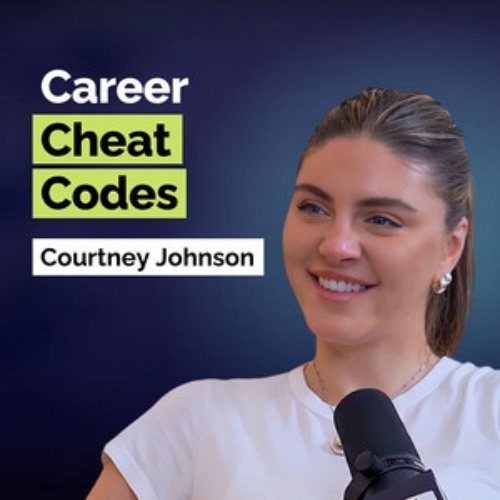
Courtney Johnson: Career Cheat Codes to Stand Out, Get Promoted, and Win at Work | Career | E395
Career success isn’t always about working the hardest, and Courtney Johnson learned that the hard way. While climbing the corporate ladder, she was told to keep her head down and grind, only to discover that top performers play by a completely different set of rules. Getting laid off forced her to crack the code and write Career Cheat Codes to help others build thriving careers with ease. In this episode, Courtney shares actionable strategies to get noticed, land promotions, negotiate raises, and build a personal brand that creates real opportunities.
In this episode, Hala and Courtney will discuss:
(00:00) Introduction
(02:30) The Expensive Lie About Working Hard
(07:33) A Players vs. B Players Mindset
(12:49) How Entrepreneurs Can Build Visibility
(14:55) How to Impress Your Boss and Clients Fast
(23:30) Job Search Strategies That Work in 2026
(30:56) Using Keywords for Resumes and Branding
(34:33) Overcoming Imposter Syndrome at Work
(36:30) Building a Personal Brand and Monetizing Content
(52:26) How to Land Paid Speaking Gigs
(54:25) How to Become Visible and Profitable
Courtney Johnson is an entrepreneur, author, and personal brand strategist who helps professionals accelerate their career growth through visibility and strategic positioning. Her new book, Career Cheat Codes, reveals the unwritten rules of workplace success and career development. Known for her viral content on LinkedIn and TikTok, she has built a loyal community of professionals and creators who follow her for no-nonsense career and personal branding advice.
Sponsored By:
Huel – Get over $50 in savings with the Discovery Bundle from Huel. Use my exclusive code YAP15 for 15% off at huel.com/yap15.
Indeed – Get a $75 sponsored job credit to boost your job’s visibility at Indeed.com/profiting
Shopify – Start your $1/month trial at Shopify.com/profiting.
Quo – Run your business communications the smart way. Try Quo for free, plus get 20% off your first 6 months when you go to quo.com/profiting
Experian – Manage and cancel your unwanted subscriptions and reduce your bills. Get started now with the Experian App and let your Big Financial Friend do the work for you. See experian.com for details.
Intuit – Start paying bills the smart way, not the hard way. Learn more at QuickBooks.com/billpay
AT&T Business – Power your small business with reliable connectivity from AT&T. Switch today at business.att.com.
Fabric – Protect your family with term life insurance from Fabric by Gerber Life. Apply today in just minutes at meetfabric.com/profiting
ZocDoc – Stop putting off those doctors’ appointments. Find and instantly book a doctor you love today at Zocdoc.com/PROFITING
Blinkist – Turn the world’s best nonfiction books into quick 15-minute reads or listens. Grab your free trial plus an exclusive 30% discount at blinkist.com/profiting
Resources Mentioned:
Courtney’s Book, Career Cheat Codes: bit.ly/CJ-CCC
Courtney’s Instagram: instagram.com/courtlynnjohnson/
Courtney’s TikTok: tiktok.com/@courtney..johnson
Courtney’s Website: courtneyjohnsonnews.com
Atomic Habits by James Clear: bit.ly/JC-AH
Show Your Work by Austin Kleon: bit.ly/AK-SYW
Active Deals – youngandprofiting.com/deals
Key YAP Links
Reviews – ratethispodcast.com/yap
YouTube – youtube.com/c/YoungandProfiting
Newsletter – youngandprofiting.co/newsletter
LinkedIn – linkedin.com/in/htaha/
Instagram – instagram.com/yapwithhala/
Social + Podcast Services: yapmedia.com
Transcripts – youngandprofiting.com/episodes-new
Entrepreneurship, Entrepreneurship Podcast, Business, Business Podcast, Self Improvement, Self-Improvement, Personal Development, Starting a Business, Strategy, Investing, Sales, Selling, Psychology, Productivity, Entrepreneurs, AI, Artificial Intelligence, Technology, Marketing, Negotiation, Money, Finance, Side Hustle, Startup, Mental Health, Career, Leadership, Mindset, Health, Growth Mindset, Hiring, Startup, Business Ideas, Growth Hacks, Money Management, Career Podcast
Courtney: [00:00:00] It is an expensive lie to say you have to pull your head down, work hard, and everything is gonna work out for you because the opportunities do not go to the hardest worker. The opportunities go to the person who is most visible.
VO: Courtney Johnson, a personal brand strategist and content creator. Known for her career cheat codes.
VO: She helps professionals build visibility online and turn content into real career opportunities.
Courtney: I want other people to have a shortcut to where they don't have to go through so many ups and downs and so many problems in their career. They just understand the information and they can go. I got laid off and so I was forced to post every single day for 365 days.
Courtney: And that year completely changed my life. Consistency compounds. The only way to fail the entrepreneur game. The personal brand game is to quit. It's to come up with an excuse and say, I'm gonna come back in two weeks.
Hala: For somebody who's looking for a job, what do they need to know about [00:01:00] how hiring works?
Hala: Today in 2026,
Courtney: the biggest tip to getting a job as easy and fast as possible is to build a personal brand.
Hala: How do you suggest people decide what's the first platform they should focus on?
Courtney: I recommend people start with.
Hala: Hey, young and profits. Today we are taking a turn from our usual topic of entrepreneurship and we're gonna focus on careers.
Hala: So this episode is especially valuable if you are climbing the corporate ladder, but of course, we're gonna touch on entrepreneurship because we always do at Young and Profiting podcast. If you're working hard, hitting your goals, staying loyal, but still invisible when promotions raises, and big opportunities come around.
Hala: This episode is for you today I'm interviewing Courtney Johnson in the flesh. And she's breaking down the real rules of career success. She's a personal brand strategist, entrepreneur, and author of career cheat codes, and her message is clear. Opportunities don't go to the hardest worker. They go to the most visible worker.
Hala: She's sharing [00:02:00] exactly how to work out loud, build strategic relationships, and position yourself so opportunities stop passing you by and start coming straight to you. But before we get into it, if you're just discovering us, I'm so glad you're here. Make sure you subscribe and follow us so you never miss a conversation.
Hala: And by the way, me and Courtney did this interview in real life. So if you like to watch your podcast episodes and feel all that chemistry, go check it out on YouTube. All right, let's get into the conversation. Courtney, welcome to Young and Profiting podcast.
Courtney: I'm so pumped to be here.
Hala: Me too. I'm so excited for this conversation.
Hala: I feel like you've got so much to share in terms of career advice for people who are professionals and then also for entrepreneurs. 'cause you're an entrepreneur yourself. Mm-hmm. So you've got this new book called Career Cheat Codes coming out in April this year, which is like super exciting. And in the book, your premise is really like this.
Hala: Old, you know, um, adage saying of keep your head down, work hard, everything's just gonna work out, really [00:03:00] just isn't true. Mm-hmm. And a lot of high achievers act this way. They just think they can work hard and good things are gonna happen to them. Why is that an expensive lie?
Courtney: It is an expensive lie to say you have to put your head down, work hard, and everything is gonna work out for you because.
Courtney: Your work. Like nobody's gonna go out of their way to find your work. Nobody's gonna search through your Google Drive and say, oh my God, that report was so good. Nobody is going to pluck you out of a crowd. And I think we have this idea, I used to have the same idea. And honestly, I think it was from hearing those stories of like Victoria's Secret models and like a South African mall.
Courtney: And they're like, you, like we're picking you out of a crowd. Yeah. And now we're giving you a career. That just doesn't happen. Okay. Maybe that worked in like 2008 in this one industry, it doesn't work. Right. And Austin Cleon says if your work is not online, it does not exist. Um, I actually went to a, went to a bar one time and that's kinda where this idea came from.
Courtney: And, [00:04:00] and the, the band was really good and I went up to the band after and I said. Wow, that was amazing. Like, can I follow you on Spotify? And they're like, oh, we don't have Spotify. And I was like, okay. YouTube, SoundCloud. Like, where can I keep up with? Yeah, with your work. Especially since they said it was their dream to share their music with the world, to get a, uh, record label, you know, all the, all the music dreams.
Hala: Yeah.
Courtney: They're like, oh, we're, we're not on online, we're not on Spotify. We're not on. Instagram, but you can come see us at this bar every third Thursday.
Hala: Oh my God.
Courtney: And anybody that heard that would say, that is crazy. There's no way that you can have a successful music career just being at this bar every third Thursday.
Courtney: There's not like Music Scouts out and about. Going to give you the golden ticket, right? You gotta put in the reps yourself. But a lot of us think like that when it comes to our careers. We're putting in the reps, we're showing up internally. But when we're not making ourselves visible externally, those opportunities just aren't coming to us.
Courtney: And I'm curious if you got that same advice from your parents?
Hala: From my parents? No. My, my parents. [00:05:00] We're from the Middle East. Mm-hmm. And so they were immigrants and my dad was a doctor, and so for them, they were just like, you know, study hard, work hard, but they didn't have much career advice to give me, like I felt growing up like really alone in terms of how to navigate the corporate world and the business world, because they never had corporate jobs, neither of them.
Hala: My dad just kind of like studied and went to med school and that was the route that he knew. Um, so no, I did not, you know, I was, I was like, uh, reading your book and I noticed that you had mentioned that a lot of people kind of grow up. At the dinner table. Mm-hmm. Learning about how to navigate corporate.
Hala: But no, that, that definitely wasn't me. I learned it on my own.
Courtney: Yeah. That did not happen to me either. And that's why, why I wrote this book because I was kind of given the advice, like, you know, working class, just keep working hard and you'll get the opportunities. But the opportunities do not go to the hardest worker.
Courtney: The opportunities go to the person who is most visible. Because when, when you're looking for someone, when you're looking for a [00:06:00] graphic designer to hire, you're looking for someone to book on a stage, you're looking for someone to bring on your podcast, you're looking for the person to, to give a promotion to, we're gonna choose the easiest choice.
Courtney: We're gonna choose the person that is obvious, or it makes us look good to our boss. We're gonna choose the person that is. Um, that is, it's easy to enroll everybody into why we're hiring them, why we're promoting them, and you wanna make it easy for people around you to say yes to you. And when you're hiding because, oh, I'm humble, or because, oh, I, my work speaks for itself.
Courtney: You're really robbing yourself of all of these opportunities.
Hala: Yeah. I remember, I, I forgot who I interviewed, but they told me that humble literally means low to the ground. So who wants to look up to somebody who's low to the ground?
Courtney: Right.
Hala: Right. So you never wanna be humble.
Courtney: Yeah. Also, like you're robbing the world of your gifts and talents if you're staying humble.
Courtney: Right. Some people are like, well, I don't wanna make it all about me, me, me. It's not about you, you, you, it's about [00:07:00] all the people you impact. Right. Like. Young and profiting is not just about hala, although you weave in your stories and your experience. Young and profiting is about all of the listeners, the millions of people who have listened to this podcast, learned something, learned something, implemented it, and changed their life in some way.
Courtney: And if you, if you were to stay quiet and say, well, I'm gonna be humble. I'm not gonna do this podcast. I'm not gonna put myself out there, you are robbing those millions of people that have had massive changes in their life, massive improvements in their life, their business, their career because of you.
Hala: Yeah. One of the concepts I loved in your book was this. A player B player concept. So tell us like, what does an A player look like? What do they do and what do they not do?
Courtney: Mm-hmm. An A player is someone usually who comes from a family where they were told all of the unwritten rules of, uh, of work. And for me, when I got to the workplace, I saw all these A players and I'm like, wait, why are they talking like that?
Courtney: Why are they doing that? I thought. [00:08:00] I would just do my work and everything would work out. I come from very much a b player background. So really the book is exposing all of the tips and tricks of the A players and some of the things that the A players do. A players really, really understand psychology relationships.
Courtney: A players understand that, um, they wanna find out their boss's goal and help their boss achieve that goal. A players understand visibility, they understand that. Visibility is what gets their work noticed. A players also understand, again, relationships, how to build strong relationship across your company with your clients, et cetera.
Courtney: And the main difference between A players and B players is that a players understand that it's a game and they embrace the game. And a lot of times we can be afraid to embrace this corporate game because it's fake, it's bullshit, whatever. But if you want, if you don't like the game of corporate, just [00:09:00] gain power and change it yourself.
Courtney: So really a players play the game. They notice that it's a game. They see it's a game. They play the game. B players say things like, oh, I don't wanna play the game. I don't want to pretend to be someone I'm not. They're very resistant to the game.
Hala: Yeah.
Courtney: But everything in life is a game, and we can choose to learn the rules and play to win.
Courtney: Or we can choose to be pissy about it and stay stuck.
Hala: And one of the games that a players play is working out loud.
Courtney: Mm-hmm.
Hala: Can you give us some examples of how you can work out loud?
Courtney: Yeah, working loudly would be something like when you finish a great project, talk about it in Slack or Teams or whatever your company communication is.
Courtney: Share, Hey, I'm super proud of our team and we accomplished this or that I contributed in this way. Working out loud is also sharing your work publicly. I know a lot of people can't share their exact work publicly, but you can still share what you're learning. So that means posting on LinkedIn, working out loud means, um, [00:10:00] being open to speaking opportunities, to hosting opportunities, even if it's not external.
Courtney: Can you host a tutorial with a different department in your organization? Can you go to a conference, record a loom video about what you learned and share that with the team? It's really this idea of like bragging about our work because again, if our work is invisible, we're not gonna be first for the promotion.
Courtney: We're not gonna be first for those opportunities that we really, really like. Um, another way to flex. Working loudly is just to update your boss. Hey boss, these are the things I did today. These are the things I accomplished this week. And start to make a trail of everything that you've accomplished. It makes it a lot easier to get a promotion, and it makes them honestly like you a lot more and be a little bit less on your ass because they really trust you.
Courtney: Yep. Because they see that your work is visible, it's visible to them, it's visible to the broader team.
Hala: Mm-hmm. So it's not really about. Necessarily doing the best work, of course you wanna do the best work.
Courtney: Mm-hmm.
Hala: It's about the [00:11:00] perception.
Courtney: Mm-hmm.
Hala: That you're doing the best work.
Courtney: Totally. Totally. And you're exactly right.
Courtney: It's not. The best, most talented work that gets the promotion or gets the opportunity or signs the deal, it's the one that's easiest for other people to see. Right? And listen. It's helpful if you can do the best work, but the best work just isn't the differentiating factor. Now, a lot of people listening to this.
Courtney: Probably are rock stars at their work. They're amazing at their work, so it's, it's gonna be even easier. But unfortunately some people are kind of shitty at their work and still get the job and the promotion and the deal. And I'm sure a lot of listeners listening to this right now are like, yeah, I've, I've seen those examples and I hate that that happens.
Hala: Yeah,
Courtney: I wish it went to the best person, but it doesn't,
Hala: A lot of high performers, I think, fall into this bucket of not wanting to play this game because in school. It's not really about politics. You take the test, you get a good grade, you know, you get [00:12:00] honors and you keep getting rewarded. So they end up going into corporate and they think it's the same system when it's really not.
Hala: So even if your work does get you shine and you're really talented, it could be the key differentiator where you're going ahead, somebody who has really good work and good politics.
Courtney: Mm-hmm.
Hala: And they're gonna get the promotion over you.
Courtney: Totally. Yeah. And you don't have to be perfect at either game. Like you're never gonna be the top of the top the best at what you do, and you're never gonna be the most socially intelligent or aware, right?
Courtney: It's like how do you play into your own strengths and really amplify those?
Hala: Mm-hmm. I feel like this is also relatable to entrepreneurs. Totally. Working out loud. Totally. Because it's this whole whole concept of like documenting your journey, sharing before you're necessarily ready. Like everybody thinks they have to be an expert to share online, but you can actually share what you're learning.
Courtney: Mm-hmm.
Hala: Talk to us about how entrepreneurs can use this concept as well.
Courtney: First, entrepreneurs can work out loud with their clients. So if you wanna make sure you're retaining your clients or your [00:13:00] users, make sure you're reminding them of the impact. Maybe you have an a marketing agency, Hey, like we're super proud because we're seeing these results this week.
Courtney: We just had this major win or a small win. You know, you might text your client a screenshot of somebody that said. Hey, I loved that presentation. I loved that thing, right? It could be so small. Maybe you have an app. We wanna make sure that we're continuously reminding our audience how much time they're saving or how much money they're making, or whatever outcome that you are creating.
Courtney: So constantly remind your clients, remind your users, remind your customers the benefit that they're getting from your service. Or they might forget 'cause they're not thinking about you all the time. It's like you gotta make sure that you're retaining these users as well. Um, and then also for new users and new opportunity for new clients.
Courtney: For new prospects, we wanna make sure we're building in public, so we are posting [00:14:00] consistently. And it doesn't have to be crazy. You don't have to drop everything and become an influencer. Just give your audience routine updates of what you're doing, what you're celebrating, so you can stay top of mind.
Courtney: Because when our audience comes to a buying decision, they're gonna choose the person that's the most top of mind. In the same way, when your boss is looking for someone to promote, they're gonna choose the person that's most top of mind. They're not gonna think and sift through and really. Get in the weeds.
Courtney: I wish they did, but they don't So constantly remain top of mind.
Hala: This is so smart. I I love what you're saying about reminding your clients because they will come up with their own narrative, right. About how the service is going. Right. They'll remember like a few things from few meetings and kind of piece it together, and their narrative could end up being a lot more negative than the truth.
Hala: Mm-hmm. So your job is to kind of craft the narrative for them and share it with them. Ongoingly, which I just think is so smart.
Courtney: Exactly. It's so, so important.
Hala: So how can you make a good impression on your boss? Mm-hmm. Because it is usually your boss that [00:15:00] is, you know, helping you get a promotion or moving you along your career.
Hala: So how can people better impress their boss?
Courtney: Yeah, you can better impress your boss first. You gotta learn what their goal is. Their personal goal and their professional goal is that their goal is to run a marathon this year. Okay, great. What can you take off their plate? Can you go to that morning meeting to give them time for their marathon training?
Courtney: Right? Uh, maybe their personal goal is to buy a house this year. Can you just give them some encouragement? Can you say, oh, great, you're touring with a realtor. I'll take that over that day.
Hala: Hmm.
Courtney: Or, oh, my cousin's a realtor. Here you go. So you wanna figure out their personal goal. You also wanna figure out their professional goal.
Courtney: Maybe they wanna get promoted. Maybe they wanna raise, maybe they wanna achieve a certain outcome or metric, and you wanna create your focus around helping your boss achieve that goal. A lot of times we get caught up in the weeds of what we think we should do, maybe even what's best for the company. But really, if you want your boss to be obsessed with you.
Courtney: Figure out their goals and [00:16:00] help them achieve those goals as your very first priority. The next thing you wanna do, if you wanna make your boss obsessed with you, is to give them more updates than you think. I call this the Monday, Wednesday, Friday rule. So Monday you're gonna tell them, Hey boss, here are my five priorities for the week Wednesday.
Courtney: You're gonna send them a quick update. Here's how we're progressing on A, B, C, D. On Friday, you're gonna send them a summary of, here's what I accomplished. They are going to feel like a, a load is lifted off their shoulders. If you do this, they are going to be way more hands off, let you run on your own because they are always visible into what you're working on.
Courtney: And this is gonna give you a lot more time because now that you have your priorities, you're giving your boss the updates, they're not gonna be micromanaging you. And you could take that extra hour. To go workout or go on a walk or go to the park with your dogs. Take some of your time back.
Hala: Yap. Gang.
Hala: What's your weekday breakfast Actually like be honest, mine used to be coffee and starve myself till noon when I could grab something between [00:17:00] meetings. But recently I had Dr. Amy Shaw on the podcast and she said the number one way to get more energy is a 30 gram protein breakfast. That stuck with me and that changed everything.
Hala: Now, every weekday morning I grab a. Fuel Black Edition, ready to drink 35 grams of protein, 27 vitamins and minerals, no artificial sweeteners, and under five bucks, the chocolate peanut butter flavor is so good. A complete meal. I drink on the way to the studio and I'm full for hours. It's especially great if I'm in a rush.
Hala: I got sick a lot this winter. In fact, I'm recovering from a cold and so. I made a decision this spring and summer. I'm going all in with my health. I'm not great at remembering to eat, let alone taking all my vitamins. So I've used habit stacking to fix that liquid B12 and other vitamins in my coffee. And my rule is if I don't have a Hue protein in the morning, I drink my hue at lunch.
Hala: Daily Greens that is, that's 42 vitamins, minerals, and superfoods, only 25 calories. [00:18:00] I love this stuff and it tastes. Tastes delicious. Protein at breakfast. Multitasking my coffee and greens at lunch. Done. Done, and done. Heel has a limited time offer. Get 15% off with my code profiting at heel.com/profiting.
Hala: New customers only. Again, that's. Hue, HU el.com/profiting. And thank you to Hue for supporting the show. Hey, young and Profits, if you've been around for a while, you know that this show has leveled up more in-person content, more mind-blowing guests, better production, and not only happened because of the incredible team we have behind the show when it comes to hiring great talent.
Hala: I trust Indeed, sponsored jobs. Every time sponsored jobs, boost your listing to the top of search results and matches you with candidates based on the exact skills, certifications, and location that you need, and you only pay when it works. Spend less time searching and more time actually interviewing candidates who check all of your boxes.
Hala: Less stress, less time, more results when you need the right person to [00:19:00] cut through the chaos. This is a job for Indeed sponsored jobs and listeners of this show will get a $75 sponsored job credit to help get your job the premium status it deserves at indeed.com/podcast. Just go to indeed.com/podcast right now and support our show by saying you heard about Indeed on this podcast indeed.com/podcast.
Hala: Terms and conditions apply. Need a hiring hero. This is a job for Indeed sponsored jobs. You give such cute hacks in the book. Uh, one of them is the snackable surprises for your boss. I love that hack. Can you tell us about that?
Courtney: Yeah. Um, this is fun because. You know, we have this, there's this concept of like iterative wins or iterative surprises, right?
Courtney: Where if I brought donuts to work in every single day, you would start to expect it from me. But if I bring in fun little surprises ad hoc, you become more addictive as a person. This is actually how, um, how, um, toxic relationships work. But we're just [00:20:00] using it for good. So, um, so for your coworkers, bring in a little surprise offer to help somebody, offer to help your boss take something off of their plate.
Courtney: But if you don't wanna be held to it, do it a little bit more intermediately. Okay? Rather than. Consistently, but you wanna consistently give your boss them Monday, Wednesday, Friday.
Hala: Got it. So in terms of these snackable surprises, from my understanding, it was basically like surprise them with like information.
Hala: Mm-hmm. Or something that can help them that they just weren't expecting.
Courtney: Yeah, yeah, totally. Yeah. This can also be information. This can be, again, something like. I think you would love this article. It could be, again, something like you go to a conference or you attend a webinar that they don't know about, and you send them what you learned from it, or the three actions that you're taking.
Hala: Mm-hmm.
Courtney: Um, again, it's really being proactive and going above and beyond. Something else I think is super helpful is there is a, I think it's a 1% rule or 10% rule. You just wanna go like a tiny [00:21:00] percent above what everybody else is doing. So if your boss asks you to do a report, do a report and tell them th the three predictions for the next report.
Courtney: Mm-hmm. If your boss asks you to make a pitch deck, do the pitch deck and draft the pitch deck email, like, how can you anticipate and take one extra micro step above everybody else's really gonna make you stand out? And that also will make you stand out in interviewers. So for all the entrepreneurs listening to this of like, how do I hire an A player?
Courtney: Yeah, look out for these things in the interview. Are they going one extra step in the job application process? Did they, you know. Email you after to thank you. Did they send you a quick video? Did they share with you three changes they would make or a, you know, high level of a 30, 60, 90 plan? Those are the people we really wanna hire because those are the people that are going even just one tiny step above and beyond.
Hala: As I was learning about some of these strategies, I kept thinking about my own journey as an entrepreneur, and when I heard about this, like, you know, [00:22:00] snackable surprises. I realized like this is what I do to get mentors now. This is what I do to get like really high level clients because people who join my network have to have like a certain amount of downloads.
Hala: They're typically like really famous and I've gotta like stand out and impress them somehow. And so what I'll do is just like try to be helpful. Mm-hmm. And not in an annoying, like, spammy way, but like if I have a piece of information that they could. You know, really used or implement, I'll like, you know, shoot a loom video and like send it to them and until finally like they wanna have the call with me or they realize that I've got value to share.
Hala: And so you can also use this strategy to get clients and mentors as an entrepreneur.
Courtney: Totally. Like introductions is a great way to do this of, hey, I would love, like for a couple of people I've been like, Hey, I would love to introduce you to my book agent. I know that'd be really valuable for them. That would deepen the relationship.
Courtney: Um, it could be, Hey, I have an extra ticket to this conference. Like, do you want to go? I'll give you this ticket for free. Um, I love the information. I actually had somebody use this on me [00:23:00] last week. They were like, um, it was somebody that worked at LinkedIn. They said, Hey, Courtney, here are three things that, um, are kind of under the radar that I've learned.
Courtney: Like I would love to come guest speak, and. If they wanna guest speak and the way that they're putting their foot in the door is telling me these like kind of three bits of insider information that, that only they would know, which is really, really cool. So yeah, I love that. I love implementing information as a leverage point and as, um, value that you're giving tidbits of value.
Hala: Mm-hmm. So you were just mentioning the hiring process.
Courtney: Mm-hmm.
Hala: For somebody who's looking for a job, what do they need to know about how hiring works today in 2026?
Courtney: Yeah. Right now, the hiring process, the hiring landscape is completely different than it looked even one year ago. With AI, with massive layoffs.
Courtney: I mean, it is competitive and it is wild. Um, a couple of things I would want somebody to know if they were applying to a job right now. [00:24:00] First, your volume has to be higher than you think. A lot of people come to me, Courtney. I'm trying. I'm applying and applying and applying, and I haven't gotten any interviews.
Courtney: And I ask them, how many jobs have you applied for? They might say, oh, 10. 15. It's gonna take a lot more than that. Yeah. It's gonna take a hundred, 200. Second, you wanna make sure that you're working with recruiters and that you're connected with a bunch of recruiters on LinkedIn. So I actually tell my clients they're not allowed to complain about not having a job unless they're connected to 200 recruiters on their linked.
Courtney: And people say, oh, but Courtney, my inbox is gonna be annoying. I hope your inbox is annoying. Yeah.
Hala: That's
Courtney: the point. Yeah, that's the point. Like, I hope all these people are fighting to place you, so you wanna make sure that you are connected with a fuck ton of. Um, of recruiters. Um, next you wanna make sure you're always going one step above and beyond, so you're sending them an extra message, an extra video.
Courtney: You're sending [00:25:00] them some things that you would implement or change. And the biggest tip to getting a job as easy and fast as possible is to build a personal brand. Yes, the simplest way to do this is just post on LinkedIn, start posting on LinkedIn weekly. It's gonna put you above every single other person that's competing for that job because.
Courtney: They're glancing at your LinkedIn profile for maybe a second.
Hala: Yeah.
Courtney: If it looks really professional, if you look like a thought leader, you look like you're educating others. You post consistently, you are immediately going to gain higher favor because I have what I call a three second test on LinkedIn, and it's really like a one second test if you just glance at your profile for a couple of seconds.
Courtney: What are people thinking? It's not even what they're thinking. It's what is the unconscious biases that start to come out. And I use the word bias as a neutral term because it could be something like, oh, you have speaker in your bio and in my mind speaker has positive attributes and it sounds like you're really qualified.
Courtney: So I see speaker the biases, oh, you're probably really qualified. Mm-hmm. Right. [00:26:00] Or it might be more negative. I might see. Polka dots on your shirt, and you're wearing a college graduation cap. So I assume my bias is, oh, you're young and inexperienced. So you also wanna make sure that your profile is reflecting the positive biases that if somebody just glances at your profile mm-hmm.
Courtney: They're taking away things that are gonna support that hiring decision. And then once you start posting, opportunities are gonna come to you. So few people do it, and so few people stay consistent with it, that if you are posting consistently, it is going to make you stand out again, if you're connected, if you have 200 recruiters in your network, you're posting once a week and they're seeing those posts.
Courtney: Their unconscious bias is, oh, this person's gonna be really easy to place.
Hala: Yeah.
Courtney: Like they're hardworking, they're going above and beyond. Like, I'm gonna go outta my way for them.
Hala: Yeah. And either way, if you don't end up getting a job, your personal brand can help you. You know, become an entrepreneur. Mm-hmm.
Hala: So either way, you've gotta leverage your personal brand, I think, to get a job or to become an entrepreneur. And I feel like a [00:27:00] lot of people in corporate, they're kind of scared
Courtney: mm-hmm.
Hala: Of creating a personal brand. They feel like because they're in corporate, they don't need one, or they even might get in trouble.
Hala: For starting one. Talk to us about why it's so important to build a personal brand. Whether you're in corporate and you've got a stable job or you know you're looking for a job.
Courtney: Yeah, this is so important. I get the question a lot. I'm in corporate, but I feel weird 'cause what is my boss gonna say about me posting on LinkedIn?
Courtney: Or what if I get fired for posting on LinkedIn? There is a lot of fear that comes up around this, but the truth is, the odds that you're gonna be at that company forever are very, very, very small. So. Even if something does go wrong, were you gonna stay there forever? Probably not. The best way to avoid any negativity from you posting on LinkedIn.
Courtney: One block the people that you're afraid of seeing your stuff. Like it's that simple. You can block people. Second, share your mission with your team. So if you're a little afraid of what your boss is gonna think, figure out what your [00:28:00] underlying mission is and share that with them. For example. Hala, you're my boss, Hala.
Courtney: I just wanted to let you know, like I started posting on LinkedIn. I'm really excited because first I think it's really gonna help us get more visibility into X, Y, Z product. But two, it's always been my passion to inspire young women and my posts are like, my intention for my post is to inspire more young women to go into engineering.
Courtney: What, what are you gonna say? Oh, you, you can't inspire young women, right? Yeah, of course
Hala: not.
Courtney: Yeah. Like if you position it in a way that's. Sharing that your intention is to, um, elevate the whole company, not just you, and to inspire some group of people. I've never seen that. Not work. 'cause they don't wanna look like an asshole.
Hala: Yeah. And you'll actually become more valuable because you're gaining new skills. So let's say like you're in finance, but now you're dabbling in Mark in, in, on LinkedIn, and now suddenly you're good at marketing and writing and your boss or your company can find more opportunities for you. Totally. I remember when I started working at [00:29:00] hp.
Hala: That's when I started posting on LinkedIn and I became a big influencer and I became more popular than the CEO at h hp. I love that. And then suddenly they were like, go to every cons, uh, conference, you know, interview the CEO at the town halls, can you help train our sales team on LinkedIn? And I was actually getting more opportunities because I was posting on LinkedIn.
Hala: And at first it was really my peers, my coworkers, who were like, what are you doing? Like, why are you doing that? But all the executives. Actually loved it and, and thought that it was a strength that I was posting on LinkedIn. So I also think there's some benefits to it that people don't necessarily like realize right?
Hala: At first, like maybe at first there'll be pushback, but if you actually start to gain traction, you become more valuable.
Courtney: Totally.
Hala: Um, and also you become. More visible to other companies who might poach you for a higher salary or something like that?
Courtney: Totally. Yeah. I think as long as you're getting ahead of the narrative and then again sharing those wins.
Courtney: So, hey, a customer dmd me on on LinkedIn and they said they really, [00:30:00] really liked this feature. That's so cool. Right? Like even these little breadcrumbs of positivity. Again, just in the same way we're like. We're shifting the narrative and we're controlling the narrative of our customers by sharing wins with them.
Courtney: We're gonna do that internally and we're gonna share with our boss. We're gonna share in our company WINS channel. Even these tiny things as simple as a customer commenting on your LinkedIn post, you're a narrative. There is simply, look, I'm fostering relationships with our customers, like I'm using this as an additional touch point, and we know the more touchpoints we have with our customers, the longer they retain or whatever it might be.
Courtney: Um, and then also I would make sure that you have a good mix of things about your company, but also things about you. So you were probably talking about hp, but you were also talking about the mentorship you were getting, the books that you were reading, like things outside of that one job because you definitely don't wanna be.
Courtney: Pin down to one
Hala: totally
Courtney: specific job if you're not gonna stay there forever.
Hala: I totally agree. Now, something that's not so obvious to people, especially people [00:31:00] who haven't built a personal brand before or haven't spent a lot of time with algorithms, is that keywords.
Courtney: Mm-hmm.
Hala: Really, uh. You know, are a big part of strategy online, even a big part of resume strategy.
Hala: Mm-hmm. So help us understand why keywords play such a big part of getting your resume found, and then also how that translates to being an entrepreneur and starting an online brand.
Courtney: Totally. Well, both in our resume and in our content, we have AI algorithms that are picking up certain keywords. So if you're really into baking, it's picking up keywords around recipe, around healthy eating, around whatever in order to feed it to you, because the algorithms want to feed you content of what you like.
Courtney: So we just wanna make sure that our resumes are very keyword rich. Mm-hmm. In whatever job we're searching for. So. Let's say I'm a general marketer. I'm gonna apply to a social media job over here, and I'm gonna apply to an email marketing job over here. I'm definitely gonna wanna shift my resume a little bit and have more [00:32:00] social media keywords over here for the social media job, or more email marketing keywords over here for the email marketing job.
Courtney: And you can use AI to do this. You can put your resume in chatt, whatever your favorite AI is and say hey. Can you help me optimize this for this specific job? One of my favorite things to do is just take that job description, copy it, put it into ai, put it into chat, GPT, and ask chat, how to optimize your resume, tailored to that specific job application.
Courtney: There's so many tools and resources to optimize your resume. I used to do this manually for hundreds of job applications. I'm so happy that, that you can do this, um, on your own or you can do this automatically. And then as far as building our personal brands, same thing. We can ask our friendly ais, um, what keywords to sprinkle in to our content, although.
Courtney: I find it happens really automatically. Like if you're talking about software engineering, you're probably [00:33:00] naturally gonna bring up a lot of keywords that people are already consuming and already searching. I would say it, it's, it's more strategic on your resume.
Hala: Yeah. On LinkedIn, the algorithm is so like straightforward mm-hmm.
Hala: Where basically like every user has, uh, two clouds.
Courtney: Mm-hmm.
Hala: One cloud is their like. Interest their profile, the keywords that's found in their profile and their content. And then one cloud is like the stuff they engage on. Mm-hmm. And so the algorithms just matching people. Like, okay, what does this person engage on?
Hala: And who talks about that? And it just matches each other. So the same keywords you're probably putting in your resume, you wanna make sure is in your title, your bio, your description, even your description of the past jobs that you've had on LinkedIn, right? Mm-hmm. All that metadata. It's fed to the algorithm and then they'll know, the algorithm will know like, you're an expert in X, Y, Z and creates a keyword cloud for you.
Hala: Mm-hmm. So I feel like if people just understood that they, they could get so much further on LinkedIn.
Courtney: Yeah. It, it's also important to remember that just because your [00:34:00] company has this like. Crazy word for your job title that might not work on your resume. Right? If your job, like I've worked at some startups where the social media manager is like the social media guru, like I, I don't know, there's some bullshit.
Courtney: Yeah, like you wanna make sure you have a standard, um, job title or elevate it a little bit. Like if you worked in, you know, if you worked as a waitress, maybe you're not writing waitress, maybe you're writing like hospitality associate or something.
Hala: Yeah, totally. So what do you think about imposter syndrome?
Hala: You know? Mm-hmm. This is like a hot topic. Everybody, you know, talks about imposter syndrome. What's your take on it?
Courtney: So imposter syndrome is when we feel like we're not qualified enough or we don't have all of the information that we need to do a certain task or to do a certain role or get a certain opportunity.
Courtney: And the truth is we are literally cyborgs, like we have all of the world's information at the tip of our fingers. And right now in [00:35:00] job applications, in career, in entrepreneurship, you do not have to know everything.
Hala: Mm-hmm.
Courtney: You just have to be able to figure out the problem, like problem solving is. The most important skill, not do you know, you already have it memorized how to do this thing.
Courtney: Like, that's so silly. So to what I would, what I would say to people dealing with imposter syndrome is you don't have to know the answer. You just have to know how to figure it out.
Hala: Mm-hmm. And in terms of getting a raise. How do you suggest that people approach getting a raise in their job?
Courtney: Yeah. When you wanna get a raise, you really need to understand the value that you bring to the company.
Courtney: So most of the times, you're either making the company more money or you're saving the company money. If you're not doing one of those things, you probably wouldn't have a job. And you might think, well, I work in this other, uh, department that doesn't have any revenue attached to it. No, everything has revenue attached to it.
Courtney: Mm-hmm. Or you would not work there. Yep. Maybe you're saving them money 'cause you're mitigating some risk, or maybe you're bringing in money, you're bringing in [00:36:00] users, et cetera.
Hala: Yeah. Retaining clients.
Courtney: Retaining clients. Exactly. So the first thing is really understanding whether you're making the company money or saving the company money, and then starting to quantify that.
Courtney: You can just have a conversation with Chad GT and say, Hey, here's my role. Here's what I've done. Can you help me understand how I'm saving or making the company money? And you wanna really have a, a raise conversation of tying it back into the money because. Honestly, nothing else really matters. We think like, oh, well the client said this nice thing about me and I accomplished this and I worked for this long, and I went above and beyond in these ways.
Courtney: And although that's all great and shows you have a great work ethic. What your company wants to know is, a client gave me this compliment and that led to them retaining, which led to an extra a hundred thousand dollars, whatever, or you know, I, instead of taking six months to hire someone as a HR professional, I took three months that cut our time to hire in half which time to [00:37:00] hire.
Courtney: You know, it really cost us an extra $10,000 a month. So I saved us $30,000. Like you wanna really find areas. And again, I, I, I coach people on this and they might say, well, there's, there's no way. Like, I didn't do anything to make or save the company money. And you absolutely did. Or you would be fired.
Hala: Yeah. I love that. Such great tips. So you wrote this book, career Cheat Codes. Why do you feel so passionate about this topic? You also like blew up on TikTok initially. Mm-hmm. Why do you feel so passionate about this topic?
Courtney: I feel so passionate 'cause it took me a long time to understand these cheat codes and I had to figure it out for myself, and I want other people to have a shortcut to where they don't have to go through so many ups and downs and so many problems in their career.
Courtney: They just understand the information and they can go, and I think of this as information equity. I think we talk about a lot of different types of equity and equality in our world, how to make the world more equitable. We talk about it in terms of money, in terms of where we come from, [00:38:00] et cetera. And the type of equality I've just been really passionate about is information equality, because I have seen so many stories where somebody comes from a really rough background, somebody comes without, um.
Courtney: Without having access to some of these job opportunities, et cetera, and they can work their way up just by having the information. One of my good friends, she is from the Philippines and she's from like a very small village where the average salary is like $200 a year, and she just, through watching YouTube videos, she learned how to be a va.
Courtney: Eventually made her own VA agency. Now she has a seven figure business. She travels the world. She's literally living her dream.
Hala: Amazing.
Courtney: Because of information equity. Mm-hmm. Because somebody decided, Hey, I'm gonna put what I learned on YouTube. Hey, I'm gonna put what I learned into a book. I'm gonna put what I learned on social media.
Courtney: And I just think the more we can give out information, the more we can un gatekeep. Because I know some people like to gatekeep shit.
Hala: Yeah.
Courtney: Some people like to say, I'm not gonna share this with others. [00:39:00] Because I want this to be my own special advantage. What I wanna see in the world and my vision for the world is we're not gate keeping this information like we are actively sharing information and education with others so we can level the playing field and have a more equitable world.
Hala: What's up Y gang? On the show, I've sat down with Robert Green, Seth Godin, Alex Ramzi, Gretchen Rubin, James Clear, and every single one of them has a bestselling book and every one of those books are on Blinkist. Here's something I've been thinking about lately. In the age of ai, everyone has access to the same answers, but the people who actually read, who absorb real ideas and think for themselves, they're the ones with the original take in the room.
Hala: AI can summarize, but it can't replace the frameworks that you build from reading widely. That's your real edge as an entrepreneur. Blinkist turns the world's best nonfiction into 15 minute reads, or listens over 9,000 titles covering entrepreneurship, marketing, psychology, habits, everything we always talk about on this show.
Hala: I use Blinkist to go through [00:40:00] several books a week, pull out the key insights and decide which ones deserve a full deep dive and a full read. Between meetings at the gym, whenever I just have 15 minutes. In a world where everybody is copying the same AI output, reading is the thing that can make you different.
Hala: Grab your free trial plus an exclusive 30% discount at blinkist.com/profiting. That's blinkist.com/profiting. Talk to us about how you first started as a creator. From my understanding, you got laid off and that really, uh, that setback actually turned into an opportunity for you. Tell us how that unfolded.
Courtney: Yeah, so as I, I, I actually, most of my career has been being a ghost writer for other people, so building other people's personal brands. So I was posting on and off very inconsistently, but I got laid off. I think this was. 2019 or 2020. Mm-hmm. Um, and that's what finally catapulted me because I was like, I, I wish I could say that I bravely quit my job and decided to go all in on myself, but I didn't.
Courtney: It was forced. I [00:41:00] got laid off and so I was forced to post every day. I was like, fuck, I gotta get a job. I gotta figure this out. And through that process of just committing, I'm like, I'm gonna post every single day. No matter what, no matter if it's a bad post, no matter if I don't feel like it, no matter if I'm sick, I am posting every single day for 365 days.
Hala: Hmm.
Courtney: And that year completely changed my life. I mean, absolutely insane. But yeah, my, I mean, that was basically my journey. I had seen so many other people succeed with their personal brand, and I was like, I want that for myself.
Hala: How did you laser in on. Your niche? Like were you testing different topics or were you like, I'm just gonna start with careers and, and land there?
Courtney: I love this question. Um, I, I actually started posting about everything. Um, I started posting about my dogs and living in Austin and, and my house and, and career and personal brand and all these other topics, and I just looked at the [00:42:00] data of what, what are people liking? Um, and it was a lot of career and personal brand.
Courtney: Another way that I would figure out what to post is I would ask my friends, Hey, what advice do you ask me for? I would notice what advice my friends are asking me for. I would also ask my friends things like, when you think of me, what do you think of? So a lot of times the our zone of genius is so obvious to us that we don't even consider it.
Courtney: But our zone of genius might be mind blowing to somebody else. And for me, that was career. I thought these career cheat codes were obvious. And so I was like, I would never post them because like, duh, people know this, or it's easily Googleable, or there's already a lot of career creators. And it wasn't until my friend was asking me throughout her whole job application journey and had a really good result that she was like, Hey, you should share some of this stuff.
Courtney: And so I, I started sharing it.
Hala: And I know that you're a proponent of like sharing stuff even when it's not perfect. You call it b plus content?
Courtney: Yes. [00:43:00]
Hala: Why is that so?
Courtney: Because I see people all the time, overthink, overthink, overthink their content to where they don't actually post. Or maybe they'll post once or twice, fall off for a couple months, do it again, and never actually get consistent, which.
Courtney: That was actually me. I was overthinking. I was trying to make it so perfect that I never actually gained traction because I never actually was consistent. I actually believe there's two skills in personal brand. Well, there's a lot of skills, but there's two main skills. One is the skill of consistency.
Courtney: Second is the skill of optimization. You cannot optimize if you're not consistent. Yeah. Some people, they try to make like a 12 point strategy with their seven content pillars and the perfect time of day and the perfect whatever before they even get started. But the truth is that is, that's not, that's gonna be completely irrelevant in like a couple of weeks or a couple of months.
Courtney: So I believe. You should start posting consistently, even if it's bad, even if it sucks, even if it's just an Instagram picture of your dog every [00:44:00] day and like what you're feeding them. I don't give a fuck. Just start posting consistently every day. Once you have the habit down of posting consistently, then optimize.
Courtney: Um. I love the book Atomic Habits. Yeah. And it talks about a similar example of if you really wanna get really fit, build a gym habit, have the best technique, the very first skill is just driving your car to the gym.
Hala: Mm-hmm.
Courtney: Can you do that every day? Can you drive your car to the gym and literally sit in the parking lot?
Courtney: Okay. Now, once you've mastered that habit, go into the gym. It doesn't matter if you're walking on the treadmill for five minutes and you leave, you're just doing something.
Hala: Yeah,
Courtney: then you're gonna slowly optimize. But the reason why people fail at the gym is because they get this crazy seven week program where it's super hard and they're so sore after the first day.
Courtney: It doesn't integrate into their life. But consistency is more important than anything. Like there has not been a single person online that has showed up consistently every single day, slowly optimized. [00:45:00] Not seen success. It just doesn't happen. It doesn't exist.
Hala: Yeah. How do you suggest people decide what's the first platform they should focus on and did you focus on one platform or did you focus on LinkedIn, TikTok and Instagram at the same time?
Courtney: I started on uh, LinkedIn and I was only on LinkedIn for about a year before I went to TikTok and I was on LinkedIn and TikTok for like. Two years before I went to Instagram. So I recommend people start with the platform where they will be the most consistent. Mm-hmm. And will where they will actually start.
Courtney: Because then when you move to the next platform, you have a lot of content you can repurpose. It makes it a lot easier. But a mistake I see people make when they're building their personal brand is trying to be on 10 platforms at once. It's best to really understand one platform. Optimize for that platform.
Courtney: And then once you're in a good rhythm, once you've built the habit, once you've really optimized, then pick your second platform and your third PLA platform. Now, if you have a whole team or you're hiring a massive agency, you can skip the [00:46:00] step, but most people don't have those resources. For most people, it's just them.
Hala: I totally agree. And I feel like the other thing that we need to talk about is, um, everybody's strengths are different.
Courtney: Mm-hmm.
Hala: So a lot of people are like, you know, I can't do social media 'cause I'm not good at video.
Courtney: Mm-hmm.
Hala: And LinkedIn doesn't need video. Mm-hmm. Substack is huge. That doesn't need video.
Hala: School is blowing up. Mm-hmm. That doesn't really need video. So I feel like there's other avenues for people. Who don't necessarily wanna be on video. Do you agree?
Courtney: Yeah, totally. I have a client right now that's like making a ton of money on uh, Instagram threads and does not require any
Hala: Wow.
Courtney: Any video at all.
Courtney: Yeah, I mean, first of all, I'm bad at video is just not true. It's a skill. It's like saying I'm bad at guitar. I've never been to a guitar lesson. I can't say I'm bad at guitar. Right? If I go to a guitar lesson three times a week for the next 10 years. I will be good at guitar. Totally see him as video. If you create a video.
Courtney: Every week, three times a week, every day for the next few years, you will [00:47:00] be good at video. It is a learned skill, however, starting with video can be very scary, very overwhelming, and you might not get very far if it's not something that's sustainable for you. So, like I said, I have a client right now that's just absolutely killing it on threads.
Courtney: Um, start with the thing that's most comfortable for you. So if that's writing, great. If that's photos, great. If that's, um, LinkedIn, if that's substack. What is the most sustainable? Start there. Build the habit and then slowly grow. And it's also like our comfort zone, right? Like we gotta push the edges of our comfort zone in our nervous system.
Courtney: And if you overwhelm your nervous system and go straight to like, I need to create all these fancy videos. It's gonna be really overwhelming and you're not gonna stick with it.
Hala: Yeah. And I feel like sometimes you approaching a platform differently, like everyone's posting reels mm-hmm. On Instagram, but then you have like Case Kenny
Courtney: mm-hmm.
Hala: Who posts like little, like handwritten quotes and that's his thing. And he posts, posts a handwritten quote every day and he is got like. Millions of [00:48:00] followers. Now from doing that. It can also help you stand out to think about what's your strength and how can you apply that to the platform.
Courtney: Totally. Yeah.
Courtney: It's like what are you obsessed with? Like for him, he's obsessed with like visual art, topography writing. That's incredible. Like what? What is somebody else obsessed with? Maybe you're obsessed with long form content. Maybe you're obsessed with video editing sunsets and landscapes like that. Whatever you are.
Courtney: Obsessed with your obsession will lead you down the path that's the most authentic to you. And I love that you bring up that example because there is also no right answer. Yeah. Everything I have said today about career, about content, there is some people it's not gonna apply to. There is some people that a different way is going to suit them.
Courtney: By doing it the wrong way is going to be better.
Hala: Yeah.
Courtney: So it's also important not to think that. I gotta find the perfect formula that is proven to work, that always works, that will work perfectly for me. That does not exist in anything that we do, not in entrepreneurship, not in career. So figure out what's [00:49:00] authentic to you and take baby steps towards that.
Hala: Mm-hmm. How did you make your first dollar online?
Courtney: Oh my gosh. The first dollar I made online was freelancing. I started posting on LinkedIn and somebody reached out and said, Hey, can I get on a call with you, uh, to talk about LinkedIn? And I think I charged him 50 bucks. The first dollar I made from something outside of me was from an ebook.
Hala: Mm. I.
Courtney: I wrote an ebook. I didn't write an ebook. I wrote LinkedIn blogs and my top performing LinkedIn blog. I copied it, pasted it into a PDF, and that became an ebook.
Hala: Amazing.
Courtney: Um, I listed it on Gum Road and yeah, that was my first digital product sale.
Hala: And today, how do you, like, what are all your different revenue streams today?
Courtney: Yeah, I've, I've narrowed it down a lot. I'm glad you're asking me this today and not a year ago, because I've simplified. So I have my content club where we meet every single day on Zoom and I give you a content prompt. We work on it together. Um, I have level up on LinkedIn, [00:50:00] which is my LinkedIn cohort.
Courtney: That's very much around mindset of building your personal brand on LinkedIn and overcoming any visibility blocks. Um, I do speaking, I have my book and I do brand deals and that's all.
Hala: That's so cool. So what kind of freedom do you get from having all these diversified income streams?
Courtney: Yeah, I mean, it's so helpful because if something isn't, um, going great, one month, another.
Courtney: Uh, another income stream will, will help. And I even have things outside of my business too. I have like real estate and investments and all that. Um, and it's really helpful because the market can change, social media can change. So to have backups and have that security of multiple income streams just makes me feel so much better.
Courtney: Um, and they're all kind of scaling and compounding on their own independently, which is really, really beautiful.
Hala: What's the thing that's like working really incredibly well right now, either platform wise mm-hmm. Or revenue stream wise?
Courtney: Great question. What's working well right now? [00:51:00] Um, for recurring revenue is getting people to commit to a year.
Courtney: I've tested a lot in my content club and I just find that when people commit to a year and having really solid offers of like, yes, this is a month to month subscription, but when you upgrade to a year, you get all these extra bonuses, their results are so much better. Just the mindset of them being locked into a year, they're showing up way more committed.
Courtney: They're so much more excited. They're excited to bring in other people. And it's a win-win because that helps my revenue a ton because now I'm creating much larger a RR.
Hala: Yeah. And consistency.
Courtney: Yeah.
Hala: And then platform wise, in terms of like getting leads to your content club, what's working?
Courtney: What's working really well right now is.
Courtney: Two things. One on LinkedIn storytelling, especially sharing personal stories. Um, the more vulnerable I am on LinkedIn, the more people wanna work with me, and I find that true for a lot of people around me. It can be really scary to be vulnerable on LinkedIn.
Hala: Yep.
Courtney: Um, but I highly [00:52:00] recommend it. It's
Hala: back to standing out and doing what everybody thinks is the wrong thing to do on LinkedIn.
Courtney: Exactly. Exactly. Yeah. I mean, the thing that you've struggled with is the thing people are gonna connect with you over.
Hala: Mm-hmm.
Courtney: Right. Um, something else that's working really well is just giving free resources on Instagram. I love ManyChat. Um, adding a keyword that goes to a free resource and bringing them into my top of funnel is really.
Courtney: Um, valuable right now.
Hala: Very cool. So I know one of the things that you're known for is public speaking and a lot of people who are creating online brands, that's really their end goal. They wanna get speaking engagements, maybe they wanna become an author. What is your best guidance for somebody who wants to get started in speaking and, and get these gigs?
Courtney: If you wanna get started speaking, this is a little bit of a problematic tip. You start by creating your own events. You wanna keynote, make the event you're keynoting at.
Hala: Mm.
Courtney: Make your own conference, put together a get together with others and speak at it. Make a retreat that you speak at. This is one of the best ways to get [00:53:00] speaking gigs because you're guaranteeing it.
Courtney: Last year at South by Southwest, I applied to be a main speaker. I didn't get it, so I made my own. So by Southwest event, and I had a ton of people come and I got to keynote my own. Little mini, um,
Hala: I
Courtney: love that s that I made. Um, so that's how I would get started. Um, as far as how to monetize your, uh, your speaking, you gotta be posting every day.
Courtney: That's so, so important. Um, and when you're applying to speaking, make sure you're following up with everybody on LinkedIn. You can circumvent like anytime there's like a speaking application, you can circumvent the entire application just by reaching out to one of the people that work on staff. Seems kind of sneaky.
Courtney: It is sneaky in, in the same way that if you're job hunting. You gotta be connected to 200 recruiters. If you're looking for speaking gigs, you gotta be connected to 200 conference organizers. Yeah. Event planners. And they'll, they will reach out and then also get sneaky with the budget. So [00:54:00] sometimes they're not gonna have, they're gonna say they don't have a budget to pay you, but they do have a budget from some other department.
Courtney: They might have a consulting budget, a marketing budget, whatever. And you can offer them something else. Throw in something. There's always a budget that, that you can find. Um. So, yeah, those are my speaking tips.
Hala: Okay. So before we go, just a couple last questions. For those in corporate, what would you say is like one easy thing they can do today to become more visible at work?
Courtney: Ooh. Mm-hmm. I mean, if you wanna be more visible at work, one thing you can do today, go post something on LinkedIn. It really is that simple.
Hala: Mm. Post on LinkedIn and just put yourself out there.
Courtney: Yeah, post something on LinkedIn. Uh, what's amazing is that if you haven't posted on LinkedIn in a while, that initial post is gonna remind so many people of you and LinkedIn often will send out that post more.
Courtney: Right. Like if it, if it, if it's been a while.
Hala: Yeah.
Courtney: Um, another thing you can [00:55:00] do is just share one win on Slack or Teams or whatever today. Just one tiny win. Share it with your boss. Share it with your team. Just elevate your work a little bit.
Hala: Yeah. Well, I loved your book, career Cheat Codes. Thank you. It was awesome.
Hala: I feel like it's gonna be so valuable for those in corporate. I also feel like entrepreneurs can learn a lot from it. I end my show with two questions that I ask all my guests. The first is, and this could be related to the episode or whatever you want, what is one actionable thing our young and profits can do today to be more profitable tomorrow?
Courtney: Ooh. One actionable thing that young and profits can do today to be more profitable tomorrow. Love that question. Um, set up a free call with 10 prospects or clients. It could be a 15 minute call. Um, what you're gonna do is you're gonna ask them their problem. So Hala, I know you really wanna build a personal brand, like what's in the way?
Courtney: Like, what are you struggling with? I really wanna understand your language. I'm gonna transcribe all 10 of these interviews on Zoom [00:56:00] or Otter or whatever. Put them in a chat, GPT and pull out the language of my audience. So a lot of times when we're creating our landing pages, we're creating our social content.
Courtney: It's from our perspective and our words. When you flip that to your customer's perspective and words, you're gonna get way higher conversions and thus be way more profitable. So go give out some free interviews, ask people their problems. Take their exact language and start to sprinkle that language into your marketing materials.
Hala: Hmm. So smart. You always wanna talk like your audience, so they feel like you're a like-minded friend.
Courtney: Yeah. They're like, oh my God, how are you in my head right now? Yeah. Like, that is what you want.
Hala: What would you say your secret to profiting in life is?
Courtney: Hmm. Secret to profiting in life is consistency. It's just showing up every single day, even when you don't feel like it.
Courtney: Consistency compounds. The only way to fail the entrepreneur game. The personal brand game is to stop. It's to quit. It's to come up with an excuse and say, I'm gonna come back in two weeks. Right? Show up with a micro step every [00:57:00] single day and it's going to compound and you will be successful.
Hala: Consistency is everything.
Hala: It really is, especially, it really is. Courtney, where can everybody find more about you and everything that you.
Courtney: Yeah, you can find my book Career Cheat Codes on Amazon and all the places books are sold. Um, you can find me on Instagram at k Cortland Johnson, or TikTok at Courtney, period, period. Johnson, if you just Google, Courtney Johnson, all my stuff will come up.
Courtney: So I hope to see you on my socials.
Hala: Amazing. And I'll put your links in the show notes. Thank you again for joining us on Young Profiting Podcast.
Courtney: Thank you, holla.
Hala: Well, young and profiteers. What a masterclass from Courtney Johnson. Today, she shattered the biggest myth we've been fed that if you keep your head down and work hard, you'll automatically get rewarded.
Hala: You won't not unless people can see your work. The real differentiator is visibility. Courtney calls it working out loud, and it's simpler than you think. Start with the Monday, Wednesday, Friday rule. Tell your boss the top five priorities on Monday. Give a progress report on Wednesday [00:58:00] and send a win summary on Friday.
Hala: That single habit builds trust, reduces micromanagement, and puts you front of mind when promotions are handed out. Next, stop optimizing for effort and start optimizing for impact specifically your boss's goals. Know whats are trying to achieve both professionally and personally, and align your work to that.
Hala: Then add one micro step beyond what's expected. It's not always about being perfect, it's about being the obvious choice. And finally, build your personal brand. Now, yesterday, in fact, post on LinkedIn weekly, connect with recruiters, strengthen your profile with the right keywords. You don't really need to go viral, but you do need to stay consistent because consistency compounds and invisible talent stays overlooked.
Hala: So stop hiding yourself. And if this episode inspired you, help young and profiting get seen too, share us comment on our show, and leave us a five star written review. That's how we grow this movement. You can now watch all of our live and in-person interviews just [00:59:00] like this on Spotify video and YouTube.
Hala: I also love connecting with you guys personally. So come say hi to me on Instagram at YAP with Hala, or connect with me on LinkedIn by searching my name, Hala Taha. This is your host, Hala Taha, AKA, the podcast princess signing off.
Episode Transcription
Enter your name and email address below and I'll send you periodic updates about the podcast.

