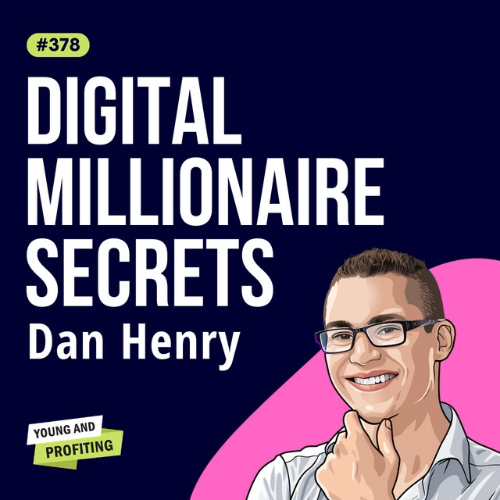
Dan Henry: The Marketing Strategy Entrepreneurs Use to Build Massive, Money-Making Brands | Marketing | E378
Dan Henry’s journey into marketing began in extreme financial hardship, surviving on $500-a-week pizza delivery shifts. A brutal winter night with no heat became the turning point that forced him to reinvent his life. Determined to change his future, he became ruthless about acquiring high-leverage marketing skills that eventually helped him generate over $10 million in sales. In this episode, Dan reveals the online marketing secrets that turned him into a multi-million-dollar entrepreneur and breaks down how to build a powerful personal brand, attract attention, and convert audiences.
In this episode, Hala and Dan will discuss:
(00:00) Introduction
(02:14) His Early Hustles and Marketing Origins
(06:35) Building ‘Velocity Vehicles’ for Business Growth
(12:37) The Strategy Behind Powerful Personal Brands
(24:49) Creating High-Converting Marketing Funnels
(30:47) Optimizing Webinars for Massive Sales
(35:50) Converting Cold Prospects Into Loyal Customers
(40:47) Using Books as Brand-Building Marketing Tools
(44:52) Creating Demand With Smart Offers
Dan Henry is a digital marketing entrepreneur, founder of GetClients.com, and Wall Street Journal bestselling author of Digital Millionaire Secrets. He has built several high-revenue online businesses by teaching entrepreneurs how to craft compelling personal brands, structure high-converting presentations, and scale through automated marketing. Dan’s content, storytelling, and sales frameworks have helped thousands of business owners generate millions.
Sponsored By:
Indeed – Get a $75 sponsored job credit to boost your job’s visibility at Indeed.com/PROFITING
Shopify – Start your $1/month trial at Shopify.com/profiting.
Revolve – Head to REVOLVE.com/PROFITING and take 15% off your first order with code PROFITING
DeleteMe – Remove your personal data online. Get 20% off DeleteMe consumer plans at to joindeleteme.com/profiting
Spectrum Business – Visit Spectrum.com/FreeForLife to learn how you can get Business Internet Free Forever.
Airbnb – Find yourself a cohost at airbnb.com/host
Northwest Registered Agent – Build your brand and get your complete business identity in just 10 clicks and 10 minutes at northwestregisteredagent.com/paidyap
Framer – Publish beautiful and production-ready websites. Go to Framer.com/design and use code PROFITING
Intuit QuickBooks – Bring your money and your books together in one platform at QuickBooks.com/money
Resources Mentioned:
Dan’s Book, Digital Millionaire Secrets: bit.ly/DigitalMilli
Extreme Ownership by Jocko Willink: bit.ly/EOwnership
The One Thing by Gary Keller: bit.ly/The-ONEThing
The Subtle Art of Not Giving a F*ck by Mark Manson: bit.ly/-TSAONGAF
Active Deals – youngandprofiting.com/deals
Key YAP Links
Reviews – ratethispodcast.com/yap
YouTube – youtube.com/c/YoungandProfiting
Newsletter – youngandprofiting.co/newsletter
LinkedIn – linkedin.com/in/htaha/
Instagram – instagram.com/yapwithhala/
Social + Podcast Services: yapmedia.com
Transcripts – youngandprofiting.com/episodes-new
Entrepreneurship, Entrepreneurship Podcast, Business, Business Podcast, Self Improvement, Self-Improvement, Personal Development, Starting a Business, Strategy, Investing, Sales, Selling, Psychology, Productivity, Entrepreneurs, AI, Artificial Intelligence, Technology, Marketing, Negotiation, Money, Finance, Side Hustle, Startup, Mental Health, Career, Leadership, Mindset, Health, Growth Mindset, SEO, E-commerce, LinkedIn, Instagram, Social Media, Content Creator, Advertising, Social Media Marketing, Communication, Video Marketing, Social Proof, Marketing Trends, Influencers, Influencer Marketing, Marketing Tips, Digital Trends, Content Marketing, Marketing Podcast
[00:00:00] [00:01:00]
Hala Taha: Young and profits. We've got a special conversation in store today, and it's so good we had to make it a two-part series. I'm sitting down with Dan Henry, a self-made entrepreneur who went from delivering pizzas to building a multimillion dollar digital empire. Dan is a straight shooter who breaks down the psychology of marketing and influence in a way that's simple, actionable, and insanely effective.
In part one of the show, we're gonna go super deep on how to build a personal brand that sells, attract dream clients, and create what my guest calls [00:02:00] velocity vehicles systems that make success. Faster and easier instead of harder. So you're gonna wanna grab your notebook for this one. Yap. Bam. I promise.
Because this conversation is packed with so many gems that you can start applying right away. Dan, welcome to Young and Profiting podcast.
Dan Henry: I'm so happy to be here.
Hala Taha: I'm so excited for this conversation. I love marketing and sales. I'm a marketer. My main job as the CEO of my company is sales. And so when I was preparing for you this morning, I was like, oh man, this is gonna be an interview that I know everyone's gonna love.
So just so happy to have you here. Thank you so much.
Dan Henry: Yeah, I'm ready to go. I love your show.
Hala Taha: Okay, so I learned that you were such a hustler grown up. You really always had this entrepreneurial spirit, and I learned that you were basically slain pizzas for seven years. There was a point in time where you were selling water bottles on the street to pay your bills. So talk to us about your hustle, your entrepreneurial spirit, [00:03:00] and where that came from.
Dan Henry: I always wanted to be an entrepreneur because I wanted to be able to take care of my family. My mother and father worked way too hard in my opinion, and I know you got started in radio. My dad worked for Clear Channel for 30 years.
He won like seven ADDIE Awards. He is highly recognized in the radio industry. He helped break out the Alman Brothers, all this amazing stuff that my father did. And when he retired, he had to deliver pizza in order to stay afloat. And I was in my mid twenties and at the time I was also delivering pizza.
I was living in Chicago I always had this dream. I just thought it was unfair that someone who had achieved so much who was so good at what they do was not paid in accordance with that. And I just wanted to become successful so I could retire. My dad. And buy my mom and dad a house, stuff like that.
At the time I was delivering pizza. I didn't have any time for [00:04:00] hobbies. I love juujitsu. I love playing pool. No time for that, so let alone retiring them. And the most I ever made delivering pizza was 500 bucks a week. And then I had what I call hell week. You know how like some people, they try and they fail, they try and they fail, but then there's that like turning moment, that tipping point in their life.
For me, it was right before Christmas and my furnace went out. Now in Chicago at the time, it's negative 16 degrees, negative 52 with windchill. And I called the landlord and I said, Hey, you need to send somebody to fix this. And he says, well, I can't do anything until Monday, so just pay for it and I'll take it off the red.
Well, it was $300 to fix that. I didn't have the money. I didn't have $300. So I went and I bought four cheap space heaters and my girlfriend and I at the time had to sit in between those space heaters to stay warm until Monday for three days and every hour of course, they would trip the breaker [00:05:00] and we had to get up and flip the breaker.
It was horrible. Then I had a delivery that week. I went all the way to this guy's house again in negative 16 degree weather. Went 15 flights up of stairs 'cause the elevator was broken. Then I had to go back to the store and all the way back because he wanted something extra and the guy stiffs me and.
It was at that moment that I was like, you know what? I'm done relying on others. I'm done relying on the generosity of others to pay my bills to make my way. And I was so excited to go home and tell my girlfriend that, but when I got home, she had her backs back at the door and she was leaving me. 'cause I wasn't going anywhere in life.
And so this is what I call my hell week, right? That week broke me, but it also built me and I became ruthless about acquiring skills and building what I call velocity vehicles. That allowed me to [00:06:00] do things that most people just would not be able to do in life. If I did not know something I would. Be super aggressive on seeking out the book, the person, the mentor, whatever, to figure it out.
And you Now I've built a multimillion dollar business, I've been able to retire my mother, my father buy them stuff, you know, just do the thing I set out to do. And so the real driver for me was always taking care of my family. 'cause I just thought it was unfair that my father did not get paid for his contributions.
Hala Taha: I love that story. And I love that phrase, velocity vehicles. I've never heard about it before. So talk to us about some of the velocity vehicles that you created and how you first got your start in the digital world, because you're known as this big online entrepreneur.
Dan Henry: Thank you. Yes. So a little analogy I use to explain velocity vehicles is imagine that you had a sack of $10,000 that was 20 miles away.
So you're standing in the [00:07:00] middle of the road and 20 miles away is this sack of $10,000. Now you have two options. You can walk 20 miles to get this sack of 10 grand, or you can walk one mile in the opposite direction and there's a car. Now you can get in the car and you can drive to the $10,000. Which one would you choose?
The car. The car. I mean, anybody who has not had a recent head injury would choose the car. But see, the thing is when you do that, you at least for a moment are temporarily walking in the opposite direction of what you want. So what I discovered was that brute force brute effort, and I know that there's a lot of gurus and whatnot these days who say, oh, you just gotta work 5,000 hours a week and just brute effort and this and that.
I just don't believe in that. 'cause that's not what happened to me. I discovered that if you find what I call velocity [00:08:00] vehicles, it's much better to put effort into finding the thing that makes it easier than just putting in raw effort. And so I would go and try to build these velocity vehicles to make what I was doing easier.
So for instance, a couple of velocity vehicles for me was I was obviously trying to build a business, right? So I find that when you build a personal brand. It makes it much easier to sell. So if you are not good at marketing and sales, but you're good at personal brand, people will still buy from you. Now, if you're not good at personal brand, but you're really good at sales, I discovered that a 45 minute to 60 minute talk,
well crafted could be the only thing you need to blow up your business. I did 10 million in sales for my business without any sales reps, any sales people, and it was just a 45 minute video that I would send people to. And of course, if you have both of those things, well then you're gonna smash it.
But I would just build these things. It just made it easier. I never believed in putting in [00:09:00] tons of hours. I would rather put in tons of hours building the thing that makes it where I don't have to put in tons of hours anymore.
Hala Taha: Something else you talk about that is along these lines is a circle of focus.
Mm. You talk about the need to really focus on one thing and not distract yourself with shiny objects. Talk to us about the importance of focus and how you've also used that to get ahead.
Dan Henry: Focus is big. And look, I don't want to act like I'm this focus guru. There are so many times in my life where I break my circle of focus, I do get distracted just like anybody else.
But what's important is not that you're perfect all the time, it's that you understand the concept so that you can always reel yourself back in. And this is a little exercise you can do at home. You just draw a circle. And what I do is I say, what's the thing you're currently working on? The thing that is gonna make the most impact in your life?
And maybe you're making YouTube videos, and YouTube videos are really bringing you sales in your business. Okay, well, if you just did YouTube videos, [00:10:00] then that thing is 100% of your circle of focus. But if you start saying, well, I'm also gonna start a side business, or I'm also going to build an Instagram, or I'm also gonna do this, or I'm also gonna have a podcast, or I'm also gonna do this, then what happens is you start adding things.
To your circle of focus and you now have to start drawing lines like a pizza, and you'll realize that you're not giving a hundred percent effort to that YouTube channel. You're giving like 10, 20, or if you got a lot on the board, 5% effort, you just can't do two things and give a hundred percent effort to both.
Now you might say, okay, well what about people that have YouTube channels and Instagrams and stuff like that. Here's the thing, once you master the thing you're working on in your circle of focus to the point where either it's so easy for you, you've attained a mastery where you put in minimal effort, yet you get the same results [00:11:00] as when you used to put in maximum effort or you've learned how to delegate that thing to your team and they can get the same results when it's, you've achieved either of those things, you can now move it out of the circle of focus.
Into the delegation list, right? Or the minimum effort list. So now it really doesn't take that much effort for you. So now you can move something else to your circle of focus. So for me, when I got started, I just happened to focus mostly on Facebook ads, and my first 10 million in revenue came from Facebook ads, and I was just really good at those things.
Then I got into Instagram, I cracked that, then YouTube. But what I did not do was try to do everything at once, and I certainly did not try to start multiple, multiple, multiple businesses and run multiple organizations before. One of them was hyper success.
Hala Taha: Yeah, and it's also helpful when the things that you're working on feed into each other, where they work together.
So for example, I'm a podcaster. The guests that I [00:12:00] interview become my social on podcast clients or become the clients in my network. So my podcast is for creating content, for creating my audience to sell low ticket offers or get sponsorships, but then the guests that I interview also double as connecting with people that eventually become my clients.
And I don't try to get clients in any other way. Really, that's my main way of just getting clients. So when things work together, it's also really great. Now. You've become this incredible creator, entrepreneur. You've built this huge personal brand. I've been running this podcast for seven and a half years now, so for a long time, and I tend to see these patterns and themes, and in the last year, everything is about creator entrepreneurship.
It's all anybody wants to talk about. It's become a huge theme. What are your thoughts about building a personal brand online right now?
Dan Henry: Building a personal brand is the one thing you can build. You can be an entrepreneur, you can be a professional, you can just be a normal person, [00:13:00] and in any case, a personal brand will maximally improve your life.
If you're an entrepreneur and you have a personal brand, it simply makes people like you and trust you, and more people know about you. So it's easier to sell your products and services if you're a professional. Most people don't know this, but Harvard Business Review did a study where they found that in the same job, in the same profession, with the same skillset, someone with a personal brand can get paid up to 13 times more than someone without a personal brand.
So imagine two people have the same job, one's driving a four Taurus, one's driving a Rolls-Royce, all because they had a personal brand. There is another study that showed that people trust influencers more than they do Fortune 500 CEOs. That means the kid in his bedroom with an iPhone that knows how to build a brand with his phone is trusted more than someone who runs a billion dollar company.
So the landscape has changed. Now, if you're a [00:14:00] normal person, you don't have a business, you don't have a product under that. When you build a personal brand online. You are the business, your name is the business. And what that means is that someone might pay you to promote or talk about their products and services.
Like on your podcast, when you have this section where you talk about sponsored products, right? Or maybe you have a popular supplement that you like. Maybe you have a brand on sleeping, so you have a sleeping supplement you use and they have an affiliate program. Well, now you can promote that sleep supplement, get 30, 40% commission.
Or maybe you just wanna open doors in your life. For instance, one time I had a software company reach out to me and they wanted to pay me to be the face of their brand. I didn't have to build a company, I didn't have to run the company. I just needed to be the face of their software. And so I said, okay, I'll do it, but I don't want to be paid.
I want equity. And they said, how much do you want? I said, I want 50%. They say, well, okay, well how much are you gonna put down [00:15:00] to get 50%? I said, I'm not gonna put any money in. You get my face, you get me, you get my name. And they agreed. And I ended up getting 50% of that company just to be the face of the company.
And two years later, we sold it for a multiple seven figure exit. Why? Because of the brand, the personal brand. So when you build a personal brand, you become a name. And when you become a name, everything opens up to you, everything becomes easier. This is what I mean by velocity assets. You're building something that makes whatever you do easier.
And I will tell you as much as, I hate to say this and I hate to say it 'cause I'm a sales and marketing guy, and I hate to say this, but if you have a personal brand, it will actually move the needle more than if you're really good at sales and marketing. And it pains me to say that. Trust me.
Hala Taha: So how does one create an amazing personal brand?
You said you just cracked the code on Instagram, I know you're into YouTube and everything like that. What is your formula for doing that?
Dan Henry: So I [00:16:00] studied personal brands and I'm a big systems guy, right? So I try to figure out what is the system, the repeatable system behind this. So every brand follows the same pattern and all you have to do is re reverse engineer the same pattern.
So. They have what I call the brand triad. Every brand, every personal brand has something they stand for, have something they stand against, and they have a flaw. And this actually is derived from the greatest personal brands of all time, which are superheroes. Superheroes are the longest lasting personal brands.
No matter who plays them, no matter what movie, you still buy 'em. So I'll give you an example, Superman, he stood for truth. He stood against injustice. But when they first released Superman as a character, nobody liked him because he didn't have a flaw. They were gonna like just release him from the DC universe.
And then when they introduced the concept of Kryptonite, it gave them a flaw. So it makes 'em relatable. Now, [00:17:00] why are these three things so important? Well, they're important because. Standing for something gives people something to rally around. Standing against something makes them like you very quickly because the enemy of my enemy is my friend.
So when you find something they don't like, it could be a person, a concept, an organization, et cetera. The more you say, Hey, this is why they're the enemy, they align with you. And then the flaw makes you relatable, makes you human. And so all your content simply has to reinforce this brand triad. And here's the crazy part that most people don't get about personal branding.
Most people think you need to share value. That's the worst idea. Having a brand where all you do is share tutorials and how to and value is not gonna build your brand. You do not build a personal brand by just sharing value. You do it by sharing values. Okay. Values are what make people align with [00:18:00] you.
So I'll give you a perfect example. I'm sure you're familiar with Alex and Layla Harm, right? \
Hala Taha: Of course. Yeah.
Dan Henry: They're a perfect example of rapidly building personal brands, and their brands are different by the way, and so by. If I were to say, Hey, here's how you build a brand. I would say it's very simple.
You write down a list of your core values and then you take every value and you make a slogan out of it, something that is repeatable, something that people can quote you on, and then you just tell tons of stories, analogies, and metaphors to support that core value, and you end it with a slogan. For instance, Alex Zi constantly talks about do the boring work, and he has a million stories he can tell around that.
Layla Zi says, F your feelings. Follow the plan. You can see that on her Instagram like 10 times just this week, as she tells multiple stories that support that. So I discovered this, and this works in marketing as well. It works in sales. I read a story about Jerry Seinfeld. [00:19:00] Nearly a billionaire from being a comedian.
And what Jerry Seinfeld would do is he'd make a joke bank. So every day he'd observe something in life and he'd basically write a joke out of it, and then he'd write it down in his little joke bank. Now, whenever he needed to make one of the hundreds of episodes of Seinfeld, or he needed to be funny on an interview or he needed to be funny on stage, he did not write a joke at that moment.
He just pulled it out of his joke bank, and that was why he was always funny all the time. And a lot of comedians do this. So if you have just a list of five to 10 values, you have a little slogans that are quotable. All you need to do is look at your life and go, Hey, here's the personal stories, here's the metaphors, here's the examples I can say to continuously reinforce these core values or slogans.
And this is how you reverse engineer it. 'cause people are gonna start quoting you. A brand is what people say about you. And when you can engineer what people say about you, you can engineer growth. And so [00:20:00] all you have to do is do that, but align it and point it at the North Star. The North Star is, okay, are we selling something?
Are we trying to get speaking on stage? Like what are we doing? Once you figure that out and you just build your brand bank, because I mean think about this one slogan based on a core value. If you have 10 different stories to support that, and then you put each of those stories on Instagram, Facebook, YouTube, like this is hundreds of pieces of content off one value that you hold as a human being and that's how you do personal branding.
Hala Taha: It's so good. It's such great advice. I've never heard it framed in this way, and it's so true. Branding is all about consistency, repeating the same things over and over. Even if you think like you're being repetitive, you're not because new people are coming to your page all the time. Also, it's how the algorithm works.
You've gotta train the algorithm on using the same keywords over and over again so they know who to point your content to because you're talking about the same things [00:21:00] over and over again. So what do you repeat often? I know you have something called like blunt truths. You're all about having blunt truths and things like that.
Dan Henry: Life is long, right? We have long lives, like 30, 40, 50, 60 years. A lot can happen in that length of time. And so whatever I'm doing at the moment in my brand, 'cause here's the thing, your personal brand can shift a little bit depending on your goals. One of my favorite personal brands is Cody Sanchez.
Because she has such a simple message, buy boring businesses, right? Like I, it's so good, you know? And so for me, I always say, okay, what am I trying to do in my life right now? What am I trying to do in my business right now? And how can I point my brand towards that goal? So for the past two years, I was selling a high end sales training that taught people how to pitch, how to do that 45 minute talk I was talking about, right?
And so I would give an example. I would [00:22:00] say something like, people that pay pay attention and people that pay attention pay more. And this is something I say because I truly believe that giving away free content is great, but I like offering paid content because when people pay, they pay attention, right?
So here's an example of something I would say. When I'm on on a interview, like right now, even though this is a bit meta, 'cause I'm explaining what I'm saying. Yeah. But I might use an analogy, right? So I'll say, okay, here's why you should charge for a webinar rather than give it away for free. This is why you should do a paid presentation rather than a free presentation.
How many times have you watched a movie trailer? You saw something you didn't like and you just were like, I'm not gonna go see that movie probably a million times, right? Mm-hmm. But how many times have you gone to see a movie? You paid your money, you sat down, you got your popcorn, you got your drink, and you saw something in the first couple of minutes you didn't like, and then [00:23:00] you got up and left the theater.
Hala Taha: Never.
Dan Henry: Never, right? Why? Yeah.
Hala Taha: Never
Dan Henry: because you.
Hala Taha: Yeah. Already done,
Dan Henry: right? Mm-hmm. So that's the thing. When you have a presentation, if you simply charge for it, you ensure nearly a 100% view rate or show rate, and now those people are gonna pay way more attention. So this is just a very simple thing because one of the things that we do is we sell products and services on how to do these talks and.
When you sell something, minimal price, you can do the free talks. But when you sell something very expensive or you wanna sell it without a sales team, I truly believe that a paid talk or a paid presentation is the way to go. So I might just use that one thing. And I have probably 20 of those that I use.
And when I did that in December, I did a paid presentation and I just had all these analogies, all these metaphors, all these slogans. And in [00:24:00] the course of three days, we did $800,000 in sales with no sales team. Wow. Just yacking on a camera. Okay? Because words matter the way you shift your words. Jim Rohn, who is Tony Robbins mentor, he said, if you have something good to say, say it often and you'll be successful.
And so most people think, oh, I gotta say all this. I gotta come up with new content all the time. No. You should say the same thing over and over again in different ways. That's how you build a brand. And if you can just decide on what those few things are, building a brand and posting all this content becomes way more attainable.
It becomes way easier. And again, these little slogans, these values that you're gonna share over and over again, these are little velocity vehicles that allow it to be much easier to build a brand.
Hala Taha: So talk to us about how you connect what you actually sell with the words that you say.
How do you actually bring people down the funnel? Like what does your funnel actually look like? [00:25:00]
Dan Henry: So now we're getting into the real specific internet markety, nerdy stuff. So I'll try to explain this so anybody can understand it, not just the marketers. Imagine that somebody watches you on Instagram, okay.
And they like your content. I'll give you an example of one real I posted that got 2200 email leads from one reel. It got, I don't know how many views it got. It got a lot of views, like, I think it was like 600 and something thousand views. We did a ton of sales from it. And here's what I did. I started out and I simply told a story of a man named Ben Feldman, who used a single analogy to sell more life insurance than any person in history.
What this guy would do is he would ride up and down the elevators and he would simply say to people, Hey, if you had a money printing machine in your basement, would you insure it? And they would go, yeah. And then he'd go, well, aren't you that money printing machine for your family? [00:26:00] And they'd go, wow. Yeah.
And then they would buy life insurance. And I literally would say, this guy like worked out of a small Ohio office. And he just used this one analogy and it built him into the most successful life insurance salesman of all time. This is called an agreement analogy, and if you know how to use these, you can massively improve your sales.
So I say that in the real right. Then I say, look, I've got a list of five agreement analogies that you can use for your business. Comment the word analogy and I'll send it over. Now, what happens is when they comment that word, a little chat bot, I use, ManyChat, just sends them a message and says, Hey, what's your name?
And email gets the name and email. Boom, they're added to my email list. Then it sends them the free guide. In the guide, there's a link to go to my talk. In my emails, there's links to go to my talk. Okay? It all goes back to the talk. And then when they watch the talk. They buy our done for you webinar service or our [00:27:00] mastermind or whatever it is.
I happen to be selling, because you know, I've obviously sold different things over the years, but what I have not changed is the structure. Everything gets attention for the right people. Because think about it this way, if I'm selling a service where my team writes you a talk or a webinar, well, why would someone care about that if they didn't care about using analogies to sell things?
So you see how those things are related?
Hala Taha: Mm-hmm. Right. They connect. Yeah.
Dan Henry: Okay. So if you sell over the phone, if you sell through stage, if you sell on social, if you sell really anything that's not ice cream at premium price, well you can use one of these talks to sell more of your stuff. So what has to be aligned is would someone care?
Would someone care about this? Who would buy my product? So all you gotta do is basically say, okay. Who buys my product? Would this person care about this piece of content? Yes or no? We don't overcomplicate it more than that. [00:28:00] And if the answer is no, they would not care, then you don't do the content. If the answer is yes, they would care, then you do do the content.
Okay? But it is important to realize that there are three types of content. There's growth content, there's nurture content, and there's conversion content. The growth content is meant to get new followers. The nurture content is meant to show those followers that you can help them, and the conversion content is meant to get them to do something like give them your email, et cetera.
And these things can overlap in one piece of content, but the growth content will tend to be a bit wider. The nurture content will tend to share values more because again, you build a brand by getting attention and then making the people that you temporarily got their attention care and become fascinated with you and align with you.
And then the conversion is, okay, well now that you're trust me here, do this thing, get on my email list, et cetera. Does that make sense?
Hala Taha: Yeah, totally makes sense. And is one of the ultimate things you wanna do. You said to watch your talk, so are all your webinars [00:29:00] prerecorded at this point, or do you like to do live webinars?
Dan Henry: If I'm doing a new offer, I do it live for a period of time. Once I know that it works, then I'll put it just on a recording and look, there's no, oh, is that part of the strategy? No, I'm just lazy and I don't wanna work that hard. I mean, I made 10 million with my first. Automated talk or automated webinar.
And I got used to that, right? And so now I'm just like, I don't want to have to do it live all the time. So I just get it really good and then I put it on automated and it will never convert quite as good as live. But here's the thing, you're not gonna do it live constantly. So if you zoom out, you're gonna make more money, usually doing it automated.
'cause you're just, you're gonna get burnt out if you constantly do it live. Unless you're just super young and you just, all you wanna do is make money and you're unmarried and you don't have any kids, you know? Mm-hmm. Yeah. But for me, I like to automate. Now I'm doing a new. Presentation [00:30:00] on personal branding coming up in a couple weeks, but I already did that talk at an event in Bali where they asked me to come speak on personal branding.
Very beginner friendly talk. I pitched from stage. We did six figures in sales in a Indonesia, which is pretty good. Yeah. Awesome. So now I'm like, okay, so this is a great offer and I haven't had a more beginner offer in a while. We sell a bit more high end, and so I'm excited now to have a new offer on personal branding that is more beginner, it's going to help more people. That one I'll be doing live for at least a couple months.
Hala Taha: I am obsessed with webinars, by the way. I think a lot of people who tune into the show, it's mostly entrepreneurs who actually listen to the show. So I think everyone's gonna like dig all this really nerdy stuff that we're talking about.
you probably don't know this, I'm a big influencer on LinkedIn. That's where I really got my start. I've been an influencer on LinkedIn for like seven years and like one of the most popular people on that platform. So I launched a LinkedIn masterclass and the way that I sell that [00:31:00] is through webinars.
I was doing this for like multiple years and I took a little pause on selling. I got kind of bored of it and I took a little pause. I am now going to be selling lower ticket social media services for LinkedIn on webinars, and I'm gearing up to launch this. Previously I was selling very high ticket that nobody could afford like 10 KA month to run your LinkedIn.
And it's usually people who come on my podcast that can afford that kind of high ticket service. And now I'm launching a three to 4K offer just on webinars. And you basically get a discount if you sign up for six months or a year if you buy within 48 hours of the webinar and things like this. So what advice do you have for me as I'm planning out this launch webinar? How can I make it as effective as possible? Do you feel like there's any problems with this idea?
Dan Henry: So just so I can repeat it back, you're gonna do this live first, right?
Hala Taha: This is a [00:32:00] whole other question for you, but I've never had success with paid ads to something like automated or something like that.
Hmm. I've always done just live webinars. We promote them for like two weeks. We get a thousand people to show up, and then I just talk, teach, and sell. And that's basically how I've done it.
Dan Henry: I'll answer your question directly, but I will say this, all the people I've worked with over the past 13 years, 2,500 clients, we have helped literally hundreds of people create seven and dozens of eight figure webinars.
I mean, I've got guys doing two and a half million a month with their webinars, right? A lot of 'em are doing paid webinars as well. Nothing will impact a webinar more than just saying the right thing. That is the number one top. It's just how good the damn thing is, okay? Mm-hmm. But besides that, a couple tricks is when you're running ads to a webinar on the next page, always sell a VIP.
If it's a free webinar, always sell a VIP. You do it two hours before the [00:33:00] webinar, whatever, 97 bucks, it'll help liquidate 60 to 70, possibly even 80% of your ad spend. So now imagine that your ads were 80% cheaper right off the bat, okay? When you get on the VIP two hours before, see the main webinar is to show them how you can help them.
But in the VIP, you're actually gonna help them. That's to show them that you can help them. The people who are in the VIP, those are your buyers, and so you now have more face time with them. You actually are demonstrating you can help them, and you'll get way more sales when they watch the webinar, but you'll also liquidate and cancel out some of your ad spend, and you will learn so much from those interactions.
So one trick that I always recommend people do is when you launch a webinar or a talk. Do not launch it big at first. Launch it tiny at first. If you have to only [00:34:00] email a very small amount of your list, only run a little. Like don't tell anybody about it. Make it soft. Make it only like where a few people know, but most people don't.
Get one to 200 people on if you can or even less, do the webinar and then send out what I call a didn't buy survey. Anybody that didn't buy you send them a form and you say, Hey, I noticed you watched this training, but you didn't take us up on the offer. Could you answer a few of these questions and tell us why you didn't buy?
Well? Now when they answered those questions, you are going to understand the things you did wrong in the webinar. And so you can go back, you can tweak those things and then when you do the big launch, imagine for a moment you made the mistakes. You put all your might, you spent money on ads, you emailed your list, you told everybody about it, and you converted at say 2%.
Because you made a bunch of mistakes. But if you do this little test webinar and then you figure out what the mistakes are [00:35:00] first, now you could convert at three or four or 5% because you figured it out first. And if you want to even go crazier than this, you can just run cold ads to it. Exclude the people that already know who you are, and now you're putting yourself on pro mode because now you're only doing the webinar to people who don't know who you are.
This is advanced stuff, but this is little things I've done over the years because like most people don't make as much money with webinars and online talks as guys like me or like Iman Gaze or whatever, because we go crazy with it. We literally get down to the science of it so that we can make the maximum amount.
But to be quite honest with you, the average person, if they have a good talk, even if they don't do all this stuff, it's still gonna make a lot of money. But we're trying to make millions, not hundreds of thousands or tens of thousands. So that's a tip I would give you.
Hala Taha: for me, I find that paid traffic just doesn't convert nearly as well as just getting traffic off my LinkedIn post or Instagram posts or things like that.
Would you [00:36:00] suggest you just gotta figure out paid ads?
Dan Henry: It's not so much that. It's when someone finds you on YouTube, when someone finds you on LinkedIn, they were looking for you. They were there to learn something, they were there to. Interact with the platform, but when you run ads, it's the equivalent to someone knocking on your door at 7:00 AM to tell you about Jesus.
Right? Which, even if you're a devout Christian, I'm gonna be annoyed getting knocked on my door at 7:00 AM right? Yeah. I just, this is not nice, okay? So when you run ads, you're interrupting whatever people were doing. It's interruption marketing, you're interrupting them so they weren't already looking for you.
So obviously if you interrupt them and they go, oh, but this is a bit interesting. Let me see who this person is. They're not gonna be as warm as someone who found you organically or has followed you organically, all of their own accord. However, the trick is to convert that person into someone that would do that.
So when [00:37:00] someone gets on my email list from an ad, or they buy something, I make sure to retarget them or email them with my best, most endearing content so that. They turn into the person that goes and watches my socials and my organic. This is a part of branding. So one trick and nobody wants to do this.
It's so easy to do. Now with ai, you can do it in a few hours and people still resist it. And I just think sometimes people hate money. Okay? But the easiest way to build a brand, in my opinion, quickly, is to write a book, because book buyers are. Literally the best buyers. It's like when somebody says, I don't wanna read the book.
I wanna watch the movie. I'm in and out in two hours. Right? Those people, they're dopamine chasers. The person that's willing to read a book, they really wanna learn something. And so I find that book buyers are the best buyers. You've read the article a thousand True Fans about how you only need a [00:38:00] thousand true fans.
Yeah. Mm-hmm. Yeah. So I find if you can just get a thousand people who have read your book, 'cause when somebody's done reading your book, even if you don't sell anything, if it isn't just a book about how you think about life, if you do it well, they're so endeared to you. They're so into your brand, they're gonna read your emails, they're gonna go watch your socials, et cetera.
Now, what is the book? The book is your best stuff. It's all these stories, all these slogans, all these metaphors, all these brain building assets, the best of the best in one piece of text that when people buy it, from the time they start reading, to the time they end, they go from, oh, I'm just this cold prospect on Facebook that got hit with an ad for a book and.
When they're done reading it, they're a lifelong fan. And so I've always sold books because then whatever else I send them to webinars, whatever, or just whatever I happen to promote. I convert them from cold to warm much quicker through books. And my last few books I wrote in a few hours using ai. My best stack [00:39:00] for making money is add to book webinar as a bonus, or just get them on your list with the book and then hit 'em with a webinar when you launch it.
And then if you really wanna make a lot of money, you take them eventually to a paid presentation that is multiple days, and that's where you make big money. That's my personal view on it. But again, whether they saw you on an ad or whether they found you on their own, eventually they're gonna still watch your content.
You just gotta make that process happen faster and to more people.
Hala Taha: I can imagine that book would probably help you frame out what your values are, what your analogies are, what the pillars are for your actual personal brand, and you can give that to your team or whoever's helping you to actually help you scale that content as well.
So I can imagine it helps in that way.
Dan Henry: Yeah. Mark Manson did that. He wrote the book, the Subtle Art of Not Giving a Fuck.
Hala Taha: Not Giving a Fuck. Yeah, okay.
Dan Henry: Now, all of his personal branding, all of his socials, all of his YouTube, all of his Instagram [00:40:00] is just more of that book over and over and over again. And so one of the reasons I like writing a book is 'cause it kind of gives me a blueprint for everything I'm gonna, if you'll notice
Hala Taha: Yeah. For that season, right? For that one year, year or whatever.
Dan Henry: That's a great analogy. You'll notice my personal brand shifts throughout my career. Whenever I'm about to release a new book is Okay, Dan's. You gotta go this way now, you know? Mm-hmm. It always goes with a book. It's like your brand Bible. And so you will sell things that are different over the years.
Not you will get into new things. You will possibly start new companies. You maybe you start a charity. There's so many opportunities and things you could do throughout the course of your whole life. And it's okay to change directions once you wanna do something new if you've previously been successful.
But for me, I always start that change. I always point that ship with a book,
Hala Taha: I've been asked to write a book multiple times, I've never done it. And I keep thinking, this is a year, and maybe this is actually the year that I write a book. Do you recommend going niche and also just generally talking to everybody who's listening to the [00:41:00] show?
When somebody's writing a book, should they go super niche and just talk about their expertise? Or do you recommend go as broad as you can?
Dan Henry: When you write a book, the whole concept of a really well done book, like for instance, Jocko Willick and Le Babin wrote a book called Extreme Ownership, okay? Mm-hmm.
And it was a book about how the Navy Seals lead through this concept called extreme ownership. And to just put it simply, you basically just pretend everything's your fault. No matter what somebody else does. No matter what happens, it's your fault. It's your fault. It's your fault. Because when you do that, when you take extreme ownership, it allows you to always seek solving the problem rather than to put it on somebody else, right?
It's very simple concept. He wrote a whole book, a very thick book about this, and it was all these military stories of basically this time this happened and I took extreme ownership. This time this happened. [00:42:00] And then he told stories about how he's helped people incorporate, use that same ideology to grow their business.
And so when he sold the book, it was like, okay, well now that you understand this concept of extreme ownership, come to my $5,000 seminar on how we're gonna go through this in two days and apply it to your company. So what he was really selling was business consulting, but the way he sold business consulting was through his brand on extreme ownership and military stories.
So you see how even though those two things don't seem related, they are massively related. Okay. Yeah. And the idea here is. Your book has to have a core principle.If you've ever read the book, the one thing, this is another perfect example, but your book just has to get one point across, one simple point, and then it just has all these little sub points that support the main [00:43:00] point.
And at the end, when they get the main point, the one principle. Now they're like, oh my gosh, this is the key to what I want. This is what I've been missing. Well, whatever you're selling simply has to allow them to execute on this principle easier or faster. For instance, there was an interview on founder where the CEO of a company called Easy Webinar, which is a webinar hosting platform, was asked, what are the most successful webinars?
Obviously you have the data, and his name was Casey. I can't remember his last name, but he said that all they are are presentations that show you a path to success, poor principle, and then offer to do it for you, with you or make it easier or fast. You, for you would be done for you. Services with you would be coaching and consulting.
Easier or faster would be things like courses and software. Or physical products. Simple. Okay. And so branding is also very simple. [00:44:00] Brands have one big idea. Cody Sanchez buy boring businesses, right? Gary v Jab, jab, right hook. Give value. Give value, give value, give an offer. Always have gratitude.
Hala Taha: Be kind.
Dan Henry: Yeah. Be kind. Mm-hmm. Right? And so Gary V built up a massive following, but his clients are not people who watch his content. His clients are like Coca-Cola who hire VaynerMedia for whatever, 200 grand a month for social media marketing only because they saw that he's good at social media marketing. So when you write a book, all you have to do is go, what is the core principle, the one thing I need people to believe?
And then write it around that. And then align that with your products or services. As long as your products or services, make them act on that thing and make it easier for them to act on that thing. You're gonna have a brand, you're gonna have a book that makes you money, and you're gonna have a great business.
Hala Taha: Do you think about your offers in terms of having like an entry offer that scales up to a more high ticket offer? How do you think [00:45:00] about your offer ladder?
Dan Henry: A lot of people think about it like, well, you sell something cheap and then you get them to buy something more expensive, and then you get them to buy something a bit more expensive after that, and then you get them to buy something really expensive that can work.
But I find that, and I'm a big Steve Jobs fan, right? And Steve Jobs hated focus groups. He thought they were stupid. And he said, people don't know what they want. You tell them what they want. And when Steve Jobs made Apple, nobody wanted a computer that you could not change out the components. You could not change out the ram, you could not change out the CD rom, and it was three times more expensive.
They didn't want that. Nobody wanted that. He made them want that by creating the concept of think different and all this. Right? And so. The point here is that when I have an entry level offer, my goal for an entry level offer is to make it affordable and teach someone something that allows them to be a bit successful so [00:46:00] that I create a market of people that can buy the high end stuff.
So for instance, we have a offer that's obviously not cheap, it's a done for you webinar offer, right? Well, if you don't know that you can make a lot of money with doing that stuff, then I'm only selling to people who are solution aware. 'cause there's, you know, five levels of customer awareness that now we're getting really markety, nerdy.
But if I'm only selling to people who know I need this thing. Well, I'm limiting my total available market. The amount of people I can sell to is small, but if I introduce these concepts to people and I make it easy for them to understand and I show them this new opportunity, now I create desire rather than simply finding people that already have the desire.
Okay, so I'll give you an example. We have a personal branding offer coming out. Well, let's say you did not know how to monetize your business as well as you could, or how to monetize your name. [00:47:00] Well, now when I help you create a personal brand and I say, well, hey, did you know you could actually monetize it through doing these talks?
Well, now that creates a customer. I've already showed them and I can help them. I've already helped them build a personal brand. Now they're like, wow. I need the next thing. Okay. Not because I just held something back, but because I showed them how to be successful at something that made them want to be more successful at a bigger thing.
So when I sold my first book, digital Millionaire Secrets, that book did really well. Like it was a Wall Street Journal and USA today bestselling book. It was 10 bucks, 10 bucks for a book. When they read the book, they realized, wow, I can make money through my knowledge. And so they ended up buying my offer on how to create an education program that you can sell that book people bought it and people who bought that book, read that book and then bought our higher end program.
We did $15 million in sales off people that read that book. Now, [00:48:00] most people that read that book didn't even know you could make money selling your knowledge. They didn't even know that. So you see what I'm saying? I created the market. Yeah. And so this is what the best entrepreneurs do. This is what Steve Jobs did, this is what people do.
Hala Taha: Well, yap gang. There you have it. Another epic episode in the books. And Dan Henry just dropped straight up gold on how to build a powerful personal brand and scale your business through systems that actually make life easier. Now I love how Dan. Flipped the script on hustle culture. We often get hustle culture down our throats, but he reminded us that success doesn't come from just grinding harder and harder.
It comes from building what he calls velocity vehicles, the assets, tools, and frameworks that multiply your effort. It reminds me of Ben Hardy's. 10 x is easier than two x. You've gotta do things differently If you wanna scale faster, whether it's an automated webinar or a high [00:49:00] performing piece of content, or a strong personal brand, these vehicles keep working for you long after you clock out.
Another gem from this conversation was Dan's circle of focus. Instead of chasing shiny objects, you've really gotta give 100% to one thing until you completely master it. So much so that you can delegate it effectively. Focus creates momentum, and momentum builds wealth. You can't grow a business by splitting your attention 10 different ways.
And of course, we can't forget his brand triad framework. Every great personal brand stands for something, stands against something and isn't afraid to show a flaw. That authenticity is what makes people connect with you, trust you. And like you, Dan said, that you don't build a brand by sharing value. You build it by sharing values.
I absolutely love that line. What I love most about Dan's story is how personal branding changed his life. It helped him retire his parents, gain financial freedom and create opportunities that just didn't exist before. That's what happens when you [00:50:00] build a name.
People know, like, and trust. Everything just gets so much easier. Yeah, fam, if you listen, learned and profited from this episode, be sure to share it with a friend who's growing your business or brand. And don't forget to write us a five star review on Apple Podcast, Spotify cast box, or a comment on YouTube.
It really helps us reach more listeners. I wanna know what was your biggest takeaway from this episode, because I know that you had one. If you wanna watch this episode, I highly recommend you go watch it on YouTube. I would listen to it again. If you've listened to it on audio, go watch it on YouTube because Dan.
Was drawing up his different frameworks and giving examples on his whiteboard while we were talking. So this is a great episode to go watch On YouTube, you can just find the channel Young and profiting on YouTube. You can also find me on Instagram and LinkedIn. Just search Hala Taha and be sure to tune in next week for part two where Dan and I dive into his million dollar sales, psychology, and storytelling frameworks.
this is your host, Hala Taha, AKA, the podcast Princess signing off.
Dan Henry: [00:51:00]
Episode Transcription
Enter your name and email address below and I'll send you periodic updates about the podcast.

