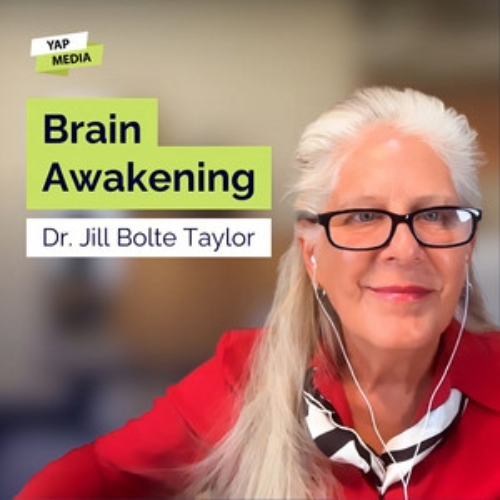
Dr. Jill Bolte Taylor: The 4 Brain Characters That Transform Habits and Critical Thinking | Human Behavior | E390
Dr. Jill Bolte Taylor’s fascination with brain health and human psychology began with a personal question: why do people perceive the same world so differently? After growing up with a brother diagnosed with schizophrenia, she dedicated her life to understanding the brain. At age 37, she suffered a massive stroke and watched her brain shut down in real time. That experience gave her rare insight into how the brain truly works. In this episode, Dr. Jill shares her whole-brain framework and explains how understanding our four brain characters can transform how we think, feel, and show up in life and business.
In this episode, Hala and Dr. Jill will discuss:
(00:00) Introduction
(02:51) Childhood Curiosity About the Human Brain
(10:14) Experiencing a Stroke at Age 37
(20:38) Warning Signs and Prevention of Stroke
(25:13) Watching Her Brain Shut Down
(33:45) The Four Brain Characters
(44:05) Debunking Left vs. Right Brain Myths
(51:19) Whole-Brain Thinking for Entrepreneurs
(53:57) Why Society Is Left-Brain Dominant
(1:04:24) Can You Control Your Brain?
(1:09:25) Habits to Activate the Right Brain
Dr. Jill Bolte Taylor is a Harvard-trained neuroanatomist, bestselling author, and adjunct lecturer in anatomy, cell biology, and physiology at the Indiana University School of Medicine. She is the national spokesperson for the Harvard Brain Tissue Resource Center and is best known for her 2008 TED Talk and memoir, My Stroke of Insight. For her groundbreaking contributions to modern brain science, Dr. Jill was named one of TIME Magazine’s 100 Most Influential People in the World.
Sponsored By:
Indeed – Get a $75 sponsored job credit to boost your job’s visibility at Indeed.com/profiting
Shopify – Start your $1/month trial at Shopify.com/profiting.
Spectrum Business – Keep your business connected seamlessly with fast, reliable Internet, Phone, TV, and Mobile services. Visit https://spectrum.com/Business to learn more.
Northwest Registered Agent – Build your brand and get your complete business identity in just 10 clicks and 10 minutes at northwestregisteredagent.com/paidyap
Framer – Publish beautiful and production-ready websites. Go to Framer.com/profiting and get 30% off their Framer Pro annual plan.
Quo – Run your business communications the smart way. Try Quo for free, plus get 20% off your first 6 months when you go to quo.com/profiting
Experian – Manage and cancel your unwanted subscriptions and reduce your bills. Get started now with the Experian App and let your Big Financial Friend do the work for you. See experian.com for details.
Bitdefender – Start protecting your business today with Bitdefender Ultimate Small Business Security. Get 30% off your plan at bitdefender.com/profiting
Intuit – Start paying bills the smart way, not the hard way. Learn more at QuickBooks.com/billpay
Resources Mentioned:
Dr. Jill’s Website: DrJillTaylor.com
Dr. Jill’s Book, My Stroke of Insight: bit.ly/DJBT-SOF
Dr. Jill’s Book, Whole Brain Living: bit.ly/DJBT-WBL
Dr. Jill’s TED Talk, My Stroke of Insight: bit.ly/DJBT-TEDTALK
Active Deals – youngandprofiting.com/deals
Key YAP Links
Reviews – ratethispodcast.com/yap
YouTube – youtube.com/c/YoungandProfiting
Newsletter – youngandprofiting.co/newsletter
LinkedIn – linkedin.com/in/htaha/
Instagram – instagram.com/yapwithhala/
Social + Podcast Services: yapmedia.com
Transcripts – youngandprofiting.com/episodes-new
Entrepreneurship, Entrepreneurship Podcast, Business, Business Podcast, Self Improvement, Self-Improvement, Personal Development, Starting a Business, Strategy, Investing, Sales, Selling, Psychology, Productivity, Entrepreneurs, AI, Artificial Intelligence, Technology, Marketing, Negotiation, Money, Finance, Side Hustle, Startup, Mental Health, Career, Leadership, Mindset, Health, Growth Mindset, Positivity, Human Nature, Robert Greene, Chris Voss, Robert Cialdini
Dr Jill Taylor: [00:00:00] Brain cells are like people. We're social. They're social. A single cell can have 10 to 15,000 connections in a network with other neurons. 10 to 15,000. That is a social network. Talk about influencers. Boy, it's those brain cells.
Hala Taha: Dr. Jill Bolty Taylor, a Harvard trained neuroscientist who experienced the unthinkable.
Hala Taha: She witnessed her own brain shut down moment by moment. Today's conversation will change how you understand your brain and how you use it.
Dr Jill Taylor: Running a business is very different than being an entrepreneur. Especially not in this day and age, entrepreneurs have to have creativity. In order for you to do everything that you do, you have to have brain cells that perform that function.
Dr Jill Taylor: We have four major modules of cells inside of our head. Two emotional, the right hemisphere in the left hemisphere, and then two, thinking the right thinking and the left thinking. [00:01:00] The value of the right hemisphere says I care about people. Creativity is in the right hemisphere. It is that left emotional brain that looks at someone and says, you are different from me.
Dr Jill Taylor: I'm going to push you away. We are skewed to the values of the left hemisphere.
Hala Taha: When you were 37, you had a stroke. It took you about 45 minutes or longer to realize. That you were having a stroke and you were somebody who studied the brain. How can we know if we're having the symptoms of a stroke and what do we do immediately when we feel those symptoms?
Dr Jill Taylor: So the warning signs, here are the warning signs. I use S-T-R-O-K-E to help people remember. S stands for.
Hala Taha: Hey ya fam. Welcome back to another amazing episode. Today's conversation will change how you understand your brain and how you use it. Our guest is Dr. Jill Bolte Taylor, a Harvard trained neuroscientist who experienced the unthinkable At just 37 years old.
Hala Taha: She suffered a massive stroke and she witnessed her [00:02:00] own brain shut down. Moment by moment, that life altering experience became the foundation for the whole brain living. A powerful framework that reveals the four distinct characters inside your brain that shape your thoughts, emotions, habits, and decisions.
Hala Taha: And once you learn to recognize them, you'll gain the ability to consciously choose clarity over chaos, intention, overreaction, and calm over stress. We're gonna be covering this extensively in today's conversation, but first, if you're new here, hit that follow button so you never miss a dose of wisdom.
Hala Taha: Dr. Jill, welcome to Young and Profiting podcast.
Dr Jill Taylor: I am so happy to be with you. Thank you.
Hala Taha: Likewise. I'm so excited. I love talking about the brain. I love understanding the brain more as Entrepr. We're using our minds every day. We need to make sure that we're optimizing our minds and our productivity. And so very excited for this conversation today.
Hala Taha: And something that, uh, really made me curious when I was researching you, Dr. Jill, uh, or was really eyeopening, is that you were actually [00:03:00] studying the brain before you had this, like, traumatic stroke. And so, when I had heard about you in the past, I thought that you had a stroke and then you got interested in the brain.
Hala Taha: But it turns out you were actually studying the brain long before you had your accident, which I wanna hear all about. But first, talk to us about why you decided to study the brain. What were you curious about? What were the kind of questions that you were trying to solve when you were initially, you know, being a scientist and a researcher around the brain?
Dr Jill Taylor: Thank you. So, yes, I, I have a brother who's 18 months older than I, and, uh, he would eventually be diagnosed with the brain disorder, schizophrenia. So as a child, I just noticed that this guy and I, we were completely different in the way we interpreted our experiences. For, for example, if we're out playing kickball and the ball goes flying out into the yard and my mom is on the stoop and all of a sudden she jumps up and she's screaming at us, [00:04:00] I interpret that as terror.
Dr Jill Taylor: That, you know, her kids are gonna get killed if we run out into the street. But my brother interpreted her, her hollering as anger. And that's a fundamental difference when we, when we are not under understanding and perceiving people's emotions in the same way.
Hala Taha: Hmm.
Dr Jill Taylor: So I just became really fascinated with what are the differences between me and my brother and what is going on?
Dr Jill Taylor: And it had to be at the level of the brain. Because biologically he's the closest thing to me that exists in the universe. So I became fascinated with body language, uh, social relations, uh, vocal languaging, all of that in what am I as a human being. I was just fascinated with what am I as a living being.
Dr Jill Taylor: Uh, so, so that caught my attention. And then as I got older, I really became fascinated with how does our brain create [00:05:00] our perception of reality? Hmm. What is, what is normal and what is not normal? So, yeah, no, I grip to, uh, uh, to be a neuroanatomist. I study. The brain at a cellular level. Uh, so because fundamentally I figured it was the differences between me and my brother were going to be in the way our brains wired each other.
Hala Taha: Something I really wanna dig deep on is the fact that you were studying what are reality is like, what is perception? How do we perceive reality and consciousness, uh, in itself? So talk to us about how you thought consciousness worked before you had your accident.
Dr Jill Taylor: Oh, that's a big question. Um, I believed that, uh, first of all, every ability we have is because we have brain cells that perform that function.
Dr Jill Taylor: And to me, the single celled organism is just this, that is life. That is the miracle. And [00:06:00] we just happened to be a bunch of cells stuck together for multicellular life, which is also fantastic, but. I was fascinated with the single cell organism. And how did the universe create a bunch of atoms and molecules that worked together in order to become a blueprint for a living entity.
Dr Jill Taylor: And then that living entity is defined by having a boundary, a cellular membrane that would be semi-permeable and things would be outside in the universe of, of that membrane. And then that membrane would allow some things in and it would have perception of some things. So, so I was very cellular, I was very anatomical.
Dr Jill Taylor: Um, so my perception of consciousness was, well, I do believe that a cell has a consciousness. It's of course not like ours, but it still, I believe, has an awareness of the difference between itself. And that was just outside of itself.
Hala Taha: [00:07:00] And you believe this before your accident? That that each each cell was had, yeah.
Hala Taha: Had its own consciousness. That's so interesting. Why did you believe that?
Dr Jill Taylor: Well, because what is life to me, the difference between. Uh, you know, in order for a universe to be able to put all the atoms and molecules in the right formation in order to come up with genetic material, and then that genetic material becomes somehow, which is nothing other than atoms and molecules, I don't believe that we have the construct of a human body and then consciousness happens to us.
Dr Jill Taylor: I think that we are, are a culmination of consciousness and we have different levels of consciousness and different parts of our brain work together in constellations of skill sets that then end up looking like separate consciousnesses, uh, which also end up looking like different personalities. So, so I always had that construct, but I didn't, but [00:08:00] I was really interested.
Dr Jill Taylor: I was working in the lab. Uh, I was teaching and performing, uh, neuroanatomy, uh, gross anatomy, which is cadaver lab. Uh, I loved my life. I loved what I was doing. Um, and, and, you know, I, I had the same thinking pattern of really focused on at a cellular level, what are the differences between me and my, my brain and my brother's brain.
Hala Taha: So, last question before we get into your, your accident and what happened. Who were you back then? Like, who was Jill back then? How did you self-identify and define success back then?
Dr Jill Taylor: I was climbing the Harvard ladder and, uh, I had my PhD in Neuroanatomy and I did, uh, my first postdoc was at, so I went from Indiana.
Dr Jill Taylor: I grew up in Indiana. Uh, and then once I got my PhD, I went to Harvard Medical School for my postdoc. Uh, I was studying the, in the lab of, uh, David Huble and Nobel Laureate. Uh, [00:09:00] so, you know, it was, it was very alpha personality. Go, go, go. Let's achieve. Uh, and then from, uh, uh, David Hubbel's Labs, I, I moved from the Department of Neurobiology to the Harvard Department of Psychiatry because I wanted to focus my basic science research on, uh, the schizophrenia and what is the difference at a neuro anatomical level.
Dr Jill Taylor: So, you know, I was climbing the Harvard ladder doing what a girl had to do, and I was, I'm, I was an artist in my heart.
Hala Taha: Hmm.
Dr Jill Taylor: And I chose neuroscience to make a living. And so when I went to, uh, the labs, I said to all of my mentors, I'm an artist in my heart, so give me projects that you care about, an aesthetic component to the science.
Dr Jill Taylor: And that meant the visualization of cells, neurotransmitters, relationships between these and let me make for you [00:10:00] beautiful art and learn new things in the lab at the same time.
Hala Taha: Hmm. So you got to kind of combine both. Yeah, both passions, which is great.
Dr Jill Taylor: Yeah.
Hala Taha: So when you were 37, you had a stroke. Take us back to the morning, the day that it happened.
Hala Taha: What were some of the initial things that you realized were happening? What did you think was happening in the moment and how did things unfold?
Dr Jill Taylor: Yeah. So first of all, um, I'm a PhD. I am a scientist. Um, of course I have had neuro, I have learned, uh, some neurology. I certainly studied stroke at a cellular level.
Dr Jill Taylor: I certainly studied all, uh, dementia, all kinds of neurological trauma. Uh, but I was a girl. I was a lab rat. Um, so I'm not, my point here is I was not an md, I was not a, uh, neurologist. So, uh, when I woke up on the morning of, uh, December 10th, 1996, I. Woke up as soon as I sat up. I had a major [00:11:00] pounding behind my left eye, and it was very unusual for me to experience any kind of pain.
Dr Jill Taylor: I was generally very happy, knock, uh, healthy, knock on wood. Uh, but I had this pounding pain and so I thought, okay, I am gonna exercise and get my blood flowing, and hopefully I would feel better. So I got up. But as soon as I got up, I realized that the light coming in through the windows was really burning.
Dr Jill Taylor: It was uncomfortable. And so I closed the windows, uh, closed the blinds. I got on my cardiac glider. It's a full body, full exercise machine back in the nineties. And I was jamming away on this thing. And I looked at my hands and my hands looked like, literally looked like primitive claws grasping onto the bar.
Dr Jill Taylor: And I thought, wow, that, that's unusual. And the pounding kept going, and I just looked at myself and it was as though I was. Observing myself having this experience [00:12:00] instead of being in the body, having the experience and the pounding in the head just, uh, uh, wasn't getting any better. And I thought, okay, enough of exercise.
Dr Jill Taylor: So I thought, okay, I'm gonna take a shower. 'cause at this point I'm still heading to work. So I'm walking across my living room and every step is rigid. And it's as though I'm having to tell my legs to move, move, coordinate, move. And as I'm getting into the sh the shower, as I'm lifting my leg. It literally was this conversation going on inside of my body of, okay, you muscles, you contract, you muscles, uh, you relax.
Dr Jill Taylor: And I'm, I literally lost my balance as I was in the shower and I'm leaning up against the wall and I go and I turned the water on. I put, it was just pull out this nozzle and the, the water hit the tub and the volume was so amplified that I fell backwards. [00:13:00] It was like energy just knocked me over. I'm leaning up against the wall and I'm looking at my arm and I'm realizing I can no longer.
Dr Jill Taylor: Define the boundaries of where I begin and where I end. I'm just atoms and molecules blending with the atoms and molecules of the wall. And about this time your audience is thinking, man, this sounds like some kind of a high trip, you know, uh, psilocybin, maybe that's what I usually get, but not having had that experience, I can't speak to it, but if you've ever had that experience, it is the dissolving of the boundaries of where we begin and where we end as a biological creature.
Dr Jill Taylor: Because I am, we are this massive conglomeration of these cells and the energy. Of the life of those cells and a group of cells, literally in that left hemisphere where the hemorrhage was happening, they had gone offline. So I could no longer [00:14:00] define the boundaries of where I begin and where I ended. So eventually I get outta the shower and I go into my bedroom and I mechanically dressed.
Dr Jill Taylor: I just somehow, uh, get dressed and then I'm asking myself, can I drive? Can I drive? And in that instant, my right arm went. Totally paralyzed by my side. And that's when I'm realizing, oh my gosh, paralysis a warning sign of stroke. Oh my God, I'm having a stroke. And then the next thing my brain says is, wow, this is so cool.
Dr Jill Taylor: How many brain scientists have the opportunity to study their own brain from the inside out? So that alpha personality, it was just really saying, okay, we're having a stroke. We'll do this for a few weeks, we'll learn what we can learn and, and then we'll go back to work. And then it took about 45 minutes, uh, in order for me to actually make a phone call and get help.
Hala Taha: Wow. Like what a [00:15:00] powerful story. Yeah. Bam. Today's episode is sponsored by Bitdefender, a global leader in cybersecurity. Now, running a small business means wearing a hundred hats at once. Sales, payroll, customers, taxes and scammers know that, especially during tax seasons, cyber criminals are sending fake audit letters, phony tax documents and emails that look painfully real.
Hala Taha: Just to grab access to your accounts while you're busy doing a hundred other things. That's why I use bitdefender Ultimate Small Business Security to keep my company safe. It protects every employee device, secure servers with customer data and shields daily activities like email and web browsing, whether you're in the office or working from home.
Hala Taha: And the part I think is really smart is their AI powered scam prevention. It's trained on real small business attack patterns, so it blocks phishing, fake websites and shady messages before they ever reach your team. Plus, you also get a password manager unlimited VPN and 24 7 expert support in one simple dashboard.
Hala Taha: Big [00:16:00] companies have security teams you don't. Bitdefender fills that gap for you. Start protecting your business today with Bitdefender Ultimate Small Business Security. Get 30% off your plan at bitdefender.com/profiting. That's bitdefender.com/profiting for 30% off. What's up? Yap gang. We're still at the start of a new year and you know what that means?
Hala Taha: New goals, new ideas. And maybe that little voice in your head saying, this is the year that I finally start my business, but let's be real. The what ifs. Show up fast. What if I fail? What if this is the wrong move? I've been there and what I learned is this. It makes a huge difference when you have the right partner from day one.
Hala Taha: And for many entrepreneurs, that partner is Shopify. Shopify is an all-in-one commerce platform that helps you build, run, and grow your business. You can create professional looking websites with ready to use templates, manage payments, and even use AI tools to write product descriptions so you can launch faster.
Hala Taha: What I love is how simple it makes everything. You don't need [00:17:00] to be technical, you don't need to have it all figured out. It just lets you get started. Yeah. Bam. Don't kick yourself a year from now because you didn't take action today. Start your business on Shopify. It's time to turn those what ifs into.
Hala Taha: What's Shopify today? Sign up for your $1 per month trial at shopify.com/profiting. Again, that's shopify.com/profiting shopify.com/profiting. Now, uh, I really wanna go into like what was happening, but I'm also very curious how can, like, could you have prevented this stroke to begin with? No. Do you feel like there was anything you could have done to prevent this or that we can do to prevent the same thing happening to us?
Dr Jill Taylor: Well, there are, so first of all, there are different kinds of stroke, two different kinds of stroke. Primarily. One is hemorrhagic. And when you have a hemorrhagic stroke, uh, uh, blood vessels come together, uh, they break and the blood seeps out into the tissue. And that was the [00:18:00] kind of stroke I had. And the specifically, I had what we call an arterial venous.
Dr Jill Taylor: Malformation. And this is essentially a, um, you have an artery that is a high pressure system, uh, that comes in and usually then it tapers down to a very small space and then all the, uh, red blood cells line up in through the capillary. And then at the other end of that, you have a low pressure vein. And that vein then ob literally absorbs liquid back to take it dirty blood back to the heart.
Dr Jill Taylor: And I had an arterial venous malformation that I was born with. This was a congenital malformation that I did not know was there. And essentially an artery is directly connected to the vein without the capillary neutral pressure. And these usually blow between the ages of 25 and 45. And I was 37 at the time.
Dr Jill Taylor: [00:19:00] So. So no, there, I did not know it was there. There's nothing I could do about it. It, unless somebody had given me an MRI and said, oh Jill, we have a problem, which we do now. But in those days we, you know, 97 we weren't given MRIs, but I had been diagnosed when I was 17, and I think this is really important for your audience.
Dr Jill Taylor: I was diagnosed with migraine headache at the age of 17, 20 years before this thing blew. And I have not had a migraine since I had surgery to remove the malformation. So if there is someone in your audience who experiences migraine headache, and none of the current medications, which are really excellent for migraine.
Dr Jill Taylor: If none of those meds help, I encourage people, go get a scan, go get your brain looked at to see what's actually going on inside of your head. Because knowing if you have an organic problem, I think is really important.
Hala Taha: Yeah. Being preventative and now, like you said, like [00:20:00] MRIs are available immediately when you said that.
Hala Taha: I, I, I know one person who always gets migraines. She's in my life that I'm like, I need to tell them to go get an MRI scan.
Dr Jill Taylor: If the meds don't work, then absolutely you wanna go and see, okay, what else is maybe going on inside of, and I have had people write to me and say, uh, I heard you give this advice on a podcast and it saved my life.
Dr Jill Taylor: Wow. So who knows who out there? Uh, um, you know, we can influence positively.
Hala Taha: Now. One more question. It took you about 45 minutes or longer to realize that you were having a stroke and you were somebody who studied the brain.
Dr Jill Taylor: Yeah.
Hala Taha: How can we know if we're having the symptoms of a stroke and what do we do immediately when we feel those symptoms?
Dr Jill Taylor: Yeah, so the typical type of stroke that happens is when a blood clot gets thrown in your body and it goes up into the blood vessels in the brain, and those brain, uh, arteries get smaller and smaller, they taper. And so a blood clot will, will go into [00:21:00] that tapering blood vessel and then, you know, when it came, when it's too big, it's gonna block the flow.
Dr Jill Taylor: So that's called an ischemic stroke. And so the warning signs here are the warning signs. Um, and I use S-T-R-O-K-E to help people remember, uh, what's going on. S stands for speech. If you have any problems with language, all of a sudden, and, and you're watching me, and I'm now in my mind, I may still be hearing my language, but clearly what's coming out is a problem.
Dr Jill Taylor: That's a huge, that's a huge warning sign. Uh, s speech, T stands for tingling or numbness in the body. Usually this is going to be on only one side of the body, but not all the time. So, uh, really paying attention to what's going on with, with your limbs and what, how you're feeling. So, s speech, T tingling R is [00:22:00] remembering all of a sudden, are you having a problem, an acute problem with remembering your spouse's name?
Dr Jill Taylor: Or where you are or where, not where you parked your car. That's kind of a common one that we all get. But if, if you're having some major acute problem with, with remembering, uh, that's a warning sign. Oh, off balance. If all of a sudden you're having a real off balance and often side, one side of the body will droop, one side of the face may droop, uh, you may be dragging your leg.
Dr Jill Taylor: All of a sudden you may have a little bit of paralysis in your arm. You can't get it to go. These are warning signs. So, and then K stands for killer headache. Uh, throbbing, pulsing, like that caustic, uh, pain that you get when you bite into ice cream. Major warning sign, usually one sided. Again, not always, but usually on one side or the other.
Dr Jill Taylor: And then E stands for eyes or all of a sudden, major problems with vision. [00:23:00] Um, and stroke is, is, it's a stroke boom. It usually happens. It happens quickly. Um, and, and, you know, so, so those are the primary warning signs. What can you do to help prevent it? What are you eating? Um, really food makes a difference.
Dr Jill Taylor: Um, how much sleep are you getting? Sleep is time period. When. Uh, new information streaming in shuts down. And this is when, uh, the cells turn on and the garbage cleaners go in and they clean out all the waste you have to consider. Your brain is like 800 billion neurons that are, are talking to one another.
Dr Jill Taylor: They're eating, they're creating waste while you're busy. So when we go to sleep, that's when we go in and we flush the system. So, uh, so that's really important. Uh, how much rest are you getting then? Um, and how stressful are you? Well, the stress circuitry is, is a go, go, go, go, go. Do, do, go, go. [00:24:00] More, more. Okay.
Dr Jill Taylor: I reached a goal, but I'll celebrate for this long, and then I want more. There's always this driving force of that left brain that wants more. So there are things that we really can do and, and let me say this hala about the brain and our vulnerability is if you look at a human brain. You can see the blood inside of the blood vessels because the, the walls of the blood vessels in the brain are so thin, they're trans transparent.
Dr Jill Taylor: So the pressure system, when we get angry and when we get mad when we're gonna holding it in or letting it out, but we're in that, that rage or we're in deep fear or, or we're just, you know, uh, feeling out of control. This is impacting the internal pressure system of what's going on inside of the brain.
Dr Jill Taylor: And, um, you know, it's, uh, it's not healthy for the overall animal, the overall organism that we are [00:25:00] biologically.
Hala Taha: Such good tips. I feel like that's so helpful. Um, so I wanna go back to your story. So suddenly you found yourself, you had awareness, but you didn't have any control. Right. And you actually felt, you were, you were witnessing your brain shutting down.
Hala Taha: What happened next?
Dr Jill Taylor: What was really interesting to me was, you know when, when we look at a human, a human brain, it has these two hemispheres and these two hemispheres process different information in different kinds of ways, and the left hemisphere has language, and language is me. My ability to create sound dog, dog is a sound.
Dr Jill Taylor: And then we can comprehend what is that sound and what is the meaning of that sound. We can read, we can write, we have mathematics, we can speak multiple languages. I mean, the left hemispheres is very, very busy place. And so the hemorrhage was happening in my left hemisphere, and so that left hemisphere would kind of go offline for a little [00:26:00] while and I would drift into the present moment because the right hemisphere, it's just a right here, right now machine.
Dr Jill Taylor: Mm-hmm. It is all about the present moment and in the present moment. I, the, my name is over there in my left hemisphere, the boundaries of where I begin and end as a human being over there in the left hemisphere, but right here, right now is the richness of the experience coming in through my sensory systems and it feels like euphoria.
Dr Jill Taylor: It's beautiful in the present moment. 'cause there's no judgment of what's right, what's wrong, what's good, what's bad. It's just, wow, I'm alive. So I, on the morning of the, the stroke, I would waffle, waffle back and forth between being in the present moment, oh my gosh, I'm alive. To, oh my gosh, I am having a problem.
Dr Jill Taylor: I need to get myself help. And, um, so, so eventually I did make a phone call, [00:27:00] um, and I did get help, but by the time I got help, I had no language. Uh, so I couldn't speak. Um, and I thought I sounded like a golden retriever. Uh, the person listening to me, he sounded like a golden retriever, and it was like, fortunately he knew it was me.
Dr Jill Taylor: He recognized my squawk, uh, and then he did what he needed to do to get me help.
Hala Taha: So you thought that you were barking?
Dr Jill Taylor: I wrote, we have golden retrievers. They speak like.
Hala Taha: Mm.
Dr Jill Taylor: I mean, they communicate and
Hala Taha: that's how you felt. Like you, that's what you were, like, you were trying to communicate, but
Dr Jill Taylor: it made no sense.
Hala Taha: Were you afraid at this time? Did you have fear?
Dr Jill Taylor: No, I did not. Um, I was very fortunate that part of the cells in that left hemisphere, in the left emotional portion of my brain were swimming in a pool of blood as well. And that would be my fear.
Hala Taha: Hmm.
Dr Jill Taylor: So I was, um, I was fine. Uh, I, I [00:28:00] and I Mm. And I didn't really care.
Dr Jill Taylor: The right hemisphere doesn't really care. I mean, it's, it's thinks life's great. It's cool. I was motivated, but it had no information to be able to attach myself to normal reality and do what I needed to do, engage in any way I needed to engage in order to take the steps to orchestrate my rescue. But between, I waffled in and out of these two hemispheres.
Dr Jill Taylor: Fortunately, I did not have fear, but I did know I was in grave danger. And, uh, right after I'd finally made the phone call, um, I, I, uh, got on my butt and I went down my steps, uh, and I unlocked my door and I, I just curled up into a little fetal ball and I just heard inside my own mind, I heard myself saying, hold on.
Dr Jill Taylor: Hold on. And then I kept thinking, what am I holding [00:29:00] onto? What does, what does that even mean? You know, hold on. And it was like, it was like, don't, don't leave the body. As soon as I'm out of the body, I felt like I had become so disabled over a course of four hours that I was afraid that if I went unconscious, then I would never be able to get this body to work again.
Dr Jill Taylor: Because in the consciousness of the right hemisphere, I literally was energetically as big as the universe because we are energy and there's no boundaries in the energy. And when you're connected to all that is, then it is that which becomes of interest. And in that expansive openness, there were no details saying, oh my God, I'm gonna die.
Dr Jill Taylor: Uh, you know, and all that.
Hala Taha: You just knew that if you left your body, you wouldn't be coming back.
Dr Jill Taylor: I felt like I would, I would be gone.
Hala Taha: [00:30:00] So what happened next in terms of like, how did you get better, right? How did you get better? What did you learn from this? And, uh, I know that you, you realized there's four characters in the brain, so I wanna talk about that.
Hala Taha: But just talk to us about like what, what happened next and how you got better.
Dr Jill Taylor: So, um, I landed, uh, right as I was passing out, uh, I was in an ambulance arriving at Mass General Hospital emergency room. And, um, I literally felt I was curled up in a little fetal ball and I felt I went unconscious. I felt, I described it as I felt my spirit surrender.
Dr Jill Taylor: Uh, at that point I had no say, um, I was gone. And so within a few moments, and I mean literally moments, um, in they take my gurney out, I'm in the emergency room, bright lights, people are on me. People knew I was coming. Um, and it was just poker and prodding, giving [00:31:00] me IV here, sign this consent form, which I re do.
Dr Jill Taylor: Remember thinking, what's wrong with you people? You know, it's like, like it was just consent, right? And take our hand and, and make a scribble. I was ridiculous. Uh, but it was what it was. And, um, so they took me into a, a room. They gave me, uh, anti-inflammatories. They gave me steroids, which are anti-inflammatory.
Dr Jill Taylor: Um, they already had. Uh, at the first hospital that I went to, they already had a CAT scan. They knew I was having a hemorrhage. Uh, they also knew that I was, uh, I was employed by Harvard. They are all Harvard Department of Neuro of neuro, uh, neurology. Um, so, uh, I, I was considered, uh, a VIP. Uh, so I got, you know, I know that, that, that helped me, uh, from their perspective.
Dr Jill Taylor: Um, but, uh, so they stopped the bleed. Um, and then, and then [00:32:00] they, they decided I needed to have, uh, brain surgery. And so, um, uh, two and a half weeks later, uh, they come ahead open and they removed the blood clot that was the size of a golf ball. And they sent me, sewed me up, and sent me home and said, we have no idea how much you will ever get back.
Dr Jill Taylor: Uh, but you know, that's now your job is to try to recover. And, um, uh, I have a mother who is an absolute angel in my life, and she dropped her world and she came to me and she, she gave, she surrounded me with in an environment of love. And let's watch and see. What could I learn? Uh, what was in the way of my learning and what could she do to rearrange and to literally teach me?
Dr Jill Taylor: Uh, starting with, she recognized I was now an [00:33:00] infant in a woman's body, and we began with, I, I couldn't see color. She had to teach me. Colors were different. Uh, she had to teach me how to make sound in order to be able to have language. Uh, she had to teach me vocabulary. She had to teach me how to walk. Uh, I mean, she taught me everything.
Dr Jill Taylor: Uh, so that, yeah, she was, uh, reared me twice.
Hala Taha: Wow. And what did this experience actually teach you about consciousness? Um, I, I know that you feel like you learned a lot from it.
Dr Jill Taylor: I did
Hala Taha: talk to us and, and realize that like a lot of us don't think about consciousness at all. So we're starting from, we don't, we don't think about consciousness.
Hala Taha: All sure. It's like. Nobody knows how it works. Like really? Yeah. And so it's just something that is, and nobody thinks about it. Yeah. So I think these are really hard concepts for people to grasp, like really quickly. So explain it to us like we're infants. Like what do you think consciousness is?
Dr Jill Taylor: So we start with a single cell, and that single cell [00:34:00] has all the DNA blueprint that it's gonna take to multiply itself into all these different kinds of cells that will differentiate into specific functions.
Dr Jill Taylor: Like, uh, you're gonna start with that single cell, then you're gonna end up with three layers of cells, essentially. Uh, one of those layers of cells, the derm is going to become the nervous system, spinal cord, brain, peripheral nervous system, as well as the skin. So it kind of envelops us, and then the mesoderm is going to become the muscles, and then the endoderm is gonna become connective tissues and other types of tissues.
Dr Jill Taylor: But all of this is a groups of cells that are differentiated. So eventually we end up with this magnificent human brain. The human brain is divided into two hemispheres. It has two. Um, so the primary difference between a reptile and a mammal is the addition of our emotional [00:35:00] system called the limbic system.
Dr Jill Taylor: So, uh, reptiles don't have emotions. Mammals have emotions. And the primary difference between mamm typical mammals in the human is this explosion of thinking cerebral cortex. So we humans, we have four major modules of cells inside of our head. Two emotional evenly divided between the right hemisphere and the left hemisphere, and then two thinking modules of cells, the right thinking and the left thinking.
Dr Jill Taylor: And most of us have heard, oh, the right hemisphere is emotional and the left hemisphere's thinking, and that's simply not true. Anatomically, anatomically, we have two emotional and two thinking modules of cells. So the primary difference then between the right and the left for me, when I lost my left hemisphere was I lost one linearity across time.
Dr Jill Taylor: So somehow or another, these amazing cells. [00:36:00] Step out of the consciousness of the present moment. I mean, this is this to me, this is the mindblower. How do they even do that? Right? But the right hemisphere, it's a right here, right now machine. So the emotions of the present moment, experience, what does it feel like to be alive as your audience is, is listening, what are they doing?
Dr Jill Taylor: What does it feel like to be sitting or to be walking, to be moving your body? What does it feel like as you, as you dive into water? What does that feel like? The experience, what is the temperature of the air or the water against your body? Is it pressure against you? Uh, what's happening, you know, uh, the glasses on your nose?
Dr Jill Taylor: What does those feel like? If you focus on that feeling, you can feel that. Otherwise you go pretty unconscious. So the right emotion is experiential. What does it feel like to be here? And then the right thinking [00:37:00] is right here, right now. If I'm just in the right here, right now, all I'm aware of is what is in front of me.
Dr Jill Taylor: Whatever behind me doesn't exist. Whatever happened before this moment in time doesn't exist. Including what is my name? I don't know right here, right now, unless I got a big name tag on the wall in front of me. But I don't have that kind of language. So the right experience, the right hemisphere is right here, right now.
Dr Jill Taylor: Emotion and connected to all that is because I don't have that boundary of where I begin and where I end because that's in that left hemisphere. So we access these parts of ourselves, the right emotion when we are experiencing something. I come from Indiana, we're big basketball, of course. What does it feel like when you sh when you're, when you're getting ready to do a layup, that feeling of lifting yourself up into the air?
Dr Jill Taylor: Throwing that ball, the movement, the calculation of the [00:38:00] brain of, of the arc that you have to make with that ball in order to get it to go into the basket. So it's the experience of mm-hmm. Being, and then the right thinking is, oh my gosh, I'm alive. In this sense of, oh my gosh, I'm alive, is this incredible gratitude of, wow, I'm alive and there are people here with me who love me and it feels like love.
Dr Jill Taylor: And I listened to a podcast where you were speaking about how close you were to your father, and when your father was ill and he knew had to go into the hospital, your heart reached him and his love reached you, even though you couldn't be in the same space with one another. And it is in that, that ca, that right.
Dr Jill Taylor: Thinking consciousness where we are beyond the limitations of ourselves and we are, are enveloping one another in this feeling of deep [00:39:00] love. So the right hemisphere is right here, right now, and then the left hemisphere, it's not right here, right now. It, these cells in the emotional system step literally out of the consciousness of the present moment.
Dr Jill Taylor: So I can say to you, Hala, hala, what did you have for dinner last night?
Hala Taha: Uh, I had Asian food.
Dr Jill Taylor: Okay. Where did you go in order to remember that? Right. You don't have the Asian food right here in front of you. You have stepped out. You have left me here alone. In the present moment, you have stepped into another consciousness that is constantly running in the background.
Dr Jill Taylor: And the beauty of that group of cells, those emotional cells, is that everything that I ever experienced is running. It's running and it's always there for me to refer to. And oh my gosh, let's say now something [00:40:00] happens in this moment, and let's say all of a sudden, uh, the ground should start to shake. And as the ground starts to shake, your brain goes and it says.
Dr Jill Taylor: Oh my gosh, I'm not safe. I don't care about Jill anymore. I gotta get out of the building because there's an earthquake and in, you know, that you what the, the experience is because you have information about that. So our, our emotional reactivity is designed to protect us. In the present moment based on experiences we have had in the past.
Dr Jill Taylor: So if I'm running a consciousness where I'm literally as big as the universe with the right thinking tissue, and I'm running a consciousness in the right experiential, what does it feel like to be in my body and to be engaging and I'm running a consciousness in my left emotional tissue that is reminding me of everything that ever happened in my past so I can protect [00:41:00] myself in the present based on that past.
Dr Jill Taylor: And then, oh my gosh, I have left thinking tissue. And that is my, my, uh, a type personality. It's my language. It's my do. It's my go. It's my value of I want more. Oh, let's do this, let's do that. Um, uh, so if we're running all four of these consciousnesses and we know all four of these consciousnesses. Then we can gain the power to pick and choose who and how we wanna be in any moment, which gives us power to choose what life we want to live.
Hala Taha: Hey, yap. Bam. I'm not afraid to say producing this podcast requires skills I do not naturally have. From audio engineering to video editing, I have to hire experts who are better than me in those areas, especially as I grow the show and every time we need to hire. My first thought usually is, this is a job for Indeed's sponsor jobs.
Hala Taha: When you sponsor your job on Indeed, you find candidates with the exact skills you're looking for without the stress [00:42:00] of digging through endless resumes, sponsored jobs posted directly on Indeed are 95% more likely to report a higher than non-sponsored jobs. That means you're not tossing your post into a void.
Hala Taha: You are connecting with qualified people who can help your business grow, spend less time searching and more time actually interviewing candidates who check. All your boxes. Less stress, less time, more results when you need the right person to cut through the chaos. This job is for indeed sponsored jobs and listeners of this show will get a $75 sponsored job credit to help get your job, the premium status it deserves at indeed.com/podcast.
Hala Taha: Just go to indeed.com/podcast right now and support our show by saying you heard about Indeed on this podcast indeed.com/podcast. Terms and conditions apply hiring. Do it the right way with indeed. Yap gang. Here's a hard truth. I had to learn the hard way. If you're running a business and you don't have a clear picture of your cash flow, you're flying blind.
Hala Taha: There was a time [00:43:00] I was approving expenses and making decisions without fully understanding what was going out of my account or when that's a dangerous place to operate from as a business owner. But all of that changed when I started using Intuit QuickBooks Bill Pay. It's a bill management tool inside of QuickBooks that brings all of your bills, vendors, and payment details into one organized dashboard so you can track and pay everything in one place.
Hala Taha: This is what you gotta do as you level up as a business owner. With QuickBooks Bill Pay, you can see what's due control approvals and understand how each payment impacts your cash flow. Now I make faster and smarter financial decisions because I actually know my numbers. Start paying bills the smart way, not the hard way.
Hala Taha: Learn more at quickbooks.com/billpay. Again, that's quickbooks.com/billpay terms apply. Money Movement services are provided by Intuit Payment Incorporated license as a money transmitter by the New York State Department of Financial Services. It's so interesting, like I've never heard of this before, right?
Hala Taha: All I ever [00:44:00] hear about is left and right brain, so let's bust some pop psychology myths about the left verse, right brain. What do we need to know?
Dr Jill Taylor: Well, number one is we only use 10 for 10% of our brain. No. If it's alive and it's in your head, you are using it. Now you have a huge life. I mean, just consider for a moment, so here we have a population of entrepreneurs who aren't generally thinking about their brain, right?
Dr Jill Taylor: However, in order for you to do everything that you do, you have to have brain cells that perform that function. Some people say to me, oh, I'm not creative at all, and I say, well, for some reason. You are using other cells to dominate the circuits in your right hemisphere that open you up to the possibility and creativity is in the right hemisphere because it's not about the box of what's right, what's wrong, what's good, what's bad, what has come before.
Dr Jill Taylor: And let's define it. That's the [00:45:00] exact opposite of creativity. So, um, but if brain cells are like people, we're social, they're social, they are. A single cell can have 10 to 15,000 connections in a network with other neurons. 10 to 15,000. That is a social network. Talk about influencers. Boy, it's those brain cells.
Dr Jill Taylor: So they're busy in there. Uh, and it's same for humans. We are social creatures. And what happens to us if we don't socialize well, we become more rigid, we become more firm in our right, wrong, good, bad, uh, and we kind of curl up in little fetal balls and, and we die. And the same is true for neurons. So number one, if it's alive and it's in your head, you are using it.
Dr Jill Taylor: Um, the other biggest one is right hemisphere is emotional. Uh, left hemisphere is thinking and it's like, well, it is true that the left thinking is the [00:46:00] rational, organize, analyze, uh, linear thinking, methodical. That is true. But we do have emotion in both hemispheres.
Hala Taha: So let's talk about how each side of the brain perceives reality.
Hala Taha: I know you've been talking about it, but again, like a lot of us are learning this for the first time. So hearing it multiple times in different ways I think is helpful. So how does the left side perceive reality? How does the right side perceive reality?
Dr Jill Taylor: So the, as far as the medical, traditional medical world is concerned, only one quarter of our brain is conscious.
Dr Jill Taylor: According to the traditional medical world, only one quarter of our brain is conscious, and that's the left thinking tissue. Okay, let's look at the condition of the world. Right? We're kind of a mess. Uh, we're killing each other. Uh, I mean, it, it is like what we value is just that [00:47:00] one portion. So imagine the world we could live in.
Dr Jill Taylor: If we actually didn't think everything else was unconscious and out of our control, and so we didn't have to take any responsibility for it. Well, if I know what's going on in these four major portions, modules of cells, and I have the power to recognize in any moment which of those four parts I'm in, which character am I exhibiting in the world based on what those cells skill sets give to me.
Dr Jill Taylor: And in this moment, I'm exhibiting when I know all four. It's kind of like a hand. If I just have a hand and I'm flopping things and pushing things and smashing things, and you know, it's not very sophisticated. But as soon as I can differentiate between those four digits of my hand, I have exponentially exploded my capacity to using that hand.
Dr Jill Taylor: And the same is true for our brain. [00:48:00] So whole brain living is about figuring out, recognizing what parts am I using, when, um, do, am I happy about that? Uh, am I remotely in balance? Um, do I need a little more play in my life? Because my left circuitry is running all the time. And that's my stress circuitry.
Dr Jill Taylor: And, uh, it really, it has interfered with my relationships. And, and it has, and I, it drive, drive drives me, but it's probably interrupting my sleep. As well in my overall wellness. So as we look at these, these different parts of who we are, then we can, can spread the love essentially in, in, I'm a, I'm not just a biological creature, I'm not a single cell to organism.
Dr Jill Taylor: I'm not a reptile and I am not a canine. I am a human being. And in the design of being a human being, we have these four different wonderful groups of cells that serve us. And if I wanna be a whole [00:49:00] successful human being, then I need to be capitalizing on the skillsets of all four parts of who I am because they're a natural part of the design for a reason.
Hala Taha: Yeah. So I just wanna recap the four characters for everybody, just so everybody's on the same page. So you've got left thinking, which is about identity planning, control, achievement. You have left emotional, which is pain, fear, trauma, and memory. You have right? Emotional, which is play creativity and connection.
Hala Taha: And you have right thinking, which is witness wisdom and peace.
Dr Jill Taylor: Let's talk about these four characters as they influence a, uh, an entrepreneur.
Hala Taha: Mm-hmm.
Dr Jill Taylor: Because running a business is very different than being an entrepreneur. And not always, especially not in this day and age. There's a lot of overlap because now a lot of entrepreneurs are running businesses.
Dr Jill Taylor: But I think it's kind of, are you going from the left brain, uh, left thinking, [00:50:00] here's my business, here's my brand, here's my product. This is, these are the beans. I'm gonna hire my bean counters. They're all about how much are we gonna earn? I'm gonna hire a creative team. They're gonna terrify us because they're gonna come in and they're not gonna give us any information.
Dr Jill Taylor: About design other than, um, we can guarantee you that if a woman is gonna shop for this and reach for the product, she's gonna pick this one instead of that one. And the left brain is going, oh my God, that's terrifying. We have to change our whole production because you think and it's like, Hmm, yeah, that's the way it goes.
Dr Jill Taylor: So we end, we end up all of our lives is about this relationship between the right hemisphere and the left hemisphere. Entrepreneurs have to have. Creativity. I mean, isn't that what happens? I am, uh, doing whatever I do, I'm relaxed. Um, I'm, uh, thinking about something and it's like, oh my gosh, here is a great idea, great idea.
Dr Jill Taylor: I got a great [00:51:00] idea. And then it's like, well, if I, if I don't act on that great idea, the idea just goes back into the idea pot and someone else may pick that out of that big vat in the universe. Uh oh. So I have to turn on my left brain. I have to figure out how am I gonna do it? I have to organize it, I have to get funding for it.
Dr Jill Taylor: I have to step through A through Z in order to set the business, in order to be able to do it. And then I have to be able to figure out how to sell it. And I have to get outta my own fear because, oh my gosh, who am I? To start a company when I don't know anything, I'm over here, have got the idea, and now I gotta trust people.
Dr Jill Taylor: Oh my gosh, I gotta trust people. Nothing more terrifying than trying to pick your team and figure out who do I trust, who do I not trust? Who do I keep? Who do I get rid of? Oh my God, I don't wanna have to fire somebody. I'm a nice girl. All of that. So that really does require a whole brain. And then you have to have the vision.
Dr Jill Taylor: And the [00:52:00] vision is going to be that right? Thinking that comes in and says, you can do this. You can do all these things. You have good. Good. You have, you have, have good intention, you have good energy, you have good logical skills, uh, you have good emotional containment and, and you're never alone. And that's the beauty of whole brain living is to know that this part of our wisdom, this part of us that connects us with others and connects us within ourselves, that is always there.
Dr Jill Taylor: So every time I experience fear that says. Who am I to do this? Who am I to say? The whole imposter syndrome thing? That that little, uh, left emotional fear. There's always that wisdom wise loving part that can come in and say, I got you right here inside of our own head. I got you. And that's not arrogant.
Dr Jill Taylor: And it's not Nars [00:53:00] narcissism. It's, it's an awareness that I have fear, and my fear is meant to be in formation. It's not supposed to become a lifestyle. So I'm not supposed to let those kinds of. Excuse me. Fears come in and take over and derail me. And then I get all caught up in that. It's like, no, my fear is a warning to take a bigger picture, look at everything and know that I got this.
Dr Jill Taylor: I'm okay. And I have this backfield of people who love me and who know me and who support me, and we're all in this together.
Hala Taha: Now, would you say society as a whole is like really left brain dominant? And what part of the brain do you feel like if we all spent a little bit more time trying to understand and tap into, do you feel like would help solve.
Hala Taha: A lot of the problems that you were just talking about, like the world feels, we are talking right now, it's like January, [00:54:00] uh, mid-January. The world is falling apart between ICE and Gaza and Iran and Venezuela. Like, it just seems like one after the next. It just feels like we don't love each other anymore.
Hala Taha: Um, so, so talk to us about why we're so left brain dominant and how we can become more right brain dominant, or what do you think society needs to do?
Dr Jill Taylor: Yeah, so you're absolutely right. We are skewed to the values of the left hemisphere, and this has been going on for, uh, a very long time. Uh, it came in, uh, after World War, world War ii, um, that great generation.
Dr Jill Taylor: Came in and now it's like, okay, now we wanna prosper. And what we value is our family, which is right brain. But we also now need, we want to build our roots. We wanna the all American dream. We wanna have a house, we wanna have, have enough money in the bank to do what we wanna do. We wanna have vacation, I [00:55:00] want a nice car, all these things.
Dr Jill Taylor: And then, um, the great generation gave birth to the boomers, of which I will admit, I am a tail end of the boomers and boomers. Our parents wanted us to have everything and they gave us. Everything that they could give us so that we could live a better life than what they had to go through. Because oh my gosh, they had to live through, uh, world War ii and Wow, did that completely change the landscape, especially of America.
Hala Taha: Mm-hmm.
Dr Jill Taylor: And because the US ended up influencing World War II in a way that, that war was won because of the atom bomb. It put us at the top of the powers of the world. So now the US is going to kind of be a dictator of, of influence in the world, because now we had, we were thriving. And so, you know, everything, everything happens then.
Dr Jill Taylor: Um, and, but [00:56:00] here's something else that, that you, you need to think about is that the great generation had two very different hemispheres. They had to show up and become disciplined and become organized in order to win that war. And everybody had to get on board in order to do that. And so the men went to the war.
Dr Jill Taylor: Many women did as well, but the women, they organized in the US in order to be able to take over all the jobs. And so everybody became really very pragmatic and very left brain, and the whole system became very left brain. And then the war's over and everybody comes back. And then the boomers happen. And the boomers are also, uh, left brain dominant because we get that now from our parents.
Dr Jill Taylor: But then the, the boomers had children, and the children are the millennials. And tech. The technology of what happened for the early millennials was the creation [00:57:00] of really the first little robot. It was a little teddy bear called Teddy raspin, and this little teddy bear was the first little living creature that we would, we would stick in the crib with our little millennials so that they could hear a heartbeat or they could hear a humming, or they could have a little language speaking back to them.
Dr Jill Taylor: So the millennials end up with a, a robot, essentially a very, you know, or, you know, three circuits, uh, but a robot as their, their significant, uh, calmer emotional. Uh, contentment. And so then, uh, the Gen X who are, are, uh, right behind the boomers between the boomers and the millennials. This is a group of people who are still very left brain, but they are technologically savvy and they start making everything.
Dr Jill Taylor: They just, you know, all my gens, I can [00:58:00] always tell a Gen Xer and I always, the difference between a Gen Xer and a boomer is that the Gen Xers, they just say, just push buttons. Just push buttons. And the boomers are going, oh my God, I can't push a button. I'm afraid I'm gonna explode it. Right? So these are huge societal shifts in populations.
Dr Jill Taylor: So the Gen Z, the Gen Xers come along and they're now making all this technology, all this technology. And our millennial children are. Have our learning from, from technology, and here's what the difference, if I give you a pad, an iPad, and I say, I'm gonna teach you the, the timetables.
Hala Taha: Mm-hmm.
Dr Jill Taylor: Well, anybody left brain, we learn timetables, we memorized them.
Dr Jill Taylor: That's all we did. We memorized them a two plus a two equals a four a six times a six equals a 36. We memorized them. But what we did for the millennials was we said two chickens plus two [00:59:00] goats makes four animals. We gave you a visual and we started training your right brain. So the right brain became dominant with the millennial population.
Dr Jill Taylor: And when you think about in business, I have had so many millennials say, I don't get those boomers. I mean, it is like my way or the highway. And if I hate my job, I'm gonna suffer with it for 40 years because oh my God, it's a paycheck. And the boomers are looking at the millennials going, I don't get these millennials.
Dr Jill Taylor: If they're not happy with their job, they're gonna leave. There's no commitment to the long term of the business, which is gonna make 'em suffer. So at the fundamental differences between these, these generations, it is huge right now about how these different par different age groups developed across time.
Dr Jill Taylor: And so the millennials actually are more [01:00:00] connected. They like to do things in groups. Uh, you want me to make a decision, I'm gonna check with some of my team, right? Boomers weren't like that at all. Boomers were making decisions. Even if they were bad decisions, they were gonna make the decisions. So, um, so we end up during this point in our lifetime of the left dominant.
Dr Jill Taylor: Skewed to the left value structure. Now, what that means is that the millennials, even though they're different in the way that they've learned and grown and developed, they're still fitting themselves inside of the boomer world. And the boomer world is one for profit. And all that matters is money. My value is money.
Dr Jill Taylor: You have learned that there's plenty of money. The boomer mindset is some zero, I get it, or you get it. Very different.
Hala Taha: That's so interesting. And it's so, uh, obvious now why there's [01:01:00] such differing politics, why millennial and Gen Z are, are way more of like peace, no war, you know, against genocide, against apartheid, all those things.
Hala Taha: Whereas a lot of the boomers, um. Are for all those things, or believe everything they see on tv, and, you know,
Dr Jill Taylor: so let's, let's, let's not make that gross of a, of an evaluation. Let's say that the boomers are divided between their values, the Democrats. Uh, when I think about politics, I, I'm, I go to one thing, taxes.
Dr Jill Taylor: Where do I want my tax money to go? What kind of things do I want my money to go to? The value of the right hemisphere says. I care about people. I care about social programs. I care about food stamps for people who don't have any food. I care about the mentally ill. I care about reforming the, the incarcerated population so that these people can get back into it and get ahead again.
Dr Jill Taylor: [01:02:00] Um, and so the Democrats are really looking at the value structure of what does the right hemisphere value. And there are a lot of boomers who are Democrats. The Republican brain comes in and says. Uh, well, it's, it's about me and me. Needs means I'm, I am. If there's a me, there's a you, and if there's a you, if you don't look like part of my tribe, then you are not on my team.
Dr Jill Taylor: And the left emotional brain comes online and says, well, we're tribal. And in that tribal ness, uh, it's me against you. And so we fuel this with our sports teams. We fuel this with our political teams. We fuel this with any division. Um, it is that left emotional brain that looks at someone and says. Um, I am blonde haired, blue-eyed.
Dr Jill Taylor: I'm a female. Okay? You are black haired. You [01:03:00] have a different hue colored your skin, and you are different from me. And the left brain says, because you're different from me, I'm going to push you away. And as soon as the brain says, I'm going to push you away in racism, I'm also going to elevate myself.
Dr Jill Taylor: Happens naturally to being superior to you. Right? So this is, we're actually wired at the level of ourselves to do this. The right brain comes in though, and it says. You are different from me. You have different color skin, you speak a different language, you eat a different kind of food that smells different.
Dr Jill Taylor: Hmm. My right hemisphere says, oh, you are different. I want, I am curious about you. I want to know you better. So, so to me, racism really boils down to the circuitry because every ability we have is because we're wired to be that way. Um, but there is a whole half of the boomers who, [01:04:00] um, are what they're, they are evenly divided in what they value.
Hala Taha: Yeah. So would you say that like your, like do you have control over which parts of the brain that you use or which ones are stronger than the other? Or is it something basically you're just born with or you, you, like it happens instills in you when you're a child? Like at what point can you change it and when does it develop?
Dr Jill Taylor: Okay. Uh, because we are taught by society, by the traditional medical world that only a quarter of our brain is conscious, then that leaves three quarters of our brain as unconscious. Okay? Well now you have a brain scientist who was at Harvard teaching and performing research about how does our brain create our perception of reality and wiped out her left thinking tissue, which was the conscious part, and le wiped out the left [01:05:00] emotion, wiped out the right emotion.
Dr Jill Taylor: So all I had left was the right thinking tissue. So that's all I had. So I learned well. In the absence of all that, those other cells, this is what's going on here. And then once I had surgery and I could then begin to function again and hold some energy inside of my body so I could actually learn something, then I regain the skillsets of the right emotional tissue.
Dr Jill Taylor: So I'm really clear that was very different, that portion of who I am, that is a whole different level of consciousness. And then it's like, okay, well if I'm gonna function like a normal human being in society, I have to get my language back. And so I used my, my right brain to rebuild. The skillset that I knew that I had lost because I was a neuroanatomist after all I know.
Dr Jill Taylor: Uh, because I could still visualize the language [01:06:00] circuits, I could still visualize the emotional circuits. I just didn't have any of them anymore. So it's like, okay, well what do I need to do in order to reconstruct and rebuild those circuits so they can become functional again? So then I regained, uh, a new i, it was a new reboot for the emotions, but I used what I had in my right hemisphere to rebuild those skills in my left hemisphere.
Dr Jill Taylor: And so I learned what the, what's going on in these different parts of cells. And so then it's like. Okay, well, I have the power to choose. I can choose in an instant. I can become very angry. I can hit those left emotional. I can become very analytical and do some mathematics with you. I can become very experiential and playful and joyful and creative and in instant, or I can pause and connect to the bigger picture and automatically right there.
Dr Jill Taylor: I don't know if you noticed, but there was a skip in my language [01:07:00] because the language shuts out because I become actually in the present moment and there's no language there. So, so because. Because I had this experience, I gained this insight. And then, and then I gave a Ted talk and, and it was, uh, the first TED Talk that ever went viral.
Dr Jill Taylor: It was in 2008. Um, and, and that exploded, uh, Joe Bolty Taylor into the world and Ted into the world. So that became this really interesting thing. And then I was chosen as one of time magazine's 100 most influential people in the world because they recognized what this meant to the bigger picture of humanity.
Dr Jill Taylor: And, uh, and then, um, uh, my book, which I had already written, uh, my Stroke of Insight, uh, ended up spending 63 weeks on the New York Times bestseller list. So all of that happened, and I'm now riding this wave going little girl from Indiana who had a stroke all of a sudden exploding in the world. And it's like, well, [01:08:00] um, uh, I didn't plan for that.
Dr Jill Taylor: And so I had to ride that tsunami of a wave. And then I actually, but I always felt like that TED Talk was a miss because people walked away with a reverence for me, and I didn't need their reverence. I was connected to the universe. I wanted people to have a reverence for themselves and for their own lives and for the lives of others, because that would've shift the value of more and more and more into the relationships that we have with one another in our right hemisphere.
Dr Jill Taylor: So my ultimate goal, there's nothing wrong with capitalism. There's nothing wrong with money, but that's a quarter of who we are. It shouldn't be all of who we are. And I truly believe that the driving force power of us as human beings is our. Present moment interrelationships with ourselves and others [01:09:00] as humanity.
Dr Jill Taylor: And then we have these brilliant left brain skill sets that allow us to do all these magnificent things that, that they do.
Hala Taha: Hmm. So we have about 10 minutes left together, and I feel like we should spend the last 10 minutes just talking about how we can better use the right side of our brain. Like what do we need to do?
Hala Taha: How do we catch ourselves when we're using our left brain? And how do we just build the habits to naturally start using our left brain more?
Dr Jill Taylor: Hala, what do you do for fun?
Hala Taha: I like to work out. I like to go out to dinner. I like to go to the movies, spend time with my boyfriend.
Dr Jill Taylor: Okay. So you like to work out, you like to get into your body?
Dr Jill Taylor: The right hemisphere Is the relationship, the experiential, what does it feel like now if you are off doing yoga and you're in your down dog and you're thinking to yourself, okay, let's see. I'm gonna have this conversation with this person and, and, um, and I'm doing my yoga now, and, but I, these are the three things that, you know, [01:10:00] I'm analyzing what I'm gonna be doing some other time that doesn't count.
Dr Jill Taylor: You need to bring your mind to the present. So how do you bring your mind to the present? And so if you're doing something physical, be physical, be there. Uh, listen to music, get, get your groove going. Get the movement, get a collective whole, get the whole body awake because you are this magnificent biological creature.
Dr Jill Taylor: You're not just. Brain. So I really encourage people to do things that, that require them, uh, not just to go and compete. If everything you do when you're in your body is competing, you're still in your left brain. No, I want you to actually enjoy the fact that you have a body and that, oh my gosh, it can move.
Dr Jill Taylor: And that, oh my gosh, when the head goes one way, oh, isn't that interesting? The hips go the other way. And oh my gosh, my parts are inter interactive. So, so, get [01:11:00] into your body. Uh, that's gonna be, be the, the right experiential part of who you are. Play, laugh, um, have joy, uh, be creative. Be creative without a purpose.
Dr Jill Taylor: Just be creative. Um, uh, so, so pay attention and, and now all those left brains that left thinking portion of the brain, they're listening to this podcast going, that's a total waste of time. Why on earth do I wanna go and waste time? Well, the reason why you wanna go waste time is because that's where your genius is.
Dr Jill Taylor: Genius is in the right emo, in the right emotional tissue, the left brain. It's just do, do, do linear, linear, linear, to do, to do. Cross it off the list. Jabber more, build more, make more, blah, blah, blah. Your genius. Is right here, right now in the present moment. Willing to look at something and to do something in a way that is [01:12:00] different from the way it was done before.
Dr Jill Taylor: So that's number one, getting your experiential, you know, when you're eating, actually think about your food. Don't be just like watching a movie or or doing something, or being on the phone and being distracted if you are going to fuel. Your beautiful cells. Think about what you are feeding them. And if you're standing up and doing something else while you're eating, that's not being in the present moment, having the experience with food, you, it's a pause.
Dr Jill Taylor: This is the pause to the go, go, go. So if you don't feel yourself pausing, and then some people are going, I don't like the pause. The pause feels like death to me. It's like, well, that's okay. You know, boom. We're only pausing for like, try for five seconds. Think about your breath. You know, this is why a lot of people do yoga.
Dr Jill Taylor: A lot of people do, uh, breath work. Well, why? [01:13:00] Because when we breathe, we breathe in the present moment. And in the present moment, I can really simple, I can increase the frequency of my breath, the amplitude, the depth of my breath. I can hold my breath. Human is the only animal who can, you can say, hold your breath and you can hold your breath.
Dr Jill Taylor: So really bringing your mind into the present. And then, so that's the dodo. But then there's this spiritual connection. And I know a lot of people say, Ooh, the word spiritual, you just freaked me out. And it's like, so call it whatever you want, but it's that sense of awe. That I exist at all. Oh my gosh. I was born.
Dr Jill Taylor: I have a life, I have a voice, I have manual dexterity, I even have bladder capacity. Oh my gosh. If I can't get excited about the fact that I have bladder capacity, then I'm not paying attention to the miracle of what we are as living, being, and how grateful [01:14:00] I am that I'm here in this world at the same time you are and oh my gosh, look at you and look at how wondrous you are and all the things that you can do.
Dr Jill Taylor: And wow. I mean, I mean, wow. It's just a big wow. And it's the feeling that one gets when you stand on a mountain top top and you just look out over those mountains and the vastness and the openness and it's, it's the part as we're standing on a beach and it's like, oh my gosh. I am alive and I have this time here in this form, in this place, and I can do anything.
Dr Jill Taylor: I can do anything I want to do. What do I want to do? And who do I wanna be with and how do I wanna connect? And how do I wanna bring my gratitude into my life? And if I can hold on to that and I come from that place, then I'm going to be more consciously [01:15:00] aware of what I'm building over here and how much time I'm spending in that beautiful left hemisphere.
Dr Jill Taylor: This is not about be a right brain or be a left brain. This is about being a whole human being, a whole brain, and fueling all these different parts of who we are and loving all these parts of who we are.
Hala Taha: After everything that you've lived through and been through, what do you want people to understand about who they really are?
Dr Jill Taylor: I want them to understand that every ability we have, we have brain cells that perform that function, and that this brain is this really precious, uh, vulnerable thing. Um, so I encourage people to take care of it. Um, we exist in a society where, um, we do drugs and alcohol that just, you know, I, I, I lost my mind.
Dr Jill Taylor: I lost so much of my brain and I worked so hard to [01:16:00] rebuild it that I, you know, I'll drink a beer. Maybe twice a year and love it, but that's enough for me. Hmm. Because I wanna preserve and protect what's going on inside of my head. And I think that if people really value this, all four skillsets of what these four different parts of their brain bring to their life, they will see that they can truly live a life on, uh, on purpose.
Dr Jill Taylor: And that they can gain the power to, in any moment, be who they want to be. To me, that's freedom.
Hala Taha: Mm-hmm. I totally agree. Well, this was such an awesome episode. I feel like we learned so much. It was just an influx of information. I personally learned so much. I, I did not know the major differences between the left and right brain previously.
Hala Taha: So thank you so much for your wisdom. Uh, so I end my show with two questions I ask all of my guests. Uh, the first [01:17:00] one is, what is one actionable thing our young and profits can do today to become more profiting tomorrow? So, just an actionable tip, and I know your expertise is around the brain, so it can be related to that.
Dr Jill Taylor: So I am, um, and since your population is, um, entrepreneurial and probably spends most of its time doing the hard work of the left brain, I think that the actionable is to pause. Every now and again, and ask yourself, which part of my brain am I in right now?
Hala Taha: Hmm.
Dr Jill Taylor: And what choices do I want? Do I wanna stay there?
Dr Jill Taylor: And this is also for if I become upset, our emotional reactivity, we have the power to watch an emotion. We have a thought. It stimulates the circuit of an emotion. The emotion stimulates a circuit of physiological response, and from the beginning to the end takes less [01:18:00] than 90 seconds. So if I'm staying angry for longer than 90 seconds, or sad or jealous or whatever for longer than 90 seconds, then I need to ask myself, do I really wanna stay in that loop or am I ready to let it go?
Hala Taha: Hmm. I love that. And that was also like getting outside of yourself like you were, you were mentioning before. Yeah. Um, and what would you say your secret to profiting in life is? So profiting is can go beyond finance and business.
Dr Jill Taylor: I truly believe that our number one job is to love one another.
Hala Taha: Hmm.
Dr Jill Taylor: And I think if we come from that and we have in our mind that whatever, I'm going to use my energy on benefits, all of us, then we all profit.
Hala Taha: Dr. Jill, thank you so much for your time. Where can everybody learn more about you and everything that you do?
Dr Jill Taylor: Dr jill taylor.com is my website and, and off we go.
Hala Taha: Amazing. I'll put all those links in the show notes. Thank you so much for your time.
Dr Jill Taylor: It's been [01:19:00] nice. Thank you so much. I was looking forward to this.
Hala Taha: Yeah, likewise. Well, yeah, bam. What an incredible conversation with Dr. Jill. And I'm still processing everything we learned about the brain today and consciousness. We covered so much ground and it's something that I don't often think about, but I do think about and study productivity and performance, and I've always thought about optimizing my brain, but Jill showed me that we've been missing three quarters of the picture.
Hala Taha: We've been taught that only our left brain thinking is conscious, but that left us running on a single cylinder when we have four powerful cylinders or characters inside our heads. And here's what really struck me. Your genius is not hiding in your to-do list or your relentless productivity. It lives in your right hemisphere or right side of your brain in the present moment, and play in creativity without purpose.
Hala Taha: Like Jill said, when you're grinding through your day, checking off task after task, analyzing everything, you're stuck in that left brain loop. You don't wanna be there [01:20:00] because when you pause, get in your body and actually taste your food instead of scrolling through emails while you're eating, that's when all your breakthroughs are gonna happen.
Hala Taha: And I just love how Jill explained our four characters. Once you recognize which one is running the show, at any moment, you can gain the power. To choose differently. In that moment, you can say, Hey, I wanna use more of my right side of my brain right now, and I know it's my left side dominating. When that left emotional fear kicks in the imposter syndrome, the who am I to do this?
Hala Taha: You can tap into your right thinking wisdom that says, I got you. You could do this. And that's not arrogance. That's just accessing your whole brain. That's whole brain living for my fellow entrepreneurs grinding nonstop. Remember what Jill said? Your drive and your ambition are beautiful, but they're just one quarter of who you are.
Hala Taha: The magic happens when you balance that hustle with presence, play, and connection. So get out of your head and into your body. Move without competing. Create without analyzing. Breathe in the present moment. And here's [01:21:00] something crucial. You also wanna know the warning signs of a stroke, speech problems, tingling, memory issues, balance troubles, severe headaches, vision changes.
Hala Taha: These are all signs. And if migraines won't respond to medication, get scanned. Your brain is precious. We want you to protect it. Thanks for tuning into this episode of Young and Profiting. If this conversation opened your eyes to a whole new way of thinking about consciousness and success, then share it with somebody who needs to hear this message.
Hala Taha: And if you learn something valuable today, please drop us a five star review on Apple, Spotify, or castbox. Your views mean so much to us. If you wanna watch this episode as a video, head over to YouTube and search Young and profiting. You can't miss us. You can also connect with me on Instagram at YAP, with Hala or LinkedIn by searching my name.
Hala Taha: It's Hala Taha. As always, I gotta shout out my YAP production team. Shout out to the guest outreach team. Shout out to my scripters, my production support, my YouTube team, my social team. You guys are all so hardworking. I appreciate everything you do for me and the show. This is your host, [01:22:00] Hala Taha, AKA, the podcast Princess signing off.
Episode Transcription
Enter your name and email address below and I'll send you periodic updates about the podcast.

