
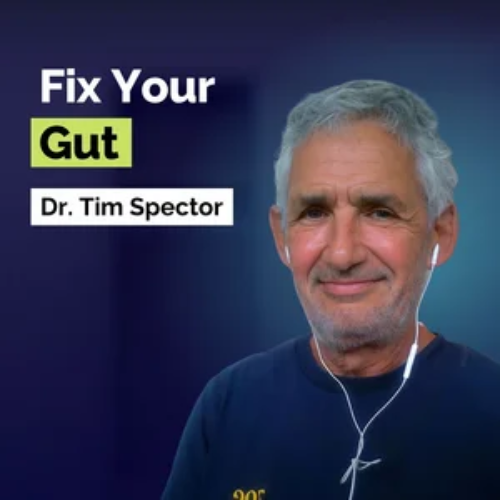
Dr. Tim Spector: The Truth About Diet, Gut Health, and Why Calories Fail | Health & Wellness | E410
After decades of human health research, Dr. Tim Spector believed our genes largely determined why people got sick, gained weight, or aged the way they did. But 30 years of studying identical twins revealed something unexpected: people with the same DNA could respond to the same foods in completely different ways. That breakthrough led him to uncover the powerful role of the gut microbiome and co-found ZOE, a company focused on personalized nutrition and gut health. In this episode, Dr. Tim exposes the biggest diet myths and shares simple habits to improve gut health, boost energy and productivity, and support long-term health, without obsessing over calories.
In this episode, Hala and Dr. Tim will discuss:
(00:00) Introduction
(01:30) What Twin Studies Reveal About Food
(04:11) How the Gut Microbiome Works
(10:32) Building a Healthier Gut Microbiome
(17:46) Processed vs. Ultra-Processed Foods
(31:22) Does Calorie Counting Work?
(36:42) The Food Matrix and Food Structure
(39:03) Dr. Tim’s Health Wake-Up Call
(47:50) Grocery Store Label Lies Exposed
(1:02:00) Fermented Foods for Energy and Focus
(1:08:54) Gut Health Tips for Entrepreneurs
Dr. Tim Spector is a professor of genetic epidemiology at King’s College London and director of the TwinsUK registry, one of the world’s largest twin studies. He is the scientific co-founder of ZOE, a nutrition science company built on gut microbiome research, and has published more than 900 research papers, placing him among the top 100 most-cited scientists in the world. He is the bestselling author of several books on nutrition and gut health, including The Diet Myth, Spoon-Fed, Food for Life, and Ferment.
Sponsored By:
Indeed – Get a $75 sponsored job credit to boost your job’s visibility at Indeed.com/profiting
Shopify – Start your $1/month trial at Shopify.com/profiting.
Northwest Registered Agent – Get a complete business identity with Northwest. Visit northwestregisteredagent.com/YAPFree and start using free resources to build something amazing.
Mindstone – Master practical AI skills without the complexity with Mindstone’s AI Competency Programme. Head to experience.mindstone.com/yap and get 10% off.
AT&T Business – Stay connected with reliable, secure internet built for entrepreneurs. Switch to AT&T Business at business.att.com.
HoneyLove – Treat yourself to the most advanced bras and shapewear on the market. Save 20% off Honeylove by going to honeylove.com/PROFITING! #honeylovepod
ElevenLabs – ElevenAgents by ElevenLabs helps businesses deliver better customer experiences. Start with a demo at ElevenLabs.io/profiting
Quo – Bring your calls, texts, and contacts together in one place. Try Quo for free, plus get 20% off your first 6 months when you go to quo.com/profiting.
Resources Mentioned:
Dr. Tim’s Company, ZOE: zoe.com
Dr. Tim’s Book, The Diet Myth: bit.ly/DietMyth
Dr. Tim’s Book, Ferment: bit.ly/-Ferment
Dr. Tim’s Instagram: instagram.com/tim.spector
Dr. Tim’s Podcast, ZOE Science and Nutrition: bit.ly/ZOE-applepodcasts
YAP E406 with Naveen Jain: youngandprofiting.co/NJ-E406
Active Deals – youngandprofiting.com/deals
Key YAP Links
Reviews – ratethispodcast.com/yap
YouTube – youtube.com/c/YoungandProfiting
Newsletter – youngandprofiting.co/newsletter
LinkedIn – linkedin.com/in/htaha/
Instagram – instagram.com/yapwithhala/
Social + Podcast Services: yapmedia.com
Transcripts – youngandprofiting.com/episodes-new
Entrepreneurship, Entrepreneurship Podcast, Business, Business Podcast, Self Improvement, Self-Improvement, Personal Development, Starting a Business, Strategy, Investing, Sales, Selling, Psychology, Productivity, Entrepreneurs, AI, Artificial Intelligence, Technology, Marketing, Negotiation, Money, Finance, Side Hustle, Startup, Mental Health, Career, Leadership, Mindset, Health, Growth Mindset, Biohacking, Motivation, Manifestation,, Brain Health, Life Balance, Self-Healing, Positivity, Happiness, Sleep
Hala Taha:Tim, welcome to Young and Profiting podcast.
Professor Tim Spector: It's great to be here.
Hala Taha: I am very excited for this interview.
I can't wait to learn all about gut health and the types of foods we should be eating. And when I was studying you, one of the things that I found really interesting is that you've done an extensive amount of studies on twins. You actually started something called TwinsUK. And based on that, you realized that genetics aren't the major factor when it comes to what we eat and how it impacts us, and that different foods can actually impact people with the same genetics differently, which I just thought was so mind-blowing.
Can you explain to us some of the studies and research that you've uncovered, uh, via twins that helped you understand how food really impacts our bodies?
Professor Tim Spector: Yeah, sure. I mean, it, it's taken me 30 years to get to this point, so it didn't... it wasn't overnight. Uh, and I was very, I was a very keen geneticist, thinking that everything was genetic, [00:01:00] um, and so a big proponent of that.
And it, it took really one experiment to change my mind, which was looking at identical twins who were raised together and really lived together until they were in their 20s, and looking at their gut microbes and seeing that when you looked in detail and you sequenced their gut microbes, the species they had were really very different.
They-
Hala Taha: Hmm ...
Professor Tim Spector: only shared a small fraction of all those species, and even less of the subspecies. And that was the first time in about 20-odd years that I'd seen anything really different in identical twins. Generally, they matched because they either had the same environment or they had the same genes. There wasn't this rather randomness of, of finding these microbes.
So for me, that was a big turning point in, uh, in my career as a researcher, and got me moving away from genetics, which I thought was the magic [00:02:00] bullet for everything, into this new field, this is about 15 years ago, uh, of the microbiome and gut health. Because for me, it, it, it was perhaps this missing link between, you know, what we've misunderstood about food, thinking that f- everyone who eats the same food reacts the same way, and suddenly you realize, well, if identical twins have different microbes, then they, uh, in a way react with food differently.
That could explain why they die of different conditions, why one gets ill, the other one doesn't, et cetera, et cetera. So that really fascinated me, is this extra bit of individuality we've all got that you can see clearly in these identical twins that's quite difficult to see in the general population.
Hala Taha: Hmm. That is so fascinating.
So I don't think our listeners truly understand what microbiome means. Like, this is a really trendy, uh, word that we're hearing. I just had Naveen Jain on the show, [00:03:00] and he was talking about gut health and microbiome, and I'm curious to understand, like, what is the job of the microbiome? Like, what does it actually do?
I know it, it transforms simple food into more complex food, and I don't think people quite understand, like, what is the job of a microbiome?
Professor Tim Spector: Well, their job is to stay alive. Um, and it's... But we use them as, uh, chemical factories. They're like gen- a whole grouping of communities of mini pharmacies that are converting the components of the food we eat into amazingly helpful chemicals for our body.
And so I think that's the best way of thinking of them, as this really big, rich, diverse community of, you know, maybe everyone has maybe 1,000 different species and subspecies inside them, all of which are producing different chemicals. And they do that depending on what you f- if you feed them right, you get the biggest [00:04:00] diversity of chemicals, and those chemicals go on and help us in three key ways.
They, they help, uh, our metabolism to stop us, uh, you know, maybe overeating and putting on too much fat and, and, and sorting out our heat, heat and gen- you know, the general mechanics. They also, um, are important for our nervous system. So, um, things travel up from our gut to our brain, and they will determine things like our mood and- Hmm
uh, influence whether inflammation in your gut is gonna cause depression, things like this. And they're also really important for our immune system. And, uh, this, uh... We're realizing more and more how important the immune system is for every, every aspect of our health. Hmm. Because it stops us aging, it stops us getting cancer, it stops us getting allergies.
Uh, you know, you name it, the immune system now is involved. So that's what they're there for, um, [00:05:00] as far as we're concerned. Uh, they're just trying to survive. Um, but we're... In a way, we give them a nice home in our gut and, uh, a place to live. We feed them every day, and in return, w- evolution has worked out that they provide us with a lot of these chemicals.
Some of them are things like vitamins and all the B vitamins, for example, they produce, as well as lots of gut hormones for breaking down food. So- Hmm ... it's a, it's a really close relationship we've got with them that, you know, we've evolved over millions of years really to, to have.
Hala Taha: And can you give us a concrete example?
Like, what happens when we eat, like, a piece of fruit versus when we eat something ultra-processed, uh, in terms of how our microbiome utilizes that food?
Professor Tim Spector: Right. So, uh, when we... Yeah, a piece of fruit, um- It, that won't be absorbed in the upper part of the gut. It goes right down to the lower part, [00:06:00] the lower intestine, so it takes longer to get there.
And the skin particularly will have lots of fiber in it, and also have these polyphenols, which are the defense chemicals you find in natural fruits that, uh, protect the plant, but also, um, our microbes extract from that fruit. So they're extracting the fibers, they break it down in our lower gut. They use the fibers for energy and to, uh, produce other chemicals.
They're like the building blocks of the, of these chemicals we're talking about. And the polyphenols, these defense chemicals that give the color to the fruit or the bitterness, um, say in olive oil, they're used by the microbes as fuel. So they're extra source of fuel, again, to make them grow better and produce more goodness.
Now, that's what should happen, and that's what, uh, happened to our ancestors. When we have ultra-processed food, UPFs, what happens is that [00:07:00] most of that, it's eaten very fast. Uh, it gets mostly absorbed in the upper part of our intestine, so our microbes generally don't get to see it, and it has v- very little fiber in it, so they're basically being starved, uh- Mm
of, of food, and the sugars and the fats are getting absorbed, uh, quite quickly with any modest interaction with our gut microbes. There's also none of these natural defense chemicals, these polyphenols. And then you've got these unnatural chemicals like artificial sweeteners, emulsifiers, preservatives, et cetera, which some of them are absorbed, but others do go into the gut where they can cause problems for our gut microbes.
Mm. Make them stick together, make them produce chemicals that might lead to diabetes, and have various, various different effects that we hadn't really thought about 10 years ago.
Hala Taha: Hmm. I know
Professor Tim Spector: that- So very different, very different.
Hala Taha: Yeah. It sounds like we [00:08:00] really should not be eating a lot of ultra-processed foods, and I definitely wanna talk about how we can tell the difference between a processed food that might be okay for us versus an ultra-processed food.
But first I wanna understand, like, how do we have a healthy microbiome? Like, what are your tips in order for us to have diversity and, and what should we be eating to have a healthy microbiome?
Professor Tim Spector: Well, we get our, our first microbiome from our mothers, so we need to thank our mothers for that.
Hala Taha: Mm.
Professor Tim Spector: Um, and birthing is a, a messy business, and that's designed that way.
So a bit of y- your mother's microbiome gets into all our mouths, uh, during birth. And then over the first next four years, we slowly build up this microbiome through s- through breast milk, and that allows us to digest breast milk. And then increasingly through the diversity of foods which, um, start to then feed different [00:09:00] microbes that we're experiencing in the a- in our surroundings when we're picking up, you know...
Uh, you get lots of microbes just on food itself. You get it from surfaces. You get it from soil, from trees. You get it from your, the rest of your family. Mm. You get it from your playmates in, in nursery school. So a lot of... There's microbes all over the place. Mm. And they, eventually they settle down, and the way to then nourish them is essentially to, uh, work out what they want to eat.
And, um, we've- We've come up with a, a few basic principles of, of what they, microbes really want. Mm. And, and we did this in, in conjunction with, with, uh, uh, the company I co-founded, ZOE. And these principles, which we're trying to sort of educate everyone with, are that microbes like, um, to eat diversity of plants.
So eating the same [00:10:00] kale salad every day isn't gonna work, isn't gonna work because each plant has different fibers and, and therefore it, it has a very different chemical composition, and our, our microbes are fussy. And that's why w- we've come up with eating 30 different plants a week as a goal to try and hit that target and exceed it.
Mm. And if you do that, that's the best way to get a diverse growth of all these microbes, 'cause the more you have, the healthier you'll be. Uh, second would be to eat the rainbow so that you're getting these defense chemicals, these polyphenols. So you pick brightly colored plants, also bitter ones, so things like dark chocolate, olive oil, coffee, even red wine have some benefits because of the polyphenols.
Uh, then you've got, uh, eating fermented foods. So, uh, studies have shown that if you have at least three portions of fermented food, you can really, really enhance your immune system, [00:11:00] uh, and get your, your gut going in ways that are different to the diversity. So in a way, that's a complementary system. And fermented foods are...
contain live microbes in food, um, so they're, they're like probiotic tablets, but actually living and they're in, in food. Mm. And they're much more diverse. And then you've got other, other little tricks such as, um, trying to eat more legumes, uh, as a source of protein rather than just raw, you know, big chunks of meat.
Mm. Um, you've got, um, g- giving your gut a rest- After, so time restricted eating. We know that your gut microbiome and the gut lining improve when you have at least 12 hours overnight when you're not eating. So cutting out late night snacking. Then you've got, um, a crucial one is to th- is to cut out ultra-processed foods- Mm-hmm
as much as possible. We can talk about which ones, [00:12:00] 'cause they're not all the same. Um, they're not all bad. Um, and then finally, I think the, the key is to think of food, uh, in terms of quality, not calories. Hmm.
Hala Taha: Mm-hmm.
Professor Tim Spector: Because- Yeah ... the food companies want us to think about food solely in terms of macronutrients and calories, and that helps them, but it doesn't help your gut microbes.
They want quality, they want real food, and we should be thinking about the quality of the food we're eating and ignore calories because calorie counting just doesn't work and it's... Nobody, nobody in my field in, in, in nutrition now believes in them.
Hala Taha: Hmm. Yeah, this gives us so much to kind of dig on. So first with the 30 plants every...
It's 30, eat 30 different plants in a week. That can sound really overwhelming, but that also includes things like spices, correct?
Professor Tim Spector: Yeah. A te- a teaspoon of spices counts as a plant. Um, you're talking [00:13:00] about every different type of nut and seed, and there's many of those. You can put them in a, in a jar, which I, you know, I do every morning.
Hala Taha: Hmm.
Professor Tim Spector: Um, so herbs, spices, um, nuts, seeds, uh, e- even different colored vegetables. You know, you can get carrots, you can get like Persian carrots which are purple. Mm-hmm. Different to orange ones. They have different chemical compositions, so as far as the microbes are concerned, it's a different treat for them.
And- Yeah ... yeah, it's really important. And I
Hala Taha: think this, I think this goes against like what is viral on social media because everything is about meal prepping and, and making one meal and then eating it all week. Like that is like a big thing that a lot of health conscious people do. They're trying to eat healthy, so they're meal prepping the same meal then eating it every day.
So to your point, if you're eating like different nuts or like other ways to kind of get different food into your system if you're meal prepping, like that's ideal.
Professor Tim Spector: Yeah, I mean, I, nothing wrong with meal prepping, uh, if it's [00:14:00] a healthy meal and you wouldn't otherwise be having healthy food. Mm. But I think finding ways to enhance the plant count, um, and vary it a little bit is really important.
That's- Yeah ... so, you know, this whole concept, uh, is really important because it... people have got used... They get into a rut. You know, you go and you say, "What's my average lunch?" And you al- always have the same salad- Yeah ... in the same place, and it seems healthy, but for your gut microbes, it, you know, th- they get bored, and only those guys will survive.
You know, we know from some of our studies that, um, there's a, a microbe inside you that only eats coffee. Mm. And so if you never drink coffee, this guy is never gonna grow. And so there might well be one for avocados or- Mm ... um, blueberries or, um, baobab, you know? And so being more adventurous i- is, is, is part of this.
And that, this whole concept was... A- and the fact that some people find it hard, they say, [00:15:00] "Oh, it's too hard. I can't do that." So we did actually come up at ZOE with a, uh, a solution, a prebiotic, uh, mix of 34 plants, most of them freeze-dried, that people could add to their, their food. So if they were meal prepping, you just add these 30-odd extra f- you know, dried plants.
Mm. And that gives you the diversity. And we did a study, uh, on it. It's called Daily 30, and it actually beat w- had, uh, more effect on your gut microbes than, say, a, a standard probiotic. Mm. So I think it's, it's a different mindset of, of- Yeah ... of what you need to do to, to eat well. It's to really be adventurous in, in what you're adding and just think, "What haven't I had, what haven't I had this week?"
Hala Taha: Mm-hmm. Um, and I know, uh, we wanna discuss the difference between ultra-processed food and just processed food, because a lot of guidance out there is like, "Don't eat anything in a box. Don't eat anything in a can." But that's not necessarily true, and that's also [00:16:00] not practical for a lot of people.
Professor Tim Spector: No. Um, a- and certainly, um, cans are generally pretty healthy.
So lots- I eat lots of stuff out of cans, and often they're minimally processed and very nutritious. So you buy a can of beans, and, uh, if there's not too much of a sweet sauce on it or no sauce, it is ideal. And there's... You can get 20 different types of bean just about in the United States. Mm-hmm. Uh, very cheap, very nutritious, good source of protein, but also importantly, lots of different interesting fibers.
And then you've got, um, uh, you know, you can buy cans of tomatoes. They're actually better in a, in a can often than buying them from a store. They've actually have... They've done tests on it, and some of their nutrients like lycopene, which is, uh, preventive of some cancers like prostate cancer, there's more [00:17:00] of it in the, in the, in the can variety- Hmm.
Interesting ... uh, than not. So cans are great. Frozen, the frozen aisle is also really good, interestingly. So if you buy the pure stuff, I'm not talking about, you know, the ready meals. But if you're buying, uh, just some chopped vegetables, uh, beans, peas, uh, or frozen berries, actually they're often at least as nutritious as the fresh ones.
So, and they're something you can always keep in your, um, in your freezer and pull out when you need it. It doesn't have to be seasonal, and they're very cheap. So I think the idea that cheap means processed isn't always correct, and I think that's a, that's a big, uh, misconception. Um- Yeah
Hala Taha: I was gonna say, and I also think people get, uh, confused.
Like, like yogurt is technically processed, right? Sourdough is technically processed. So these are actually pretty healthy foods if you're getting, you know, if you- if it has like pure ingredients and doesn't have like [00:18:00] any funny ingredients in it. Those are technically processed foods, but still like good for you, right?
Well, virtually everything.
Professor Tim Spector: Yeah.
Hala Taha: Yeah.
Professor Tim Spector: Virtually everything is processed to some degree. Um, yeah, as you said, yogurt, cheese, all the dairy products, and we know that, you know, things like yogurt have been shown to be healthy for us. So, um, I think we need to stop worrying about that a- and start thinking more sensibly, has that processing led to something unhealthy about it?
And, um, the current definitions of UPF are really far too broad because the current definition is not a, it's not a health score, it's a, a processing score. So it's saying how much, uh, according to these, uh, Brazilian researchers, this food has been processed in very broad categories. There are only like four categories of them, and, um, something could have, uh, very minimal amounts of processing that aren't harmful for your health, and yet it's included in the, the, the top [00:19:00] category.
So I think they were fine for research at population level, the sort of stuff I do, epidemiology, but not for an individual, and that, that's why, um- We've come up with a new s- way of scoring this that instead of 60% of all your food being UPF, where you have to avoid, we've cut it down to about 25% of the real ones.
Um, and it's not just processing score, it's actually accounting for all the things in ultra-processed food that are bad for you. Which is quite interesting really, because up until recently we had no clue what they were. We thought it was just the additives.
Hala Taha: Hmm.
Professor Tim Spector: You know, people focused on these dye, these red dyes or something else.
But that's just one part of the story. So we took really separate categories. So what we did at ZOE was we, um, looked at those additives. But we only included additives we worried about that were, had been associated with some health problem. Hmm. 'Cause some, some [00:20:00] additives are like vitamin C, right? So you're not gonna say, "I'm not gonna eat that 'cause it's got vitamin C in it."
Mm-hmm. Um, or iron or something else like that. So, um, that was one category. Uh, the second was, um, something called hyperpalatability, whether it's... Has it been designed by the food companies to make you, uh, keep eating it- Hmm ... and nev- never get full, right? This is this- Yeah ... so-called bliss point in the brain that the scientists in these companies are really brilliant at.
And, you know, we all know that feeling where it's big bag of Doritos or Pringles or whatever it is. They've got that, exactly that formula that is that combination of the sugar, the salt, the fat, that just makes you keep eating and overrides those signals. So you just stuff your face. You're not really, um, getting the normal signals that you should be.
Hala Taha: Hmm.
Professor Tim Spector: Um, the, um, other ones are, um... Sorry, I've just got a- You're okay. [00:21:00] My, something's buzzing here. Okay. Um-
Um So hyperpalatability is the second thing that we measure, and about 70% of these foods have that particular quality, and it's, it's good to have that warning about it. Then you've got things like, um, the, the s- the texture of the food. So we know that food companies deliberately make food, uh, softer and faster to eat.
Hala Taha: Mm.
Professor Tim Spector: And so, um, there's been some recent studies showing giving people two identical, uh, diets, and one, uh, was textured really softly, the other one the original texture. So one was processed, same basic ingredients, calories, et cetera. And those people ate about an, uh, nearly 400 calories more a day just [00:22:00] because the food was softer.
Hala Taha: Mm.
Professor Tim Spector: Uh, and we know now that generally when you're o- having these, these particular high-risk foods, you will overeat by about 500, uh, calories a day. Mm. Which, you know, is over, you know, 20% of your inc- your intake without knowing it. And you could have the identical food made from scratch, the identical food made up.
But now we're starting to understand the mechanisms. And so, um, this is why we've come up with an app that gives you this, uh, this new, uh, ultra-processed risk score so you can scan stuff in a, in a store and work it out. 'Cause it's not easy in your head to work out all these different- Yeah ... combinations.
Uh, and this is what the manufacturers really rely on, that it's so hard to tell because they've all got health claims on the front, and they all look fantastic and, uh, you know, lots of healthy farmers and, um- Mm-hmm ... happy people and, uh- ... v- pictures of [00:23:00] vitamins dancing around. So it's, um, understanding the basic science of what they're trying to do allows us to then combat it and realize, okay, this is the antidote.
Um, these are the ones you have to avoid.
Hala Taha: That's really fascinating. So is the app, uh... Is it like the Zoe app, and is it available in the US as well?
Professor Tim Spector: Yeah. Is it available in the US? Yeah, so... And it's currently free to download. So it's, um, uh, if anyone's listening, you know, it's, it's a fantastic, uh, way, an aid to understanding this whole thing, and you just use its AI.
You snap a food, or you go into a store and snap the, um- Mm-hmm ... the barcode, and, uh, you can learn a lot from it. Um, so yeah, download it while it's still free.
Hala Taha: Okay. Two questions about this. So what is some quick ways, like if we're reading the back of a, of a package and looking at the ingredient list, like what are some red flags to show, okay, this is ultra-processed?
Um, and then secondly, like what are some examples of some foods that they're making softer that we should be aware [00:24:00] of?
Professor Tim Spector: Okay. So, um, yeah, so assume you don't have the app. You're, you're in a hurry. You're looking at the back. Um, uh, y- General, as a broad rule, the number of ingredients, uh, things you don't understand, if there's several that, you know, you, you can't...
you, you don't know what that means- Mm-hmm ... that's a sign that there's lots of processing in there. If you've got lots of emulsifiers in there, which are these things, these glues that stick the food together, that's generally, uh, a red flag. And of course, the more they've tried to color it or add taste flavors to it, it, it's a sign the more they've distorted the, um, actual original structure of the, of that food and, uh, are, are making it in the way that, uh, you shouldn't.
It also, generally they're low in fiber, so trying to look at the, uh, fiber count, if you had to look at one thing on there. Mm-hmm. Uh, generally, even if it says, uh, it might say low fat on the front, that's a, that's [00:25:00] a pretty good red flag because they're generally... It's cheaper for them to add in, uh, other texture products like starches that are slightly sweet and remove the fat, which saves them money.
And so you end up having more sugar and less fat and, uh, helping their profits. So, uh, yeah, generally look at the back. Um, total number of ingredients. I don't understand any of these. You know, the, the worst offenders are really obvious. Um, there are some subtle ones that are quite hard. Um, but I think, uh- You, the texture of the food is really important.
Um, food companies want you to, don't want you to chew. They want you to just sort of absorb it without noticing in front of the TV.
Hala Taha: Mm-hmm.
Professor Tim Spector: Uh, they're, then they're doing their job. So I think they've really changed most meals. So most ready meals you buy that you just stick in the microwave, [00:26:00] they're, they're extremely soft.
You never get... If you never know, you know, pasta's never al dente when you, when you've got it- Mm-hmm ... in a, in a microwave meal. Um, in the same way that it might take you time to chew. Um, yeah, I mean, there's hardly any examples of a really tough, um, product that takes- Yeah ... uh, time to chew. And that, that I think is really important because it, it doesn't contain the whole foods.
They're too expensive or they, um, they don't store very well, so you won't get the, the whole grains, the nuts. Um, you're getting the, the soft inner parts of the, of the product rather than the whole thing. Um, and that, that's really the, the giveaway across the whole area. Everything is softer. Everything is easier to eat.
Nothing really requires much in the way of chewing.
Hala Taha: Yeah. So when I'm online and I'm following all these fitness influencers and nutritionists that [00:27:00] are influencers, a lot of them are telling you to track your calories, track your macros, and they're really obsessed with that. Uh, I know that you have an opposing view that like calories are probably like, you know, unnecessary to track and, and we really need to think about the quality of our foods.
Can you help us understand like what we actually need to be looking for and why calories is not, is not the right way to look at things?
Professor Tim Spector: Yeah, well, we've been brainwashed for the last 40 years into thinking that calories were the thing to eat-
Hala Taha: Mm ...
Professor Tim Spector: uh, and to follow. And this was really led by the food companies, but also the diet industry.
You know, the classic Weight Watchers and all the others that, that came off of that because it's, it's a really easy thing, uh, you know, to give people goals and say, "Right, s- success or failure, you know." Mm. "You've failed. It's your fault, it's not our fault." Um, therefore, uh, [00:28:00] they keep coming back and paying them more money.
But, you know, I'm a scientist, uh, foremost, and when you look at the actual data of all the studies done, even in trials where people are given amazing amount of support to do, uh, calorie restricted diets, um, you know, the most they can go is, is about two years. And the vast majority, 80 or 90%, have returned to their, uh, baseline weight by that time, and then they tend to overshoot.
So they often do worse having gone through this. So everyone... You know, most of these people are getting paid to get people into these programs. Uh, there's plenty of them. Short-term programs, easy to track your food. AI now does it for you. Um, but, you know, it works for six weeks. You lose some weight, but then you get incredibly hungry.
Your body senses you're not getting enough energy. Um, [00:29:00] your fullness, uh, s- signals are not... You're not being filled up, and you will revert. And those hunger signals just get dialed up and becomes, and it becomes unbearable. All you're thinking about is food, and that's how we've evolved as humans. So that's why, you know, this isn't true.
And, and, and as I was saying, these experiments which we did with ultra-processed food, we're using identical meals in terms of calories. So if you think about it, if you're only talking about calories, um, you, you could be out by 500 calories a day because you're eating the junk food with low calorie-
Hala Taha: Mm-hmm
Professor Tim Spector: uh, rather than the real low calorie made from scratch. And you'll be having 20% more food in that day just because you're picking the junk. Yeah. And you're count- you can be counting your calories. So clearly, you know, something's wrong with this equation. It isn't a, you know, one size fits all, that [00:30:00] everybody's the same, you know.
And, and why, you know, why should you only have 2,000 calories? How do ... You know, how's that worked out? Um, we've all got different exercise levels, but it, it all comes to this, there's a, there's a big industry around calories, diet foods, you know, short-term, uh, goals. People love a single number. We, you know, humans are, are suckers for the, the quick solution.
And- Yeah ... "Oh, well, I just need this. This is k- a fantastic low-calorie thing. Um, I can take it. It's like the magic pill." Um, but it doesn't work like that. It's all about the hunger levels, and that's why, Zoe, we, you know, we're trying to We say, you know, we don't mention the C word, right? It's like we... It, it's really important.
You've got to stop thinking about it and have more to, add more to your plate, you know, which means more, you know, in bringing enjoyment back into food. Mm-hmm. But going back to those whole foods that have lots of fiber [00:31:00] in it, lots of diversity, lots of plants. Um, but you know, still having your, your meat if you like it.
It, it, nothing's off the table. Even the occasional donut, it doesn't matter. As long as you've got a long-term ga- goal, that 80% of the time you're doing the right thing. And that's, that's really our, our idea is to really make people think about food in a different way. Because- Mm-hmm ... it's not about a few weeks and I can lose a few pounds.
It's, you know, how do I shift, uh, everything about my body and my gut microbes in that right direction that's going to last me for decades and- Yeah ... help my immune system and everything else. And once you start to feel better, then it becomes obvious. And you... And our study's also shown that if you do this and you disregard calories, you will lose weight and you actually get less hunger.
Mm-hmm. So all of the trials we do, whether it's with our prebiotic, our fermented food, or, you know, following the app, uh, hunger signals go down. [00:32:00] And this is because when you're eating things like plants and improving your gut microbes, it's sending different signals to your brain than if you're just having, uh, low calorie junk food.
Yeah. And I think that's really important that, you know, we've got to get back to quality of, of food. Uh, and not, not about calories and quantity.
Hala Taha: Yeah. Speaking of quality of food, you talk about something called the food matrix. Can you un- help us understand, like, what the food matrix is? Uh, when I heard of it, I thought of, like, the food pyramid, but I'm not sure that's the way that I should be thinking about it.
Professor Tim Spector: No, the food matrix is, is really another way of talking about food structure.
Hala Taha: Hmm.
Professor Tim Spector: So, um, and it's another example of how, um, you know, calorie counting is, is- Way off because it- Mm-hmm ... it will treat a bag of al- whole almonds the same as, um, a bag of almond flour. And yet we know from careful experiments that if you give [00:33:00] people almond flour, they'll be getting, like, 20% more calories from that than the raw almonds.
Uh, and the energy because if you break it down as the, as the pro- you know, in- industrial food places do into its tiniest components, you're breaking apart the cells of the plant, and when you do that, you're releasing, uh, sugars or fats that are stored inside there. Whereas if you have whole nuts, for example, a lot of those, that, those, uh, fats and, and sugars in those are not gonna be absorbed until really low down or they might actually pass out in the toilet.
So- Mm ... um, that's what we're talking about when there's structure, and there's lots of examples, whether it's nuts or chickpeas is another one. You know, if you have whole chickpeas rather than, uh, you mash it up as hummus. Mm-hmm. There's a slight, there's a slight difference in that, in how you absorb it and, and its effect on the body.
So it all comes back to the quality and, and the more [00:34:00] whole foods you're eating, uh, the better it is for your body and your metabolism. It sort of makes sense from an evolutionary point of view because it also takes time, more time to eat, gives your body time to react normally in the way we were evolved to do, and also makes, fills you up as it- Mm
as it's supposed to do. Whereas everything about the industrial process is to speed it up and if it can get you that food down, say, you know, you finished your meal in 15 minutes or 10 minutes or whatever, then your hunger centers won't have, uh, kicked in in your brain as well. So-
Hala Taha: Mm ...
Professor Tim Spector: it's, it's, it's all part of the same idea.
So structure is very important. Again, it goes with texture and softness and all these things.
Hala Taha: Mm-hmm. I wanna spend a moment on your story. So I found out that your father actually passed away quite young, around 50 years old, of a heart condition, and, uh, it was kind of unexpected and it was a turning point for you, [00:35:00] uh, maybe not immediately, but at some point, uh, when you had your own health scare.
Talk to us about the things that have happened in your life that made you realize that things really need to be different and that even though you thought you were operating in a healthy way, you needed to change your own health.
Professor Tim Spector: Yeah. Well, there's nothing quite like, you know, personal experience or tragedy to wake you up.
And, you know, for much of my 30s and 40s, uh, you know, I was an arrogant, cocky MD, uh, you know, who are particularly arrogant and, you know, confident because that's what we're trained to do. Um, thinking that I had the answers and that, you know, uh, we didn't learn much about, uh, food or nutrition at medical school, but no one e- no one did.
But, um, I still had the answers 'cause, you know, the pills were the answer and everything else. And I-- you [00:36:00] think you're in- fairly invincible then, you don't worry about long-term health. Um, and then it was in... Yeah, when I was, um, uh, 54, I had a, uh, this mini stroke as I was, I was on a top of a mountain in, in Italy and, um, had some high blood pressure.
I got better in three months, but it, it was a bit of a shock to the system, uh, 'cause I suddenly realized I was so close to when my father had died, and it sort of got rid of that complacency in me. So I suddenly had a bit of a reality check and said, "Gosh, I might..." You know, maybe, um, you know- This 20 pounds I've put on in the last, uh, 20 years, maybe it's not all muscle, you know?
Um, a lot of, lot of men just say, "Hey, I'm bulking up. This is great," you know? 'Cause I didn't, I didn't look fat. Um, but there w- it had certainly been slowly accumulating, and I suddenly realized my diet was pretty terrible. W- uh, you know, once I res- [00:37:00] started researching this, and I, I was writing a book on the mi- microbiome at the time called The Diet Myth, and I, I, I really started breaking it all apart, but, and, and say realizing that, you know, my, my breakfast was wrong.
My, uh, lunch in the hospital of a sandwich, an orange juice, and a bag of chips was wrong. Uh, you know, me just having, uh, l- lots of low-fat foods and lots of pasta and bread really wasn't very good for me. Mm. And so, yeah, I suddenly realized that I had to change if I was gonna avoid the fate of my, my father.
And, uh, i- you know, it, it really drove me not only to look after myself but also, you know, to, to rewrite a lot of these nutritional guides. Mm-hmm. Because a lot of those, the nutritional guidelines haven't caught up with the latest science, and they're- Yeah ... you know, always lagging at least 10 years behind.
So that was really important to me. But it was- I- ... it was, [00:38:00] it was a bit of a journey.
Hala Taha: Yeah. And, and you actually basically pivoted your career at that point, and you started, uh, putting yourself in conversations. And, and was it hard to gain that credibility initially with other thought leaders because they're like, "Who's this guy?
He came out of, came out of nowhere"?
Professor Tim Spector: Uh, yeah. No, it was. And, uh, yeah, you get treated like shit when you, when you go to your first meeting and, uh, um- ... 'cause they say, "Who is this guy? He hasn't, he hasn't done 10, 20 years in the field like we have." But I was sort of used to it 'cause I've changed careers a few time.
Um, I started, uh, as a r- a rheumatologist. I was, you know, like a board-certified rheumatologist. Um, and then I got into epidemiology, so I went back to school, um, d- did my thesis, uh, on that. And then I got... I had to teach myself genetics. So, um- I, I got a few s- you know, cold shoulders doing that as well, [00:39:00] um, as you can imagine.
So by this time I, I'd, I'd got over that initial thing, and it's, it's probably the reason most doctors don't change specialty is- Mm-hmm ... you know, doctors don't like change, and, uh, they feel, "Well, I've, I've done... I've spent the hard yards doing all this." Mm-hmm. Mm-hmm. You know, um, you know, all my certificates on the wall, you know, why am I gonna listen to this new guy?
But, uh, I think it's, it's been great really because it gives you a much broader view of everything, and medicine really needs a holistic view nowadays, uh, rather than th- these minute, you know, these people who have these tiny specialties that- Mm-hmm ... miss the point. And I think this is what it's... I'm realizing more and more.
Hala Taha: Totally, and I'm sure your work with genetics really helped you understand nutrition even more and in a different way than everybody else did.
Professor Tim Spector: Yeah, I think that's right. And we, we realized we only cracked genetics when we got really big numbers. Mm-hmm. So for 10 years I was writing lots of papers. You know, I've [00:40:00] written, uh, nearly 1,000 papers.
It's crazy. But a lot of them were rubbish. You know, they were just, uh, in the early days you thought this was a s- this gene was associated with this, and this... We found the obesity gene, we found the, you know, depression gene. It was all nonsense until we got really big numbers. We're talking, you know, 10, 100,000 people.
Then we started to see some real answers, and the same has been true in nutrition, and that's driven me both, you know, nutrition and gut health. That's why we're doing studies now with 300,000 people, which- Mm-hmm ... uh, you know, through all these members of ZOE now that we can really separate, uh, the wood from the trees- Yeah
in ways that we couldn't do before. And, and that's been a huge lesson for me, which, you know, the nutrition field was quite happy to look at 20 people, um, at a time. Generally, you know, uh, US students, um, usually male, usually, you know, under 25. So not very generalizable. Mm-hmm. So, um, I think it is... Yeah, [00:41:00] experience in other fields are really important, and I, I think more people should definitely do it and take the, take the plunge.
Although it, you know, the first time you do it, it's not easy.
Hala Taha: Yeah. And I think more people should get involved in this food revolution that's going on because it is so needed. Like, it's, it's absolutely mind-blowing to me when I have these conversations with scientists and doctors like you when we just realize that so much of what we're eating is basically food that is not really food, but just edible and, and kind of mimics what food should be, and that these scientists that work at these food companies are, are modifying food in a way that makes us eat more, that makes us, like, hungry all the time, that's not actually giving us nutrition, that's ruining our micro- uh, microbiome.
Like, it just seems so immoral.
Professor Tim Spector: It is when you, it is when you put it that way. But it's like, um, but in a way, you know, we haven't been educated and we [00:42:00] don't get taught in school about nutrition. Um, we've had very little way of fighting back and, you know, as I said, we're, we're susceptible to the, the easy solution, aren't we?
You know- Mm-hmm ... we, we like, we're proposed something, oh, this is the cure. You just have to take these pills. You can have the crappy diet, but as long as you got these supplements, um, which make huge amounts of money for those companies- Yeah ... you'll be fine. And then you get these influencers who are paid by the supplement companies to tell you exactly that.
And again, people want a simple s- black and white solution and, of course, it's very complex. You know- Mm ... nutrition is, is moved from being the most boring science subject to probably the most complex and interesting- Yeah ... uh, in m- in my view. So, you know, no me- no doctors went into nutrition because it was too dull.
Uh, that's, that's the honest... That's why there are no real MD nutrition, um, experts, or very few of them. Uh, it was, it was incredibly dull because, [00:43:00] you know, after the Second World War it was all about vitamin deficiency. Yeah. Uh, not about, um, you know, dealing with, uh, modern food and the food industry. So- Yeah
it's sort of understandable why we're in this, this. But, uh, but I think given that we have incredible power over what food choices we make-
Hala Taha: Mm-hmm ...
Professor Tim Spector: at least most of us do, not everybody- Yeah ... you know, but those with, with, with s- any sort of income, you know, we're making hundreds of food choices a week and it's not like exercise where you have to give up, you know, several hours of every day.
Mm-hmm. It's just a simple choice. You can say, "I can put this in my mouth or I can, I, no- Yeah ... I can pick, pick something else." And we- that's what we're not, we're not realizing, that we've got this incredible power-
Hala Taha: Yeah ...
Professor Tim Spector: to change ourselves and to change our, our destinies and live another, you know, 10 years of healthy life- Yeah
just by making better food choices, not, not by sp- you know, spending lots more time in the gym.
Hala Taha: Yeah. Well, this is such a great [00:44:00] segue because, like you just said, we have agency, but we need to understand how to kind of understand the marketing that's getting pushed at us and m- understand what is real versus what is BS.
So I thought we could play a little bit of a game where we go, uh, we, we talk about the grocery store label lies. So what do these labels actually mean, and what do we need to look out for, okay? So the first one is when we're in the grocery store and we see something that says low calorie. A lot of people will pick that up, think that's healthy for us.
Why is low calorie not necessarily healthy?
Professor Tim Spector: Well, I'd stick that in the trash because it means that they've, um- They've reduced the sugar in some way. Uh, generally it's the sugar they, they go for, and they've replaced it with something else. Um, and that could be low quality fats like palm oil, or they've added [00:45:00] artificial sweeteners and, uh, a mix of those.
So, um, or they've just given you a very small portion size. That's the other way around it. So, you know- Mm ... ba- baby portions. But generally for me it's a red flag that, um, I would never buy anything that says, uh, low calorie on it.
Hala Taha: Mm.
Professor Tim Spector: Because- So
Hala Taha: good ...
Professor Tim Spector: you know, unless maybe, you know, you wanted to switch from regular Coke to, uh, Diet Coke, which is probably slightly better for you.
Um, uh, you know, if you've got diabetes or something, yes, in those instances might be worth it, but, uh, generally it's a red flag.
Hala Taha: To me, soda in general, like, don't put it in your grocery cart, right? Like, just avoid at all costs.
Professor Tim Spector: Yes. There's, it's, it's a, the whole area is a, a massive red flag. And, uh, if you're not having lots of sugar, you're having lots of, uh, chemical sweeteners and, uh, we still don't know the long-term effects of those.
Hala Taha: Okay. If something is labeled [00:46:00] organic, is that something that we should take seriously, or is, does organic not really matter? Is that just hype?
Professor Tim Spector: Uh, well, it sort of depends on what product you're looking at. Um, in general, uh, y- the certification of organic in the US is, is pretty poor. So there's lots of misclassification and mis-selling.
Um, and you might be end up paying twice as much for something that says organic.
Hala Taha: Mm.
Professor Tim Spector: Um, if it's a product, for example, that has high, um, pesticide or herbicide use buying an organic one is likely to give you less of that chemical. So a good example might be if you have oats for breakfast every day, um, then, uh, you'll be getting, you know, only 20% of the s- the spray chemical on it, the glyphosate or, on your oats if you chose the organic one and, and it was true.
Um, but for many products, it- it's, it, it's [00:47:00] probably not worth it, and I'd rather people spend their money buying, you know, better quality, uh, fruit and veg than only getting organic. I mean- Mm ... in general though, we sh- you know, we should support farmers that try and do things organic, because it means they are taking more care-
Hala Taha: Mm-hmm
Professor Tim Spector: um, over those products. And, uh, you know, so there are lots of exceptions, but, um, some things it's not worth. You know, um, if you're worried about the spraying of chemicals and you're buying an orange, well, you just peel the orange. You know, it's got a thick skin, so you're not gonna get it anyway. Mm. Um, but, you know, things you're having a lot of, then, then you might want to reduce your, the, those, uh, particular risks.
Like, berries are another one. You know, a lot of berries and strawberries get sprayed a lot. Mm-hmm. So, uh, again, if you're having those regularly, might be worth it. But as a general rule, I think it's slightly over-hyped. There's no big evidence, uh, of people shifting makes [00:48:00] a massive difference. If you've got the money, go for it.
If you haven't, don't worry about it.
Hala Taha: Hmm. Now, this is a really popular one. Now everything says the amount of protein on the front. High protein, high protein. Is that becoming, like, the new low calorie, low fat?
Professor Tim Spector: Uh, unfortunately yes. Um, this is... Yeah, for a year or two now, the pr- there's been protein mania, and food companies love it 'cause it's, there's lots of cheap protein out there they can add in powders to anything.
Hala Taha: Mm.
Professor Tim Spector: And, uh, I've seen surveys in the US showing that 70 to 80% of people believe that if they see high protein in a product, it's healthy, and they don't look beyond the protein. So it's definitely gonna replace the low calorie. And, you know, you see this turning up in all kinds of terrible snack bars that, uh, look incr- are incredibly unhealthy, and they've just- Mm
added a bit of soy protein or milk [00:49:00] protein on the top, and it's- Like
Hala Taha: protein bars that we all get, yeah.
Professor Tim Spector: They're, they're generally t- absolutely terrible. Mm. So yeah, I think that's a real red flag. Uh, you know, if you want protein, get the high quality stuff. Uh, you know, uh, if you want, you know, dairy and, uh, a red, red, you know, lean meat and, uh- Mm
things like this, uh, and legumes, um, don't buy in a, in a chemical form. Because the average American is already getting, um, more than enough protein. There are, you know, a few people who are- Protein deficient, but the vast majority of people, uh, unless they're sick, elderly, or, you know, uh, bodybuilding, are not, are not really gonna be needing any extra.
There's getting plenty.
Hala Taha: Yeah. You say there's, there's a real, there's a fiber crisis, not a, not a protein crisis. Like, we've got it backwards.
Professor Tim Spector: Yeah, that's right. You know, only 10% of people need more protein, whereas, uh, 95% of people, uh, need more fiber. [00:50:00]
Hala Taha: Hmm.
Professor Tim Spector: Wow. Uh, it's, it's... we're really deficient, um, uh, in the Western world on, on fiber, and yeah, the USA is probably leading the world on that.
Hala Taha: Yeah, it's something we don't wanna be number one for, for sure. Uh, what about the word natural?
Professor Tim Spector: Uh, pretty meaningless. Um, you know, opium's natural, isn't it? And, uh- ... you know, sort of necessarily good for you. Um, so yeah, lots of natural things. Yeah, it's a meaningless term. It doesn't have a, a clear definition.
It's used on marketing. Mm-hmm. Uh, again, uh, it doesn't mean it's necessarily bad, but it, it's just a sign that someone's got to... They're trying a bit hard to market this at you- Mm ... um, by using a meaningless term. Um, nat- full of natural goodness. And of course, you know, natural, uh, w- there's this [00:51:00] definition between natural and synthetic, so people are using, um, flavorings and colorings which might, now we might say are natural in those products.
Really, uh, whereas in the past they didn't worry about that. So they realize the consumer doesn't want artificial dyes. Yeah. But they would happy if there's something called a natural dye made from carrots or beetroot, you know, they feel a bit happier with that. Uh- Mm. But in, in general, yeah, it's, it's a pretty meaningless term.
Hala Taha: When something says made with real fruit, what do you think they're typically hiding?
Professor Tim Spector: Uh, either there's virtually none in it, or, um, they're using, uh, some pulp of the, of the fruit and they're- Mm ... mixing it with other things. Um, so a lot of yogurts and, uh, breakfast cereals have, say, made with real fruit. Uh, it, it...
They don't have to say how mu- what percentage is, is actually real fruit. Mm. And, [00:52:00] uh, generally, you know, you shouldn't have to tell a consumer it's got real fruit. You should be able to see it, right? And- Mm-hmm ... generally you can't. And, um, certainly, uh, things like children's yogurts and, and breakfast cereals have these reconstituted, flavored, you know, berry flavored, um, bits of starch and, uh, crumbs that they, they pass off as fruit, and they might have added some fru- puree, um, at some point so they can claim it.
It's somewhere in that product is some real fruit. Mm. But, um, uh, generally, yeah, that's, that's another red flag.
Hala Taha: Is there anything we didn't talk about that we should beware of when we're grocery shopping?
Professor Tim Spector: Um, I think there are, there are some really difficult items when you're shopping. Um, I find bread really tough, getting, getting a, a good bread, 'cause they all claim to [00:53:00] be the same.
Mm. Um, and it's often the ratio of the, how much sugar there is in that bread compared to the amount of fibers in that bread, and that's quite a hard calculation to do in your head. Um, so again, re- look really carefully. Uh, think, 'cause people have a lot of bread, you know, they have it regularly, so it's, it's...
So the items that you buy all the time are really important to- Mm ... to scrutinize and trying to get the best one. So you should be looking at the highest fiber content and the relatively lower, um, sugar, sugar amount. And of- you don't want a big list of chemicals as well. So- Mm-hmm ... um, that's one I find difficult.
Uh-
Hala Taha: Yogurt could be, like, really good or really bad, too, right?
Professor Tim Spector: Yeah, exactly. M- it's really hard in some parts of the US, I've found, to, to get a yogurt that has nothing in it at all apart from the milk and the microbes. Mm-hmm. Um, you know, the vanilla's added as standard. Um, you get, [00:54:00] uh, sweeteners in there.
You get, uh, bits of fruit and whatever. So you just gotta try and get the least amount of ingredients. The simplest it is, uh, that you know it's gonna be good. And particularly children's yogurt is even worse. Mm. So if you've got kids, uh, or, you know, then really important that you, you don't get them those brightly colored ones which probably have got no live microbes in them at all, and, uh, they'll neutralize any, any of the goodness in that, in that yogurt as well.
Mm. So I think, yeah, so the two aisles where I think, you know, things like the children's aisle, the yogurt aisle, um, the bread aisle, that's really where you should become an expert and-
Others: Mm ...
Professor Tim Spector: um, you know, th- that... But some of these ones, you know, it may be obvious. You can work it out if they're so full of, uh, cartoons and messages, it's obvious.
Other ones you, you may have to, you know, barcode scan it, you know, uh, with an app like Zoe's. It, it can [00:55:00] be really tough, but I think work out what you're having regularly and then always get the better version of it, I think is, is what we should be aiming at.
Hala Taha: Mm. Now, uh, I learned that you had a high microplastic count in your blood at some point.
How do you feel about food packaging? Like, do, do you... Are you concerned with that? I know you were talking about canned foods being okay, but I think there's aluminum in canned foods and, and that can be really bad for us as well.
Professor Tim Spector: Yeah, um, I, so I looked into this and, um, I'm fairly relaxed about canned foods.
Um, uh, you know, they've done lots of studies. They've been around for, you know, hundreds of years. Um, but I'm more concerned now about having too much plastic and obviously clear dangers of buying, uh, say bottled water in plastic. You leave them in your car, it gets a bit hot all those chemicals leak out into the water, and then if [00:56:00] you, you know, that, that's part of your regular drink, that's not good.
So, um, I'm trying to cut down on my plastic containers, um, as much as I can, and making sure also when you, you mi- microwave or heat something up, you take it out of the original plastic container and put it in some, uh, glass or ceramic. Uh, I think we just, we've got a bit complacent around plastic. Um- Yeah
it's very cheap. It's, you know, a by-product of the petrol industry. Um, it's, you know, it's p- virtually forced on us. It's very hard to avoid it. And yeah, nobody wants to be think their s- you know, their brains are slowly filling up with microplastics. Um- Yeah ... even if we, even if we don't know exactly what they do, um, again, if there's a simple choice, going back to my idea of, you know, we're constantly making these little food choices, you know, am I gonna bother putting it into another bowl?
Yes. You know, do I want my water bottle to be plastic, or would I want it to be metal or made of something else? [00:57:00] These are very easy choices for us to make- Mm-hmm ... you know, uh, without, you know, ruining your life and getting s- super stressed about it, 'cause you can't avoid plastic, and I think we don't wanna be so plastic-phobic that, um, we go the other way, which would make, uh, would probably have negative effects on your mental health.
Hala Taha: Hmm. Yeah, I feel like for me, one of the biggest health changes I could make is to start to just avoid plastic more often and avoid w- uh, plastic water bottles, and figure out how to have, like, a better... Like, how do you drink your water? Like, what do you use for your water at home?
Professor Tim Spector: Well, after the, after my scare, I, I went and got, uh, s- water filters-
Hala Taha: Hmm
Professor Tim Spector: um, installed, and so my water tastes better and it's, y- you get the, any of those microplastics, uh, filtered out.
Hala Taha: Mm-hmm.
Professor Tim Spector: Um, so I'm quite happy to have my, my filtered water, or if I do buy specialty waters, you know, I like a nice [00:58:00] Italian or, um, Spanish, uh, mineral water I buy in a glass bottle.
Hala Taha: Hmm.
Professor Tim Spector: Um, uh, so that, that works for me, and yeah, and I, uh, I, I carry a, a metal, um, water bottle with me.
So yeah- Hmm ... I could do more, but I reckon that, you know, there's a sort of very easy, easy way of doing this. Um, and no one really knows, you know... I, I had above average microplastic levels, but nobody knows what's, what's critical, you know?
Hala Taha: Yeah.
Professor Tim Spector: Hopeful- hopefully I'll die before, you know, I have any problems due to them.
But- ... um, you know, it, it's very early science. I think there's probably many other things in our food that are worse for us than those- Mm-hmm ... although they, they sound scary, but, you know, we're surrounded by a lot of these- You know, j- just starving our microbes, I think is a, is, is a worse crime than having a little bit of plastic every time we have a drink.
Hala Taha: Yeah. So I want to close out today's interviews talking about [00:59:00] fermented foods. Uh, you just mentioned starving our microbes, and I know fermented food- foods is something our microbes really like. Uh, you actually changed your mind on this. You thought fermented foods was for, like, hippies, and then, uh, you changed your mind.
So what made you change your mind about fermented foods, and what should we know about them?
Professor Tim Spector: So what really changed my mind was understanding a mechanism of how they might work. Because the field, as I said, of nutrition is, is not well-funded. The studies are small. You know, some of them are funded by dairy companies and et cetera, um, which, you know, can be biased.
So I thought, "Well, they might have some advantages, but the evidence isn't very strong." And there's no evidence that these microbes when you drink them, say in a, a yogurt or a kef- milk kefir, they stay in your gut and they take over, you know? So that was always a bit odd. So how do they work if they're not hanging around very long?[01:00:00]
You've got to keep drinking them and they have this effect, and how are they working? Because they'd be really outnumbered in your gut, you know, because there are, um, you know, there are billions of them when you drink them, but there's trillions, hundreds of trillions of, of the other guys.
Hala Taha: Mm-hmm.
Mm-hmm.
Professor Tim Spector: By a colleague of mine, Christopher Gardner, and, uh, and Justin Sonnenburg i- in Stanford, where they gave, uh, 28 volunteers, um, really large amounts of fermented food, five portions a day. They took blood every day on these guys, and they noticed that after two weeks they'd reduced the inflammation levels in their blood by about 25%.
And that was the first time anyone had really shown [01:01:00] in a proper, you know, um, really high level experiment that microbes have this effect. And they have an effect that we didn't even... didn't expect. I didn't anyway, that it would be directly on the immune system, not by just inhabiting our gut microbes.
They're tickling something in our gut that is sending signals to the rest of the body to say, "Calm down, relax." It's like having low dose of steroids, really.
Hala Taha: Mm.
Professor Tim Spector: And to me, that was a game changer. I said, "Wow, suddenly we've got a mechanism here. We know how it works." And then I went and I did a... 'Cause it was only 28 people, usually, you know, young males, uh, as, as always in these studies.
So we did a, a real life study with ZOE. We got, um, uh, we asked 9,000, uh, ZOE members to do a citizen science study and take, um, fermented foods. Uh, uh, they hadn't... They weren't fermented food people, and we asked them to take three [01:02:00] portions a day for two weeks. And 6,500 did it. 1,000 more dropped out. They didn't like it.
But, uh, those that did go to the end and take it, over 50% of them felt better in terms of mood, energy, and hunger. And they're all inf- they, they can all be related to inflammation and brain effects. And to me, those, those two studies, uh, plus, you know, all this old literature that have been out there convinced me that these have a really important effect on our immune system via our gut microbes, and we should be having much more of it in our, in our diets.
And, you know, they're not... And until recently, you know, they haven't been recommended. Although the latest US guidelines, they've now put them back in really as a, uh... And the gut microbiome is, for the first time this year, suddenly, uh, got a place.
Hala Taha: Mm. What, what are some examples? So there's like kombucha, yogurt, kefir, [01:03:00] um, any other big ones that you think we should be aware of?
Professor Tim Spector: Uh, yeah. Well, I, I remember it by the four K's. Mm-hmm. So I get, um, so, uh, kombucha Kefir or kefir, which is fermented milk. Uh, you've got kimchi, which, uh, the national dish of Korea, which is one of the best ones- Hmm ... uh, 'cause it's got so many microbes in it. Uh, and then you've got krauts. So that's things like sauerkraut, but also could be beetroot kraut or any vegetable you can make into a kraut.
Um, then you've got, um, all the Japanese dishes, so anything based on soy, fermented soybeans. So that includes, um, uh, miso, uh, miso soup, miso paste- Hmm ... um, which I now use instead of a stock cube. Um, make my own miso and, you know, suddenly it's in everything, and it tastes amazing. Um, then, yeah, [01:04:00] and then you've got other things called...
There's, uh, something called tibicos or water kefir, which I think is gonna get more attention. Um, a- again, it's a bit like kombucha, but you add fruits to it, and it's, it's really exciting. And, you know, every country has got its own fermented food, you know, apart from, um, the English-speaking countries which seem to have got rid of them, uh, very quickly.
Mm-hmm. Um, so if you travel around, you'll get... Go to Africa, you get various porridges and, um, uh, other ferments. You go to India, they've got, uh, lots of ferments there and lassies and things like this that, um, are made, made with ferment. So- Hmm ... uh, there are hundreds, hundreds if not thousands of different ferments around the world.
And, uh, yeah, you can either buy them in a store, make them yourself. You know, that's why I wrote my book, Ferment, um, which, um- Uh, you can get in the, from the UK which is really trying to understand the science of this [01:05:00] and, uh, trying to get more people, uh, having ferments. 'Cause I think the goal should be to get trying it three ferments a day.
Mm. And if you also think that some of the things you don't think of as fermented, you've got cheese of course, and just gotta make sure it's real cheese. It doesn't come in a plastic wrapper that- Yeah ... blah. And I've, I've had a cheese on my shelf that, uh, from that famous, uh, brand Kraft that's lasted five years.
Um, it's still nice and orange and shiny. Uh, there's not many microbes there. But interestingly, we... I did do an experiment on Philadelphia cream cheese, uh, one of America's favorite. That's got some live microbes in it. Mm. So that probably means it's also good for you. So there's lots of stuff out there. Um, you just gotta, again, think about food in a different way.
You know, what can I add? And, and you can add these things to your meals. You can, you know, start using yogurt or kefir instead of cream. Um, you can, [01:06:00] um, put all these, these mixes. You can put... add your krauts to soups or curries. Um- Mm-hmm ... lots, lots of things you can, you can do that get ferments in your diet.
And start slowly. You don't have to go, uh, hardcore. That's the other thing.
Hala Taha: Now, for the listener who's an entrepreneur and they're obsessed with hustling, working hard, productivity, performance, thinking clearly, and maybe their motivation for eating right isn't necessarily, like, longevity, but it's more about how do I, like, decrease my brain fog, have a better mood and be more productive, what do you want to say to them?
Professor Tim Spector: I'd say, um, th- all the experiments we've done at, at ZOE have shown that the first effects of improving your diet from a gut point of view are in the brain. And if you value your brain, um, and you want to improve your mood and your energy, your tiredness, then, uh, a gut-friendly [01:07:00] diet is the way to go. And it doesn't matter whether you're just sh- shifting yourself a little bit towards more fiber and more diversity, giving yourself fermented foods, or you're actually taking, uh, you know, our prebiotic supplement on top of your food.
They all work. And, you know, my mood has really im- improved since I started doing this. And, and it, it's something people don't associate with food. Um, I think that's the other important thing that, um, we're never told, you know, "Oh, what you had for breakfast can influence how you feel three hours later," but it does.
Mm-hmm. And it o- and you only notice it when you start to record it. And that's what we're trying to do, is to get people to make this link between the food they choose or what they ate last night, uh, you know, how much gap they left overnight. But, you know, by me... If I went back to my old way of br- having breakfast, which was, you know, [01:08:00] um, a g- you know, a granola, uh, an orange juice, a bit of low-fat milk and tea, or maybe a, a, a bagel or a croissant, you know, compared to what I have now, which is, you know, a, a yogurt, a kefir, nuts, seeds, my Daily 30, and some berries, it's night and day three hours later.
You know?
Hala Taha: Mm.
Professor Tim Spector: I don't need, you know, a, a double coffee and a chocolate biscuit, uh, uh, or a snack at 11 o'clock in the morning. I just- Mm-hmm ... you know, I'm full and I'm mentally focused. Mm-hmm. So I'd say to anyone listening, give it a go and you'll s- you'll notice the difference in two weeks if you think about...
You know, if you're recording what your energy and mood levels are before and after. Mm-hmm. And you're focused on it. And hopefully in the app, we haven't got it there yet, but we, we're gonna start having a way of tr- people can track their mood and energy, which I think, uh, will be, uh, you know, a [01:09:00] real step forward in this.
Because doctors never ask it. It's just not something that we don't talk about really. You know, we always assume it's other factors. It's the fact that I've got a busy life. I don't sleep well. We don't actually make that link with food, but it, it is ab- I've learned it's really crucial.
Hala Taha: Yeah. So to recap, 30 different plants a week, three different fermented foods a day.
Any other big ones that you want to call out?
Professor Tim Spector: Um, yeah, lots of, um, bright color on your plate. Mm-hmm. So you, you're eating the rainbow. Um, you've got leave a gap, so no late night snacking, so you're getting at least- Mm-hmm ... 12 hours overnight. Um, switch, you know, protein source. Get lots of legumes in there, beans, lentils, chickpeas, all those things are, are really good for you.
Um, uh, cut out your UPFs as much as you can. Um, maybe, you know, use our app if, uh, you know, if that's helpful for you. [01:10:00] Um, and forget about calories. And I think, um- Yeah ... do all those things and, uh, you'll be a new person.
Hala Taha: Amazing. Well, Tim, thank you so much for joining us on Young and Profiting podcast. Where can everybody learn about what you do, and where can they find you?
Professor Tim Spector: So, uh, I'm mainly on Instagram. You can follow me on Instagram. And, uh, all the things I've been talking about, uh, there's research studies at ZOE, uh, at zoe.com. Uh, our website there has got all our research papers. We've got over 70 research papers from the team there, as well as, uh, the products that, uh, are, are available.
And, uh, yeah, so... And we also have a, a podcast. So we, the ZOE Nutrition and Science podcast is also another free, uh, to listen to for anyone who's out that wants to know, dive deeper into this area.
Hala Taha: Yeah. And the, the ZOE podcast and YouTube channel is actually, like, [01:11:00] huge. So we'll stick all those links in the show notes.
I found it really entertaining and educational. So Dr. Tim, thank you so much for joining us on Young and Profiting podcast.
Professor Tim Spector: It's been a pleasure.
Hala Taha: Cool. Great job. Uh, thank you-
Episode Transcription
Enter your name and email address below and I'll send you periodic updates about the podcast.

