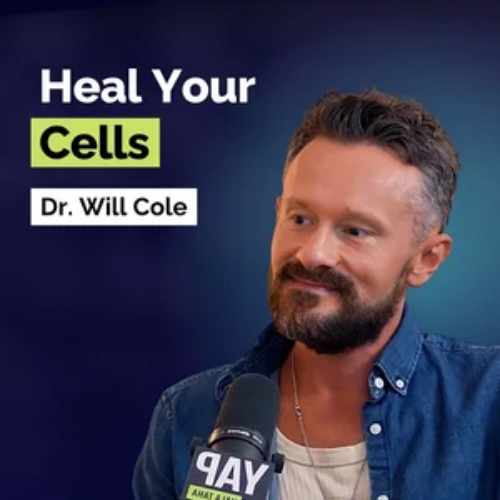
Dr. Will Cole: Fix Your Cellular Health to Reclaim Energy, Slow Aging, and Perform at Your Best | Health & Wellness | E415
Despite living a health-conscious lifestyle, Dr. Will Cole found his body overwhelmed by grief after his father’s sudden death and burnout from years of running a clinic, writing books, and hosting a podcast. This constant stress and loss revealed how little resilience his body had left and forced him to understand the role trauma, poor sleep, chronic stress, environmental toxins, and other lifestyle factors have in accelerating cellular aging. In this episode, Dr. Will shares how to support cellular health, reduce the stressors aging your body, and build the resilience and energy needed to keep up with your goals.
In this episode, Hala and Dr. Will will discuss:
(00:00) Introduction
(00:00) Why Your Organs Age Differently
(06:05) Signs Your Health Systems Are Failing
(10:41) Biological Age vs. Chronological Age
(18:30) How Nutrition Impacts Cellular Aging
(26:10) Environmental Toxins Damaging Cellular Health
(38:15) How to Heal Your Cells
(43:22) How Stress and Trauma Impact Health
(50:23) Circadian Rhythm and Deep Sleep Habits
(1:00:53) The Truth About Ozempic and GLP-1s
(1:06:14) Why Functional Medicine Is Going Mainstream
(1:11:37) The Hidden Risks of Unchecked AI
Dr. Will Cole is a leading functional medicine expert, telehealth practitioner, and host of The Art of Being Well podcast. He is a New York Times bestselling author whose latest book, Heal Your Cells, explores how cellular health influences energy, aging, inflammation, and longevity. His work focuses on helping people understand how food, stress, toxins, hormones, gut health, and lifestyle choices shape long-term health and well-being.
Sponsored By:
Indeed – Get a $75 sponsored job credit to boost your job’s visibility at Indeed.com/profiting
Shopify – Start your $1/month trial at Shopify.com/profiting.
Northwest Registered Agent – Get a complete business identity with Northwest. Visit northwestregisteredagent.com/YAPFree and start using free resources to build something amazing.
Mindstone – Master practical AI skills without the complexity with Mindstone’s AI Competency Programme. Head to experience.mindstone.com/yap and get 10% off.
AT&T Business – Stay connected with reliable, secure internet built for entrepreneurs. Switch to AT&T Business at business.att.com.
HoneyLove – Treat yourself to the most advanced bras and shapewear on the market. Save 20% off Honeylove by going to honeylove.com/PROFITING! #honeylovepod
Resources Mentioned:
Dr. Will’s Book, Heal Your Cells: bit.ly/HealUrCells
Dr. Will’s Podcast, The Art of Being Well: bit.ly/TArtOBW-apple
Dr. Will’s Website: drwillcole.com
Dr. Will’s Instagram: instagram.com/drwillcole
Dr. Will’s TikTok: tiktok.com/discover/dr-will-cole
Active Deals – youngandprofiting.com/deals
Key YAP Links
Reviews – ratethispodcast.com/yap
YouTube – youtube.com/c/YoungandProfiting
Newsletter – youngandprofiting.co/newsletter
LinkedIn – linkedin.com/in/htaha/
Instagram – instagram.com/yapwithhala/
Social + Podcast Services: yapmedia.com
Transcripts – youngandprofiting.com/episodes-new
Entrepreneurship, Entrepreneurship Podcast, Business, Business Podcast, Self Improvement, Self-Improvement, Personal Development, Starting a Business, Strategy, Investing, Sales, Selling, Psychology, Productivity, Entrepreneurs, AI, Artificial Intelligence, Technology, Marketing, Negotiation, Money, Finance, Side Hustle, Startup, Mental Health, Career, Leadership, Mindset, Health, Growth Mindset, Biohacking, Motivation, Manifestation, Brain Health, Life Balance, Self-Healing, Positivity, Happiness, Sleep, Diet
Hala Taha: [00:00:00] Will, welcome to Young and Profiting.
Dr. Will Cole: Thanks so much for having me. Can I just say thank you so much for, a few years ago, having me on your podcast and rooting for me then.
And then when I reached out, you answered right away. Mm-hmm. And I said, "I have this book coming out. Like, can I come on the show and chat with you and catch up?" And I just... Your kindness is off camera, and not, not everybody can say that, right? Aw. I can't say that to everybo- everybody. And I... You're the real deal, and congratulations on the network and all the amazing- Thank you
things and see how God's working through you.
Hala Taha: Thank you so much. Well, of course I wanted you back on the show because you provided so much value last time. We talked all about gut health. Yes. I learned so much. You were like one of my first doctors that came on the show, and then I started interviewing, like, so many different biohackers.
Yes. Uh, so that was really cool, and today we're gonna talk about cellular health. Yeah. Because you have a new book that's coming out, I think in September- Mm-hmm ... called Save Your Cells.
Dr. Will Cole: Heal Your Cells.
Hala Taha: Heal Your Cells. Yeah. Uh, and cellular health is so [00:01:00] important. Mm-hmm. And one of the most new things, unique things that I learned when I was- Mm
reading your book is that parts of our body don't age all at the same rate.
Dr. Will Cole: Yeah.
Hala Taha: And that is something I had no idea about. So your, your heart and your kidneys and your immune system and your metabolism all can age at different rates.
Dr. Will Cole: Yeah.
Hala Taha: And so my first question to you is, how is this possible?
Dr. Will Cole: Yeah.
Many people don't know, and not just know this, but why it's so important because when we're looking at the United States, and really when any Western society right now, but the US specifically spends more healthcare on healthcare than any industrialized nation, yet we have the most chronic disease and the shortest lifespan of all Western nations.
Hmm. And we spend the most for it economically, but we're paying a human price for it, too. Not just in the quantity of our life and not just the quantity of life, but the years of healthy years. Hmm. The health span, not just our [00:02:00] lifespan. But yes, the, one of the cornerstone studies that I talk about in Heal Your Cells, and I wrote the book with Dr.
Josh Axe, a friend of mine- Mm-hmm ... a colleague of mine in this, in the functional medicine space. It was a Stanford study. It was published in Nature in 2023. They found that one in five Americans have at least one organ aging more rapidly than other organs. Hmm. And why that's important is... And, and that equates to about 23 million Americans.
That's a lot of people. But why it's so compelling and why we wanted to write about this and other longevity research is it's all down to cellular health. I mean, if you can actually heal the cell, you can deal with a lot of these chronic diseases.
Hala Taha: Mm-hmm.
Dr. Will Cole: If your brain cells were aging more rapidly-
Hala Taha: Yeah
Dr. Will Cole: the researchers at Stanford found that you had about an 80% increased risk of a neurodegenerative issue- Wow ... like Alzheimer's or- Mm-hmm ... some sort of neurodegenerative problem. If your heart cells were aging more rapidly than the rest of your body, you had about a [00:03:00] 250% increased risk of heart failure, heart attack, and stroke, which is one in two Americans.
Hala Taha: Mm.
Dr. Will Cole: Are-- It's killing one in two Americans. Yeah. And 50% of Americans that have a heart as- a heart attack, their first symptom is death. And I lost my dad suddenly in a car accident because we think he had a heart attack- Mm ... or at least some cardiovascular event, lost consciousness, and it caused him to crash the car.
So that was one of the pivotal roles of me just diving into, okay, why is this happening? Yeah. Why are so many people, not just people in their 60s, the baby boomers, but we're seeing so many people getting heart disease, heart c- um, cardiometabolic problems, autoimmune problems-
Hala Taha: Yeah ...
Dr. Will Cole: cancers in their 20s and 30s and 40s.
And
Hala Taha: they look healthy. They look- They look- ... fit and muscular and healthy, but then underneath that all, they might have heart issues.
Dr. Will Cole: That was my dad. He was a bodybuilder. He was into fitness. He was into health. He was here one second, gone the next. And I've seen s- and Dr. Axe, who wrote the book with me, had [00:04:00] his father-in-law, same thing.
W- All, did all the wellnessy stuff. Yeah. Here one day, gone the next. So this concept of uneven aging, and not just looking at problems for the sake of it and saying, "Well, we can't do anything about it." Actually, it's the empowering thing is when you know what you're dealing with, you can do something about it.
'Cause largely, these things are reversible, healable, overcomeable things. Mm-hmm. But we have to do something different to see something different, which is why we called the book Heal Your Cells. Mm-hmm. And the subtitle is Reversing the Irreversible. Because the world and the system that the world runs in says there's nothing you can do.
Just take this medication. See you later. But actually, the science is pointing to actually quite the opposite. We have a lot of agency on our health, but we have to actually do something about it.
Hala Taha: Yeah. And what else was interesting for me is the fact that when we're looking at our body, it's, it's better for us to think about what is the system that is failing the most, or, like, what is the system that I need to be worried about the most?
Like, am I having gut issues? And, like, that's the thing that I really need to focus on [00:05:00] first. So you really wanna figure out what is the system that is failing the most and work on that first, correct?
Dr. Will Cole: Absolutely, yeah. Now, there, on a clinical level, 'cause we still run a telehealth clinic. Yeah. So obviously for telehealth patients, we run labs.
Mm-hmm. We can look at DNA me- methylation and some of the hallmarks that the Stanford group- uh, looked at. We can look at these different organs. Ele- 11 different organs is what Stanford looked at. And we could look at similar ones of how cells in specific type of organs, and not just the organ cells themselves, but s- the type of cells within the organ.
That's the follow-up study just this summer. They're just in June of this year. Different types of cells within that same organ can age, age more rapidly. Mm. So we can get very precise. Yeah. This is just cutting edge stuff. But yes, we have to know what organ's aging more rapidly or what's your pain point.
Everybody has... There's so much bio-individuality to that, right? Yeah. Based on genetics. But genetics loads the gun, epigenetics pulls the trigger. There's something in our life that's causing that [00:06:00] accelerated clock- Yeah ... that, that cell clock to be ri- uh, uh, aging more rapidly. So yes, we look at labs, DNA methylation, inflammation markers to look at that, and somebody's health history obviously is important, and their family history is important.
But beyond that, in the book, we adapted questions that we ask new telehealth patients. It's a cellular health report card to kind of see- Mm. It's not the same as a lab, obviously. Yeah. But I wanted people to see what organ may be the weakest for me. Mm. Maybe for some people it's their gut, and they always have digestive problems.
Mm-hmm. And there are some good clinical pearls, some telltale signs that their body is giving them a proverbial check engine light. Yeah. Like, something's off here. Um, the body's nudging them to pay attention. In our hustle culture, we're so divorced from our body, and our body some- is oftentimes is giving us some clues.
"Pay attention to me. Pay attention to me." Um, and we're no- we're not aware or conscious or paying attention to these s- signals that our body's giving us.
Hala Taha: Yeah. Most of my listeners are, like, late [00:07:00] 20s to, like, early 40s. Mm. Even some, some, like, late 40s, 50s. What should we be pa- Like, what are the common things that we should be paying attention to in, in terms of, like, realizing that a system is failing?
Dr. Will Cole: Another study Published in Nature. Nature has so many good studies on PubMed. But this is j- another summer of 2026 study, recent study, that found that people born after the age, the n- year 1965- Mm-hmm ... were aging significantly more rapidly than people born prior to 1965. But specifically, people born in the 1990s.
Basically, every decade after 1965. S- if you were born in the '80s, '90s, 2000s, every decade, the younger you are, you are actually aging more rapidly than the people older than you at the same age.
Hala Taha: How does that make sense, though? Because everybody says we're living longer.
Dr. Will Cole: We're living longer lifespan by a few years, but it's not a great healthspan.
Hala Taha: Mm.
Dr. Will Cole: So we're aging more rapidly, [00:08:00] but we... So we can keep people alive longer today because of modern medi- medicine, but we can't keep them healthier with modern medicine. So we see that in elderly homes, right? Mm. I mean, they're alone- Mm-hmm ... hopped up on tons of, tons of medication- Yep ... completely sedentary, and depressed.
It is a miserable existence. So that's not what we're talking about here. So yes, adding life to your years, but can we also add... Uh, let me say that. If I could cut that- Yeah ... maybe cut that. So of course, we wanna add years to your life, but can we also add life to your years? Mm. And that's what all this whole longevity chatter in the biohacking space, I think they lose the plot because it's like, what's...
how can we add quality of your life to the here and now?
Hala Taha: Yeah.
Dr. Will Cole: Not just look for the promise to the future. Which of course, I'm interested in living a long, thriving life, and being able to play with my grandkids someday, and enjoy life, and not be in that space- Mm-hmm ... that many elderly people find them.
But for [00:09:00] myself in my 40s or people in their 20s and 30s, like, how can we enjoy life now? I see so many of my friends that are kept back from living the life that God created them for because they're fatigued, and they're- Mm-hmm ... have nervous system dysregulation. They have other inflammatory problems.
That's not a great quality of life. So yeah, the science is pointing to the fact that there's many people in their 20s and 30s and 40s that have cells of 60-year-olds today.
Hala Taha: That's crazy.
Dr. Will Cole: Common, not normal.
Hala Taha: I, I really wanna dive deep on this whole concept of aging, and there's all these different, like, aging phrases or, or ways to calculate it.
You've got your biological age, you've got your chronological age, and you've got your cellular age. Yeah. Can you break down the differences between those?
Dr. Will Cole: Yeah. So the chronological age is how much, how many years, like how many birthdays have you had? Mm-hmm. The biological age and the cellular age, I would say pretty much the same.
Mm-hmm. It, it's the overall understanding what's happening at the cellular level. What, what's your cells' age? Hmm. Which can [00:10:00] be very, very different, and we can actually quantify this. Yeah. Looking at different metrics like inflammation, like DNA methylation, and other health biomarkers that can aggregate more or less where your cellular age is.
Hala Taha: Yeah.
Dr. Will Cole: And many people are aging more rapidly. Um, but it's... Many people think, well, to your point, people in their 20s and 30s or 40s, I don't have to be thinking. This idea of longevity isn't really sexier and they're not really into it, and that's why it's like, to me, they're missing the point. The missing point is like, yes, we all kind of have a cellular credit score, whether you know it or not- Mm-hmm
and we can improve it. And what you are dealing with in your 60s and 70s and 80s, you actually start investing in in your 20s and 30s and 40s. You can't wait until you're in your 60s to be like, "Yeah, I care about this now." You have to start building this now and investing in your health now. Mm-hmm. But even if that still, if your st- head is in the sand for the future, and that may be the case- That [00:11:00] quality of life's actually more important for me.
Yeah. It's like what are they doing, like the talent and the time and the vision that they have in their life to not be kept back. That's also a sign if somebody's not thriving in their life and being the best version of themselves, that's also a sign that their cells are aging more rapidly.
Hala Taha: Yeah. So I actually, for the first time ever, I'm gonna be taking one of those, uh, aging tests, like a really popular test.
Mm-hmm. It's gonna have 160 labs and, uh, I'm gonna get my biological age. Now what do you wanna tell me in terms of when I read that biological age? What should I take seriously or not seriously? How should I be reading that? Do you
Dr. Will Cole: know some of the biomarkers they're looking at?
Hala Taha: It's Function Health so it's-
Dr. Will Cole: Okay.
Yeah, yeah ... you're
Hala Taha: probably familiar with.
Dr. Will Cole: Yeah, yeah. So they're, look, uh, and Function Health is, I don't know all the labs that they're running, but they're running a lot of good conventional lab data. I, I diner it out on this stuff. And what, what, what we're also gonna... What, what, what we would look at, and Mark Hyman's a friend of mine and, um, they're doing [00:12:00] amazing things over there.
And what we do with our telehealth center, it's similar but one-on-one. It's not, uh, like, uh, you know. It's we're seeing people one-on-one online. Mm-hmm. Um, I would take all of that data important. It, it, I would take it all important. Knowing what you're getting done, I think all of this conventional data is important.
There's gonna be bigger deals and smaller deals potentially, right? So I think the context around these biomarkers matters. What I think you should do is actually send me the labs afterwards- Mm-hmm ... and I will give you my hot take on it. I will definitely do that. Yeah. For sure. So I think one of the things I would look at, this is what I'd look at.
Well, let me just say this. Yeah. I am h- I am assuming everything's gonna be fine.
Hala Taha: Yeah.
Dr. Will Cole: You're a healthy, vibrant person, and I don't want people to become hypochondriacs or become obsessive about this. Stressing about your health isn't good for your health either. Yeah. Exactly. So I, I'm gonna assume it's just gonna be a good pat on the back and say, "You're doing everything great," and cool.
It's a snapshot in time. It's a re- g- great report card, and we can check in next year. Mm. That's what I would assume. [00:13:00] But if there is something off, the beautiful thing, the grace in all of this, is that by you being proactive about your health- You could do something about it, you know? Uh, like Maya Angelou said, "When you know better, you do better."
Mm-hmm. Well, labs are a know better thing, and you can do something about it. So I think, uh, some of the areas I think are the most, uh, helpful for the average person are s- inflammation markers. Mm-hmm. And you're gonna go look at that high sensitivity C-reactive protein. Homocysteine is another one. Uh, specifically having to do with cellular...
Both have to do with oxidation. Because when they're high, it's the cells kind of saying, "Hey, I'm not safe."
Hala Taha: Hmm.
Dr. Will Cole: And they're trying to protect us, trying to protect themselves. But it's so- showing that something is threatening the cells-
Hala Taha: Yeah ...
Dr. Will Cole: and we wanna find out what's the root upstream cause of that threat.
And it could be both physiological, physical, or mental, emotional, spiritual, things like stress and trauma, and looking at both of those things. And that's where health history comes in. So I would say let's look all of it. And then the great [00:14:00] thing about looking at conventional biomarkers like that is we are, also can look at the tighter interval within that larger reference range of where our body functions the best.
Mm-hmm. And that's where we get our name in functional medicine. So we're looking at optimal, not average, which, which we probably talked about the last time I was here. But the lab's reference range is based on that statistical bell curve average of people who go to labs.
Hala Taha: Got
Dr. Will Cole: it. People that go to labs aren't the healthiest group of people.
So we're look- Mm ... we're looking is where does the longest vibrant li- like lives live? Where does the health span longevity people live? That's the functional range. So, uh, yeah, I think that that's a great illuminating, proactive tool for you to then ha- say, "Okay, what's, what are the thing- things I need to focus on?"
Hala Taha: Yeah. But in terms of the biological age that they're gonna give me- Oh ... I feel like every time I hear somebody tell me their biological age, it's always younger than their chronological age. Are
Dr. Will Cole: they lying to us, maybe?
Hala Taha: I don't know. Like, is it real? Should we really take that, like, seriously?
Dr. Will Cole: There's a, there's a lot of labs out there that I don't know [00:15:00] their system and, uh, like what- Yeah
they're basing that calculation-
Hala Taha: Mm-hmm ...
Dr. Will Cole: on. Uh, so not everything is accurate out there. So I'd wanna look at the reproducibility, the, the credibility- Yeah ... of the tests. But this, like for example, the Stanford researchers and us looking at DNA methylation, it's an estimate. These are estimates- Yeah ... of like more or less where can they be.
But I think, um, you know, we wanna put the, the all labs in, in context.
Hala Taha: Yeah. And also, like you mentioned, like the people who get labs are usually unhealthy. Yeah. So you're
Dr. Will Cole: like-
Hala Taha: Well,
Dr. Will Cole: who are you comparing
Hala Taha: yourself to? ... basing it on the average, like, unhealthy- Yeah. ... sort of person maybe.
Dr. Will Cole: Right. It's... Yeah. Yeah.
Exactly. But I think it's a, a ballpark is what I would say. A lot of these labs can say a ballpark. Am I trending in the right direction or am I not?
Hala Taha: Mm-hmm.
Dr. Will Cole: Uh, and it's not, it's not, uh, you know, it's not even. That's where as, as we talk about in Heal Your Cells. Yeah. You may be great in some areas, and then some pain points in other areas.
So it's... I think the [00:16:00] context around this data is important.
Hala Taha: Yeah. So there's lots of things that impact your cells. One of them is what you eat. Mm. Of course. Talk to us about, you know, s- uh, I feel like there's a lot of information out there about what we should- Mm-hmm ... be eating, but what's your, like, best guidance in terms of how to navigate-
Dr. Will Cole: Yeah
Hala Taha: our nutrition?
Dr. Will Cole: The f- the food, foods are instruction manuals to ourselves, right? I mean, they're determining how quickly or how slowly that cellular clock ticks and tocks. And, you know, we all have that sort of L- we have agency on the rapidity or the slowness of that cellular clock ticking. So it's not just about what we're eating, it's when we're eating.
A lot of researchers are talking about the chronobiological disorder. So basically, things like type 2 diabetes, heart disease, and, and insulin resistance feeds many types of cancers. Mm-hmm. That is this, yes, these are inflammatory problems, but and the foods we eat either feed inflammation or fight inflammation.
There's no neutral food. There's no Switzerland, I'm doing nothing for your [00:17:00] physiology meal. But so what you eat matters, but when you eat, the science is pointing to also. Mm-hmm. So the whole concept of time compressed feeding or time res- restricted feeding, intermittent fasting- Mm-hmm ... or fasting mimicking ways of eating is a tool that we have to slow down that cellular clock.
So it's ... You're, you are right in the sense of you're gonna ... You ask 100 different doctors in the wellness space, you're gonna get 100 different opinions pretty much.
Hala Taha: Mm-hmm.
Dr. Will Cole: Uh, I-- We can get into the granular details of it, but I think there's so much bio-individuality to this topic. Yes. 'Cause I look at people and their health history and their labs all day long.
So if I hung my hat on one way for everybody, I'd be proven wrong all day long. Yeah. 'Cause it's ... You could say, for example, a, uh, Mediterranean diet, you know, has lots of great studies around it, right?
Hala Taha: Mm-hmm.
Dr. Will Cole: But what if that person has FODMAP intolerance from SIBO, and they, they eat lots of greens and grains, [00:18:00] and it's causing a lot of bloating.
So do you say keep doing that? It doesn't make that version of the Mediterranean diet, and there's different ways to even do a Mediterranean diet, doesn't make that bad, but it makes it-- it's not loving that person back right now. Mm. So and then there's many examples of that. Things like fermented foods, right?
They, uh, have a lot of data. I love a s- the data on sauerkraut and kimchi and kefir, but if you have histamine intolerance, mast cell activation syndrome, which we see a lot clinically, that's gonna flare some people up. Mm. Does that make... Even bone broth. Bone broth's like the pinnacle of the gut health food that we talk, talked about for years.
It can be, depending on how you cook it, can be higher in histamines. Mm. So there's no har- There's very few hard and fast rules other than, of course, eat real food- Yeah ... and decreased processed, ultra-processed foods. If I had to say what are the inflammatory core four that don't love most humans back, would be gluten-containing grains-
Hala Taha: Mm-hmm
Dr. Will Cole: industrial seed oils like canola oil and soybean oil, and that, specifically, we talk about it in the [00:19:00] Heal Your Cells, how that impacts cellular membrane health. Uh, added sugar in the absence of fiber, and then I would say conventional dairy. Now, there's better for you versions of even those. Mm. Like a sourdough ancient grain- Yeah
wheat can work for some, some people, not for other people. There are better seed oils, like a, a organic cold pressed Uh, sunflower oil technically is seed oil. Um, but is it, is that what's killing America? No. Yeah. Uh, so to lump all seed oils or to lump all grains or to lump all dairy or to lump all even sugar is reductive.
Hmm. So there's a lot of nuance and context to these conversations. So I like getting into the weeds of like what loves your body back. Yeah. And that's part of what we teach in the book instead of this sort of like this is my camp. This is the carnivore camp or the vegan camp or the Mediterranean, whatever, ke- uh, keto camp.
We're all different and even within the camps, there's still a lot of variation and bio-individuality to these- [00:20:00] Hmm ... food conversations- Yeah ... nutrition conversations.
Hala Taha: Yeah. So I wa- I wanna dig deep on this concept of biochemical individuality. Yeah. And that was, uh, a concept that was discovered, I think, by Dr.
Roger Williams.
Dr. Will Cole: Yes. Wow, you've done your research,
Hala Taha: Erin. I have. And so I'd love for you to tell us what he discovered exactly, 'cause I thought that was really cool.
Dr. Will Cole: Yeah. Yeah. That's... We talk about it in the book, is that the w- it's we're all unique. We're all unique. And he was called a quack. He was k- uh, people kind of poo-pooed him.
They didn't understand it. Any disruptor, you know, it's they vil- d- typically vilified at the start and then years later, oftentimes before these people are gone, like, after these people are gone, that's when they're validated and science catch up, catches up with these guys, these pioneers. Science catches up with antiquity.
That we're so unique- Mm-hmm ... the idea that this is gonna be a one thing for everybody, and that's one of the [00:21:00] blessings, uh, and I use that word loosely there, of AI-
Hala Taha: Yeah ...
Dr. Will Cole: that we can use AI in smart, hopefully smart, regulated, thoughtful, constrained ways to be more precise. 'Cause there's only so many hours in the day, and I'm only one human being for me to say, "Okay, how many people can I even help in a day?"
Um, and then on top of that brain power of a human. Yeah. So to get precise and like we were talking about- Mm-hmm ... with lab data, getting more precise on not just food prescriptions, quote unquote, um, but also on herbal peptides, mind-body practices- Yeah ... all these things. So I am hopeful that we can get more...
But that's what that doctor was talking about, is that we're all different. Yep. And the idea that we can say we could have 100 people with a low thyroid problem, for example And what one low thyroid case needs that the other person doesn't need. Is it under conversion of T4 to T3? Is it Hashimoto's disease?
Is it thyroid resistance? So he didn't get into the [00:22:00] weeds of that, but I think he saw enough in his research to show that there's so much bio-individuality to this concept, and that is, was talked about decades and decades ago in hi- in, in his life, um, that now this is the future of medicine- Yeah ... is precision medicine.
This is how
Hala Taha: healthcare is evolving now.
Dr. Will Cole: Exactly.
Hala Taha: With functional health- So they're just- ... and your company and everything like that ...
Dr. Will Cole: yeah, they're just confirming what our, our, uh, the f- the, our ancestors knew all along.
Hala Taha: Yeah.
Dr. Will Cole: Yeah.
Hala Taha: So we're not only what we eat, right? There's other things that we're absorbing from the environment, and the environment is impacting us with different toxins.
Can you talk to us about all the different toxins- Oh, man ... that we're dealing with?
Dr. Will Cole: Right. And there's... I, I'm hesitant even when we talk about... It's important to talk about. Yeah. I'm glad you brought it up. But that word is so overused sometimes- Yeah ... and then people end up stressing and have anxiety about this stuff, and then, or they just shut down and like, "I can't do [00:23:00] anything about it."
You don't have to have perfection to start improving your health.
Hala Taha: Yeah.
Dr. Will Cole: You do not have to live in some non-toxic plastic, BPA-free plastic ... bubble because that's not, stressing isn't good for your health, right? Yeah. This is so important, guys. So I, this is the context of this, but we still have to talk about it.
Mm-hmm. We can't just have our head in the sand and because it may ruffle some feathers. But yeah, it's, it's a pro- it's a massive problem. M- I mean, the overwhelming majority, almost all of us have these forever chemicals, microplastics in our body. Mm-hmm. Common, not normal. I look at these environmental toxin tests, I see them high on nearly everybody, and by high, I mean even trace amounts.
But is there a healthy amount of microplastics in somebody's body? Especially when researchers are finding that it's, it may be these microplastics, at least a piece of the puzzle, contributing to this because they a- accumulate in the plaque, the artery, uh, arterial plaques, actually contributing to this inflammatory response 'cause the body's like, "What the heck?"
So [00:24:00] the immune system cells are saying, "I need to get this microplastic or forever chemical out of the artery." Yeah. And is that why we're seeing one in two Americans having heart attacks and strokes? It's implication in cancer, infertility issues, which the United States is below the to- total replacement level, meaning we have a massive, uh, fertility problem.
Yeah. I mean, I think it's 70% of the world is below the total replacement level, meaning we don't have enough people to replace ourselves without immigration. I mean, this is where we're at as a world today. Wow. Why? What has changed? It's not our genetics. It's the environmental issues. Mm. Um, so and then I, I, another thing I look at are these herbicides and pesticides.
I mean, most of the people that I measure on labs have these things coming out of their urine. There's not a normal amount of pesticides that be, should be coming out of your urine. Yes, I'm glad that your body's brilliant enough to clear this stuff out, but why is it in there in the first place? So it is another thing that you can, as you can imagine, make our cells feel unsafe.[00:25:00]
Hala Taha: Yeah.
Dr. Will Cole: So the body has this innate ancient mechanism called the cell danger response, and that cell that's meant to protect you- There's these pathways that upregulate to say, "I need to defend you," and the cells get defensive. And that's happening on a micro level. The cell membrane, the sort of gatekeeper that gets nutrients in and gets by- byproducts of energy out, becomes more hard- Mm
becomes more rigid. The cell membrane loses its fluidity, and, and it becomes oxidized, almost like a rusted, um, cell. Mm. And where- what's happening on the membrane, it's also receptor sites for different hormones, so that's implicated in the sort of hormonal crisis we're seeing today and fertility issues being a part of that.
Um, but these sirtuins get stressed out, especially from environmental toxins that we're talking about. Herbicides, pesticides, microplastics, forever chemicals- Mm-hmm ... heavy metals. Um, these guardian angels of our DNA, of our genome as a whole, these sirtuins then kind of are playing catch-up, just trying to de- pr- defend your [00:26:00] cells that it can't keep up.
So these whole mechanisms get thrown to this threat state. So the p- the goal is not to avoid them en- these environmental toxins entirely, 'cause we can't.
Hala Taha: Yeah.
Dr. Will Cole: But the body's amazingly resilient, but we have to give it a fighting chance. Mm-hmm. And we don't have the wiggle room that our ancestors had.
'Cause these, most of these environmental toxins have only been in the human landscape for a few decades. Mm-hmm. A blip in time when you're putting that into context with the totality of human history.
Hala Taha: Mm-hmm.
Dr. Will Cole: So something to deal with, not obsess about, not to live in fear around, because the body does have these mechanisms to clear this stuff out, but we have to actually facilitate it.
Hala Taha: Yeah. So talk to us about that. What are, like, two or three practical things that we can do to just reduce the amount of environmental toxic load?
Dr. Will Cole: It starts with what's in your house, right? I mean, you could go really basic. The Environmental Working Group has a new list every year or so. They update it.
It's the Clean Fifteen and the Dirty Dozen. I think that's a basic. Most people know about it. But just go and [00:27:00] look. It's the produce, the fruits and vegetables mainly that are... The Clean 15 are the fruits and vegetables that tend to have the lowest herbicides and pesticides, and the Dirty Dozen tends to have the highest.
Hala Taha: Okay.
Dr. Will Cole: Um, so shop there. Meaning that if you're on a budget- And you can't buy all organic or don't have access to all organic, don't stress. Do the best you can and give the rest to God because you don't have, it doesn't have to be perfect. Wash off the, the clean 15 if it's conventional and not organic.
But swapping for organic fruits and vegetables whenever you can is a good idea.
Hala Taha: Okay.
Dr. Will Cole: I mean, we could go through the whole house, but we probably don't have time for that. But like the, it's, the kitchen's one area that I would say swapping out any non-stick pan-
Hala Taha: Okay ...
Dr. Will Cole: for either a cast iron skillet or a non-toxic non-stick pan.
Hala Taha: Okay.
Dr. Will Cole: Because that's a major, just a single scratch. This is a study out of California, I believe. Just one scratch of a non-stick, a conventional non-stick, like a Teflon [00:28:00] type pan- Mm-hmm ... release over 9,000 plastic particles.
Hala Taha: Wow.
Dr. Will Cole: Right. I mean, wild. So super simple. Like, there's swaps for most of these things. So look at the things you're using on a daily basis.
The, the bioaccumulation, the sort of cellular accumulation that can happen when your cells are like, "Okay, cool. Here and there, no big deal," but you're cooking here every single day or you're having this thing every single day, that's where things can add up.
Hala Taha: Yeah.
Dr. Will Cole: And then look at all the other, I mean, going to like quickly the, the laundry room, like swapping out your laundry detergents and soaps and things like that.
It should not be smelling like this fake sort of- Yeah ... scents. Like just swap out, guys. Like there's so many better things. You can get at Target and Costco and Sam's Club that are decently priced that don't have all these scents and additives. And then going up to the, the personal care stuff. Like really vet the makeup you're using, the skincare products you're using.
Really important. And then you can get into the weeds of all different types of things. I [00:29:00] think EMFs are actually something else that you need to look at. It's invisible, but, uh, doing the best you can to minimize EMFs is a great thing. So even if it's just turning off your Wi-Fi router at night. Mm-hmm.
Like, do you really need the Wi-Fi at night? I mean, so, some people do, 'cause their, even their alarm clock's attached to Wi-Fi. But I would get the gold fashioned-
Hala Taha: Really? Like actually turn off your Wi-Fi, not just like put your phone away? Y-
Dr. Will Cole: I mean, look, I mean, you could. The more you do, the better.
Hala Taha: Yeah.
Dr. Will Cole: So do the best you can with whatever doesn't stress you out.
Like, I don't want people to become maniacal zealots about this, but- Meet yourself where you're at.
Hala Taha: Yeah.
Dr. Will Cole: Lean into it, and then progress over time as this becomes less overwhelming. Mm-hmm. So yeah, s- base, sleep with that phone outside of the room. But I would go a step further and turn your Wi-Fi off, 'cause you're sleeping in an electric box.
Yeah. So you want those... 'Cause that's another thing that accelerates cellular aging is our sleep. Mm-hmm. Our, our la- uh, light itself, like the blue light, it, that's, uh, accelerating our cellular clocks [00:30:00] as well, but it's these deep sleep states that we need to get to. Yeah. And some people are more sensitive to this than others, and you can track on the, sort of the wearables, but even that has low-grade Wi-Fi.
So I don't even like using those trackable devices, like the rings and the bands- Hmm ... long-term for most people because, A, it's like, okay, do you really need more data for ad infinitum, forever and ever? Then you stress about-
Hala Taha: Yeah, you're just
Dr. Will Cole: like- ... your sleep score ... non-stop
Hala Taha: stressing.
Dr. Will Cole: But I do think using technology smart, pointed, pulsed when it makes sense, and then keep it intuitive and basic, and yeah, minimize EMF exposure as much as possible.
Some of these are small. I don't wanna overblow it, the small frequencies, but it's adding up. It's Wi-Fi there. It's, it's, it's 5G there. It's your phone sitting next to you right there. So it's the overall entourage effect that all of this stuff plays. So the more you can start to take a dent into how much you're exposed to is a good idea.
I mean, you could go all the way up to wearing, like, [00:31:00] covering your bed with a Faraday cage- ... which blocks EMFs entirely. Depends on how nerdy you wanna get.
Hala Taha: Yeah.
Dr. Will Cole: Um, but yeah, the more you do, the better.
Hala Taha: Totally. And I think for a lot of the listeners tuning in, we probably are pretty good with our eating.
Like, we've been taught for a long time, like, avoid processed foods, fats, sugar- Yeah ... all these things. But environmental toxins is probably something we can all focus a little bit more on.
Dr. Will Cole: Yeah.
Hala Taha: And there's also biological- toxins and I believe like metabolic toxins- Mm-hmm ... which I didn't realize was a thing.
Dr. Will Cole: Oh, yeah. Well, when your cells, back to that cell danger response, if your body's all feeling unsafe, and the goal of this is from physiologically or physical factors, whether it be an environmental toxin or food that doesn't love you back, or eating too mu- like eating too late and you're not getting a reprieve.
Mm-hmm. Uh, or it's things like stress and trauma. Anything, whether it's physical or mental, emotional, spiritual, what's making your cells feel unsafe? When that, when that [00:32:00] happens and that cell membrane becomes more rigid, your mitochondria starts shifting from producing ATP. These are the cellular energy factories of your cells, and you need it for energy.
So think brain fog, fatigue. A lot of people's health problems are actually mitochondrial issues. But then it becomes, you almost... We get these leaky mitochondria. You know how people have like leaky gut syndrome- Mm-hmm ... or leaky brain syndrome, which is impacting anxiety, depression, and brain fog and fatigue.
But you're actually, on a cellular level, you're, you have leaky mitochondria with this threat, hypervigilant cellular state, and your cells are releasing these reactive oxygen species. So these bypro- products of energy, which stre- stresses out the sirtuins, those guardian angels of the genome, even more.
They're like, "Okay, I need to defend you, but you're not giving me a reprieve here." They're always working. Hmm. So they kind of lose their way in just trying to maintain the backup of these toxic byproducts. The problem is, because the cell membrane is more rigid, [00:33:00] these bo- these toxins aren't able to get out of the cell as easily.
Hmm. So that's why healing the cell membrane is a key part of what we talk about in Heal Your Cells. Yep. And just clinically, it's just so important because that's where the hormonal receptor sites are, but that's also where nutrients get in- Mm-hmm ... i.e. nutrient deficiencies at a cellular level, but also getting the bad stuff or bypro- it's not even bad, but it's just an accumulation.
It's too much of something that's part of nature. Mm-hmm. But we just need a homeostasis in the body. But when the cell is stressed out, homeostasis is impossible.
Hala Taha: Yeah. Well, I, I have so many questions. Uh, let's spend some time on how we heal our cells. So similar to how different parts of our body age faster, also our cells can renew, and they all renew at different rates depending on the body part.
So like skin is pretty fast. Yeah. Blood is fr- pretty fast. Your stomach, your stomach is pretty fast. Uh, but then other body parts are, are slower. So why is that the case?
Dr. Will Cole: Yeah. Well, the simple answer is the way God made [00:34:00] it. Yeah. It's just how quickly or how slowly those cells function, right? Okay. And some, so we have a greater grace period in certain, like our, our gut's amazingly resilient, right?
And the brain, in theory, uh, is, is healing and can heal, but it's gonna take slower for a lot of these, uh, like myelin sheath destruction or neuroinflammatory spots. It's like, oh, in, in theory if you lived long enough it could heal, but we only have so ti- so much time on this earth, uh, even the longest living of us, right?
And I want people... This research is clear. There's no reason why most of us can't live over 100 disease-free, healthy, vibrant years. So that's the healthspan and lifespan aspect of this. But theoretically, the nervous system, which is one of the more slower areas to heal, it can heal, but you'd have to live to like over 250 years old or something like that.
Mm-hmm. You know, not that long maybe. But you know what I'm saying. The body is always healing, some more rapidly than others. Yeah. Um, so why, another reason why it's so important to find out what's your [00:35:00] cellular report card- Mm ... because if it is this area that is like we can't do much about it, it's just a slower healing area, you have to get on it.
Hala Taha: Yeah.
Dr. Will Cole: Versus your gut, not to say that it's not difficult for some people, 'cause it can be very difficult, but I've seen the gut repair pretty dang quickly.
Hala Taha: Really?
Dr. Will Cole: Yeah. So it's like there's different areas that, uh, we ma- have more of a grace period than others.
Hala Taha: Mm-hmm. And there's an order of operations in terms of like what we should do to actually heal ourselves, correct?
Dr. Will Cole: Yeah. Yeah. Yeah, it is. And, and for the sake of the book, I wanted to keep it as simple as possible, uh, 'cause there definitely is an order of operations. Yeah. We have to stop this toxic load I think was one of the first things we need to do, which we kind of touched into. Yeah. Like start, if you haven't, lean into the food aspects of it.
Lean into the environmental toxin to mitigate this. And then we didn't go deep into it, but yes, what we feed our ma- body matters with breakfast, [00:36:00] lunch, and dinner, but what are we feeding our head and our heart on a daily basis? Mm. And the epidemic rise of spiritual disconnection, this sort of lack of some spiritual faith in our, in our life as a humanity, that's also creating this cellular danger response.
Mm-hmm. I would really What, look, looking at the content and the, the constant stream of information we're consuming on a daily basis, that's impacting the cellular rapidity as well.
Hala Taha: Yeah.
Dr. Will Cole: So not to be perfect, not be, become obsessive, but to say, "How can we minimize the things that aren't loving us back?" And maybe it's a food, or maybe it's a relationship, or maybe it's a job that is unsustainable and it's a toxic job.
Mm-hmm. But these things matter because what good is it if you've narrowed down the nutrient dens- dense most amazing super food, clean eating you can think of, but you're serving your body a big slice of stress every day?
Hala Taha: Yeah.
Dr. Will Cole: Or you're serving your body a [00:37:00] big bowl of traum- unresolved trauma every day in our body.
These are more nebulous, more abstract and complex certainly, but they're really important. So I think one of the first things is just taking an inventory-
Hala Taha: Yeah ...
Dr. Will Cole: of, like, what are the things that aren't loving my body back right now? Because those are the things that are causing your cells to become defensive-
Hala Taha: Mm-hmm
Dr. Will Cole: and age more rapidly.
Hala Taha: Yeah, and not just like you said, not just physical, but mental as well.
Dr. Will Cole: So important, and it's hard because it's more prescriptive for me to say, "Eat these foods. Do this type of fasting. Take these peptides," all helpful tools. But how do you say don't have that stress or trauma? Yeah.
You can't say that, right? But it's so important, so we dig into it in the book. 'Cause I see people do all the good biohacking wellness stuff, right? Yeah.
Hala Taha: They wanna jump to that first.
Dr. Will Cole: Right, and right. But and I get it, it's more linear and, uh, black and white, but these complex things need to be dealt with.
I'm not saying you have to address it all right now, 'cause that's not how it works, but you need to at least lean into these dark corners of somebody's health. So I would say [00:38:00] that's... If you talk about order of operations- Mm-hmm ... I think this is one of the first things that people need to do, is even acknowledge the things that are not loving them back at this point that's causing their cells to become defensive, that's accelerating these pathways.
Mm-hmm. Because these beautiful pathways that are meant to heal you are completely dampened when you have both either physiological or psychological stress in your life. Your body on a cellular level can't even distinguish between the two. Whether you're, it's an inflammatory food or a toxic relationship or a burnout job, your cells all kind of respond the same way.
Hala Taha: Yeah.
Dr. Will Cole: So how do we let your cells know that it's safe? Cellular safety will cause a ripple effect of healing- Yeah ... in your life.
Hala Taha: You actually have a great story in the book that really illustrates all of this. So you mentioned earlier your dad- Hmm ... uh, tragically was killed in a car crash, and you said that you got grief body- Hmm
at that time.
Dr. Will Cole: Yeah. Yeah. So backing up a [00:39:00] little, this is 2023.
Hala Taha: Mm-hmm.
Dr. Will Cole: So I was on the eve of My f- last book before this, uh, Gut Feelings, which talked about stress and trauma- Mm-hmm ... and around this, how that impact gut health, uh, and autoimmunity. And it was a book about stress and trauma, so the irony was not lost to me of, like, my dad was here.
And we had a, we had a great relationship towards the end, but as all parent- I think a lot of kids can say, yeah, sometimes our relationships with our families are complicated sometimes. And it was healing. It was, like, getting in a great place. And that's the... I'll have to ask God one day, I don't have the answer, of like, "Wow, why could it have been the best it could be and then he's gone?"
Hala Taha: Mm-hmm. Yeah.
Dr. Will Cole: But I- that was part of it all, of like, dang man, time is so sh- short, right? Yeah. And we don't know the time we have. Um, so yeah, it was all of that, of like replaying it in my mind and then thinking this guy that was the picture of health and then here then gone the sec- [00:40:00] gone in a neck- gone in a split second.
And then lots of unanswered questions with the car accident, and then having to see, not to get too graphic, but like- Yeah ... your bloodied dad on a t- metal table at a hospital- Yeah, it's worse ... and he's already gone. It's, it's, it's never easy, whether it's a slow loss or a quick loss. But yeah, that was the impact that stress and trauma on my body, something had to give.
And the foods that I would be fine with, like I love a good hot sauce, Tabasco. Like, I put Tabasco... I'm one of those guys- Mm-hmm ... that used to put Tabasco on everything. Eggs, anything. What else? My so- my son's off camera. I put it on literally everything. But I couldn't, I had no resilience. Like, my no- my gut-brain axis, your gut's your second brain.
Mm-hmm. 95% of serotonin, 50% of dopamine is made and stored in the gut. So the cells of my gut and the cells of my brain were under like, "Whoa, we need to slow down." And I was back to back. That was my fourth book. I'd run, I ran a full, and still do, run a full telehealth clinic and I [00:41:00] do my podcast twice a week.
So I had to practice what I t- taught, and I'm was, found myself in a, the same place like a lot of our telehealth patients. We know we're doing more than most people are about health. I wasn't eating the standard American diet. Uh, the worst thing that I eat is, like, an organic Valencia peanut butter- ... which, you know, some, some people in my space would say I'm slowly poisoning myself, but I love my peanut butter and I have no shame about that.
Um, the whole point being is, like, I was doing better things than the average person and I still was, like, hit that burnout.
Hala Taha: Yeah.
Dr. Will Cole: And to dig deep into some of the practices that I talk about in the book, like somatic practices and trauma work and EMDR and journaling, to sort of metabolize stored stress and trauma in my body that, yes, it hit a zenith, a tipping point with my dad, but really was a lot more than that.
Mm-hmm. Uh, and that was just the tip of the iceberg. But now, you know, I've never feel be- I have, I feel better than I ever have now, but it took some healing, and I wanted to share what worked for [00:42:00] me in the book. For the people that have done all the things-
Hala Taha: Yeah ...
Dr. Will Cole: how do you take it to the next level? And that's what Heal Your Cells is for.
Hala Taha: Yeah. It's crazy to think, because for me, when I think of, like, mental, like, trauma, I feel like it's like this abstract thing- Yeah ... in your mind, and you don't actually think that it, it's really impacting your physical health. And that's what you're saying, is that- You've gotta heal your trauma-
Dr. Will Cole: Yeah ...
Hala Taha: so that you can fully heal your body.
Well,
Dr. Will Cole: epigenetically it's one of the things that's coding on your epigenetics. It's these co- these instruction manuals for how DNA is expressed. Yeah, it can be environmental toxins or it can be an inflammatory food or eating too often and not having a proper fasting window, but it's also things like stress and trauma.
Actually codes and upregulates these genes that m- we don't always wanna be turned on, like inflammatory genes or, you know, a gene for an autoimmune condition or fertility issues. Whatever the case may be. But they are epigenetically regulating cellular expression. Mm-hmm. Part... That, that saying that I mentioned earlier, "Genetics loads the gun, [00:43:00] epigenetics pulls the trigger."
So yeah, something that's pulling the trigger for one person isn't for the next person, but it typically is a confluence of different factors. And for me it was just pretty obvious that it was the stress piece. Mm-hmm. Uh, and again, for someone that loves what they do- Yeah ... and I think a lot of entrepreneurs and business people, we don't It's hard to see where it's so relative, right?
Yeah. Or, or most people that I talk to in, in our, like, that type of position, how high is your stress, they wouldn't even know.
Hala Taha: It's our baseline is stress
Dr. Will Cole: all the time. It's our baseline. Yeah. That's, just because something's common doesn't make it normal. Just because you can carry it doesn't mean you should carry it.
Yeah. So it's like, yeah, it's like boundaries and, and, and out- and delegation and support and reaching for help and being okay with doing nothing, which is really difficult for people. Mm-hmm. Like, like us, like myself. Yeah. I can speak for myself. It's hard for me to slow down, but some of the, sometimes the best medicine is just saying no and, like, laying on the couch and just, like, chilling and unplugging and getting off your phone.[00:44:00]
Um, supporting the parasympathetic, the resting, digesting, which that, uh, is another tool to tell the cell you're safe. Mm-hmm. So I prescribe JOMO. It's the antithesis to FOMO. You, we have the fear of missing out in our culture. Well, JOMO is the joy of missing out- Mm ... and finding it. And that's a deep, hard practice, actually.
Finding joy in missing out. Mm-hmm. Missing out on business opportunities, missing out on hanging out with your friends, missing out... But sometimes that's, you know, connection's important, but there's a season also to just be still-
Hala Taha: Yeah ...
Dr. Will Cole: and to heal and connect with nature, connect with God. So that was some of the hardest work for me, and I still am not great at it, I'll be honest with you.
I've been like, I'm not some monk living in a- Mm-hmm ... in a ashram. But it's something that I have found a better pace at slowing down.
Hala Taha: Yeah.
Dr. Will Cole: Which my cells are very thankful.
Hala Taha: I think a lot of entrepreneurs tuning in really need to hear this because a lot of us have been grind, in grind mode for- Yeah ... 5, 10, 15 years, and now may be the time to embrace JOMO.
And- [00:45:00] Slow down a bit ...
Dr. Will Cole: and you will, you're, you will be the better version of yourself for it. You'll actually be more effective-
Hala Taha: Mm-hmm ...
Dr. Will Cole: because you actually have more to give versus being this frenetic, distracted energy. You'll be laser-focused when you need to show up to that meeting- Mm-hmm ... or that project.
So yeah, more isn't always better. It's hard to have that discernment, but that's part of it, too. When you have some stillness, you can have discernment and know what should you say yes to.
Hala Taha: Yep.
Dr. Will Cole: And this isn't just being a hermit, antisocial hermit, which that's, you know, you know, easy for me to do as a, you know, a introvert.
But it's about having discernment. And when you're go, go, go all the time, hypervigilant, it's really hard. You're just saying yes to whatever, and you have no idea if it's even the highest quality yes.
Hala Taha: Mm. So a couple last things about cellular health. Uh, first thing I wanna ask you about is rhythm. Mm-hmm.
So it's really important to have really good circadian rhythm. Yeah. What are some of the things that we can do to make sure that we're having good rhythm, and why is that so important? [00:46:00] It's
Dr. Will Cole: so important, yeah. Yeah. So one of the things, we talked, we actually covered quite a bit- Yeah ... are the areas that- are misaligned.
Our genetics haven't changed in thousands of years, but yet our world has changed dramatically. So what researchers call an epigenetic genetic mismatch, it's what's causing our cells to age more rapidly. Okay. And there's another quick study I wanna say. Is that there, it was in Nature Aging, which again, just this summer, so it didn't make the book, but it's showing what we're talking about in the book, is that there's two key areas in our life, age around 44 and age 60, that are these basically cellular aging cliffs- Mm
where it's a non-linear aging. And, and the problem is people that are born in the '80s and '90s, the 1980s and 1990s, millennials, and even more so for Gen Z, they're coming off that cliff faster, and they are, uh, accelerating faster around these key points. So it's really important to, again, improve that cellular credit score in your 20s and
Hala Taha: 30s.
So, like, 44, you get, like, a big aging spike.
Dr. Will Cole: spike. [00:47:00] And the problem is it's just you're jumping off the... Now people are jumping off that cellular aging cliff harder because of this misalignment.
Hala Taha: Okay.
Dr. Will Cole: Um, sorry, what was your question about?
Hala Taha: So basically, like, what, what kind of things can we do to improve circadian rhythm?
Dr. Will Cole: Oh, circadian rhythm. Yeah. Yeah. So light is resets the cellular clock, specifically the brain central clock. Mm-hmm. And the brain central clock, the SCN part of the brain, tells the peripheral cellular clocks to be in sync. The problem is we have all this light pollution all day long So it's back to that again.
People that have to be on their screens for work. Look, I'm in telehealth, so it's a blessing to be on ca- uh, uh, to talk to people around the world. I've done it for a long, years. But I need to have, like I have off-camera right now, these v- uh, bright yellow glasses, these blue light blocking glasses. They would be a lifesaver for anybody that has to be on their- Yeah
their phone- Mm-hmm ... or a laptop because it will preserve not only your eyes and eye strain, which your retinal [00:48:00] cells... I mean, the research out of Harvard right now with David Sinclair and healing these retinal damage is just so exciting the, with these Yamanaka factors. But beyond what's able to do for eyesight, I'm just thinking about it from a cellular safety standpoint.
Mm-hmm. Is that when you're constantly, your body thinks, especially at night, "Let's have blue light," it's really throwing off that sleep-wake cycle. So cortisol, that stress hormone that's actually not bad, I mean, God made cortisol. It's helps that productivity. It helps, it's an endogenous immunosuppressant, so it's, meaning it's a natural anti-inflammatory.
You want for, like the productive person out there, you want cortisol to be relatively higher in the morning and then a nice S-shaped gradual, uh, slow down towards the end of the day. The problem is when you're looking at your screen all day long and you have poor sleep hygiene, you're staying up too late, and on top of that, eating too late at night, it's keeping cortisol up too high for too long.
Mm. A breaking of the Goldilocks principle.
Hala Taha: Yeah.
Dr. Will Cole: Not too high, not too low, but just right. [00:49:00] So I don't wanna pathologize cortisol 'cause it bl- it's a blessing, but we don't want it to always be high. Mm-hmm. So we need to be consistent with these sleep habits. And, uh, a couple of hours before sleep, I would prefer, if I'm talking to a patient-
Hala Taha: Yeah
Dr. Will Cole: and I don't always practice what I teach here, but I would at the very least get a good quality blue light blocking glasses. Yeah. Next would, like the most ideal would be to just be off of screens for a few hours. Mm-hmm. Um, and then be consistent with the routine. Co- a cooler temperature. Studies show mid-60s Fahrenheit to 67 maybe is the highest some studies report to be the best sleeping temperature to improve these REM and deep sleep and heart rate variability, which is an important marker for cellular safety- Okay
'cause that's the parasympathetic nervous system. Um, so cold, like cor- lowering your core temperature. If you can't lower your home that cool, then a cool shower in the evening can be helpful Have you heard of these sort of bed [00:50:00] mats, like the- Eight Sleep ... ChiliPad, Eight Sleep- Yeah ... ChiliPad. They both have, uh, will regulate your core temperature.
Mm-hmm. A sleep mask, blackout b- blinds. Make it as cave-like as possible, um, because that will enable you to improve these sleep scores. Mm-hmm. And that is helpful to slow down that cellular clock. Because the s- when the... You're getting blue light pollution all the time, your cells become unsynced. Yeah.
They kind of lose their way and lose track of time on a cellular level, and you don't want that. That's what's aging people faster.
Hala Taha: Mm-hmm. And, uh, so we need the rhythm, but then it's also good to kind of like stress and throw everything off so your body can be more resilient.
Dr. Will Cole: Yeah. Well, all of this... Yeah, especially with food and fasting and the way that people exercise, the, the research is...
That's a great point. So chronic stress that goes in- on in perpetuity to... It's, that's too much [00:51:00] stress, right? Yeah. That's a misalignment. There's a, there's a mismatch between how our body is created and evolved and the world around us. But a little stress actually can be a great thing. Mm-hmm. Uh, the concept of hormesis, hormetic effects in the body.
That's stressful, but it's pulsed. It's micro-dosed stress. It's intentional stress. And in some ways, I think humanity needs to get a little bit more grit and resilience- Yeah ... but in a smart, pulsed, human-aligned way. Um, these adversity mimetics is what researchers call them. How can we stimulate these preservation, protection, healing mechanisms in the body so your cells can actually become stronger and more resilient?
So that, I mean, it could be anything. Like fasting is a hormetic effect. Cold plunging is a mi- a mimetic, a hormetic effect, adversity mimetic. Uh, sauna is. High intensity interval. Mm-hmm. Re-HIIT training- Yep ... which is like HIIT on steroids. I mean, there's a lot of ways to do pulsed micro dose stress to then say you're [00:52:00] more resilient.
So when life comes, like that, whatever, environmental toxin that you are, you're breathing in somewhere, or that stress or trauma or that hard meeting at work, your cells are more resilient. So it's kind of like when you integrate hormetic or good stress in your life, it's like a cellular gym. Mm. So when the stuff that's isn't so good, you'll be more resilient for it.
And even down to the food, which we didn't get into, but there's the concept of xenohormesis. It's these c- plant compounds that the plant went through stress in its life, so it kind of donates and shares it, what it's learned to ourse- cells- Mm ... and, uh, teaches our cells to become more resilient.
So think bitter [00:53:00] foods and deeply rich pigments. Fruits and vegetables, a lot of them have these polyphenols, these flavonoids that teach our... They actually, how they work, people hear about polyphenols and flavonoids and a- antioxidant properties.
How do they actually work? They're, they're, they're stress compounds that are teaching ourselves, "Hey, we went through, we went through hell out there. We grew, bugs were bite, bi- biting us." "We were out in the drought." The harder that plant's life, the more rich it is in these pigments, 'cause they're defense mechanisms.
And then when we eat it, it kind of teaches ourselves to kind of have some grit and resilience to it. Yeah. Which I think is beautiful.
Hala Taha: And I think intermittent fasting is pretty similar, right? It's kind of-
Dr. Will Cole: Absolutely ...
Hala Taha: giving us some resilience.
Dr. Will Cole: It's exa- Your body says, "Okay, the food may not be coming," so those cell defenses, things shift.
When cell defense r- uh, responds, cell danger response happens, and you give your body some of these adversity mimetics, these hormetics, whether it's food, fasting, cold, heat, whatever, it, [00:54:00] it starts to slower something called mTOR, which mTOR is building up all of these pr- We need mTOR to build muscle, but we don't always want mTOR to be excessive.
mTOR stands for mammalian or mechanistic target of rapamycin. God made it. It's not bad. We need to build muscle, but it's always high for too long. Mm. Just like cortisol. mTOR and cortisol are always high in most of us. It's a breaking of that Goldilocks principle. Mm. So if we can lower mTOR at least sometimes- Yeah
it allows our cell at least a reprieve to fix some things. So it upregulates autophagy, the cellular recycling pathways. It's sort of the anti-accelerated aging, and your body, your cells are so smart. Your cell actually envelopes those toxic byproducts that I mentioned. Yeah. And even environmental toxins, it envelopes them into these autophagosomes and then attaches it- Wow
to this lysosome, which injects all of these enzymes to break down these toxic byproducts. We have a cleaning system, but we need to tap into the cleaning system, and you can't if [00:55:00] mTOR is always high, and insulin and blood sugar is always high, or stress is always high. You need to give your body that cellular siesta, and that takes some
Hala Taha: help.
And that's basically not eating-
Dr. Will Cole: Yeah ...
Hala Taha: so that you can enter autophagy, right?
Dr. Will Cole: Exactly. Yeah, and even these, uh, more, like deeper, there's a place for deeper fasts. Mm-hmm. Like beyond even 72 hours. Yep. These, uh, m- mediated aspects of fasting can be even deeper. Mm-hmm. Where stem cells get activated and these r- r- deeper repairing mechanisms.
Hala Taha: Yeah. Have you ever heard of ProLon?
Dr. Will Cole: Oh, yeah, the fasting mimicking diet. Yeah.
Hala Taha: Valter Longo. I've, I've tried that a few times. Oh, yeah. I really like it. It's like a five-day fast, basically. Yeah. They give you some food. You don't break down your muscle, and-
Dr. Will Cole: Yeah ... you get
Hala Taha: autophagy
Dr. Will Cole: Your body thinks it's fasting without actually fasting.
Hala Taha: Yeah.
Dr. Will Cole: And the ketogenic diet as a whole, and I love what Valter Longo's d- V- uh, Valter Longo, who's the guy, researcher behind USC, uh, the, uh, fasting mimicking diet, great stuff there. Um, and then I would say the ketogenic diet done in a nutrient-dense whole food way- is also another way, because why? What's [00:56:00] happening?
Ketones are raised. Mm-hmm. Ketones are a fuel, a way to burn fat, but it's also an epigenetic modulator. It actually trains those cells to become more resilient, it lowers inflammation. Paracelsus, one of the fathers of modern medicine, he was known as the Martin Luther of medicine, he called fasting the physician within, and the ketogenic diet would be mimicking that.
It's this inner-cellular doctor that repairs things. But more isn't always better. People shouldn't always be fasting. Yeah. That's called starvation. I mean, there's a p- there's a context to these conversations that are important.
Hala Taha: Yeah. Okay, so I wanna move on to some broader topics, uh, outside of cellular- Okay
cellular healing. Uh, but you guys should definitely go grab his book, uh, Heal Your Cells.
Dr. Will Cole: Thank you.
Hala Taha: Uh, I thought of s- the reason why I said save yourselves before is because Amy Shah has Save Yourself podcast- Oh, yeah ... and I got it confused in my head- That's what happens- ... because she's my
Dr. Will Cole: client ... when you run a network, guys.
It's like, bro, all these doctors. 'Cause we were just
Hala Taha: talking about Amy Shah,
Dr. Will Cole: that's what happened. I've done Da- Dr. Amy Shah. Shout out to Amy Shah. I- she's one of the best people I know, [00:57:00] and she's so beautiful inside and out. And yeah, I, I just, I'm so proud of her, and I love that you guys are working together on this network.
Yeah. It's so cool.
Hala Taha: Uh, okay, so let's move on some, to some broader topics. So Ozempic obviously has sweeped the nation over the last two years or whatever it's been- Mm ... and everybody's on GLPs. Feel like two decades, but. You've got some pretty interesting thoughts around Ozempic, and especially what it's doing to our desires outside of just desiring food.
Dr. Will Cole: Yeah. Look, I love the United States. I love... I think we have a lot of things, and not just the United States. Western culture as a whole has obviously brought humanity a lot of great things. But, you know, the American way is if a little is good, more is better, and that's not true when it comes to health.
Just like hormesis, we're talking about- Yeah ... okay, what's the nuance and context of this? And we love to over-correct, 'cause I do find it interesting that as a culture, I don't wanna get too controversial here- ... but like we were praising body positivity, and there's no such thing as a bad food, and health at any [00:58:00] size.
And apparently that ended abruptly for a lot of people as soon as Ozempic came on the thing. Look, one was problematic. There are foods that don't love the human body back. Mm-hmm. We were gaslighting people and pandering and placating people, but then we like to over-correct, and now we're advocating for medically induced starvation mode, which people are overdoing these things and shutting down hunger.
Hala Taha: Yeah.
Dr. Will Cole: Food noise in balance is not a bad thing. You need to eat. So it's creating, I think, a lot of disordered eating that, "Oh, I'm feeling hungry. That's bad. Let's up the units." And we're overdoing it. Look, I look at gut health for a living. The body makes these GLP-1 peptides endogenously, naturally, as we improve gut health.
I am a fan of appropriately using micro-dosed, cyclical, both/and, not either/or approach to GLP-1s and other types of peptides. Okay. Because when the gut is wrecked- Even if you get the, someone's gut health improved dramatically, which we do all the time [00:59:00] Maybe their gut's not gonna ever produce enough GLP-1 to be the best metabolic health because of modernity, because of what we've done as a human species to the planet and ourselves.
Mm. The human microbiome is, the gut microbiome is intimately connected to the soil microbiome and the soil that we f- grow our food in. Um, so I think a pragmatic, logical approach is a both/and, not either approach to this. But the problem is we over-correct in America, not with just this, w- with many things, and we swing the pendulum in the completely other direction, and we shut down these cues too much for too long in perpetuity.
That is an issue. It's an issue... Obviously, there's all the medical side effects that people are talking about with gastroparesis and muscle loss, like, and then gaining it all back- Yeah ... the minute you stop. I mean, there's a lot of problematic... The sustainability of this is problematic. But also, I'm seeing this phenomenon that, and not a pe- not a lot of people are talking about it, but it- I've see it firsthand with telehealth patients telling me they're seeing that in their family and [01:00:00] friends, are these Ozempic personalities.
Mm. Like, they're becoming dull, and they don't have very highs and lows. It's exacerbating some depression for them. It is too much of a good thing, and it's even impacting, even impacting relationships. Yeah. Yeah, it's shutting down f- their desire for food, but it's also impacting their cravings for love and relationships.
It can help some people with their relationships 'cause they feel more confident. It'll actually improve their relationship. Yeah. So I don't want to throw the baby out with the bathwater. That's a horrible saying, I apologize. But I think the sweet spot is the bioindeva- individuality to this- Yeah, back to that
and what's the lowest dose needed to improve? And if you pair it with actually dealing with why you have the problem in the first place, which is not an Ozempic deficiency, it's actually improving your gut and improving your metabolic health- Mm-hmm ... and dealing with nutrient deficiencies, you actually won't need that much GLP-1.
Yeah. That's the conversation that we don't wanna have in our culture- Mm-hmm ... because we love a good quick fix.
Hala Taha: Yep.
Dr. Will Cole: And this is l- unlike anything else. Uh, and w- [01:01:00] this is directly proportional to people falling in love with their chatbots and AI- Yeah ... and, like, uh, completely having in- unhuman con- relationships.
I'm concerned with humanity when you look at the total replacement level and f- and our fertility rate, uh, a- and then this rise of people not caring about relationships as much. Uh, and, and it's not just Ozempic's fault, but it's part of the conversation-
Hala Taha: Mm-hmm ...
Dr. Will Cole: that we are... What are we being sold? Yeah. And what are we choosing as a society?
Hala Taha: Yeah. And it seems like now that GLP-1 is mainstream and, like, traditional doctors are prescribing it, now it just seems like it's become, like, a new Band-Aid, that everybody's getting prescribed GLP-1s. Yeah. Um, and something I'm curious about... So I- my whole family's doctors. I have three siblings that are all doctors.
My dad passed away, but he was a surgeon. And I've realized, like, as I've been, you know, interacting with them over the years that- Years ago, they were v- very against [01:02:00] functional health. Hmm. Like, kind of like, not very against, but like, it seemed like quacky, right? Yes.
Dr. Will Cole: Yeah. It was the other.
Hala Taha: Yeah.
Dr. Will Cole: It was the not us.
Yeah.
Hala Taha: Now it's... Now, like, uh, my sister's getting really into functional health and everything like that, and so she, so she's, like, embraced it and I think, like, more doctors are embracing it and understanding that there's, like, a full picture to look at.
Dr. Will Cole: Yeah.
Hala Taha: Can you talk to us about kind of like the, the evolution that's happening in healthcare?
Dr. Will Cole: Yeah. I love that. I really do love it. And I have seen that, 'cause I've been... I started the first functional medicine telehealth clinic 16 years ago, so I've seen a lot over that time. And it... U- we used to get phone calls from people early, this is 2009, something like that, and people would call and say, "How dare you say you could reverse Type 2 diabetes?"
Like, "You're lying. You are, like, uh, completely giving false hope." Now, you're not gonna meet a com- not even a functionally minded doctor, this is your average conventional doctor, they're... If they're still saying you can't reverse Type 2 diabetes, get a new doctor.
Hala Taha: Yeah. '
Dr. Will Cole: Cause that's like standard, basic stuff.
Like, it's just like we [01:03:00] know it's lifestyle driven. Yes, it's more difficult for some people. If you have, um, severe insulin resistance, of course, especially with this c- our conversation of GLP-1s, I mean, everybody's talking about it. It's... But beyond even GLP-1s, I think most doctors will be like, "Yeah, looking at food and exercise are a key p- point."
I think that's a, a simple example of how I've seen the industry change. What was radical 15 years ago is not radical anymore. So I think there's a few reasons for that. I think... Well, I think we probably In some ways infiltrated the system, I think a bit, in the best of ways. The, I mean, mainstream institutions have functional medicine centers now.
Yeah. I mean, the Cleveland Clinic has a functional medicine center. Mm-hmm. That wasn't around when I first started. There's many mainstream m- um, medical and hospital systems that have integrated medicine and functional medicine systems. So I think they're not opening multi-million dollar clinics and institutions because of quackery.
They're doing it because the data speaks for itself. Yeah. And you're on the wrong side of history, or really are so [01:04:00] archaically tribal that you don't realize it's actually welcome to 2026 and beyond. Yeah. I mean, this is the future of medicine, is a both/and, not either/or approach. Mm-hmm. And it's not, shouldn't be threatening.
Like to me, it's like the we, we... Let's have the best. Like, if somebody needs a life-saving acute emergency ER care, like if my dad could've been saved, I would want him at the ER with the best advancements of medicine, not coming to me .
Hala Taha: Yeah.
Dr. Will Cole: But when you talk about chronic healthcare, like dealing with autoimmune conditions, fertility issues, metabolic issues, think weight gain, anxiety, depression, functional medicine is a significant part of the solution.
Hala Taha: Yeah.
Dr. Will Cole: If not the majority of it, I would say. Yeah. Because we don't have this problem of chronic h- disease in the United States because of a pharmaceutical deficiency, but yet that's all that mainstream medical doctors are largely trained on, is pharmacology. Yeah, yeah. Which has its place. But we need to change the way we're educating doctors.
This is not an indictment on any individual physician. This is an indictment on a paradigm shift.
Hala Taha: Yeah.
Dr. Will Cole: Which [01:05:00] we're tr- I mean, not to get too political, but they're trying to change that. They're upping the nutrition hours. 'Cause most doctors that are conventionally trained, research shows, would fail a basic nutrition test.
But that's important because, to fix, because the majority of people they're seeing are there because in part, if not entirely, because of lifestyle.
Hala Taha: Yeah.
Dr. Will Cole: So this is a paradigm problem. This has to go, this goes back, and we talk about it in the book actually, the Flexner Report and sort of the subjugation of diversity of thought in medicine.
It become, it became big money-making orthodoxy. Mm-hmm. Uh, it became very, um cartel-like, let's just say- Yeah ... a financial cartel that said, "We wanna monopolize, and it's gonna be these petroleum-based pharmaceutical drugs, and that's how we're gonna train them, and we're gonna consolidate the market, and anything else is going to be shut down and canceled and, and sometimes imprisoned."
Hala Taha: Yeah.
Dr. Will Cole: And that's where we've been, but I think it's beautiful that it's changing now.
Hala Taha: It really is.
Dr. Will Cole: It's so changing, and it doesn't have to be this war. Let's come together. Let's help people. 'Cause when we're fighting each other as healthcare professionals, the only people that are hurting are the [01:06:00] people that need our help.
Hala Taha: Yeah. And I think it's entrepreneurs who are changing the game. Amen to that. It's, it's the doctors that are creating their own private companies- Yes ... and their own Viome and Function Health and your company, and that's- That's, that's what it is ... who's changing the world.
Dr. Will Cole: And I... And that's it. I think the blessings of long-form conversations like the one we're having right now, the internet, long for- podcast, the democras- the, the democratization, the decentralization of health information.
There used to be so many gatekeepers, so they can control the narrative.
Hala Taha: Yeah.
Dr. Will Cole: It was the five network televisions. It was the five o'clock news. They would s- it was all sponsored by whatever, whoever, and that was... And the guy with the white coat that you saw every six months would say it was trained by the system, and that was it.
Now, there's information that there's no gatekeepers on a lot of information, which is why it historically maybe has been so threat- threatening, especially during COVID, but the reality is I think people are just so awake now in the best way. I mean by that conscious- Yeah ... alert, informed, empowered. Uh, that is threatening to an old [01:07:00] system, but actually, I think there's so much people...
Like, most doctors got in this because they wanna help people. Yeah. Entrepreneurs are finding solutions to help people. So I think this is actually the benefit of, obviously, our culture and democracy and a free market to, um, to let's d- let's work smarter. Yeah. Let's come together and level up, 'cause the data doesn't...
It's not looking good.
Hala Taha: Mm-hmm.
Dr. Will Cole: It'd be one thing if we, if the system was producing great results, but the system's actually not pretty great. Yeah. I mean, the Journal of American Medical Association, the United States spends the most but yet has the worst outcome. So it doesn't take a rocket scientist or a woo-woo person to say this, we have to do something different- Yeah, we need a revolution
to see something
Hala Taha: different. Yeah, we need change.
Dr. Will Cole: Yeah. And if you're still clinging to the old way, why? Like, what, what are... That just, like, it's not data-driven at all.
Hala Taha: Yeah. Speaking of data, uh, and change, AI has really changed everything. Yeah. And you have some really unique takes on AI. So what is your thoughts around AI in healthcare but also AI in general and, and how [01:08:00] it's impacting the way that we think and the world, uh, uh, in general?
Dr. Will Cole: It's the American way too. If a little is good, more is better. I'm concerned about that.
Hala Taha: Mm-hmm.
Dr. Will Cole: I think, like, somebody's wearable CGM, AI. Their ring that's tracking REM and deep sleep, AI. My electronic he- health records, AI, part AI. Uh, I think AI's in a lot of different things. That's not what I'm talking about.
Those things all make people work smarter, not harder.
Hala Taha: Yeah.
Dr. Will Cole: Become more efficient, be less stressed, become more powerful, and impact ch- positive change in the world.
Hala Taha: It's like AI ver- v- version one,
Dr. Will Cole: basically. AI. Baby AI. Yeah. I'm all for baby AI. Uh, but the baby AI is turning to be maybe quite the monster.
Uh, maybe not right now. I think certainly we're in the honeymoon period with AI. But like all honeymoons, they end, and I'm concerned of the end game without having a bit of a pause as a culture of the [01:09:00] view behind some of the people behind these big companies, this race that they're all having-
Hala Taha: Mm-hmm ...
Dr. Will Cole: to say who's gonna be the biggest and who's gonna be the ones consolidating more power.
Um, on- that's on a macro level, philosophical level of these ac- accelerationists, right? I mean, they, is they're compelled to build as fast as possible and to beat the other. And the road to hell is paved with good intentions 'cause they'll say, "Well, other countries will have it. China's gonna have it, and Russia's gonna have it, so we have to beat them."
So we're all a race to the bottom or a race to techno authoritarianism.
Hala Taha: Mm-hmm. '
Dr. Will Cole: Cause that's, not to get too existential, but that's the worldview of some of these guys. Not all of them, but some of them. I don't know if you've looked into Nick Land and sort of the- Mm-mm ... I mean, wild story. I mean, people just search if they, if it sh- sh- provides you the information when you search-
uh, and does- doesn't censor it. But Nick Land, the, is the father of, godfather of accelerationism. He came out of Eng- He's still alive, but he's University of Warwick, and he... I mean, it's wild occultic stuff. There, I mean, you [01:10:00] think AI, secular Silicon Valley, right? This guy channels what he calls non-human entities called lemur demons- And he's inspired most of the AI guys, but these future AI entities, which they call them hyperstitions, they think that they're fake, but they do tell him stuff.
But collective consciousness makes them real. This is their worldview. This is their worldview. It's like almost like a-
Hala Taha: Wow ...
Dr. Will Cole: belief system. But they, those, these future entities... Guys, research everything I'm saying here. Vet it. Don't take my word for it. That it, these future entities are saying that we need AI and capitalism to be as aggressive as possible and so the singularity happens, and it's, AI is conscious and more powerful than us, so AI can solve all the world's problems.
I'm concerned about some of these people and their end stage of where- Yeah ... they see this going. But it, when I'm, I'm wearing my aura ring, am I thinking about that? No. I don't think it's inherently evil. I just think the system... Maybe if you think of, what's his [01:11:00] name? Uh, Hin- Hinton, Geoffrey Hinton, another godfather.
He left Google to be able to talk about this freely. Just look at Geoffrey Hinton's words. I mean, he says like, "Yeah, we put it, the process in motion, AI. It's a blessing. But now we actually don't know how it works because we, it's be- becoming, uh, and ch- chatting. It's, it's becoming more smart than we are."
Mm. So I'm concerned about the end game, and then bey- That's a macro existential thought that I have just from a societal health standpoint. But on a micro level, I'm concerned about these data centers and the impact they're having on our health.
Hala Taha: Yeah.
Dr. Will Cole: From an EMF standpoint, what it's doing to bees and what it's doing to people around these data centers.
I mean, the amount of electricity and EMFs. I mean, the, I t- I asked pa- patients for 16 years, "Do you live near, near power lines?" Yeah. 'Cause EMF-sensitive people, we talked about EMF earlier. Mm-hmm. Turning your WiFi off at night can help your health. This is enough electricity to fuel cities, just one data center.
Hala Taha: Oh my
Dr. Will Cole: God. Some of these are, [01:12:00] one data center is enough electricity and EMFs to fuel small states, and there's no sign of stopping.
Hala Taha: Oh, gosh. And they can build anywhere. There's
Dr. Will Cole: like- They can build anywhere. So for the health of our planet and our health, at least, I'm not anti-AI. I, AI ethicists talk about slow AI and it, uh, reflective, intentional use for ourselves.
'Cause the cognitive offloading that we do, like, we're, we're letting AI to think for ourselves, that's not good. There's studies that show that w- people that use these AI chatbots, even for 15 minutes, decrease brain function by 55%. Like, people are, like, losing discernment. Yeah. They're losing critical thinking skills.
They are, they are becoming mentally, uh, weak because they have lack of discernment because they're offloading too much on AI. Mm-hmm. But then, yeah, beyond that, it is the larger what are we doing for our health being surrounded by this EMFs all the time. Um, it's, it's, it's... Yeah, we have to... So going back, sorry, slow AI.
A- it's just saying, hey, can we just pause as [01:13:00] humanity on a micro level? How are we using this tool? Yeah. Are we letting it think for ourselves? Are we, is it impacting our life in a bad, bad way or a neg- or a positive way? And then societally, slow AI- Mm ... is saying, "Let's, like, look at what this is doing because maybe we should pause it until we figure things out."
Hala Taha: Yeah. It's so crazy because I was in a bubble about AI because I was talking to all these AI experts, Mustafa Suleyman, Mo Gawdat, all these, like, pro-AI people, and all I could see was, like, the efficiency, the productivity. Entrepreneurs can compete more than ever, right? Mm-hmm. And lately, when I post stuff about AI, there's so much hate in the comments.
People are so angry because data centers are being built in their towns and cities, and for some of us, like, we're not impacted by that yet, so we don't realize that there's such, like, a, uh, an environmental problem and also so much, like, hate being built up- Yeah ... because people don't want AI in their cities.
Dr. Will Cole: Well, it's, it's easy [01:14:00] whenever it's not in our backyard, right? But when it's in our backyard, then you care.
Hala Taha: Yeah. '
Dr. Will Cole: Cause this thing that's free, which I also think is interesting, nothing in America is free.
Hala Taha: Mm.
Dr. Will Cole: Why are these most powerful things free?
Hala Taha: Mm.
Dr. Will Cole: We're all contributing to the training of it towards the singularity.
I mean, it's wild when you think about it. It's, uh, we are just being served. The way that it's being shoved down our throats, and we're just like, "Give us more," the AI slop, uh, it is... We need to have some critical thinking here. Yeah. Um, but yeah. It's always easy whenever you're just like, "Wow, this is so great," but if that data center's in your backyard, how great do you think it is now?
Hala Taha: Yeah, not so great.
Dr. Will Cole: Yeah.
Hala Taha: Yeah. Well, well, this was such an awesome conversation. Mm-hmm. I end my show with two questions that I ask all of my guests. What is one actionable thing our Young and Profitable-ers can do today to become more profitable tomorrow?
Dr. Will Cole: Wow. I would say
Two things you said?
Hala Taha: One, one
Dr. Will Cole: actual
Hala Taha: thing.
Dr. Will Cole: The one thing. [01:15:00] Yeah. One, I, I am horrible at rapid fire. I, I, I d- I have like the worst person you wanna have on for rapid fire. I ruin every rapid fire. I would say, I would say o- this is what I would do. Do the best you can. S- I said it earlier, but I will say it again.
All this information that we talked about, be curious, do the best you can, and give the rest to God. What I mean by that is just saying stressing about this stuff isn't good for your health, but I want people to at least pick one thing, and then, then the thing is lean in from there.
Hala Taha: Mm.
Dr. Will Cole: You don't have to do all the things because y- people can get paralysis of analysis and then think, "I'm just gonna give up."
So I would say that's more head space that, uh, is really important because, uh, you, for you to be the most profitable, productive, amazing version of yourself, you need to do something different to see something different. And if you don't have your mental health or physical health or spiritual health, what do you have?
Yeah. Like, you're gonna burn out sooner or later. So this is, like, the engine for you to have sustainability in your [01:16:00] career, is dealing with this vessel that you have- Yeah ... in this lifetime that you have.
Hala Taha: I love that. And what would you say your secret to profiting in life is? And this can go beyond business.
Dr. Will Cole: Mm.
Hala Taha: Which we didn't even talk about business too much.
Dr. Will Cole: Yeah, yeah, too much. Yeah. I would say... What do I like? I, me, yeah, let me think. I would say My relationship with God and nature- Mm ... I think is powerful. Like, I call nature God art. I think that's powerful. God
Hala Taha: art.
Dr. Will Cole: God art.
Hala Taha: Mm.
Dr. Will Cole: Yeah.
Hala Taha: That's beautiful.
Dr. Will Cole: Yeah. It's just like getting out...
And the research shows that. Shinrin Yoku, the research out of Japan and South Korea, is using nature as a meditation and medicine. It shifts your gut-brain axis. It tells your cells it's safe. Mm. Even if you think about it, bird- the birds. Birds chirp. Bird song happens when birds feel safe, and there's something somatic on a cellular level that tells your cells it's safe as well.
So I think that's a non-negotiable for me is I use nature as a, like, an act [01:17:00] of worship. Mm. And, like, just saying, "Wow," like, "What a beautiful planet we are." And it gives me sort of divine downloads from God to say, like, "This is the next right step for you."
Hala Taha: Yeah.
Dr. Will Cole: And I think in our hustle culture to slow down and pause, and this isn't woo-woo stuff, this is physiological, this is being explored in the scientific literature of how nature can recalibrate.
And again, to bring it back to the cells, it's the ce- cellular symphony of safety when you kinda connect to that. And it's also, back to the EMF conversation, one of the great ways to dispel EMFs. 'Cause guess what? EMFs aren't even inherently bad. EMFs, you, there's God-made EMFs. Non-polarized EMFs are f- the science around grounding.
Mm. Like, and earthing. Like, put your, like, touch grass literally. Put your feet in grass. It actually recalibrates and synchronizes that cellular clock that we talked about earlier. Instead of it being stressed by all this manmade EMF- Mm-hmm ... you have some nature-made EMFs. Mm. So that's a non-negotiable.
Hala Taha: God art.
Dr. Will Cole: God art, baby.
Hala Taha: Love it. [01:18:00] And where can everybody learn more about you and everything that you do?
Dr. Will Cole: Thank you for the opportunity. Uh, everything's at drwillcole.com. D-R-W-I-L-L-C-O-L-E.com. Mm-hmm. The telehealth clinic, um, information's there. Tons of free resources. Heal Your Cells is there. My podcast, The Art of Being Well, which I would love to have you on.
Hala Taha: Oh, yeah.
Dr. Will Cole: Anytime. Um, The Art of Being Well, it comes out twice a week. So yeah.
Hala Taha: An amazing Instagram channel with-
Dr. Will Cole: Thank you ...
Hala Taha: almost 900,000 followers.
Dr. Will Cole: Thank you. Crushing
Hala Taha: it. @
Dr. Will Cole: DrWillCole on, go to old J- IG, and I'm back on TikTok. Your boy was banned for a minute. But I came back in a different form.
Hala Taha: We'll put all his social links and his book links and all that in the show notes.
Dr. Will Cole: Thank you so much.
Hala Taha: Dr. Will, thank you so much for joining us- Thanks for having me ... on the Young and Profiting podcast.
Dr. Will Cole: Thank you.
REELS SECTION
Hala Taha: Great job.
Dr. Will Cole: Thanks.
Hala Taha: Great job. Okay, we're at 1:49. Uh, so I took you pretty long.
Dr. Will Cole: No, that's okay. It, it was a great conversation, and I'm happy to-
Hala Taha: Yeah ...
Dr. Will Cole: give time. We can knock out the-
Hala Taha: I would love to try to see if...[01:19:00]
So if we do these reels, the goal of it would be to, like, try to be, like, short and sweet.
Dr. Will Cole: Yeah. Okay? I, I suck at that, but I'll try my best.
Hala Taha: Well.
Dr. Will Cole: I, I, I- How
Hala Taha: did you like the combo? It was great.
Yeah?
Yeah.
Dr. Will Cole: Let's do it.
Hala Taha: Okay. Um, Mike, we're still rolling, right? Who's that? I'm sure we're... We're still rolling? Yep. Okay, thank you
Okay. Ready?
Dr. Will Cole: Yeah. My, uh, um, is the mic still on? Mic's still
Hala Taha: on. It's still on.
Dr. Will Cole: Okay. Okay.
Hala Taha: Okay. Are millions of chronically ill people being told it's all in your head because medicine is just simply not looking in the right places?
Dr. Will Cole: Absolutely. I mean, the, the training and the standard model of care, conventional medicine, is to diagnose a disease and match it with a medication.
It... We have a very reactionary approach. So they need the proper diagnosis criteria to be labeled with a [01:20:00] ICD-10 code, a diagnosis code. But health and health problems exist on a spectrum. By the time somebody's diagnosed with a chronic health problem, researchers estimate it's about 4 to 10 years prior to that diagnosis that things are brewing on this inflammation spectrum.
So what are you... When you are n- not feeling well, you're, you have symptoms, but you're not bad enough to be prescribed a pharmaceutical drug. Mm. There's a lot of people that are medically gaslit, most of the time unintentionally, because the system's so trained in this one paradigm. You don't fit our box.
There's a lot of people that aren't in your small box- Yeah ... of conventional medicine. So, uh, yeah, uh, we need to really pay attention to people. People know their body, and this isn't about being a hypochondriac or looking for problems where there aren't problems. This is about running the appropriate labs.
You'll find the data, conventional data, that show, yeah, these labs aren't bad enough to be diagnosed, but they are suboptimal, and they're trending towards problems, and we have to do something different to see something different.
Hala Taha: Mm. If somebody buys a peptide online, [01:21:00] what could actually be in that vial?
Dr. Will Cole: Man. Lots of gnarly stuff. I mean, it's completely un- It's we don't know. Heavy metals. It could be completely inactive ingredients. Mm. I mean, you don't know. Environmental pollutants. It could be things that are really irritating to your immune system, whatever it is, but there's actually no... very little oversight, right?
Mm. Especially when you are coming at it from a research-only. That's sort of the loophole that was happening. Yeah. But look, this is because the government shoved the peptides into a black market.
Hala Taha: Mm-hmm.
Dr. Will Cole: Uh, during the last administration, they did that, and it created a whole problem. Uh, peptide use went up, but yet it's all through these back-channel sort of gray area online markets.
Yeah. So it's risky. Now, there are reputable companies that are trying to work within the confines of this weird secondary black market, uh, research-only market, but you have to know what you're doing. Yeah. Um, so I want there to be oxygen infused into the pept- peptide world. [01:22:00] Hopefully, things look to be moving in the right direction.
My hope is that it doesn't become consolidated with just a few giving preferential treatment to a few multinational big pharma companies, but compounding pharmacies, and compounding pharmacists, and doctors, and people can decide for themselves what they put in their body, and then you'll get safety.
You'll get real-time data. You'll get amazing, uh, uh, you'll get amazing results when it's done properly and not in the shadows.
Hala Taha: Cool. Uh, let me see what else. Oh, great, this is a good one Could Ozempic make you thinner but less interested in love and relationships?
Dr. Will Cole: Yeah. The same receptors that impact food noise impact the desire for love, the cravings for relationships.
So I'm a fan of peptides done appropriately for the individual. So micro-dosed, cyclical pulse dose for people who need it. Mm-hmm. I mean, the gut's making a lot of these peptides, not just GLP-1, but things like BPC 157. [01:23:00] So the American way is oftentimes if a little is more... Uh, sorry, let me say that from the top.
Hala Taha: Mm-hmm.
Dr. Will Cole: The American way is if a little is good, more is better. That's not true when- Mm ... it comes. Like, there can be too much of a good thing.
Hala Taha: Yeah.
Dr. Will Cole: So judicious w- pragmatically and judiciously, what is the dose that moves the needle, lowering... I mean, there's a lot of amazing research with GLP-1s lowering inflammation, helping people with autoimmunity, even beyond the weight loss piece- Yeah
which I'm excited about. I- and I- we've utilized it clinically and have had great results. But the American is like, "Let's shut down all food noise 'cause it's bad." It's not bad. Uh, and we just need balance, and the same receptor sites are impacting people's relationships. This needs to be researched.
Hala Taha: Yeah.
Dr. Will Cole: It hasn't been researched yet, but I am seeing people's marriages, their relationships being crushed. Wow. Now, you could argue maybe it's bringing cracks out because their body's changing and maybe they're not putting up with things they used to put up with. Mm. There's an argument for that, but I think there's more to it.
Hala Taha: Yeah. '
Dr. Will Cole: Cause I hear people feeling like an Ozempic [01:24:00] zombie. Mm. And I'm picking on Ozempic. It's all the GLP-1s. It's even the compounded stuff. It's just too much of something that could be done, done amazingly, and then you're shifting your biochemistry, neurochemistry, uh, too much in a, in a, in a way that you're dulling your feeling for life.
Hala Taha: Yeah.
Dr. Will Cole: And these normal human emotions are then pathologized.
Hala Taha: They're calling it Ozempic personality.
Dr. Will Cole: Yeah. Do you have Ozempic personality?
Hala Taha: I don't take
Dr. Will Cole: Ozempic. No, not you. I might call my I was talking to the person out there. If you- Do you
Hala Taha: have
Dr. Will Cole: Ozempic personality? That's what, that's what I said. It sounds like a big pharma. Do you have Ozempic personality? Talk with your doctor.
Hala Taha: Cool. I think we're good.
Oh, one more.
Can trying too hard to be healthy actually make you sick?
Dr. Will Cole: Yes. You can eat the best foods under the sun, like love the kombucha, love the whatever, grass-fed steak and bone broth, but are w- are you serving your body a big slice of stress- Mm ... or ruminating on past trauma on [01:25:00] a daily basis? Yes. The, the s- the head and heart space in which you live your life is bio- it's information for your biochemistry just as much as a food that loves you back or one that doesn't.
So these mental, emotional, spiritual things are paramount to health. Mm. And if you've done all the things on the physiological side, maybe you need to look at the mental, emotional, spiritual side because those things are instructors to your nervous system, to your immune system, i.e. inflammation, and your hormones.
Hala Taha: Yeah. Your mental health is your physical health.
Dr. Will Cole: Exactly. Mental health is physical health.
Hala Taha: Cool. We got it.
Dr. Will Cole: Cool. Thank you so much.
Episode Transcription
Enter your name and email address below and I'll send you periodic updates about the podcast.

