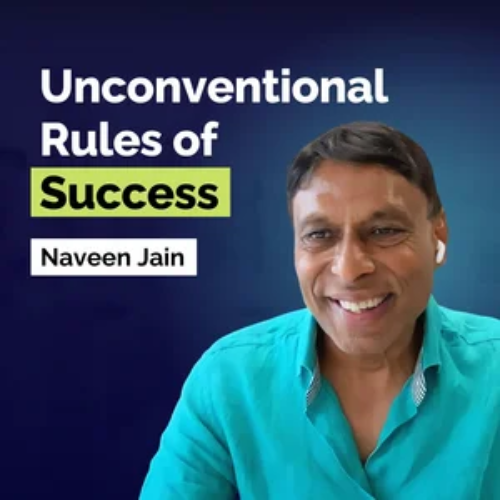
Naveen Jain: The Business Mindset That Makes Money Follow You | Entrepreneurship | E406
Entrepreneurship often begins with the goal of making money, but Naveen Jain believes chasing money is the worst way to get rich. After losing his father to stage four pancreatic cancer while building Moon Express, he realized success means little unless it helps solve the real problems causing people to suffer. That mindset led him to build Viome and reshape his life’s work around human health. In this episode, Naveen shares how entrepreneurs can think counterintuitively, solve bigger problems, and build businesses that create wealth by improving lives at scale.
In this episode, Hala and Naveen will discuss:
(00:00) Introduction
(01:38) Will Chasing Money Make You Rich?
(03:21) How Top Entrepreneurs Thrive Solving Big Problems
(08:22) The “Why This, Why Now, Why Me” Framework
(16:17) The Outsider Advantage in Business
(30:20) Why the Best Salespeople Never Sell
(34:50) Building a Mindset of Positivity
(42:50) The Traits of Counterintuitive Thinkers
(49:50) Execution Traps That Keep Founders Stuck
(56:53) The Real Measure of Success
Naveen Jain is a serial entrepreneur, philanthropist, and author known for building companies that tackle ambitious global challenges. He is the founder of Viome Life Sciences, a health technology company focused on making illness optional, and Moon Express, a lunar exploration company. His latest book, Counterintuitive, teaches unconventional principles for success in life and business.
Sponsored By:
Indeed – Get a $75 sponsored job credit to boost your job’s visibility at Indeed.com/profiting
Shopify – Start your $1/month trial at Shopify.com/profiting.
Northwest Registered Agent – Get a complete business identity with Northwest. Visit northwestregisteredagent.com/YAPFree and start using free resources to build something amazing.
Mindstone – Master practical AI skills without the complexity with Mindstone’s AI Competency Programme. Head to experience.mindstone.com/yap and get 10% off.
AT&T – Stay connected with reliable, secure internet built for entrepreneurs. Switch to AT&T Business at business.att.com.
Quince – Make your summer wardrobe feel easier. Go to Quince.com/profiting for free shipping on your order and 365-day returns. Now available in Canada, too.
Resources Mentioned:
Naveen’s Book, Counterintuitive: bit.ly/NJ-Counterintuitive
Naveen’s Book, Moonshots: bit.ly/NJ-Moonshots
Naveen’s Instagram: instagram.com/naveenjainceo
Naveen’s LinkedIn: linkedin.com/in/naveenjainintelius
Naveen’s Website: viome.com
YAPE22 with Naveen Jain: youngandprofiting.co/E22
YAPLive with Naveen Jain: youngandprofiting.co/NJ-YAPLive
Active Deals – youngandprofiting.com/deals
Key YAP Links
Reviews – ratethispodcast.com/yap
YouTube – youtube.com/c/YoungandProfiting
Newsletter – youngandprofiting.co/newsletter
LinkedIn – linkedin.com/in/htaha/
Instagram – instagram.com/yapwithhala/
Social + Podcast Services: yapmedia.com
Transcripts – youngandprofiting.com/episodes-new
Entrepreneurship, Entrepreneurship Podcast, Business, Business Podcast, Self Improvement, Self-Improvement, Personal Development, Starting a Business, Strategy, Investing, Sales, Selling, Psychology, Productivity, Entrepreneurs, AI, Artificial Intelligence, Technology, Marketing, Negotiation, Money, Finance, Side Hustle, Startup, Mental Health, Career, Leadership, Mindset, Health, Growth Mindset, Passive Income, Online Business, Solopreneur, Networking
Learn more about your ad choices. Visit megaphone.fm/adchoices
Naveen Jain: [00:00:00] Making money is a byproduct of doing things that actually improve people's lives. If you can help a billion people live a better life, you can create a $100 billion company. And people who focus on making money rarely make money. In other words, making money is like having an orgasm. If you focus on it, you're never going to get it.
You just have to learn to- ... enjoy the process.
Hala Taha: Most people ask, "How do I make more money?" But Naveen Jain asks, "What problem is big enough to make wealth a byproduct?" He's a serial entrepreneur who has built across internet infrastructure, space exploration, and precision health.
Naveen Jain: There are three questions you ask yourself when you're starting a company.
Why this? If you are successful, would it help a million people, 10 million people, 100 million people live a better life? The second part of why now? The third thing really is probably the most important part in success for an entrepreneur, which is why me? And [00:01:00] why me is what questions are you asking that are different from what everyone else in the industry is asking?
Hala Taha: Why is it such an advantage to actually not be a part of the industry that you wanna start a business in?
Naveen Jain: The main reason is-
Hala Taha: Your personality is so bubbly. You're so positive. Help us understand, as entrepreneurs, how we can become more optimistic.
Naveen Jain: People pay attention to negativity. Every news, it starts with a murder, rape here, and riots here.
They want negativity because that's what people- Mm-hmm ... pay attention to. So what I tell entrepreneurs is-
Hala Taha: Naveen, welcome to Young and Profiting podcast.
Naveen Jain: Thank you so much. I'm really looking forward to
Hala Taha: it. Naveen, this is your third time on YAP, so we're gonna skip the whole origin story. We did that the first time you came on, episode 22, back when I was just a baby podcaster starting out.
You came on and supported the show, which is a theme about you. You love to support other people. Then you came on, and [00:02:00] you talked about Viome and health and how you're making illness optional, and today we're gonna talk about how to be more counterintuitive, which is the perfect topic for entrepreneurs who are listening to Young and Profiting podcast.
So first, I wanna just cut straight to it. Why is chasing money the worst way to try to become rich?
Naveen Jain: Well, I think, you know, making money is a byproduct of doing things that actually improve people's lives. Uh, and people who focus on making money rarely make money. I mean, there are exceptions here and there, but rarely.
If you focus every single day when you wake up in the morning and say, "What can I do to make my fellow humans' lives better?" In whatever way you can, and if you can help a billion people's life better, you can create a $100 billion company. Uh, you can help a million people. You can help 100 million people.
But at, at the end of the day, the peoples [00:03:00] whose lives are getting better become your loyal customers, and that is really where the sustainable enterprises are get created. In other words, making money is like having an orgasm. If you focus on it, you're never going to get it. You just have to learn- ... to enjoy the process.
Hala Taha: I love that advice. It's so true. It's like if you help people and you solve problems, you're gonna end up making money. So talk to us about why solving really big problems sometimes is easier than solving small ones.
Naveen Jain: Well, of course, Hala, I mean, if you think about it, when you are doing something that has a potential to change the way people are gonna live their lives, potential to change the trajectory of how humanity is going to live, you attract best and the brightest because the best, the most successful people want to work on what I would call legacy-making ideas, right?
This is why, you know, if you look at the best entrepreneurs, why do they attract the best talent? Because they're [00:04:00] focusing on doing things that can, you know, change everything that how we know that things are done. So you look at Elon, you look at, you know, Jeff, you look at any one of those guys, they're fundamentally changing what we thought was possible, and they attract the best talent.
Now, once you have the best talent, guess what happens? The money follows and say, "Oh my God, look at this team. What an amazing team they have assembled." And every single person wants to fund it, and they have this grand idea, and if it can be successful, they look at this thing, this could be such a massive market, such a massive opportunity.
So people don't focus on what's happening today, but they're focusing on what is possible tomorrow. The great example, you look at SpaceX. It's not the $18 billion revenue that makes it a $2 trillion company. It is the future of what is possible in the next five, 10 years. And, and people say, "Well, that's too [00:05:00] small.
Why are we giving that so much valuation?" It is the team, it is the entrepreneur, and it is the idea that has potential to change the trajectory of how humanity's going to live.
Hala Taha: So for all the entrepreneurs that are tuning in that might have like, let's say like a marketing agency like I do, or a car wash, and they're making good money, but they don't really have that big why.
They're not mining the Moon like like you are trying to do. How can we have a why that still moves the needle? Like, do we need to have like a moonshot why in order to be successful entrepreneurs, in your opinion?
Naveen Jain: You know, in some sense, an entrepreneur is someone who sees a problem, and not only come up with a solution, they actually go out and do something about it.
That means they execute on the idea. They don't simply ideate, right? They don't simply complain about the problem, and they don't simply ideate. They go out and implement it, right? Now, in terms of- An entrepreneur that to me, anything [00:06:00] you do that's worth doing takes 10, 15 years of your life. You're gonna dedicate 10, 15, 20 years of your life to doing it, and it takes the same amount of energy and effort.
So why not do something that brings you joy? Like, ask yourself why do you want to s- wake up in the morning and do something, unless it is bringing you true joy. So forget about just helping a billion people. You have to ask yourself, what does it mean to you? What are you willing to die for and then live for it?
When you wake up in the morning, do you jump out of the bed or you are still lying in the bed hoping that, th- you know, maybe I could just, another half hour later I can wake up. And unless you're really willing to jump out of the bed every single day, it is not your calling. And when you fall, when you find your calling, it doesn't matter what that is, you actually end up [00:07:00] finding joy.
And when you find joy, you become successful. And a single car wash becomes a car wash franchise, and the car wash franchise becomes a massive enterprise about how people find happiness.
Hala Taha: Yeah, fam, as my business keeps growing, I feel like I'm always hiring. I recently added two new video editors and a producer to my team, and I can tell you from experience the right hire can give you leverage.
The wrong hire gives you a second job, and that's the last thing you need. So when I need the right person and not just another resume in the pile, I go to Indeed Sponsored Jobs. Indeed Sponsored Jobs boost your job posts in search results so you can reach candidates who meet your specific criteria like skills, certifications, location, and more.
Because the goal is not more resumes, the goal is better matches. Spend less time searching and more time actually interviewing candidates who check all of your boxes. Less stress, less time, more results. When you need the right person to cut through the chaos, this is a job for Indeed Sponsored [00:08:00] Jobs. And listeners of this show will get a $75 sponsored job credit to help get your job the premium status it deserves at indeed.com/podcast.
Just go to indeed.com/podcast right now and support our show by saying you heard about Indeed on this podcast. Indeed.com/podcast. Terms and conditions apply. Need to hire? This is a job for Indeed Sponsored Jobs. You've got this framework that I've heard you say before, why this? Why now? Why me? Which I think is a great framework for people who are hoping to become entrepreneurs but don't really know where to start.
Naveen Jain: Sure.
Hala Taha: Can you break that down for us?
Naveen Jain: Absolutely, Hala. You know, there are three questions you ask yourself when you're starting a company. Why this? Why this, I think we talked about briefly. Any time before you start something- Ask yourself, God forbid I am actually successful in solving the problem that I set out to solve.
That means assume you're successful. Whatever it is that you're trying to do, assume you're [00:09:00] successful. And if you are successful, would it help a million people, 10 million people, 100 million people live a better life? Because anytime you can solve a problem that helps a million people, 10 million people, or even 100,000 people, you can create a great enterprise.
And again, focusing on what can you do to make people's life better, right?
Hala Taha: Mm-hmm.
Naveen Jain: The second part of why now, the timing is a number one predictor of an entrepreneurial success, right? Yes, despite being the team and despite being a great idea, the timing is a number one predictor because sometime you're too early and sometime you're too late, right?
So- And now the, the way to find timing, actually, is there the time to start now, there are two ways of doing it. One is you look at this stuff and saying, "What would it take to solve this problem?" So you don't focus on how you're going to do something, you focus on what problems have to be solved for this [00:10:00] big idea to actually become real.
And the second is you look at the stuff and saying, "What changed in the last couple of years?" But more importantly, what do you expect to change in the next three to five years that will allow you to solve this problem at scale in three to five years, and this problem could not have been solved five years ago, right?
So that means- Mm ... most entrepreneurs fail, and they end up only doing the things they are good at because they focus on how to do something, not on what needs to be done. And I can give- Mm ... several examples of that. So for example, if you wanna live on Venus, you don't focus on, "How am I going to do that?"
You focus on, what are the problems that have to be solved. You have to leave Earth orbit, number one. You have to go from Earth orbit to Venus orbit. You have to land on Venus. And number four, you have to create a habitat [00:11:00] on Venus, right? And then you see which problems are already solved, which are incrementally, and what are the one big thing that needs to be solved that I can focus on, right?
And that really- Mm-hmm ... is you break down the problems into smaller chunks, and then you start focusing on how to solve each problem rather than f- think- figuring out how to solve this big problem The second is you have to understand are you solving the root cause of the problem, or are you solving the symptom of the problem?
And this is another place where entrepreneurs fail, right? They look at something and say, "Oh my God, that's the problem," and they focus on fo- solving this, and some other entrepreneur comes along and solves the root cause, and the symptom just disappears, right? And that is a fundamental way of learning when something is a symptom versus something is a root cause.
So for example, if you look at the fresh water and the, you know, Third World countries, people die because they don't have access to fresh water. And you start focusing on [00:12:00] that and say, "I'm gonna build a nano straw that you can drink water from, and that is going to help so many people get fresh water," until you realize that majority of fresh water is used for agriculture.
And you say, "My God, I need to fix agriculture to use hydroponic, aeroponic," and you're feeling good until you figure out that majority of agriculture is used to feed the cattles. And now you say, "Oh, it is the cattles that causes us to have more agriculture that do- takes the fresh water. What if we can actually grow meat without having to grow cattles?"
Right? Mm. And then suddenly the fresh water problem becomes a synthetic biology problem. That means can we take a stem cell from a cow and really grow the muscle tissues that people want to eat? You don't have to grow eyes, you don't have to grow the e- you know, the organs that people don't want to eat, and only grow the organs that people want to eat.
And suddenly you solve it, you know, root cause of the problem rather than the symptom of the problem. The third thing really is probably the most important part in success for an [00:13:00] entrepreneur, which is why me? And why me is what questions are you asking that are different from what everyone else in the industry is asking?
The questions you ask are the problems you solve, right? So this really comes down to is if you are an expert in any field and you start something, you tend to take the foundational knowledge as granted because that's what makes you an expert. And if you're- Mm-hmm ... not going to challenge the foundation of what every expert has taken it for granted, you end up becoming incremental.
Maybe you'll be 10% better than someone else, but you're not gonna be 10 times better. To be 10 times better, you have to challenge that foundation So for example, today there are 8 billion people on planet Earth, and we say, "Look, what if in the next 2050 they're gonna have 20 billion people on planet Earth?
How are we going to solve this world hunger?" And people say, "Oh, you need to [00:14:00] grow more food for 20 billion people. You have to reduce the wastage of transportation that, you know, amount of food gets wasted." But nobody's going to ask the question, why do we eat food? Because when you ask the question why we eat food, you realize you need energy and you need nutrition.
What are the different ways can you get energy? At the end of the day, we are eating plants. How do plants get energy? They use carbon dioxide, radiation, right? And they get the energy. Why can't we do the photosynthesis ourselves, right? And suddenly you have a solution that wouldn't have been available to you to feed 20 billion people, uh, without growing food because you asked a different question.
And that's the theme of everything, is how do you challenge, how do you look at the different perspective? And the less you know about the industry, the better you are in disrupting it, right? And Hala, you are a great example of that. You didn't come from the media industry. You didn't come from [00:15:00] all of the typical p- how media industries get created.
And h- here you started something because you saw a need that could help millions of entrepreneurs be more successful. Because any time an entrepreneur becomes successful, they help 10,000, 100,000, million people live a better life. And so if you can help a million entrepreneurs, now you have essentially levered them to help 100 million people and a billion people, right?
Mm-hmm. And I think you are a great example of someone coming from outside the industry, creating an amazing platform, and I'm just so proud of you, and everyone who's listening to this should send a note- Uh-huh ... and let her know how amazing she is in what she does.
Hala Taha: Navin, you are so sweet. It's true. I mean, when I started in the podcast industry and started my network, one of the reasons why I was successful is because I never was really part of a [00:16:00] network, so I started selling ads differently than everybody else.
I was selling across all different channels instead of just podcasts, and now a lot of the networks, like, copied what we are doing because we kind of, like, set the stage. So let's go deeper on that. Why is it such an advantage to actually not be a part of the industry that you wanna start a business in?
Naveen Jain: Yeah, and I think the main reason is that you are, you are able to bring a completely different perspective on the same problem And just to ground it, uh, Hala, I wanna go back to... I know we talked a lot about Vayom, but I think this is relevant to bring up how, how I started Vayom. Because I wanna im- you know, I wanna show people the same thing that this framework about why this, why now, why me, how I applied it myself to create a new company.
So here I was, as you know, I was working on mining the moon for helium-3 to build the fusion [00:17:00] reactors, right? And we became the f- a company called Moon Express. We became the first company ever to get permission to leave Earth orbit. Mm. We actually got the President Obama to change the law, that anything we bring back from the Moon, we get to own it, because there was no law.
It simply said that every planet outside planet Earth is the, is, is the property of humanity. We all own it, and no one can own it. What does it really mean? If I bring back the helium, do we own it? Do humanity own it? Who owns it, right? So we had to get the law clear, so we got President Obama to sign into the law.
And then we became one of the six companies to get $2.6 billion NASA contract And I felt, you know, really that I was on top of the moon. And then my dad was diagnosed with stage four pancreatic cancer. I didn't even know he was sick, let alone he had stage four cancer, and he was given couple of months to live, and unfortunately, that's all we got.[00:18:00]
And it broke my heart that here I'm thinking that, you know, we can, m- you know, colonize the Moon and the Mars and create a multi-planetary society, and still we have loved ones suffering and dying on planet Earth. So I said, "I'm going to switch track here." And this is really every entrepreneur now start should pay attention.
The two words in the English language that are most powerful, one is imagine, and the reason the imagine is really powerful is when you tell someone, say, "Imagine," they actually remove all the preconceived ideas, and now they're willing to say what is it that you want them to imagine. That means you can now give them the vision of what the new world could look like.
The problem here is the vision needs to be so visual that people can actually visualize it in their own mind. And the problem that I think, uh, you know, Hala, you help entrepreneurs [00:19:00] solve that. You ask them what is their vision. "I want to be the largest car wash company that generates $10,000 a day revenue."
I'm sorry. How do you visualize that? Like there is nothing here. So you want to be able to have a clear vision, very similar to how Dr. Martin Luther King said, "Imagine a world where a Black man is holding the hand of a white girl walking together." You can close your eyes and you can visualize that. Now, that is the kind of vision you want people to see.
Hey, imagine a world where your loved ones are no longer suffering from depression or anxiety or have a heart disease or heart attack. They have immobile. They have d- you know, they have Parkinson's where they can't move their hands. They have cancer that they're going to suffer and die from, right? This is something you can easily say, "Oh, my God, I remember my great-grandmother or my grandmother or my, you know, this relative who suffered through it," right?
[00:20:00] That is something you can visualize, God, what a wonderful world that'd be, right? And that's the reason you have to have a very clear vision of what you're trying to do. So that's one word. The second word is what if And what if allows you to take away the possibilities of what is possible today, and what if allows you to actually look at the, what the world can be tomorrow, right?
So here's my what if was. What if we can actually understand what changes in the human biology, human body before people develop cancer or diabetes or heart disease or depression or any of these chronic diseases? What changes in the human body so we can diagnose this disease early, prevent them from happening, and use the food as a medicine to reverse these diseases?
And that was our whole statement. What if we can actually understand what is going on inside the human [00:21:00] body? And then we said Why this? What if I am actually successful in solving this problem? Would it help a billion people? Answer is eight billion of us, because every one of us is gonna suffer from it.
So great, why, why this is check mark. Next thing was, why now? And we said, "Look, to solve this problem, you have to be able to digitize the human body. You have to be able to process massive amount of data, and then use AI to be able to actually make sense of all of it." And we said, "Look, cost of sequencing is coming down massively.
Cost of processing is coming down massively. AI is getting more and more powerful. In three to five years, we will be able to scale this business even though it is more expensive today, but the prices are plummeting. We should be able to build a great business and help billions of people live a better life, because these things are all happening."
Now, the third part was the most important part, why me?
Hala Taha: Mm.
Naveen Jain: And we noticed that [00:22:00] everybody in the industry was doing one thing. They were all saying, "I want to know about Hala's genes, your DNA, because if I know your DNA, I'll be able to find out what's going on in your body." And not coming from the industry was really simple for me to ask really dumb question, "Hey, does your DNA actually change when I gain weight?"
And people say, "Of course not." "Well, it must definitely change when I become diabetic." No. Or heart disease, or depression, or anxiety, and answer is your DNA doesn't change. Even after I die, and you look at my DNA 100 years or 500 or 1,000 years later, it's identical DNA. DNA can't even tell you you're dead or alive, let alone are you healthier or sicker.
So my first thing was why are we spending time looking at DNA? It doesn't tell you- ... are you becoming healthier or sicker. And what that change, people told me, was RNA. The gene expression is constantly changing. So genes are identical, but the gene expression makes us [00:23:00] who we are. And Hala, this, I think not being a scientist, you and I both can appreciate every part of our body is identical DNA.
So my hair. Remember the crime shows? You find a hair, you find the skin- Yeah ... or you find anything, your blood or your neurons, your kidney, your heart. Every single part of our body is identical DNA. Yet I don't have the n- you know, eyes growing on my finger and the nails growing on my head. Why is that?
It's because the same DNA, but different expression makes the eyes and ears and n- you know, skin and lungs and kidney, but same DNA. So it's really the expression that what matters. So my thinking was what if we can actually measure the RNA? L- we're not focusing on how we're gonna do something. Remember?
We're gonna say, "What needs to be done?" So we said, "Look, we're gonna focus on measuring RNA." And second thing is that would that solve the problem? The answer was kind of, not quite. Why is that? Because [00:24:00] ninety-nine percent of all the genes that are expressed in our body don't come from our mom and dad. They come from these hundred trillion microbes that are in our gut, in our mouth, all over us, and these microbes really interact with the human body and actually make us who we are.
These are not parasites. The-- We outsource many of these functions to them. Now, interesting thing is, in those days, there was no AI, so we used Dr. Google, and we say, "God, Parkinson's and microbiome, the Alzheimer and microbiome, diabetes and microbiome, cancer and microbiome." Turns out every single chronic disease is connected to microbiome.
In fact, even the cure for addiction, cure for cancer, so immunotherapy or all of these things actually depends with, you know, gut microbiome. So if your cancer therapy, immunotherapy doesn't work, you change the microbiome, it starts working. People who have addiction, they change their microbiome, and the addiction went away, right?
So interesting thing was [00:25:00] people realized the microbiome is important, and I saw there were tens of companies doing microbiome testing. Then I said, "Why is this problem still exist?" And it turns out every microbiome company, Hala, was making the same mistake. They were doing the DNA of microbiome. So they can tell you, "Oh, you have this organism, you have this organism," without ever understanding what these organisms are expressing and what they are actually doing.
And in my mind, the same organism, like a human being, could do it in something good in the good environment and something bad in the bad environment. And that's literally what happens. People have this idea, "Oh, I have bad microbiome or good microbiome." No. Some same organism can do something good or bad depending on, uh, what the environment of the gut is.
So, for example, E. coli People say, "Oh my God, E. coli is a bad bacteria." No, no, no, no. E. coli is needed to take the iron from the food and transport it to the bloodstream, right? [00:26:00] And it-- or it can kill you if it is, uh, bad behavior. Same thing, akkermansia is a really good organism, people take it as probiotic.
And guess what? If it is eating the fiber, it produce butyrate, which is good for you, and if not, it eats your gut lining, and it causes a leaky gut, and it can cause MS. It's the number one predictor of multiple sclerosis, right? So imagine that, not the organism, but their behavior that changes. So we say, why not just measure the-- their gene expression, look at the human gene expression, look at AI to connect them all together, and that's how we're gonna solve the problem.
And that is literally what became Viome. We found the technology at Los Alamos National Lab. And Hala, I think, uh, since you and I talked two years ago, so much had changed now. So when you do a test, we get a spit of your saliva, so we can look at your oral microbial activity. Touch of your [00:27:00] stool, so we can get your gut microbial activity, your gut lining.
Finger prick blood, so we can get your mitochondria, your immune system, and all the one... So we, by the way, analyze one hundred million transcripts, one hundred million biomarkers in your body. And then based on that, we can tell you what is happening, your biological age, your heart health, your gut health, your oral health, your immune health, your cognitive health.
Or we can go as deep as you want, your uric acid production, your, you know, LPS production, your sulfide production. And then we can say, "Look, don't eat avocado because your uric acid production is too high. Here is a score that is bad for you, and here is a science paper." Every single food, we say, "Eat this food.
Here is why. Here is the science paper. Don't eat this food. Here's why. Here's the score. Here's the science paper." And then we also tell you what nutrition your body needs. You need twenty-two milligram of elderberry, [00:28:00] twenty-nine milligram of lycopene. You need eighty-nine milligram of amylase. And then we custom formulate that for each individual.
We don't have a pre-made capsule. We don't have a pre-made formula. So these are mine. It made for me every month. And every month, based on your wearable data, based on your electronic medical record, we constantly reformulate for you every month. So as your body changing, we're reformulating it for you. We give you the personalized probiotics and prebiotics, personalized oral lozenges, and we even have personalized toothpaste.
I don't know if you saw that or not, for morning- Wow ... morning and evening personalized toothpaste. And here's the best part. We actually did double-blinded placebo control trials, and we showed people in 90 days, not 9 years, in 90 days, if you take our personalized supplements, you... If you were pre-diabetic, your A1C came down by 0.42 and you became healthy.
If you had- Wow ... IBS, which is 15% of us suffer [00:29:00] from constipation, we showed 68% of the people in 90 days became healthy, compared to 11% on placebo. People who had anxiety and depression, 52% of the people became healthy, compared to 28% on placebo- Wow ... simply using food as a medicine. So remember what we set out to do, what we're doing, and here's the latest news for you.
Now- Mm-hmm ... we are able to diagnose stage one pancreatic cancer. Remember how I lost my dad? Because there was no- Yeah ... test for diagnosing stage one cancers. So we are able to now, we're launching a test that can diagnose pancreatic cancer at stage one, 94% specificity, 88% sensitivity for stage one cancer.
We can now diagnose stage one oral cancer, stage one throat cancer, IBD, which is Crohn's and colitis, and now we are validating our test for colon polyps, which is 7 to 10 years before you develop a colon [00:30:00] cancer. That means you can remove the colon polyps if you can detect them 6 to 10 years before you develop a cancer.
I mean, this is how we change humanity, right?
Hala Taha: Yeah, that's amazing. That's so awesome, and, and the way that you speak about it, I can tell, like, you don't care about selling kits. You're just explaining how it's gonna help-
Naveen Jain: Yeah ...
Hala Taha: humanity, and this is actually, uh, something that you teach. You always say, you know, your best sales pitch is actually not selling.
Naveen Jain: Yeah.
Hala Taha: And- Talk to us about that ...
Naveen Jain: so, Hala, we, obviously, any time you feel that you're being sold- You tend to become skeptical and you lean back, "Oh my God, I'm being sold to now," right? You lean forward when you're having a conversation with someone. You're talking to someone who are giving you information, right?
So to me... Now, look at Hala, what you do. What is advertising? Advertising is not about buy, buy, buy, buy, buy, buy now, buy now, buy now. Advertising is about letting you [00:31:00] know how whatever problem that you have, here is a solution, here is the information, here is the, you know, pros and cons. And the more you talk about, "Hey, this is downside, here's the upside.
Here's why it might work. Here's why it may not work," and you give that information, then you're much more credible than you tell someone- Mm-hmm ... it works for everyone. Everyone will work. Everyone should do this. And what I find really is anytime you hear someone says everyone should take NAD, un- unless your name is Everyone, just don't do it, right?
So, so idea is that it- there's no such thing as universal healthy food. There is no such thing as universal healthy supplement, and there's no such thing that it works for everyone. And that is the big beauty of selling is when people, number one, believe that you're doing it for the right reasons. Mm-hmm.
[00:32:00] When they believe they can hear the Obsession in your voice. When they can see that you're doing it because you're willing to die for it. When they believe you're doing it because you have the interest of fellow humans in your, uh, voice, right? People don't buy on infomercials saying, "Buy now, and if you don't buy now in 30 minutes, you will never get this price again."
It's like, people say, "Just get over it."
Hala Taha: Yep, gang. I built an app in 15 minutes, and before you ask, I did not suddenly become a software engineer. I've actually never written a line of code. This all happened through Mindstone, an AI transformation company that helps close the gap between having access to AI and actually getting value from it.
I attended their AI Breakthrough Weekend, and I had no idea what to expect. I was completely blown away, and this weekend was life-transforming. I left that weekend thinking about how I need to implement AI across my company, thinking about all the [00:33:00] training that I need to implement. I used to use AI for one-off tasks: draft this email, summarize this doc, give me a few ideas here and there, and that's not the right way to use AI in 2026.
There's so much more that you can do. I now use AI as a second brain. AI is going through all of my emails, is going through all of my call transcripts, is going through my Slack messages, and knows everything about me, every article that I've ever written, every webinar that I've ever wrote. Mindstone gives you these tools.
But first you've gotta actually do the training so that you know how to use AI appropriately, and that's their AI Competency Program. That's where most people start. It's a four-week online program, no code. It's totally hands-on. This is what I put my whole company through, so all 60 of my employees just got this four-week program, and they learned so much about how to prompt AI, how to use AI correctly, make sure that you're giving AI enough context, and then how to actually use their [00:34:00] Mindstone platform, which you get access to.
It's called Rebel. I use Rebel every single day, and it's helped me become so much more productive, and it's helped my whole company become more efficient that we've actually froze hiring. So if you guys wanna learn how to use AI in your company, if you wanna roll out AI and you don't know where to start, this is a great program.
It's really affordable, and it's something that I highly recommend that everybody do for their teams. You can get 10% off the AI Competency Program. Head to experience.mindstone.com/yapp to start. That's experience.mindstone.com/yapp to get 10% off the four-week AI Competency Program. When I think about you, and I...
And you know, we've met three times now. Your personality is so bubbly. You're so positive. You have such an abundant mindset. You have such a, a mindset of service, and these are the themes that really come out. It's like optimism, abundance, [00:35:00] service You can't have a scarcity mindset and build the types of things that you do.
So help us understand- Sure ... as entrepreneurs, like, how we can become more optimistic, how we should think more abundantly.
Naveen Jain: In life, it is very, very difficult. We evolved to think negatively. We evolved to pay attention to negativity. Uh, our amygdala in our brain is actually designed to look for all the bad things to happen.
Because if you- Mm-hmm ... go back to when we were living in the savannas of Africa, if you missed the good news, nothing bad happened to you. If you missed the bad news, you got vibed out of the gene pool. You were no longer around to, uh, reprodu- reproduce, right? So what happens is, once we realize as humans that, oh my God, people pay attention to negativity, every news I...
If you watch a news, everything starts with a murder here, the rape here, and the, you know, the [00:36:00] riots here. If it bleeds, it leads. They want negativity because that's what people pay attention to, so now they can sell them ads, right? And what I find really is, as an entrepreneur, people label things as success and failure instead of labeling everything you do as an experiment.
And I think, let me just explain because it's such a key concept, right? So if I say I do this Oh, my God, I failed. Or if I simply say, "This is my next experiment. An experiment has an outcome A and outcome B. When outcome A happens, I do C. When outcome B happens, I do D." Right? And then everything is now not a success, oh my God, A was a success and B was a failure.
It simply says everything you do give you new information that allows you to do the next thing, and that give you new information that allows you to do the next thing. So everything you do is a [00:37:00] stepping stone rather than a success or a failure. Because any time you label something, it changes your perception of, uh, yourself and perception of what you're going to do next, right?
Simply labeling something good or bad changes our, how we feel about it, right? I, I don't know if we ever talked about this, you know, the, you know, this idea of good or bad. Because as soon as something happens, we have a tendency- Mm-hmm ... to assign it a label. So let's assume you break up with your girlfriend or your boyfriend.
Mm-hmm. And you say, "Oh my God, that's the worst thing that can happen to me. This is so bad." And your mind is saying, "Oh my God, I gotta protect this thing. This is really bad." What's this saying? And by the way, 10 years from now, you're gonna meet someone even more wonderful, you're gonna say, "Oh my God, what a nightmare we avoided," right?
Hala Taha: Yep.
Naveen Jain: So, but at that second, it looks like it's a question of life and death by simply labeling that. Instead of that, [00:38:00] what if we say, "Oh, that happened Universe is my friend. If this happen, it is probably for my best.
Hala Taha: Mm.
Naveen Jain: Right? And this is really the best thing to do, is to say, "Look, this happened," acknowledge it, and then say, "Universe is my friend.
It is for my best." Now, let me give you an e- uh, you know, every culture has these stories about good or bad. I don't know your cul- uh, Hala, what- what's your, uh, e- ethnic background?
Hala Taha: I'm Palestinian, 100%.
Naveen Jain: Oh my God. Oh, I gotta, you and I gotta- Yes ... have a chat about, uh, that part. You know, my wife- Yeah ... actually grew up in Palestine.
Hala Taha: Wow.
Naveen Jain: Yes.
Hala Taha: Wow.
Naveen Jain: Yes, yes.
Hala Taha: Yeah.
Naveen Jain: So in Indian culture, there's a story about this king and his wise man. So king and a wise man go and they go hunting together, and then, uh, as they were hunting, king falls down from his horse and breaks his arm. And the [00:39:00] wise man says, "Oh, so that happened. It's probably for the good."
And the king looks at him and says, "I just broke my arm, and you're telling me it's for the good? You are not a good human being, and I can sh- I'm gonna tell you what good is." He takes him back into the palace, puts him into the dungeon, and says, "This dark dungeon is where you belong." And the wise man say, "So that happened.
It's probably for the good." And king says, "We'll see." So king, a week later, goes back hunting all by himself, and this time he got caught by a tribe. And the tribe now want to sacrifice him, and they take him, they get him ready for sacrifice. The priest comes out, and the priest says, "Let him go." Why? He say, "He's a broken man.
We don't sacrifice a broken man in front of the god. We only sacrifice a man who's not broken." And he goes back to the dungeon and says, "Wise man, wise man, you saved my life. You were right. [00:40:00] It was for the best that I broke my arm." And he say, "No, King, thank you, because you saved my life." "How? I put you in the dungeon."
He say, "If I, if I was with you, they would've sacrificed me." Right?
Hala Taha: Wow.
Naveen Jain: Right? So my point is, it didn't, it doesn't matter what you thought was bad turned out to be good, what you thought was good turned out to be bad, right? Point is, in life, you simply have these events, and the concept I was gonna really go was that- Learning to know the difference between happiness and joy, right?
Mm. So happiness is something transient. When someone says, "I love you," it, it makes you temporarily happy. When someone says something that's hurtful, it may make you temporarily unhappy. But guess what? The happiness may change, but your joy is internal. No one can bring you joy, and no one can take that joy away [00:41:00] from you.
Once you find that bliss in doing things that you're doing every day, you find this tremendous amount of joy. And yes, you may be unhappy, unhappy on some days, and some days you may be more happy than others, but your joy is internal. So once you find that joy that comes from helping people live better, finding something that you find that is a true calling, that joy can never be taken away.
Mm. And last thing as an entrepreneur, Hala, and I think as we get there, is these ups and downs that we talk about are part of life. So what I d- tell entrepreneurs is, "Look The only way you know you're alive is when you do a- you have a heartbeat, right? What happens in every crime show when someone is down, they touch them, say, "Do you have a heartbeat?"
Hala Taha: Yeah.
Naveen Jain: Right? What is a heartbeat, if you put them in the heartbeat, what does it look like? It's up and down, and up and down.
Hala Taha: Mm-hmm.
Naveen Jain: And when you see this smooth line, [00:42:00] that means the person is ... Flatline, you're dead. Now, imagine that. So what I tell entrepreneur is, any time you have these ups and down, that means you're still alive.
When you have this flatline, when you think you're living a smooth life, when you find yourself living a smooth life, you are dead. You just don't know it. You're living a life of a zombie. This ups and down tells you that you're alive, and the beauty is, when you are down, never feel that this is forever.
You know if you can just hunker down, the next beat is going to be up. And most importantly, when you are on top of that beat, never become too arrogant, because remember, winter is coming, and winter always comes.
Hala Taha: I feel like every entrepreneur tuning in needed to hear that. I think that was, like, such an awesome, beautiful analogy.
So I wanna talk about the art of counterintuitive thinking. Yes. 'Cause you have a new book about counterintuitive thinking, and you talk about the five traits of somebody who's a [00:43:00] counterintuitive thinker. The first one is question everything, which I think we did talk about, but I'd love for you to, like, give us, like, what is, like, an example of something that seems dumb or, like, an example of just really questioning everything.
Naveen Jain: I will tell you that this is actually, it may also be a lesson about parenting. So I have three children. I think you and I have talked about that, right? I have three children. My oldest, uh, uh, he runs the company called Built, and most of you young- Yep ... people probably you know about Built. So he's my- Yeah,
Hala Taha: he's crushing it.
He's crushing it, right? I was gonna say, I need to have your son on the show, too, when I found that out.
Naveen Jain: Yeah. Yeah, he's crushing it. And my daughter, who's by the way... So he's a Wharton graduate, and my, uh, daughter went to Stanford, and she is a Stanford STEM fellow, Stanford Mayfield fellow, and she runs a company called Evvie.
So every woman who's listening to it, Evvie, which is a vaginal microbiome company for women's health, and she's all about women's health. And sh- before that, she led a company that actually removed the gender bias in hiring, right? So she's all about [00:44:00] how to take womens and actually bring them, uh, into the s- you know, same level.
And what she tells me, and it's really mind-boggling to me. She said, "Dad, every time I go to a investor, they say, 'Oh, women's health is such a niche market.'" And she say, "You know that 51% of the people are women?" I mean, it's a niche market? It's the biggest market . But apparently for some reasons, people somehow think that women's health is such a niche market
Uh, anyway, point I'm trying to make is that she's doing, she's absolutely crushing it. The largest database on humanity, by the way. Largest database on women's health ever assembled. So every man should get it for their girlfriend, their mom, and sister. Amazing product. And my youngest one, by the way, is another Stanford grad, uh, be- became a Schwarzman Scholar, and he runs a fintech company, another unicorn.
So all three of them are running a unicorn. Now, the reason, what I was gonna say was that you asked me about counterintuitive. So I remember the best [00:45:00] counterintuitive thing is when they were young, my son would say, "Dad, Dad, look up. What a beautiful blue sky." And most parents will say, "Look up," and say, "Indeed, it is beautiful," because you wanna support your kid, you encourage them, and you wanna...
And guess what? Mm-hmm. You missed the best moment you had to actually teach them a basic lesson, which is do you know that sky doesn't really exist? The sky is a figment of our imagination. It is a blue light that scatters, and we see this barrier called sky. There is no sky. When you go from here to Mars, you don't say, "Mom, I just passed the sky."
There is no sky. And by the way, there is no color blue. Blue, the... If you look in the outside, it's simply the electromagnetic waves and the photons that rip- hit our retina, and our visual cortex makes up the color. There is no color out there, right? Now, what you just taught them, Hala, is exactly that, that something you [00:46:00] are 100% certain about, you see with your eyes the blue sky, and you're saying, "What if?
What if there is a different explanation? What if that is wrong? What if there is no sky? What if there is no color blue?" And that is how you fundamentally change and teach them that everything that you take it for granted, ga- granted can be challenged, and if you challenge that, you get to get to the truth of what it is.
Hala Taha: Okay, so the second trait is exploring different perspectives. Talk to us about that.
Naveen Jain: Yeah, so I think it... I think we've briefly touched on that. You know, a person who is an expert, someone who has an hammer, he- they think everything out there is a nail. They wanna hammer everything in. They think that's, that's a solution to everything.
And what happens is when people have broad knowledge and they have different perspective, they can say, "Oh, this one really requires a screwdriver. This one really requires the hammer. This may require [00:47:00] the wrench," right? So there are different solutions to different things, and you only see them when you see them from a completely different perspective.
And I think everyone knows intuitively that it's like a blind man, uh, and they're looking at elephant. Depending on their perspective, if they touch the tail, they think that is the elephant is what the tail looks like. If they touch the trunk, they think that is what elephant looks like. When they touch the legs, that's what the elephant looks like.
And everyone has their own perspective. And yes, they are all part of the elephant, but they are not the whole elephant.
Hala Taha: One of them that we didn't talk about, one trait of counterintuitive thinking that I think is really interesting, is demonstrating courage. I'd love to understand how entrepreneurs can be courageous, um, and not let their fear stand in their way.
Naveen Jain: So I think people have this idea that, you know, courage is about not having the fear. Courage is not about not having the fear, because that [00:48:00] is naivety and stupidity The courage is knowing the fear and willing to go out and actually push forward, knowing what the ... Because you cannot be so naive not to know that, hey, when you walk up there, there are dangers, so you can prepare for it, right?
So the beauty of courage is knowing the fears, knowing what can go wrong, and then preparing for it and doing your best so that it doesn't go wrong, right?
Hala Taha: Mm-hmm.
Naveen Jain: It's not about fear, it's about preparing for that fear is what the courage is all about, right? So, and, and I would say having that intellectual curiosity is probably one of the best things in an entrepreneur.
That means always know you have to be able to learn something completely new. You have to be able to ask the questions that have never been asked [00:49:00] before. And this is really very interesting is, if you go back and look at the last few decades- The most successful people were the ones who had all the answers.
You know how to do this, and you became successful. People who had the answers became successful. In the age of intelligence, it's not the people who have all the right answers, it is the people who are asking all the right questions, right? Mm-hmm. So, so think of this, you know, uh, AI, ChatGPT, it has all the answers.
What questions do you ask? And the questions you ask changes what you're actually doing, and that's really the question. The key becomes is what questions would you ask? What is your perspective of that problem? And it can have all the answers, and everyone is like enlightenment, right? When you say, "I prayed a long time, and I got the enlightenment," is you actually got the right question that you got the answer to, and that [00:50:00] God calls enlightenment.
Hala Taha: We've got to be good at asking the right questions. I also think we need to be good at spotting patterns. Absolutely. Uh, you were just alluding to this, too, in terms of, uh, you'll be less fearful if you know what's going on, if you know the patterns and can anticipate what's gonna happen. How can we be better?
Naveen Jain: That's intuition. Intuition is basically a pattern-matching, just like AI, right? I mean, we have our internal AI that is essentially there are two types of computing we have, at least in my, in my own way I look at the things. One is a, what I would call a high-fidelity computing. That means you get all the data, and it finds the pattern, and it says, "This is black or white."
That's our brain, right? So our brain is very simple. You give it the data, and it says, "Here is this," right? Our gut has, y- you know, lots and lots of neurons in our gut, and that works much more on a fuzzy logic. That means it [00:51:00] looks at the probability of things happening, and you get this gut feeling, right?
Women have this amazing intuition, right? You look at someone- On paper, your brain says, "Oh my God, he's tall, he's dark, he's handsome, he's charming, he is powerful, everything." And then you said, "Something about him, I just don't like it." And, and you can put down on the piece of paper, you cannot touch what is that something I don't like, but there's something in your gut says, "Ooh, walk away from it.
It's not a good one." Right? And that is that probability of saying, "My God, there's some pattern here. I may not be able to put my finger, but I can sense that there's something wrong here." That is that intuition that your neurons in your gut are calculating it for you. See, it doesn't have black and white that your brain does, but it does a probability of something going wrong is high here.
Hala Taha: I wanna play a game with you, Naveen. It's called execution traps.
Naveen Jain: Go for it.
Hala Taha: So I'm gonna say an execution trap- Yeah ... something that keeps [00:52:00] founders stuck.
Naveen Jain: Yeah.
Hala Taha: And then you tell me the counterintuitive fix, like why it keeps people stuck, and what is the counterintuitive fix.
Naveen Jain: Love
Hala Taha: it. Okay? Number one, waiting for perfect.
Naveen Jain: Aha. So perfection, as we know, is the enemy of actually entrepreneurship. The success of entrepreneurship depends on you being embarrassed of the things you launch. That means if it two years from now you're not embarrassed about what you did two years ago as an entrepreneur, you ha- you waited way too long, right?
Now, I'm gonna ask you, go back to four years when you, back when you started, and you think, "Oh my God," I look at this stuff and say, "How dumb and naive I was."
Hala Taha: I, I'm embarrassed of all my videos. And they live forever when you're a podcaster, so.
Naveen Jain: But guess what? The reason is because you got them started. If you waited for perfection, you'd be waiting until today to re- to start them, right?
Hala Taha: Okay. Number two, believing failure exists.
Naveen Jain: Yes. [00:53:00] So I think it's not the failure exist. The, A outcome B exist, right? And that's what I want people to know. There is no such thing as success and failure in an experiment. You have to reframe what that is. And the best way to describe that, Hala, is that you look at Thomas Edison.
When people asked him, "Didn't you fail 10,000 times before you could build the light bulb?" And he said, "No, I experimented 10,000 times to learn what doesn't work so I'm able to find something that actually works." Right? So these are- I love that ... not failures, so these are outcome of an experiment.
Hala Taha: Number three, taking on too much too soon.
Naveen Jain: Yes. So I think most entrepreneur die from indigestion rather than from starvation, and that means it's never about doing too few things. Entrepreneurs die because they're doing too many things, and they spread themselves too thin. And the reason [00:54:00] they fail is they always look at every other lawn if the grass is greener there, I want to go there.
Oh my God, everybody's doing this, uh, AI. I've gotta go do AI. Everyone's doing AI. I gotta go do this. Everyone is going blockchain. I'm gonna do that. Everyone is doing NFT. I have to do NFTs. You know what? Focus on what problem you are solving and stay focused on that problem, right? We never got distracted, by the way.
We were doing RNA testing. We saw COVID even before anybody knew it was COVID. We were seeing because we do RNA virus, and we saw that- But COVID-19 won. And everyone said, "My God, you're so well prepared to do COVID testing." And I said, "That does not help me get my mission accomplished." Mm. I'm here to solve the problem around chronic diseases.
It's going to actually take me away from my mission, and I would have wasted two, three years of my life to chasing money, and I could have made some money, but then I would have been farther away from diagnosing stage one pancreatic cancer, farther away from [00:55:00] having a two million tests that we have done.
I have 400 quadrillion biological data point that allow us to tell how to remove diabetes and depression and anxiety and ideas from humanity.
Hala Taha: What do you have to say to the entrepreneurs who are creating a me too app?
Naveen Jain: And my point is, it's okay to create a me too app, but you have to know how you're going to own it, right?
It's not... So there are two types of entrepreneurship. Someone says, "I'm doing something completely brand new." So it's like saying, "Hey, uh, this is what they teach you at Harvard Business School," which is completely wrong, by the way. Go into a novel market where there is no one there and build a better... You know, go out there- Into a new place where there is no other business, right?
So you go to a town and you say, "I'm the first person to sell the mousetrap here."
Hala Taha: Mm-hmm.
Naveen Jain: And you never wonder why there is no one else selling a mousetraps here, because there are no mice here, right? So when you go out there- And that's [00:56:00] my point. So it's okay to be going to the place and saying, "Oh my God, look at this town.
There are 100 people selling mousetraps. I'm going to build a better mousetrap, and I'm gonna be 101 company, but I'm gonna- my mousetrap is gonna be such a superior mousetrap that I can own the whole market." So it's okay to be me too, but then you have to say, "What is my unique perspective of this that will change the whole idea of mousetrapping?"
Hala Taha: Number four, hiring clones of yourself.
Naveen Jain: Oh my God. So this is, when you're looking for a friend, you want someone who is just like you. You wanna hang out with a guy when you're looking for a friend. When you're an entrepreneur, you want someone who is completely unlike you, right? Because when you are an entrepreneur who has got a vision, who's got a clear idea of where you're going, you want someone behind you who is a operation person, who is building the road while you're cutting the trees.
He doesn't have to be rah-rah guy. He's gonna keep driving you nuts [00:57:00] and say, "Why are we going there? Why do you think there is a road there?" You say, "Just keep building the road. I know exactly the North Star where I'm going forward to." So you have to find people who are complementary to you, not people who are like you, because if you have everyone thinking the same way, then there's no one else to actually put the balance in your thinking.
Hala Taha: I totally agree. Okay, last execution trap, relating to stress as bad.
Naveen Jain: Why would a human body have stress? Stress is what causes us to actually act temporarily a way to do things. Stress is what allows us to be extremely productive very quick. The chronic stress is what causes us to really become bad. So stress temporarily is the best thing that can happen, because when there was a stress, your body goes into fight or flight response, and you're basically willing to fight or flight, and that's how we survived when the tiger were chasing us, right?
But chronic stress is what causes people to lose their, [00:58:00] uh- Perspective, right? So yes- Mm ... stress is good, but chronic stress is really bad.
Hala Taha: I feel like a great way to close out this interview is to talk about how you measure success. Something that really stuck for me from your book is that you believe Steve Jobs and Mother Teresa are equally successful, and I thought that's a, that's a great story to kind of round everything out and, and all your beliefs about entrepreneurship.
Naveen Jain: Thank you, Hala. So I think your success is never measured by how much money you have in the bank. It is only measured by how much, how many lives you have improved while you are still alive. So measure your success by the number of lives improved, not the number in your bank account. And just always remember that your self-worth never comes from what you own.
It comes from what you actually create. So if you haven't created anything, then you're still a parasite on humanity. So don't be a parasite. Go out and do some crazy, audacious thing that can help a billion people live a better life.
Hala Taha: And [00:59:00] I ask two questions to end all my show. The first one is what is one actionable thing our Young and Profiters can do today to become more profitable?
Naveen Jain: I would say Do things that improve people's lives. Don't focus on how to make more money. You will make more money by helping more people live better. So take the focus away from making more profit to making people even better. The more people lives are better because of you, they will become your loyal customer.
You'll make more profit from it. And-
Hala Taha: Mm-hmm ...
Naveen Jain: and number one action you can always do is do it, not to talk about it, right? So if you don't do it, you can keep talking about it, it's not gonna get you anywhere.
Hala Taha: Yeah. And we talked about all those execution traps that you can fall into, and you gave great advice there.
And what would you say your secret to profiting in life is? And this can go beyond business, beyond financial. What is your secret to profiting in life?
Naveen Jain: Secret to profiting in life really to be in- always remain intellectually curious, and con- constantly keep learning. The day you stop [01:00:00] learning is the day you actually die, right?
So never, ever stop learning. Every single day, ask yourself, "What have I learned? What did I learn today? Am I better off intellectually today? Am I better off emotionally today than I was yesterday? Am I spiritually better today than I was yesterday?" But constantly keep learning, and then one day you'll find yourself in a place where you say, "You know what?
Life has been extremely blessed for me."
Hala Taha: Naveen, I don't think this will be the last time you're on the show, so looking forward to many more interviews over the years. Where can everybody learn about you? Tell us about your new book. Uh, tell us about where they can get Viome and all of that.
Naveen Jain: Absolutely. Ab- So yes, the book is gonna be available everywhere, coming out on July 7th.
You can pre-order it right now, you know, from Amazon to Barnes & Noble and your favorite bookstore. Uh, you can find me on Instagram, you can find me on LinkedIn. You can always email it to me, and you can always get Viome at viome.com, V as in Victor, I-O-M-E.com.
Hala Taha: Amazing. And the book is called [01:01:00] Counterintuitive, right?
Naveen Jain: Yes. Counterintuitive: Unconventional Principles for Success in Life and Business.
Hala Taha: Amazing. I loved reading it. Naveen, thank you so much for joining us on Young and Profiting podcast.
Naveen Jain: Well, first of all, thank you for hosting me, and I'm looking forward to listening to your podcast, uh, time and time again.
Hala Taha: Young and Profiters, I just loved having Naveen back on Yap because every conversation stretches the way that we think. Today, Naveen reminded us that wealth is not the target, impact is. Lasting entrepreneurs are not waking up asking, "How much more money can I make?" They're asking, "What problem can I solve?
Who can I help? And how can I make people's lives better at scale?" That's where loyal customers, opportunities, and legacy-making ideas come from. Money follows service and not the other way around. Naveen also gave us a powerful filter for any big idea. Why this? Why now? Why me? Why this asks whether the problem matters enough to devote 10 years of [01:02:00] your life to it.
Why now forces you to look at timing, technology, cost curves, and what has changed that makes this impossible idea newly possible. And why me asks what unique perspective or outsider advantage you bring that insiders may be missing. That's the power of counterintuitive thinking. It's questioning the obvious, seeing it from a different angle, spotting patterns, using imagination, and having the courage to move before everything feels certain.
And I just loved Naveen's heartbeat analogy. The ups and downs are not signs that you're doing entrepreneurship wrong. They're the proof that you're alive, building, experimenting, and still in the game. When you're down, the next beat can take you up. When you're up, stay humble because the winter always comes.
The goal is not a perfectly smooth life or business. The goal is to build something so aligned with your joy and your service that you keep moving through every season. Thank you for spending time with us, Yap Fam. If this episode made you rethink the problem you're solving or [01:03:00] question that you're asking, share it with the founder, creator, or high performer who needs this reminder today.
And if you listened, learned, and profited, follow the show, leave us a review, and drop a five-star rating wherever you listen to the podcast. Subscribe, like, comment on the episode, and tell me what questions hit you the hardest. Why this? Why now? Or why me? You can find me on Instagram at yapwithhala or LinkedIn by searching Hala Taha.
As always, this is your host, Hala Taha, AKA The Podcast Princess, signing off.
Episode Transcription
Enter your name and email address below and I'll send you periodic updates about the podcast.

