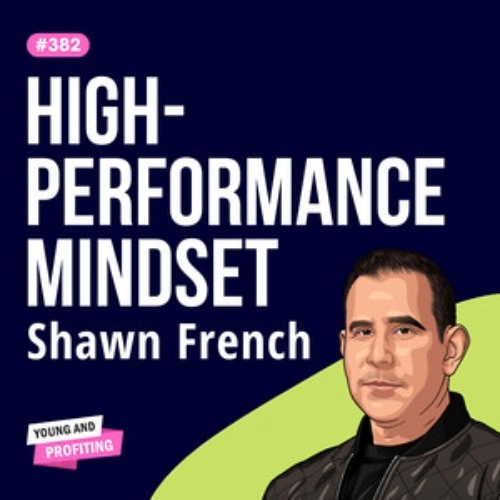
Shawn French: Conquer Fear and Self-Doubt to Build an Unstoppable Mindset | Human Behavior | E382
Early in his sales career, Shawn French struggled with crushing anxiety and fear of failure that nearly pushed him to quit and return to coaching baseball. Under pressure to provide for his family, a pivotal question from his boss about what he would tell his son sparked a profound mindset shift. He confronted the psychological patterns holding him back, became a top 1% salesperson, and built a thriving personal brand in his 40s. In this episode, Shawn shares the psychology of overcoming self-limiting beliefs and reveals the habits behind unstoppable success and personal development.
In this episode, Hala and Shawn will discuss:
(00:00) Introduction
(02:16) Overcoming Paralyzing Anxiety in Sales
(06:49) Why Authenticity Matters While Selling
(09:05) His Journey into Creator Entrepreneurship
(13:36) Building a Personal Brand Despite Naysayers
(19:12) The Five Habits of Unstoppable Success
(27:39) The Role of Motivation and Discipline
(31:56) Developing Peak Performance Routines
(36:10) Building a Creator Business From Scratch
Shawn French is a high-performance coach, keynote speaker, and founder and host of The Determined Society Podcast. He is the author of Unstoppable, where he outlines a foundational self-improvement process for achieving peak performance through five core habits. Through his work, Shawn helps individuals unlock the mental toughness, discipline, and intentionality needed to thrive in business and life.
Sponsored By:
Indeed – Get a $75 sponsored job credit to boost your job’s visibility at Indeed.com/PROFITING
Shopify – Start your $1/month trial at Shopify.com/profiting.
Spectrum Business – Visit Spectrum.com/FreeForLife to learn how you can get Business Internet Free Forever.
Northwest Registered Agent – Build your brand and get your complete business identity in just 10 clicks and 10 minutes at northwestregisteredagent.com/paidyap
Framer – Publish beautiful and production-ready websites. Go to Framer.com/profiting and get 30% off their Framer Pro annual plan.
Intuit QuickBooks – Start the new year strong and take control of your cash flow at QuickBooks.com/money
Quo – Run your business communications the smart way. Try Quo for free, plus get 20% off your first 6 months when you go to quo.com/profiting
Working Genius – Take the Working Genius assessment and discover your natural gifts and thrive at work. Go to workinggenius.com and get 20% off with code PROFITING
Resources Mentioned:
Shawn’s Book, Unstoppable: bit.ly/-Unstoppable
Shawn’s Podcast, The Determined Society: bit.ly/TDS-apple
Shawn’s Website: thedeterminedsociety.com
Shawn’s Instagram: instagram.com/theshawnfrench
Active Deals – youngandprofiting.com/deals
Key YAP Links
Reviews – ratethispodcast.com/yap
YouTube – youtube.com/c/YoungandProfiting
Newsletter – youngandprofiting.co/newsletter
LinkedIn – linkedin.com/in/htaha/
Instagram – instagram.com/yapwithhala/
Social + Podcast Services: yapmedia.com
Transcripts – youngandprofiting.com/episodes-new
Entrepreneurship, Entrepreneurship Podcast, Business, Business Podcast, Self Improvement, Self-Improvement, Personal Development, Starting a Business, Strategy, Investing, Sales, Selling, Psychology, Productivity, Entrepreneurs, AI, Artificial Intelligence, Technology, Marketing, Negotiation, Money, Finance, Side Hustle, Startup, Mental Health, Career, Leadership, Mindset, Health, Growth Mindset, Positivity, Human Nature, Human Psychology, Critical Thinking, Robert Greene, Chris Voss, Robert Cialdini
Hala Taha: [00:00:00] [00:01:00] What's up? Yeah, fam, have you ever been so terrified of failure that you physically couldn't move? That's where Sean French found himself. Sitting in his truck on a rainy day, unable to walk through another door. The anxiety was so crushing. He was ready to quit sales and return to teaching, but then his boss asked him a question that changed everything.
What are you gonna tell your son about why you quit today? Sean French is a high performance coach. Keynote speaker and host of the top rated podcast, the Determined Society. In this episode, he shares how he went from that breakdown to becoming a top 1% salesperson, how he then went on to [00:02:00] build a thriving personal brand in his forties, and why your struggle is truly somebody else's survival guide.
Together we'll talk about pushing past fear, leading with authenticity, and turning pain into purpose. Yeah, fam, I know you're gonna love this one, so sit back and enjoy this conversation. Sean, welcome to Young and Profiting podcast.
So excited to be here. Good to see you.
Yeah, I'm excited. I'm excited to speak with you today, get all of your wisdom. And when I was doing research about you this morning, I found out that you had a breaking point in your truck one day, and that was the pivotal moment in your life where you transformed your life and went in a new direction.
So talk to us about what happened that day in the truck, what was going through your mind and how it led to the unstoppable process?
Shawn French: I think you're referring to the day where I broke down in tears.
Hala Taha: Mm-hmm.
Shawn French: Yeah. So I had left teaching and went into payroll [00:03:00] sales and you know, I had my first child and I wanted to be able to provide a better life for him.
Right? More money, more opportunities to do things and provide experiences. And the first 90 days it was just so bad. I was so terrible at it. It was like walking in from door to door. Sometimes I was just stuck. I couldn't get a word out and I was just embarrassed. And I started getting this type of anxiety to where I would pull up to an office or a place of business, and I literally could not get outta the vehicle.
I was so terrified of something that wasn't going to even kill me, but how I was defining it, it was so big and large. And so I found myself driving around my territory, and then I parked at a grocery store. It was pouring down rain in Marco Island, Florida, and I literally broke down. I was like, I can't do this anymore.
I just need to quit this and I need to go back to doing what I was really good at, which was coaching baseball. And the only way to [00:04:00] coach baseball was to teach school. So it was a vehicle to get to do what I wanted to do. And so I went into my good friend Dan Ello, who was my boss at the time. It's funny enough, I just hired him to work for us.
So he starts Monday.
Hala Taha: Funny how the day will Stern.
Shawn French: Yeah, it's great, isn't it? And I just said to him, Hey, this isn't for me. I'm gonna go back to do what I know best. I just can't do this anymore. I'm terrible. I'm sorry. And he looked at me and he said, you know what? I told you I was gonna give you a year and you're gonna do the same thing for me.
I was like, buddy, I can't do this. I can't live a year like this. He's like, well, you have a decision to make, man, because one day your son's gonna ask you, why did you stop working at Paychex? Whatcha gonna do? Tell me quit. I was like, wait a second. You're onto something here. So that evening I decided to really get introspective and understand why I wasn't doing well.
The overarching theme was I wasn't prepared enough. I didn't have a plan, I didn't have a strategy. I was just getting in my truck and just bopping around the community trying to [00:05:00] get business. And so I just literally started taking notes every single day and I made commitments of what zip codes I was gonna be in every single day.
And I predetermined where I was gonna stop. Thought of some things that I was gonna bring up and talk about even it was just going to say, Hey, I'm Sean French. I'm your rep. I just wanted to say hello. I don't know if there's a, a need here, but I would love to explore it if there is. And from that day on, I caught fire.
I just exploded that month and the month after and the month after and the month after. And it was five years of that, literally five years. And then I went into the medical industry and did the same thing. And so I was tired of it and to where this came up, the podcast came up and I'm like, I've gotta go all in on this.
And I took the principles that I use here from my early days at Paychex. So that day literally built me in that career, and then in my next venture into medical, and it's what I apply here every single day.
Hala Taha: I love how you explained being [00:06:00] tactical, like a lot of sales is bottoms up strategy. Like the more emails that you send, the more opportunities that you get, the more likely that things will close.
But what was going on mentally for you at that time? What was the mental shift that you had to go through to double, triple your sales and become a top 1% sales person?
Shawn French: What story did I want to tell my son? How did I wanna lead? So for me, it was that he dingle the carrot. 'cause he knew how much I love being a father.
He knew how much I loved my son. He was, I think about a year at the time, he was like, what are you gonna tell your kid or your future kids that you quit something? And so for me, that mindset shift, it was immediate. It's like there's no way on God's green earth am I ever gonna tell my children that I quit doing something because it was hard.
Hala Taha: So you have a quote that you say, people buy people, not products. Talk to us why authenticity in sales really matters.
Shawn French: I think people need to like you, they gotta [00:07:00] understand that they can be comfortable around you, that you're not gonna judge 'em for certain things that they say in sales. It's really big.
Let's face it, Paychex may not have been the best product out there all the time. It may not have been the cheapest, but when people make emotional buys, they buy the person that they're working with because they feel comfortable, they like them or they can trust them. And so I've taken those same principles into the podcasting careers, what I do now a hundred percent of the time, and.
It's just really what it is. People listen to the show because they either like me or they stumbled into me and they stay or leave for either not liking me or really liking the authenticity piece of it, which is the latter part of your question. In a world where everybody's talking about being authentic, I pride myself on actually being authentic and I'm gonna show up how I show up and I'm gonna say what I feel, but I'm also gonna do it with empathy.
And I think that is the main difference. How can you show up like this every day? And [00:08:00] then I just realized I'm just gonna be me. I'm not gonna try to be somebody else. I'm not gonna try to be you. I'm gonna be how I feel I am. And of course, there's different growth patterns and stages of every individual, but for me it's just about living your truth.
And I think that shines through with everything that I do.
Hala Taha: When you say living for me, how do you define what that is? Do you have core values that you stick by? How do you make sure that you always act how you want to act and represent yourself?
Shawn French: So first and foremost, family. Family is at the forefront of my mind, my wife, and my three children.
And I always wanna represent them well. And so for me, that is my initial temperature gauge. Am I representing my wife and my children well right now? And if I am okay, I'm gonna keep doing that. That's really my only gauge. It's pretty simple, but I like to keep things simple because if I start getting complicated with things, I can get lost.
My A DHD kicks in and I'm gone. So I really focus on what can I control? [00:09:00] I can control how I show up. I control my attitude, and I can control my effort. And that's it.
Hala Taha: You had this awesome sales career and then you pivoted into creating your personal brand with this podcast, with writing a book. Why did you make that change?
What made you want to become a creator, entrepreneur and put your face out there?
Shawn French: I didn't seriously. I did not want to. It was about 2020, I think, 2021. I think it was about 2020, and my wife and I got approached by a good friend of mine to go to this direct sales company called Melaleuca. And they said, well, if you're gonna sell this stuff, you'd be really good at it, but you need to have a personal brand.
And I go, well, I'm not an inventor, I don't have a product. What are you talking about? I didn't even know what it was, She's like, well, no. What do people say about you? What's your brand? I go, I don't know. I have no idea. So I was a hard case study for her, and she goes, well, look, this is what we're gonna do.
You post a picture of yourself on your stories and then make a question box, It says, what's the [00:10:00] first word you think of when you see me? That scared me. First of all, I only had like 700 followers at the time. I didn't know what a question box was. That was a heavy lift for me, and it was scary. And so my friends had some choice.
Funny words, Like you have a stupid hat on, or some other derogatory comments. But the, the main theme was leader, coach determined, determined determination. So there's this massive response of some derivative of the word determined. And so I went back to her with that information and she said, okay, great.
Now make a Facebook group. I called what? Just call Determined, like, who's gonna want to go to that? She goes, no. You find ways to create the name of the Facebook group based on your personal brand. I'm like, so you're telling me my brand is determined? And she goes, yes. That's what people say about you.
That's what your brand is, how people view you as who you are to an extent, right? So I said, okay, I don't get it. I don't understand it. And she got frustrated and [00:11:00] said, Sean, what in the world do you want out of life? I go, honestly, you know what? I wanna wake up in a society where people wake up determined to chase their dreams no matter how they feel emotionally at that time.
She goes, determine society. I go, I don't like it. She goes, I said, it's missing something. I said, it's missing the word, the, so let's go with the determinant Society. She goes, great. Make your Facebook page, tease it, launch it, whatever. And so it was a Facebook page for about. Three, four months and people were coming on there joining and interacting and posting and talking about their wins, talking about their struggles.
And I had a really good case study of what people were actually struggling with. It was getting out of their own way, believing in themselves, doing things when they didn't want to emotionally at that time. And so one day I'm driving to work, I was going to a hospital. I was on I 75 about Sarasota, Florida.
I remember this exactly. It was the Clark Road exit. My brain just exploded. Whoa. I started seeing things. I was like, listen, this is not just [00:12:00] a Facebook page. I could really help people. I'm gonna start a podcast called The Determined Society. I'm gonna talk to local people and talk about their success, so that way they can help give other people a roadmap to get outta their own way or to excel in a current industry that they're struggling with.
And that's how it started. And I started recording. My first shows were in my car, just on my iPhone talking.
Hala Taha: I love that.
Shawn French: And yeah, I eventually moved into my den and then I had three iterations of a logo behind me. And then all of a sudden, you know, I don't wanna say all of a sudden, but now we're hearing a studio and I'm not talking to local people so much.
I'm talking to, you know, names like Jay Leno. You know how it is. You have amazing people on your show. Matthew McConaughey, David John, just you're amazing. That's how it started. It was an accident. Now, deep down, I always wanted to have a show, right? I was listening to the M-F-C-E-O project way back in the day with Andy Ella.
I was like, man, if I could have a podcast that pours into people and helps them, and I could be [00:13:00] unapologetically me, dude, I'm all in. I'll double down on that thing. And it kind of just went outta my mind. And then one day it just all came back and I never looked back.
Hala Taha: How old were you when you started building your personal brand?
Because I'm wondering how like everybody else around you treated you when you started trying to have influence online, and if there was any doubters or if you had any doubts or felt embarrassed posting online, especially starting your stuff a little bit older than other creators out there.
Shawn French: Yeah, so I'm almost 47.
I turned 47 at the end of this month, and the show launched in 2021, so I'll give myself 42. Okay. I was 42 years old. Yeah. Successful salesperson posting things online. Now, the moment I flipped that camera thing around, I hit that reverse and I talked into it. It was scary. And what was even scarier is when I posted [00:14:00] it, because then people are like.
Who do you think you are? What are you doing? What are you trying to be? Tony Robbins? I'm like, nah, I'm just getting some things out. And so the way I was treated at the very beginning, it was ignored, you know? And then you put things out that someone doesn't like. I talked about mental health in my Facebook group one day, and this guy that I used to coach with.
Got belligerent with me, sending me dms, wanting to meet up with me and, and fight it out. I'm like, talk about mental health here. Good lord, man. Like what's going on with this guy? I used to sit in a dugout with this man and go on road trips with this guy and just be friends with him, and then all of a sudden I post one little thing that's just trying to help people.
It was a live video and he just torched me. And so there was a lot of hate. There was a lot of naysayers. There was a lot of people that didn't believe in me. My friends would make fun of me, and I don't think they're doing that much now. But I wasn't treated very kindly about it. I was dismissed a lot.
Hala Taha: I can totally [00:15:00] relate.
I mean, I started my podcast just when I turned 30. And even though I started my career in radio, I had a blog. I've had multiple shows. I took like a five year break. And when I went back to podcasting, I remember my friends were like, you're too old to start a podcast, or What are you doing? You're ruining your life.
You're throwing away your career. You look stupid. They were really, really negative. And now I have the same friends or some of the same friends who like. Now wanna start a podcast after they see everything that I've done with it. You know? So people always ask you why you're doing it, and then they ask you how, how to do it.
Everything that you want is on the other side of cringe when it comes to this creator entrepreneurship game.
Shawn French: It really is. I remember people saying like, why are you starting a show? What have you ever built? Mm, what have you ever done? And I believe that story for such a long time all. And I was like, wait a second.
I've overcome a blood clot. I almost lost my life. I went and played Division one baseball at LSU in the College World Series. I overcame my [00:16:00] grandmother's death. I overcome not having a father figure, you know, until I was nine years old. I've overcome a lot and I've been relatively successful. I'm a well-adjusted man.
Are there any other well-adjusted men and women out there that do have some struggle? Why can't I talk to them? I just said, you know what? People on the sidelines, people in the stands are always gonna say something. But I get the opportunity just to show up and fulfill what I believe my purpose is, and that's what I did.
Hala Taha: So I wanna dig into this personal branding stuff because I know that you have a personal branding keynote. You talk a lot about it. So why don't we just start with somebody who wants to start their personal brand today. What are the first couple of things you think that they should do?
Shawn French: Really examine why they're doing it.
Here's why I say that, because a lot of people see what's exploded since COVID, right? Let's just call a spade a spade. They saw bars still blow up during COVID. They saw creators blow up and make money online by doing [00:17:00] funny videos or just talking into the camera, and everybody's like, well, okay, well then I'm gonna do that.
But if you're doing it just for that. That's a long road for me is understanding why you are doing it. Are you doing it because you feel you have value to give or do you really feel you want to do this just because of the vanity part of it? And if it's the latter, then you probably shouldn't do it because it took me years to make money.
Years it was a money pit, right? So that's the first thing. And then I go back to. Who are you helping? Who are you talking to? Who's your audience? And then it's very easy to figure out. Then once somebody realizes like, who was I before? How did I operate in my life before? That's who you talk to. That's who you help.
So those two things right there will do a lot for you at the very beginning. 'cause it gives you perspective and it gives you a roadmap because you can literally write everything down that you struggled with or still struggle with at times. Whether it's body image issues, whether it's anxiety, whether it's [00:18:00] rejection, dysphoria, whatever that is.
You can literally dive into those things and then talk, and you're gonna inspire somebody. You're gonna have somebody come into your page that says, wow, thank you. I really needed that. And you're like, wait a second, I'm onto something. And then you just keep doing that.
Hala Taha: To your point, you don't need to be super successful or super rich or have all these accolades or credentials in order to start speaking online.
You could just literally talk about a problem that you had solved yourself. And I love this quote from you. You say your struggle is somebody else's survival guide.
Shawn French: I said that one a while back. I mean, it was probably three, four years ago. But listen, that just goes onto what I'm saying. You know, help the person you used to be.
For me, I lack discipline in a lot of areas, and so now if I could be super disciplined and look the picture of discipline, then I can help somebody else find theirs. And so your struggle, your failures, and I think failure's great. I don't subscribe to failure's bad. I think it's a good thing. It helps you [00:19:00] grow, obviously, but when you take your own struggle and turn it into a map for somebody else, that's where the results are.
And that's why people keep tuning in. That's why new people come in all the time because it's relatable.
Hala Taha: You wrote a book a while ago called Unstoppable, and you had this unstoppable process where you talk about five habits. They were mindset, mental toughness, discipline, intention, and transformation. At a high level, can you just break down these habits and has anything changed since you wrote this book in terms of the habits, or are those still the five habits that you believe are a strong foundation for success?
Shawn French: Those are the five habits that I double down every single day. You gotta be clear on what you want to do. You gotta have a roadmap, which is a strategy. You have to have the strategic activity, you have to have all those things. You have to have mental toughness, you have to have grit, all those different types of things.
So for me, that book is way old, right? But at the same time, I live that every day. If I say I'm gonna do something, I'm [00:20:00] going to do it. And if I don't do it, then you know what that does? It chips away at my confidence and if it chips away at my confidence, my interviews aren't as good. I don't show up well for my wife.
I don't show up for my children the way that I know I want to show up. So for me, those habits are everything.
Hala Taha: I'm gonna play a game with you called Fix the Foundation. Okay. Uhoh. So I'm gonna give you a scenario now that we know a little bit about the five habits, everyday scenarios that a lot of us probably can relate to.
And then I want you to tell me what habit it is and how we can fix this foundational element. Okay?
Shawn French: Okay.
Hala Taha: Scenario one. I keep setting huge goals at the start of every month, but by week two I've already fallen off the wagon. What is the habit and how do we fix it?
Shawn French: So it could be a couple things. It could be clarity, or it could be strategic activity.
The clarity is the reason why you're doing it. You better be clear. If you want to get in great shape and you wanna be shredded, are you doing it [00:21:00] for vanity or are you doing it 'cause you wanna stay alive longer? Right? If you wanna be alive longer, who is it for? Is it for your spouse, your children? What is it?
Then from that point on, you go to the strategic activity. What can I do little by little every single day to build those wins and not go from zero to 60 right away because you're gonna fall off. That's why people fall off after the two weeks. They're not clear and they don't have the right strategy.
Hala Taha: Okay, next one. I get easily discouraged, one small setback, and I'm convinced I'm just not good enough.
Shawn French: That's mental toughness. You gotta be open to the fact that you're gonna fail a little bit. If you can be open to that and just know that not everything is gonna work and that not good enough complex that comes from somewhere, come from childhood could, could come from somebody you know, love and trust so much.
It could come from a mom, it could come from a dad, but you have to dive into those things in order to fix that. So being mentally tough and understanding like, Hey look, that's not my story. [00:22:00] That's the story someone told me and I chose to subscribe to and believe and make it about me. That might, could have been about them.
So I'm gonna leave that there. What can I do every single day to fix that? It's really operate outta love for yourself. Everybody talks about you gotta love yourself no matter what. I, honestly, I don't believe that. I don't love every version of myself, But I can have love for them. But I don't love the undisciplined Sean.
I don't love the Sean that decides to sleep in and then eat like crap. Like I don't like that version of me, but. I can try to rectify that and transform that individual to who I am now out of a place of love. It's so funny, this is kind of a side note, but my alarm clock used to say something aggressive, wake up, whatever, you know.
Now it says, I love you, Sean. I love you. When my wife first saw the alarm clock and she goes, who wrote that? I go, I did. And she goes, that doesn't sound like something you would say about yourself. I was like, well, see, that's the [00:23:00] problem because if I don't get here and see that every morning when I wake up and understand I'm operating and I'm getting up at 4:00 AM to go to the gym out of the fact that I love myself, then what am I ever gonna become?
Hala Taha: So it's like telling yourself a different story, but talking about that failure piece, a lot of people are just really stuck on just being so afraid of failure that they don't just start, how can we reframe failure?
Shawn French: Forget everything everybody's told you. So my wife did something very special for me back in 2000 and probably 17.
I was having a very hard month at work and I was failing everywhere, and I was still a top performer, but from my standards, I was just getting my butt kicked and my teeth kicked in every day. And she sent me this YouTube video and it was Will Smith, Justin Timberlake. And it was just this montage. You know what I'm talking about, those motivational montages.
And the first voice says, fail early, fail often, [00:24:00] fail forward. That was Will Smith's voice. And so for me. I reframed my belief system on failure based on what that video was. I still have it saved. I still listen to it. You know, it's like you have to reframe what failure means, and sometimes you have to go outside 'cause you're not gonna have the answer yourself.
You gotta hear something or see something from people that everybody knows and that you respect because they've done so well and they're so successful. And so for me, that's what it was. It's just reframing by listening to that video and watching it over and over and over again until I believed it for myself.
Hala Taha: Okay, next one. I've achieved so much on paper, but I still feel empty inside, like I'm the same person just with better results.
Shawn French: Oh. That one's hard to define, right? That's hard to define the habit. 'cause I think that's all the habits mixed together. Mm. I believe that if you focus on the wrong thing, whether it's monetary or vanity, you're always gonna feel empty no matter how much you accomplish.
Right? You could [00:25:00] say, okay, by this date I want to make this much money. And then you get there, and it's, you still feel empty retract it's process,The process. If you really submit to a standard of what you need to do every single day and make the journey the goal and the win, then when you get to that goal, like you realize I'm empty because I didn't enjoy all this.
It's like, this is where I live right now, Holly, like the journey of building this. That's what I geek out on whatever goal I achieve. I remember when getting a million listens in a year was like this. Monumental thing. And then when I got there, I was like, oh, shoot, what? Now it's 'cause I didn't enjoy all this.
Now we do that plus 500,000 in a month. But I'm enjoying the struggle. I'm enjoying the process of building this show. So I think it's process.
Hala Taha: I love that you've gotta enjoy the journey, not just a [00:26:00] destination 'cause then the goalposts just keep moving and moving and moving and moving and you're never happy and it's never enough.
Mm. So I totally agree with that. Okay, last one here. I know what I want, but I keep procrastinating and waiting until I feel totally ready.
Shawn French: When are you ever really ready? I'm not criticizing the question, but it's something that people need to really ask themselves. You're never gonna be ready. I was never ready to leave Corporate America and give up benefits and you know that big W2.
Right? So that's clarity. In my opinion, just being clear on what you want outta your life and what you want to give the world, and if you feel you have a purpose. So I feel like my purpose is this.
Hala Taha: Mm-hmm.
Shawn French: And it was given to me by God. And I know how upset parents get when their kids don't use their gift. Well, I'm surely not gonna squander the gift he gave me as the ultimate act of disrespect.
Hala Taha: Mm-hmm.
Shawn French: So for me, it's just [00:27:00] understanding the clarity of like, what is your purpose? If it's your purpose and it's burning you, then you have to move forward. And again, you don't have to go zero to 60 and quit everything and burn the bridges right away because that would be irresponsible because sometimes you gotta do what you don't want to do, to do what you wanna do full time, right?
So being clear on what it is that you are meant for and believing it and operating out of that belief no matter what everybody else thinks. So for your listeners, might not ever be ready. You might not ever think it's the perfect time because the perfect time doesn't exist. There's always gonna be challenges, but you gotta be able to move forward and get the most outta your life.
Hala Taha: What's your advice for people who feel like they can never get motivated and like they don't know how to motivate themselves?
Shawn French: Oh, motivation's a fickle mistress, isn't it? She's there one day and she's gone the next. I think motivation's essential to kickstart some things. It's the Kindle, it's the pilot, but what you have to understand is the [00:28:00] discipline.
Understanding what you need to do every day. That's the real thing. I'm not motivated. That's the thing. This morning, alarm clock goes off at 4:00 AM and that's just the time I choose to do it, because if I don't do it, then I won't get in the gym later. 'cause my life is busy. I'm never motivated to wake up at 4:00 AM and go to the gym when my body hurts and I'm exhausted.
I'm never motivated to do that, but I said I was gonna do it. So I have to. I have to because the easiest word to break. Is to yourself. No one can see it. No one knows if you're lying to yourself. You can have this whole conversation going on in your mind right now of why it's okay that you didn't get up and read or send your emails or go for the walk.
It doesn't matter if it's walk your dog, I don't care what it is. The moment you say you're gonna do something, you don't do it. You chip away at your confidence. So that's how I feel. And again, you don't want to think of it as, oh my God, I'm a bad person 'cause I didn't wake up today and go to the gym or, or do whatever.
There's gonna be those days. [00:29:00] To sit there and go, you know what? The mere fact that I'm not gonna do something because I'm not motivated, gives me zero joy. Why are we waiting on the motivation? Because nothing will ever get done. The only thing I'm really motivated to do every day is hug my children, tell my wife I love her, and record shows everything else I have to force myself to do.
Hala Taha: Speaking of that, this is an entrepreneurship show. A lot of my listeners are really interested in creator entrepreneurship. I think we have the dream job for a lot of people out there. So what are the different things that you're running in terms of revenue streams and how are you bringing in revenue with your personal brand as a creator entrepreneur?
Shawn French: Right now, we are obviously with the network, so we're running ads. We'll start to do some 360 social campaigns. I help young podcasters in the new in the business wanna launch their show, and I take that as a very case by case basis because honestly, the last thing I wanna do is be on coaching calls all day.
I really don't. But for [00:30:00] those people that are truly driven to grow their show. We do build some good revenue with that because we give the actual value. It's not a cookie cutter thing. I'm the one doing the calls. I'm the one helping them set up their accounts. I'm the one teaching 'em what an RSS feed is.
I'm the one teaching 'em what a good microphone is. I'm the one teaching 'em what a good direction of the show based on their belief system and based on what they want to give the world is.
And speaking engagements obviously too. I do go do speaking engagements, um, for hire and then I do get asked to go speak to medical sales teams and teach them the things that we talked about today so they can perform better.
Hala Taha: For all the entrepreneurs tuning in, I know that you're also a sales expert.
What's your best advice sales wise? Some pointers that you wanna give them or things that they should remember the next time they're going on a sales call.
Shawn French: So this is gonna sound silly because everybody wants to teach features and benefits. Look at my pamphlet. Look at my brochure. This is what this is.
This [00:31:00] is what it means to you. No one cares about how much you know until they know how much you care, right? So you can show up as yourself, right? Because that company hired you for a reason. They liked your personality and they liked your skills, and they liked your ability to communicate. But a lot of times when people.
Come into organizations, they go to the trainings and they hear everything that the lead trainers are talking about, and they feel like they have to have that same verbiage, that that same energy, and they change everything about them. They fall flat on their face. So that's what was happening to me. So show up as you and show them how much you care.
Find the problem. People think sales is selling something, it's solving a problem. And if you can solve a problem for somebody, whether it's payroll, whether it's medical, whether it's podcasting, whether it's a roofing company, it doesn't matter if there's a pain point and you can respectfully solve it, and they like you, they're gonna buy.
Hala Taha: So I don't know about you, but for me, the most important [00:32:00] thing for me to make sure that I have good interviews is making sure I get. Good sleep. That is definitely the most important thing. And so I make sure that I never do anything crazy the night before an interview and that I'm in routine and anytime I've ever tried and I end up not having good sleep is like something that I totally regret.
So what are some of the things that you do to ensure that you're at like peak performance when it comes to your interviews?
Shawn French: I eat whole foods. I get good sleep, decent sleep, six, seven hours a night, and I work out. Then all the decisions leading up to the actual interviews. I'm preparing, obviously, right?
For my guests that have a good idea of what they do. And my show is very open format. We just have great conversation and it's very natural. So for me, as long as I'm sharp, I don't drink alcohol very often. I mean, probably twice a year. And it's not because I'm this guy that doesn't believe in alcohol. It just doesn't work for me.
I don't metabolize it well. [00:33:00] So I'll wake up, if I have two beers, I'll wake up groggy the next day and I'm not having this great conversation like I'm having with you. So I try to keep my mind as clear as possible. I do have a great,
Hala Taha: mm-hmm.
Shawn French: So when I record something, my team does the clips, they post it for me.
I have people do my engagement. So I'm not tied to my screen. I'm not tied to a bunch of other things that are filling my mind with clutter and I feel energized. That's just kind of how I operate.
Hala Taha: Speaking of some of these mental patterns, you said in the past, thoughts are random, but thinking is not. So how can we make sure that's true, that we control our mental patterns?
And that's also about showing up as your best self. Because if I'm here and I'm thinking about some client or something and not present, it's gonna mess up the interview.
Shawn French: And I think the context around that quote was, you mentioned earlier like people that think I'm not good enough, or I'm ugly, or that person [00:34:00] hates me, that's a random thought.
Everybody's gonna have these random negative thoughts. But true thinking is how you respond afterwards. Is it actually true? And if you feel it is true, okay, what's the evidence? What are the examples of why I'm not good enough? Explain that, right? And then you have this dialogue with yourself and after a while you go, wait a second, I've done this, I've done that, I've done this, I've done the other thing.
I am good enough. Right? And so you just have to work yourself through those moments. Random thought. It's okay. Negative thinking is believing that random thought and let it perpetuate the rest of your day in your life. There's a big difference there. There's a big gap.
Hala Taha: as we close out this interview, I wanna talk to you about networking.
So you just mentioned earlier. That you had Jay Leno on the show, which is huge, and you've got some really big names that have come on your show. What are you doing these days to have a really high value network? What are some of the things that you do?
Shawn French: I have secret weapons.
Hala Taha: What's that?
Shawn French: No, I have a great [00:35:00] publicist, mal Zucker.
Hala Taha: Oh, nice.
Shawn French: See, that's the authenticity part of it, right? Mm-hmm. A lot of people say, well, I don't just send dms, I just show up, and like, no, no, no, no, no. I built a whole team to support me, to help me grow my brand, improve my image, and it's everybody in the background doing amazing work, even down to my production team, that, that creates amazing visuals and clips and gets everything out on time, spends times on.
My partner does the show notes and he does the graphics for the, the YouTube thumbnail and the cover. Like, all these things are working and these people are helping me grow this thing. So everything put together, but really it was about me. Trusting somebody and knowing that I needed publicity, knowing that I needed news media, knowing that I needed all these things.
And there was a time where I was just wearing a hat on my show and I was wondering why I wasn't going anywhere. Right. And there was no brand. It was a cool podcast. It was neat, it was a hobby. But the moment that. I changed my image and changed how [00:36:00] I operated in my discipline. Day to day. Investors came, partners came, and it all started to work together, and then it gave me the opportunity to go, okay, now, now I can go find a great publicist.
Hala Taha: So you mentioned earlier how you started with really low level equipment. I know Jenna Kutcher. I have a podcast network. I don't know if you know that. So Jenna Kutcher's in my podcast network, she started recording in her car with no microphone. I, two years into podcasting, interviewed Matthew McConaughey in my mother's basement.
Everybody thinks this is some overnight success that you need to have all this money to pump into equipment, but. You have a really great origin story where you weren't even entrepreneur or anything when you started. You quit corporate, you were in your forties, you got started and just built brick by brick to become where you are today.
So just walk us through what were some of the big milestones in terms of how you started? For me, it's, I had a volunteer team of [00:37:00] 20 people, and I just kept leveling up. What was your journey like?
Shawn French: Yeah, so, and thank you for that. Yeah. The origin story of the Determined Society also started like Jenna Kutcher's.
It was in my car. I had an iPhone. I was talking into it. Some of the milestones, well, the first milestone was recording that show and it went something like this. Hi, this is Sean, the Determined Society. I don't know if anybody's gonna listen. I hope you do, and if you do, I hope you like it. I just went through and I just had no plan, and then the next day I was coming through and Apple Podcast and I noticed that my show was on Apple.
I was like, wow. That for me was a big moment, right? It wasn't burning the world down, but I'm like, oh my gosh, how do I have an Apple podcast? I didn't even know how it worked. So that was a big milestone for me. And then when I learned that I could upload video to Anchor, I started doing Zoom interviews,
And they were terrible. Why would I ever hit record before someone came in? Why would I ever do it? But I did. And so like, it was [00:38:00] clunky. And then I had Andy Ellos co-host, uh, DJ on, then had Larry Hagner on from the Data Edge podcast, and then it started giving me this belief system that I could get cool people on and have good interviews.
Another small milestone was when I you're gonna laugh. I printed off the original logo of the Determined Society, which was a word cluster for crying out loud, hala a word cluster so bad, and I put it in a frame from CVS or Walgreens, I can't remember which one. And then I got the 3M. The 3M tape, the double sided tape, and I just
Hala Taha: popped it on the wall.
Shawn French: Official, official. This is dope. Look at this thing, man. And I look back at it and I just wanna throw up. But that was a milestone for me, right? So there's many milestones that I look back on that mortified me then. But now I'm very proud of because the audience has been able to see my, my growth, my stages, right?
So starting off having everything, it's not necessarily a good thing. I think you need to want a little bit. I think you need to get your butt [00:39:00] kicked a little bit. Because then you can really appreciate this industry as you know that it's very hard.
Hala Taha: Well, talk to us about the team you built over this journey.
What was the first thing you outsourced? What was the first thing you invested in?
Shawn French: Well, the first thing I outsourced was editing. Right? I would pay somebody like a hundred, you know, bucks an episode. And then I was like, wow, this is expensive, right? And my wife's like, Hey, wait a second here. You're spending 400, 500 bucks on editing.
This was at the very beginning. I outsourced it, and then before it was monetizing. I was taking the family income and doing that, and I'm like, wait a second. I need to learn how to edit myself so I can get my show out and not take away from my kids. I didn't want to do that. I didn't wanna be selfish with it.
That was the first thing I outsourced, and then I started outsourcing, you know, things like graphic design, distribution, and then I went back to editing, and then finally production. And production was my first go around, wasn't the [00:40:00] greatest. But my team now, they kill it for me. They move mountains for me.
And then it was PR and then some social media engagement. Not engagement, but more social media management, right. That's something that I, I wanna talk to you about actually. It's something that I don't want to do, right? And so those are all little things that I've outsourced and pretty much everything I would say mostly other than the backend conversations with Valerie, my partners, that was another big thing.
Marina and Brad Miller, pat Sickens, Roman Galey, my wife's involved without my partners. I would be a hot mess. I truly would. Instead of being prideful like I own this a hundred percent is a hundred percent. A zero is still zero. So those are all the things that we've outsourced. Right. And to the point now where you know how it works.
I don't even hunt for my own campaigns anymore. Right? Like we have people doing that and it's great because then I can focus on this. [00:41:00]
Hala Taha: To your point, it's important. I feel that you are probably a better podcaster because you were hands-on in the beginning. You did edit your own stuff in the beginning. So you probably have a lot more empathy with your team and like understand what they're doing and also can help direct them better because you were hands-on from the start.
So I think there's an advantage with that.
Shawn French: It's tactical. It's a tactical business, right? It, I think it. Doing all those things, to your point at the very beginning, made me better. It helped me grow exponentially because if you look at it like four years in and we're doing the numbers that we're doing with no marketing, because I still haven't pushed the button on marketing.
Hmm.
Hala Taha: I, we gotta talk.
Shawn French: I know, right? I know. She's like, dang it. She See Danny, see Danny's watching. He's like, you're in a sales pitch right now, and I'm here for it. I love it because the bottom line is without a real integrated marketing plan or any type of, get the word out right, it's hard to grow. So I've been blessed. I'm I'm [00:42:00] fortunate.
Hala Taha: Sean, I end my interview with two questions that I ask all of my guests. The first one is, what is one piece of actionable advice our young and profits can take today to be more profitable tomorrow?
Shawn French: I would say know the thing that you want to do and why. I think it's very basic. It's so basic, and it just like the people are probably listening, like, is he really just saying that?
But they're saying it and it triggers him because they're not doing it. Why do you really want to do the social media business? Why do you want to do podcasting? Why do you want to go sell cars? You have to have some type of passion around why you're doing it, because it's gonna be hard. You're gonna get your teeth kicked in a little bit.
I said it that a few times today, but it's true. You're not gonna always be successful in every single moment. So you have to understand that this is gonna be difficult and is the struggle worth it for me? If you don't wanna go through that struggle, you probably [00:43:00] shouldn't be going do that thing. So find what you wanna do and know the reason why you want to do it and be clear on it.
And then make a plan. Don't listen to anybody that hasn't done what you're trying to do or been very successful at it.
Hala Taha: It's true. People could love you so much and give you terrible advice 'cause they're speaking from their own insecurities.
Shawn French: Absolutely.
Hala Taha: So the last question is, what is your secret to profiting in life? And this can go beyond business and financial, just what do you feel like is the recipe for success?
Shawn French: The recipe is just staying in my process. Just what I wrote in the book. If I can stick to that, I know I'm in a good spot. And you have to be a lifelong learner as well. By no means do I think I have it figured out.
Trust me, there's many shows of mine that I listen back to. I'm like, dude, you could have done better there. If there was a question you could have gone deeper with, you can be better, Sean. So I'm always open for feedback and I think people should always be open for feedback, especially successful people, because there's always somebody more successful than you.
[00:44:00] But for me, when I look at the total enrichment of life, I look at am I a success? Does my wife and my children feel safe? Tell me their feelings. That has to be an astounding Yes. And it's not always a yes, right? Because we're human beings, we mess up a little bit at times. We don't have the right reactions to things.
But as long as I handle my process, handle the things that I need to and that my family feels safe in expressing to me, that is everything to me.
Hala Taha: Why is it so important that your family feels like they can express to you and your family feel safe? Like why is that so important to you?
Shawn French: 'cause I didn't have it. I had parents that love me and my mom. I have a great relationship with my mom, but you know, hey, you know, some people have more emotional capabilities to be there for people. And, you know, I, I grew up, like I said, you know, the first eight, nine years without a father figure, right?
So for me it was just, there was times where I wasn't feeling seen and heard and understood, and so I just. I always told myself like, I'm gonna be the exact opposite, and I'm not slamming my [00:45:00] mom. I'm not. I love that woman. Love you, mom. Like it's not that. It's just the reality of it. She had her own childhood that she's still healing from, right?
She never got through it because the family sheltered her from the reality, and it didn't allow her to grow. They masked it, and so how could she ever have the tools to be there for me in those certain moments that I needed? I didn't even know what I needed, so that, that's the reason why I just didn't have that.
Hala Taha: Any last words for the 60 to 80,000 young entrepreneurs and aspiring entrepreneurs that are gonna listen to this episode?
Shawn French: Enjoy the ride. Literally enjoy the ride because there's not too many people that are going to do what you are trying to do. All these entrepreneurs, the 80,000 of them listening right now, they think.
Their reality is everybody else's reality. The reality truly is, is what you're doing is scary. What you're doing is hard, and there's not a whole lot of people that are sitting there banking on your [00:46:00] success. They're waiting for the phone call for you to fail. So don't ever give 'em the opportunity to receive that phone call, dig in hard, understand why you're doing it, and never come off of it.
Because at the end of the day, my biggest fear. I would hope that most people fear this is being on my deathbed, wishing I would've done more, wishing I would've chased my dream, wishing I would've enacted a little bit more strategy. You're not gonna be worried like, well, I had this car, had this amazing house.
You're gonna be like, did I do everything? Did I do everything that I wanted to? And so, as long as you stay true to that and keep that at the forefront of your mind every day, how the hell are you gonna lose?
Hala Taha: I love that. Sean, this was such a great conversation. Where can everybody learn more about you and everything that you do?
Shawn French: Thank you for that. I had a blast. You can go to the determined society.com, right? That's the website. We're on Spotify at the Determined Society. Same with Apple. Instagram is at the Sean French, and I'm pretty easy to get to know. I'm pretty approachable.
Hala Taha: Awesome. Well, thank you so much for joining us on [00:47:00] Young and Profiting Podcast.
Shawn French: Thanks for having me.
Hala Taha: Yeah, fam, I hope you got a lot outta my conversation with Sean French. He is yet another example of somebody who turned deep adversity into Unstoppable Drive. Sean went from breaking down in his truck, paralyzed by fear and self-doubt, to then becoming a top 1% salesperson, a keynote speaker, and a creator who built the determined society from the ground up.
What I love about Sean's story is how simple, yet profound his turnaround really was. He didn't find success through luck or magic. He found it through clarity, preparation, and discipline. When he realized he was failing because he wasn't prepared, he didn't make excuses, he started planning his days down to the zip code, logging every single action and executing with intention.
That structure became the blueprint for his unstoppable process and the foundation for everything that he's built since. Sean also reminded us that authenticity is everything. [00:48:00] People don't buy products. They buy people. Whether you're in sales, leadership or building a personal brand, showing up as your true self with empathy and consistency is what earns trust and drives connection.
The moment Sean stopped trying to sound like everyone else and just showed up as his true self, his career absolutely exploded. And one of my favorite takeaways was his idea that discipline beats motivation every single time. Motivation fades, but keeping your promises to yourself. That's what builds your confidence, and that confidence compounds into success.
Every rep you do at 4:00 AM every time you follow through when nobody else is watching, you're proving to yourself that you can be trusted. So if you're waiting for that perfect moment to start that project, pivot your career or share your story. Remember Sean's words, you'll never feel ready. Move anyway.
The process itself is where the growth and motivation happens. Yeah, fam, if you listen, learned and profited from this episode with Sean, share it with a friend who's ready to become unstoppable [00:49:00] too. And if you haven't already, I'd really appreciate if you took a quick second to drop us a five star review on Apple Podcast, Spotify or castbox, wherever you tune in.
I love to read your reviews. They're really important for social proof. And if you'd rather watch your podcast as videos, you can always come and hang out with us on YouTube. All of our episodes are uploaded there. We've got like 60,000 plus subscribers and growing. So make sure you hit that subscribe button on YouTube for us.
And as always, you can connect with me on Instagram at Yeah, with Hala or LinkedIn by searching my name. It's Hala Taha. Thank you guys so much for tuning in. This is your host, Hala Taha, AKA, the podcast Princess signing off.
Episode Transcription
Enter your name and email address below and I'll send you periodic updates about the podcast.

