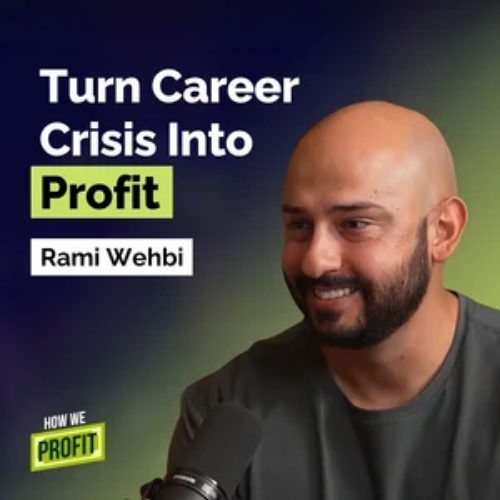
This Ex-Doctor Turned Career Regret Into a $2M Business Helping Healthcare Workers Pivot | Entrepreneurship | How We Profit | E9
Before Rami Wehbi pivoted into entrepreneurship, he was stuck in a medical career he no longer wanted and $400,000 in student debt. After leaving residency, he gave himself three years to build a new path. In that time, he founded MatchDay Health, a business helping healthcare professionals pivot into non-clinical roles, which is now on track to generate nearly $2 million this year. In this episode, Rami shares how he turned his own career crisis into a profitable high-ticket coaching business and breaks down the pricing, marketing, and sales strategies that helped him scale it.
In this episode, Hala and Rami will discuss:
(00:00) Introduction
(01:05) How MatchDay Health Works
(05:09) Leaving Medicine for Entrepreneurship
(16:10) Startup Failure, Health Tech, and Podcasting
(24:23) How the Company First Started
(32:51) The Current Offer and Business Model
(40:14) Coaching Costs and Profit Margins
(44:20) Scaling Through Paid Ads, Webinars, and Social Media
(1:01:29) Tools and Systems Behind MatchDay
(1:06:45) A SWOT Breakdown of the Business
(1:21:02) Founder Failures and Lessons for Entrepreneurs
Rami Wehbi is a physician-turned-entrepreneur and the co-founder and CEO of MatchDay Health, a career transformation company that helps healthcare professionals transition into non-clinical careers. Before founding MatchDay, he trained in family medicine and later moved into health tech, where he served as VP of Clinical Operations for an AI startup. Rami also hosts The Dream Job Podcast.
Sponsored By:
Indeed – Get a $75 sponsored job credit to boost your job’s visibility at Indeed.com/profiting
Shopify – Start your $1/month trial at Shopify.com/profiting.
Northwest Registered Agent – Get a complete business identity with Northwest. Visit northwestregisteredagent.com/YAPFree and start using free resources to build something amazing.
Mindstone – Master practical AI skills without the complexity with Mindstone’s AI Competency Programme. Head to experience.mindstone.com/yap and get 10% off.
AT&T Business – Stay connected with reliable, secure internet built for entrepreneurs. Switch to AT&T Business at business.att.com.
HoneyLove – Treat yourself to the most advanced bras and shapewear on the market. Save 20% off Honeylove by going to honeylove.com/PROFITING! #honeylovepod
ElevenLabs – ElevenAgents by ElevenLabs helps businesses deliver better customer experiences. Start with a demo at ElevenLabs.io/profiting
Quo – Bring your calls, texts, and contacts together in one place. Try Quo for free, plus get 20% off your first 6 months when you go to quo.com/profiting.
Resources Mentioned:
Rami’s Company, MatchDay Health: matchday.health
Rami’s LinkedIn: linkedin.com/in/ramiwehbi
Rami’s Instagram: instagram.com/ramithefounder/
Rami’s Podcast, The Dream Job: bit.ly/TDJ-apple
Active Deals – youngandprofiting.com/deals
Key YAP Links
Reviews – ratethispodcast.com/yap
YouTube – youtube.com/c/YoungandProfiting
Newsletter – youngandprofiting.co/newsletter
LinkedIn – linkedin.com/in/htaha/
Instagram – instagram.com/yapwithhala/
Social + Podcast Services: yapmedia.com
Transcripts – youngandprofiting.com/episodes-new
Entrepreneurship, Entrepreneurship Podcast, Business, Business Podcast, Self Improvement, Self-Improvement, Personal Development, Starting a Business, Strategy, Investing, Sales, Selling, Psychology, Productivity, Entrepreneurs, AI, Artificial Intelligence, Technology, Marketing, Negotiation, Money, Finance, Side Hustle, Startup, Mental Health, Career, Leadership, Mindset, Health, Growth Mindset, Passive Income, Online Business, Solopreneur, Networking
Hala Taha:Rami, welcome to How We Profit Wednesdays.
Rami Wehbi: Yeah. Thank you so much for having me.
Hala Taha: Thanks for being here. I know you're based in Austin, so it was an easy trip out to the studio. And we're gonna really be unpacking your business model today. I wanna understand how Match Day Health profits. So to begin, let us know what Match Day is exactly.
Like, what is the business today as it stands?
Rami Wehbi: Yeah. So to put it simply, Match Day Health, we are a career transformation company for healthcare professionals. So we help healthcare professionals build second careers, maybe even third careers. Um, and in a nutshell, that's what we do.
Hala Taha: Okay. Cool. So you basically are helping healthcare practitioners transition into more of like a corporate career.
Is that right?
Rami Wehbi: Correct. Yeah. So if you think about healthcare professionals, they start, you know, their degrees when they're 18 years old, get into professional school, and then, you know, they, they do that for a [00:01:00] number of years, some 5 years, some 10 years. But what nobody thinks about is what do they do after that?
Hala Taha: Mm-hmm.
Rami Wehbi: Typically, healthcare profession careers have a ceiling, and you enter that career and you kind of stay at, at the same range for as long as you're in that career. So a lot of healthcare professionals, when they're, you know, maybe 5 years or 10 years in, start thinking about a second career.
Hala Taha: Mm-hmm.
Rami Wehbi: And so what do you do when you want a second career or you wanna grow or you p- you wanna progress, or maybe you're burned out The typical path has been going back to school or getting an MBA or getting more certifications or just staying in your same job forever.
Hala Taha: Mm-hmm.
Rami Wehbi: And so what we've created is a path now or an off-ramp, so to speak, for healthcare professionals that doesn't require them to get additional schooling or certifications, but rather teaches them how to take their existing experience, repackage it, and enter into what we call non-clinical careers or just [00:02:00] industry in general.
Hala Taha: That's really cool. Um, I actually come from a family of doctors, so my dad was a surgeon. He passed away. Oh, I'm sorry. My three siblings are doctors. Um, two of them are actually no longer doctors. One of them is an entrepreneur who works on all different things, like has a peptide business, had a medical device company.
And, uh, my second oldest brother, he's a pediatric neurologist, and now he works in pharmaceuticals- Oh ... and research, and he's like a research director helping, like, cure pediatric epilepsy. So he still gets to work on his dream of helping with, like, uh, pediatric brain issues, and he just does it in a different way.
And so it's really cool that you're actually helping other medical professionals do something similar.
Rami Wehbi: Yeah, absolutely. And it's actually not that uncommon, um, especially nowadays with the way industry's growing both on the pharma life science side of things, but as well as health tech as well. It's becoming much more commonplace for clinicians to have that role that maybe isn't fully [00:03:00] clinical or patient-facing.
Mm-hmm. Um, and you know, sometimes they start hybrid or part-time and then potentially becoming full-time.
Hala Taha: Yeah. So this is a How We Profit episode. I've gotta know, like, how do you actually sell?
Rami Wehbi: Yeah. So we run, um- We, i- it's a career transformation fellowship, so we call it, uh, we call it that because it's a comprehensive coaching program, and it takes people through a journey that we've developed now by doing this hundreds of times with clinicians.
And so, um, it's a $6,000, uh, coaching program.
Hala Taha: Mm.
Rami Wehbi: And it's paid up front usually by, by our clients.
Hala Taha: Okay, so it's $6,000 for the coaching program, and they're paying it all at once. How long is the program?
Rami Wehbi: Three months.
Hala Taha: Three months, okay. Yeah. And then you're basically getting them ready, repackaging their experience, redesigning their LinkedIn profile, coaching them on h- how to do the interview so that they can actually land a job.
Rami Wehbi: Exactly, yeah. And all the way through to landing the [00:04:00] job, uh, well, getting the offer, negotiating the offer, and, um, even becoming part of our alumni system after that.
Hala Taha: Mm.
Rami Wehbi: Yeah.
Hala Taha: Okay, I wanna get more into the nitty-gritty of your business and how you acquire customers and, you know, all the different aspects of it. But first, let's get into your story, because I think it's really cool that you basically turned your business, or you basically turned your pain into a business, your own pain of transitioning from a medical, you know, degree into the corporate world.
You actually never became a doctor, right? So you-
Rami Wehbi: I did, actually.
Hala Taha: You did? Yeah. Okay. Well, tell us the story. Yeah. Tell us the story.
Rami Wehbi: Yeah. So, um, so yeah, I am a physician. Okay. I went to, completed medical school. I did two and a half years of residency, and then I dropped out.
Hala Taha: Hmm.
Rami Wehbi: And so I was training in family medicine and, you know, I ended up not really...
There's a whole story I, like, I can get into, and it's actually a, a not too [00:05:00] uncommon of a story.
Hala Taha: No, tell us the story.
Rami Wehbi: Well, well, okay, so I am Middle Eastern Lebanese, like you.
Hala Taha: Mm-hmm.
Rami Wehbi: And you just mentioned to me, like, you have three brothers that are in medicine.
Hala Taha: Yeah. Two brothers and a sister, yeah.
Rami Wehbi: Two brothers and a sister.
So for our culture- It's very common to be encouraged to pursue the medical path.
Hala Taha: Mm-hmm.
Rami Wehbi: And for me growing up, uh, my prior- and, and, and I should even add context for our listeners too because, because our families, a lot of them came here as immigrants- Mm-hmm ... escaped war- Mm-hmm ... tragedy, a lot of suffering, and so they came here looking for stability-
Hala Taha: Yeah
Rami Wehbi: and opportunity. And so our parents, their number one priority for us was to have stability, to have a hap- you know, a great career, and it wasn't about our passions or what makes us happy or what we're good at- Mm-hmm ... right? They just wanted us to be secure and established and be able to- And respected and- Respected- Yeah
Hala Taha: and
Rami Wehbi: prestige and all that.
Hala Taha: [00:06:00] Mm-hmm.
Rami Wehbi: And so I think that's very common amongst our community- Mm-hmm ... and many other communities as well. And so my idea growing up was that's the route I should take, and, uh, that's, you know, if I was gonna do anything, I wanna do something that I can be the best in. So obviously, if you become a doctor, that's a career path where you can be the top of your field or the best or respected- Mm-hmm
or that sort of thing. And so, you know, graduate high school, very vaguely decided I wanna go down this medical career path. I had an interest in sports. I was injured one time, went to see an orthopedic surgeon, and I liked that experience. And so without too much thought, I kind of just decided I'm gonna go down the medical path- Mm
and pursue that.
Hala Taha: Mm-hmm.
Rami Wehbi: And so I did it. I got good grades. I got into medical school, and my first two me- two years of medical school, I, I did great. And it was when we started actually seeing what is it actually like being a doctor- Mm-hmm ... and working in the [00:07:00] clinics and preceptorships that I had, like, a huge shock, and I realized, "Oh, no, I think I made a huge mistake.
Uh, I don't think I wanna do this at all."
Hala Taha: Mm.
Rami Wehbi: I wanna say after it first happened, I thought it just would go away, and I thought, "No, I'll just, you know, find a specialty I like or something else." But that never really happened. I felt like as time went on, things just kept getting worse.
Hala Taha: Hmm.
Rami Wehbi: And I kept feeling like this wasn't what I wanted to do.
And so, um, I almost actually didn't do residency at all. So I thought, "Okay, do I just drop out of medical school and then start something else?" Well, now I'm $400,000 in student loan debt. Oh
Hala Taha: my gosh.
Rami Wehbi: And so I kind of felt pretty stuck and pigeo- pigeonholed, and so I said, "Well, I'll do another year. I'll do a year of residency, see if it gets better."
So I did that.
Hala Taha: And you're at least getting paid, right? So-
Rami Wehbi: Yeah, you're getting- Yeah ... paid a small amount. It's like $60,000 in residency. Um, but yeah, you're at least [00:08:00] getting paid and, and, you know, also maybe I should just finish re- do residency- Mm-hmm ... get done, and have a stable career after that.
Hala Taha: Mm-hmm.
Rami Wehbi: So I sucked it up for a year, um, and did it, and then at the end of that year, I was super burned out and I almost decided I was gonna drop out then.
I got cold feet and decided, "All right, I'm gonna do another year." So I did another year. Again, that was when COVID hit. It was about 2019. The burnout got so much worse, and it really started to feel like I was swimming upstream. Um, I don't know if you've ever had this feeling where you're going in a direction in life and you're just resisting everything, the way life's trying to take you.
Hala Taha: Mm-hmm.
Rami Wehbi: And that's the best way I can describe what I felt, is like I was trying so hard to show up every day enthusiastic, engaged, and trying to do what's right for my patients.
Hala Taha: Mm-hmm.
Rami Wehbi: But the, like the matrix of healthcare and the system and the hierarchy and all of it was just so soul, [00:09:00] soul-sucking for me.
Hala Taha: Mm-hmm.
Rami Wehbi: And so it really felt like I was just swimming upstream, and like it reached a point where I was like, "I just can't do this every day anymore," and I just kinda like let go and, and that's the best way f- to describe it. I just let go and I just started going with the tide.
Hala Taha: Hmm.
Rami Wehbi: And when I did that, everything started to kind of fall into place for me.
Uh- I dropped out of residency, so I put in-- I talked to my program director, we had the heart-to-heart. W-we just talked it all out- Mm-hmm ... and decided, "Hey, like, I'm gonna put in my month's notice and I'm out."
Hala Taha: Mm.
Rami Wehbi: And that day was January 21st, 2021.
Hala Taha: Wow. So I just wanna pause here because, uh, your story reminds me of something that Gretchen Rubin talks about, which is this idea of drifting.
Rami Wehbi: Hmm.
Hala Taha: So, so many people actually just drift into their careers. They drift into $400,000 of debt going into medical school or [00:10:00] going to law school. They're doing it 'cause they just feel like it's the next logical step, it's the right thing to do, somebody else told them to do it. They're doing it with, like, no thought.
And you were able to study, do well on your tests, get into residency. You could have completed res-residency. It was you who didn't want to continue on and do it. Mm-hmm. And so talk to us about the sunk costs- ... that you felt with this $400,000 in debt.
Rami Wehbi: You know, it's so funny s- you mention that because I actually-- At one point, I was writing a book called, called "The Sunk Cost Fallacy".
And I wanted to just talk about it because that was the biggest thing holding me back. I invested so much time, so much effort, so much money, and I felt really, truly stuck.
Hala Taha: Mm-hmm.
Rami Wehbi: And unfortunately, I, you know, not too long ago, I heard of a, uh, a medical stu- a medical resident who had finished from the Caribbean, graduated with $600,000 in student loans.
Oh my gosh. Couldn't get into [00:11:00] residency, ended up committing suicide. And so people feel so stuck when, like that-- when you have that kind of like, it's like you're stuck in the matrix.
Hala Taha: Yeah.
Rami Wehbi: And people don't know how to look at that objectively and take themselves out of the situation- Mm-hmm ... and not just be s- drowning by it.
And so for me, the sunk cost fallacy is really- Perspective shifting. Because you can look at a situation and say, "This is doom and gloom," or you can look at it and say, "Well, you know, what if I, what if I gave myself three years? What if I time boxed the situation to try, try and create something new?"
Hala Taha: Mm-hmm.
Rami Wehbi: So I could just take some risks so I could try something different so that I could just start on a new path.
Hala Taha: Mm-hmm.
Rami Wehbi: And it's really just fear around all of the sunk costs. It's not really, uh, it's not a real thing. It's something we perceive- Mm-hmm ... to be the [00:12:00] case, and so you just have to remove yourself from it.
Hala Taha: Yeah. Something that I loved about your story actually was that you positioned, like once you-- From my understanding, when you left residency, you were like, "Okay, this is my fellowship, and I'm gonna do like a three-year business fellowship." Yeah. 'Cause you see all your friends who are, who were in residency taking their fellowships, basically working for free, training, working for a low amount, and you're like, "Well, I could do the same thing but in the business world and not feel so bad about it."
And I thought that was a really great way to think about it.
Rami Wehbi: Yep, exactly. That was exactly my mindset shift that allowed me to take on all that risk, because a lot of people thought me jumping out of residency with that much student loans without any real tangible path is just absolutely crazy.
Hala Taha: Mm.
Rami Wehbi: And I've always kind of been someone that's okay with risk.
Like I'm willing to take risks as long as they are calculated.
Hala Taha: Mm-hmm.
Rami Wehbi: And as long as I feel internally that, that good about it. Like I have to have conviction. And [00:13:00] so for me in that position, I said, "I'm gonna give myself three years." And like you mentioned, a bunch of my friends were doing, uh, cardiology fellowships- Mm-hmm
GI fellowships, and all these different things, and they were taking a pay cut to do that.
Hala Taha: Mm.
Rami Wehbi: And I said, "This is so stupid," because we're able to, we're able to do a, take a pay cut for someone else, as long as it's some corporation or institution that tells us, "Hey, you have to, you know, do this for three years and do X, Y, and Z."
Hala Taha: Mm-hmm.
Rami Wehbi: And we're so willing to do that- Yeah ... because it's the norm, because it's, there's some institution making it normal.
Hala Taha: Mm-hmm.
Rami Wehbi: I said, "Well, why don't I just do that for myself? Why don't I give myself that permission?" I
Hala Taha: love this. I love this reframing. It's so good.
Rami Wehbi: Yeah. And, and I could easily make $60,000 or $70,000 a year, which is what you would make in a fellowship.
And I'd say if I worked this hard, like 100 hours a week, which is what I was working in residency, at anything, I'm going to be successful. [00:14:00] It's just there's-- I haven't, I haven't done it yet.
Hala Taha: Mm-hmm.
Rami Wehbi: And so that was my commitment. I'm gonna give myself three years. By the end of three years, I'm gonna have my own business.
I'm gonna be making X amount of dollars. And if I haven't reached these goals by January 21st, 2024, I'll go back to school or go back to residency. I'll do something else.
Hala Taha: Mm.
Rami Wehbi: And that was my commitment, and that was what allowed me to Take my, like just reframe everything and just not be so caught up in the fear or the drama or what people are gonna think.
Just I'm gonna go do my thing for the next three years and figure it out.
Hala Taha: So what did you do first? I think you, you raised some money, right?
Rami Wehbi: So the first idea was I'm gonna go right into being an entrepreneur-
Hala Taha: Mm-hmm ...
Rami Wehbi: right off the bat.
Hala Taha: No experience.
Rami Wehbi: No, no experience at all. And so the idea I had was I wanted to build this shared co-working space for clinicians where they could work together and see patients and rent out space, almost like, you know, like WeWork, the- Mm-hmm
but it's just [00:15:00] for patient space. And- Okay.
Hala Taha: WeWork for patients?
Rami Wehbi: Yeah. Uh, not for patients, for clinicians-
Hala Taha: Okay,
Rami Wehbi: got it ...
Hala Taha: to see
Rami Wehbi: patients.
Hala Taha: Got it. So it's like private practice doctors can like share an office space. Yeah. Kind of like a medical center.
Rami Wehbi: Exactly, yeah. Okay. But it's more like hip. It's more- Mm ... um, it's more like your average c- co-working- Yeah, got it
space.
Hala Taha: So it's like a hip medical center.
Rami Wehbi: Yeah, exactly. And clinicians can rent space, like by the hour, by the day, by, or just permanently. Hmm. And that was the idea, and it was... it had its flaws at the time. And so for about six months I was working on it. I was pitching to investors, trying to raise capitals.
A capital intensive project, it would've taken $2 million to stand up the, the first kind of full building and operations for a year. And so I pitched like 100 investors within that six months and raised zero dollars.
Hala Taha: Zero dollars.
Rami Wehbi: Zero dollars. Yeah. And-
Hala Taha: Nice ...
Rami Wehbi: yeah. And basically at the end of that six months, I was [00:16:00] like, "Okay, I'm running outta money.
I gotta do something." And I, you know, that was my first failure, and it was a huge punch in the face for me because I was... I had so much riding on me being successful after that- Mm-hmm ... because I was like, I just left out, dropped out of residency. I'm doing this thing. But I felt like everybody was watching me.
They obviously weren't.
Hala Taha: Yeah.
Rami Wehbi: But I felt like I had to prove myself. I had to do something big-
Hala Taha: Mm-hmm ...
Rami Wehbi: to be successful so that it could justify dropping out of residency.
Hala Taha: Why do you think nobody gave you any money?
Rami Wehbi: Um, I probably- Honestly, I, I, I think I just probably didn't have enough experience, and it was a big risk for people-
Hala Taha: Yeah
Rami Wehbi: probably at the time. Like, this is a first-time founder, and, and the, and the environment I would say is very different today.
Hala Taha: Mm.
Rami Wehbi: Like, what I'm seeing now on ve- in the venture world is lots of people are getting money and getting funded. But it wasn't a tech business. It was, uh, it was almost like a real [00:17:00] estate business.
Mm. And I'm someone without any real estate experience, don't have a co-founder, and I don't think I'd built enough trust-
Hala Taha: Yeah ...
Rami Wehbi: to, to- And
Hala Taha: maybe even the upside wasn't enough, like-
Rami Wehbi: Yeah.
Hala Taha: Yeah.
Rami Wehbi: So, so there are multiple reasons. I just don't think that... You know, I took the swing, and I think I learned a lot through that.
Yeah. It taught me how to pitch. It taught me, you know, how to build a pitch deck and tell a story and what investors- Mm-hmm ... wanna see. And so even though it didn't work out, I learned so much from it. Mm. And it gave me the confidence to go and do my next thing. Um, but, you know, it could be for, for many reasons.
I, I, I think I remember the feedback being was just, you know, "You're gonna need so much money, and there's no way to scale this, and you- Mm-hmm ... don't even have anybody signed up yet."
Hala Taha: Yeah.
Rami Wehbi: So.
Hala Taha: Well, okay. So, so that didn't work out, and then you were like, "I'm gonna go actually get experience at a startup." You went to a startup, right?
Rami Wehbi: Yeah, I did. So actually, before that, I went back, moved back to Michigan. I had to [00:18:00] get a real job. Um, I had earned my medical license, so technically, when you have a license, you can still practice. Mm. So I had unrestricted license. Wasn't board certified, but it all- it allowed me to go work in the urgent care, which is what I did.
Worked in the urgent care for a little bit. Um, made enough money to, you know, pay my bills, and then I was actively pursuing my next thing, which was trying to get into health tech.
Hala Taha: Mm.
Rami Wehbi: Figured, hey, I'm not ready to be an entrepreneur yet. Let me go work with a s- startup founder, work in a startup, do something that I'm potentially passionate about and, and see what happens.
Hala Taha: Mm-hmm.
Rami Wehbi: And so it was about nine months, and I caught a break, uh, which actually brought me here to Austin, Texas, and that was my first, uh, health tech opportunity.
Hala Taha: Cool. So, so you did this health tech opportunity, and then on the side, you started to, to build your next business.
Rami Wehbi: Correct. Right? Yeah, so I actually landed another opportunity after that.
Okay. So did that one for about six months. Landed another opportunity, and, and during that time, I was getting so many clinicians asking me, [00:19:00] "Hey, Ramy, I wanna pivot too. How did you do it?"
Hala Taha: Mm. "Can
Rami Wehbi: you show me where you're finding these jobs?" And that was around the time that I realized, well, it's not really about a job board.
It's not about, you know, just finding the jobs. You have to go through an entire transformation. You have to rebrand yourself- Tell your skills in a different way, go through this identity crisis because it can be a lot to process.
Hala Taha: Mm-hmm.
Rami Wehbi: You know, from alwa- from thinking about yourself as a doctor to now thinking of yourself as someone who's an operator.
Hala Taha: Mm-hmm.
Rami Wehbi: And so I had to kind of figure out how do I tell people or show people really that there's, there's a lot to bridge here, and just applying or finding the opportunities isn't actually going to solve the problem.
Hala Taha: And so while you were working in corporate, you also started a podcast, right?
Rami Wehbi: I did, yeah. So actually while I was in, uh, in medical school I started the podcast.
Oh,
Hala Taha: wow.
Rami Wehbi: Long time ago. Yeah, it was in 2017.
Hala Taha: Okay.
Rami Wehbi: I was doing my first few episodes on Skype. Um, so and because [00:20:00] Zoom wasn't even around then, and it was just so early.
Hala Taha: Yeah.
Rami Wehbi: And so it was called Beyond Medicine, and I had-- What I did was I would interview, uh, physicians that were famous on social media.
Hala Taha: Hmm.
Rami Wehbi: Ask them what they're doing beyond medicine, what they're doing with their social- ... media platforms.
Hala Taha: No wonder you left. You got all this- ... inspiration from all these other people who- Right ... who had left medicine.
Rami Wehbi: Yeah. So I had that entrepreneurial bug, and I was actually making money from my podcast during medical school and residency.
Hmm. Was selling T-shirts and all these other things, and it was... It wasn't a lot, but it was a small business for me- Yeah ... at the time. And so, yeah, that, that did trigger my inspiration, and I think looking back, I was always interested in that. Um, but yeah, that was my first podcast, and I grew it through influencers at the time, which was kind of like a new thing.
Hala Taha: Yeah. Okay, cool. So you ended up starting Match Day. Talk to us about like how you... Like, what was the first iteration of the Match Day concept?
Rami Wehbi: Yeah. So I started Match Day in [00:21:00] 2023, and the first iteration wa- uh, the first iteration was we were building a startup. Um, excuse me. I'm gonna- You're good ... redo that.
So the first iteration of that was we were doing a startup, and we went and actually pitched the idea that we wanna build like the Tinder for doctor jobs.
Hala Taha: Hmm.
Rami Wehbi: And build a matching platform that helps physicians and other clinicians land jobs, um, in a better way. And so we raised about a million dollars in capital from investors, angel investors, and we started building the platform.
And it started that way, and obviously-- And then it just evolved from there into something completely different.
Hala Taha: Hmm. Okay. So it started as a, a Tinder for doctors. Why do, why don't you think that worked? Why did, why didn't you continue building that? Did it ever launch?
Rami Wehbi: We did-- We never actually launched it, no.
So we spent money on, you know, hiring the right team, engineers, building the tech stack, and then doing sales and, and finding partnerships. And so [00:22:00] we were looking to partner with hospital systems, and we were talking to hospital systems. And, you know, at the time, we were burning about like $30,000 a month, which is not that much for a startup.
I think it's pretty lean, actually, for a startup. But still, you know, we were burning that capital every month. We were spending money on, on engineers to build the tech stack, and that was before Claude and all of that came- Yeah ... about, and it was all really expensive. And so- Come, you know, the end of 2023 going to 2024, started to realize we're gonna burn through all of our capital before we even have our first partnership signed.
And, you know, for the anybody familiar with hospital, selling to hospital systems or B2B, those life cycles can take a year, a year and a half.
Hala Taha: Hmm.
Rami Wehbi: And we didn't have that time as a startup, as a small startup. You know, we were gonna burn through that capital, we were gonna go back to investors and ask to raise, and they were gonna ask us, "Well, what, what do you have?
What's your revenue?"
Hala Taha: Mm-hmm. "
Rami Wehbi: And, and, and how much have you grown?" And [00:23:00] so I kinda saw the writing on the wall at some point that we're gonna run out of money, and we're gonna still be trying to get this one pilot on, and it just, it was keeping me up at night.
Hala Taha: Yeah.
Rami Wehbi: And I knew, like, we're gonna... I'm gonna have to go back to my investors and say, "Hey, this whole business has failed, and I'm, I'm really sorry," and I just couldn't live with that.
And it was like, yeah, I just remember I woke up at 3:00 in the morning one ti- one night, and I was just sitting there, and I was just so stressed out. Mm-hmm. Like, I just had, like, my hands in, like, my head in my, in my palms, and I was just, like, thinking, like, "What am I gonna do? This business cannot fail. I'm not gonna go back to my investors and, and say that we failed."
And so I just prayed that night. I was like, "God, show me a way that I can take this business and open up that path for us."
Hala Taha: Hmm.
Rami Wehbi: Very next day, I go to LinkedIn, and I post on LinkedIn, um, just kind of like a hunch, an intuition to see how people [00:24:00] would respond to it. And I say, "We're gonna... If you're a healthcare professional and you wanna go and land a non-clinical job, comment on this post.
We can help you do it." And it was something along those lines. Yeah. I'll have to go back and, and find the post. But it went viral. Nice. Um, I think 200,000 impressions. Got 1,000 comments, and everybody that commented just said like, I don't know, comment career or something. But we got all these people commenting and filling out the form, and I hired a VA to just reach out to eve- every single person, and all of a sudden I was like, "Okay, this is something people actually want."
Hala Taha: Yeah.
Rami Wehbi: It's something that I know really well. Um, maybe we pivot the business to this and just help all of these people that so desperately wanna change actually land a job and pivot. And so the lesson I learned from that was I fell in love with the solution in the very beginning. I had this idea to build a tech [00:25:00] company, to be a startup founder, to do something cool in health tech, and help with job matching, and I, I...
That's what... That was the dream. Mm-hmm. That was the goal. That was what I was gonna do. We were building tech. And then what I realized is I, I fell in love with the wrong thing. I fell in love with something that was make believe, that people didn't really want, and if they did want, it was gonna take forever to actually build.
Hala Taha: Hmm.
Rami Wehbi: And I went to falling in love with the problem.
Hala Taha: Yep.
Rami Wehbi: So many of these doctors and clinicians, they didn't really care about clinical jobs. They didn't care about another tech solution to help them, because recruiters were reaching out to them all the time.
Hala Taha: Mm-hmm.
Rami Wehbi: They had a ton of options, and it wasn't a real, like, major problem for them.
Hala Taha: Yeah.
Rami Wehbi: Instead, they were wanting to build new careers, get their life back, land better jobs, not feel stuck like I was feeling stuck.
Hala Taha: Mm-hmm.
Rami Wehbi: And it was a huge pain, and there was no solution.
Hala Taha: Yep.
Rami Wehbi: So basically w- [00:26:00] I, I fell in love with the problem of figuring that out, and figuring out how do I actually help them in this area.
Hala Taha: And you... D- Is that when you funneled everybody to a Slack community from that post?
Rami Wehbi: Um, we... No. From that s- from that post, we, we took everybody and put them into a CRM. So we had a little form, had them fill it out.
Hala Taha: Okay.
Rami Wehbi: Went to a CRM, and then we just started calling everybody one by one, emailing them, and setting up appointment times to, to basically see if they were willing to, to work with us to help them land a job.
Hala Taha: And what was your first offer?
Rami Wehbi: The first offer, it's- that's a good question. Because it evolved into what it is now. So the first iteration of this was, um, because we didn't have any social proof or any track record, it was, uh, a contract. So you would work with us, we would invest in you basically, and help you land a job.
And after you land a job, you would sign the, the agreement would say you would pay us a percent of your first-year salary.
Hala Taha: [00:27:00] Mm.
Rami Wehbi: And so it was like 7% or something like that.
Hala Taha: Did people actually do it?
Rami Wehbi: Yeah. So in the first iteration of that, it was, we took on all the risk. We paired them with a coach, we helped them land a job, and people started paying us, you know, if they landed a $100,000 job, $7,000.
But- That came with its issues and problems. That's why we ended up pivoting to the model we have now.
Hala Taha: Okay. So the first model was a contract. At what p- I read that you had a Slack community.
Rami Wehbi: We did. That was a Beyond Medicine group. We
Hala Taha: still- Okay, that was from the podcast back then. From the podcast. Got it.
Yeah, yeah. Okay. Did any of those people end up becoming clients later on, or that was like long gone?
Rami Wehbi: Uh, I think so, yeah. There were people that I knew through that community that ended up being clients, but-
Hala Taha: Okay ...
Rami Wehbi: it wasn't a huge percentage of them.
Hala Taha: Okay. I, I asked that because actually my company, YAP Media, basically started as a Slack channel.
Rami Wehbi: Yeah.
Hala Taha: I basically had fans that would reach out to me that loved the podcast, and they were like, "How can I help?" And I started a volunteer team- Hmm ... in Slack, and that turned into my whole company now, and we're making, like, [00:28:00] almost $10 million a year.
Rami Wehbi: Yeah. So,
Hala Taha: yeah.
Rami Wehbi: And you know, before I took the leap on Match Day, we like, we tried so many ways to...
So first it was a community. It was called Beyond Medicine Group. It was off the podcast. I charged $99 a year to become a member, and I grew it to, like, 300 people.
Hala Taha: Mm.
Rami Wehbi: And at the time, I started, you know, getting three or four signups every single day. So it was like four do- $400 every day- Yeah ... coming in, going into the Slack community.
And that was when I realized, I was like, "Oh, I can actually leave my job and pay my rent and start building this." And so-
Hala Taha: Hmm ...
Rami Wehbi: the second iteration of Beyond Medicine Group was Matched, was, uh, Match Day Health. So we started it as a community in, in, in a way, but we were trying to, like, tell the story of, like, it can be so much bigger than that.
Hala Taha: Yeah. Let's pause there for a second. So basically you're saying that when you were, when you were working at the startup- Yeah ... that's when you started the Slack community, and then-
Rami Wehbi: Yeah ...
Hala Taha: that side hustle gave you the funds to then [00:29:00] become an entrepreneur or just try new business ideas. Is that, is that right?
Rami Wehbi: It gave me the confidence because I started to see, like, I was getting, you know, three or four signups every single day.
Hala Taha: Mm-hmm.
Rami Wehbi: And I was working for-- I was VP of clinical operations for an AI startup. And I didn't-- I was learning a lot. I enjoyed it, but I just... My goal and my head was always like, think back to the fellowship.
Hala Taha: Yeah.
Rami Wehbi: I have three years to do this. I was coming up on year two almost. So I was like, "I gotta figure this out now and, and start planting those seeds." And so once it got to a point where I was like, I can just pay my bills, now even if it was just, like, making $3,000 a month, I was like, "I'm willing to take that risk."
And as soon as Beyond Medicine Group, which is now Match Day, hit that point, I was like, "All right, I'm all in."
Hala Taha: Okay, got it.
Rami Wehbi: Yeah.
Hala Taha: So, um, first iteration, like we were saying, was, uh, basically like a re- recruiter model, right? You, you get somebody a job, they give you a percentage of their first year salary.
Mm-hmm. What is the model now? [00:30:00]
Rami Wehbi: The model now is it's, it's paid upfront by the client. And so in the recruiter mo- model, the recruiters work for companies, and they get paid when, when they match someone. So, uh, you know, it's like, it's like you having your own personal recruiter, but they're not really a recruiter, they're a coach.
They're, they're invested in your success.
Hala Taha: Okay.
Rami Wehbi: They're invested in you getting a job. And so that's obviously something you would have to pay for to have that h- white glove service. And so the fellowship now is a, it's a coaching program, and it's paid upfront by the client.
Hala Taha: And you call it a fellowship?
Rami Wehbi: Yeah.
Hala Taha: So basically it's these medical professionals. It was doctors just at first, and now you've widened it- Yeah ... up to nurses and, and other types of, uh... Well, who, who can, who can do it? Yeah. What are the types of professionals?
Rami Wehbi: Yeah. So pretty much any healthcare professional. Anybody with a clinical background from medical assistants to physical therapists to nurses, PAs, NPs, doctors.
Pretty much anyone who's built their [00:31:00] career around, um, a healthcare profession and is looking to make a career transition.
Hala Taha: Got it.
Rami Wehbi: And so going something non-clinical in industry, mainly, you know, our focus is health tech and life science.
Hala Taha: Cool. Okay. So now what is the-- Like, tell us the, the most recent offer.
What is it exactly?
Rami Wehbi: So it's a three-month fellowship, and it's $6,000.
Hala Taha: Okay. For
Rami Wehbi: the
Hala Taha: most recent. Three-month fellowship, $6,000. How many clients do you have typically?
Rami Wehbi: Um, every month we sign up around, it, it could vary, like between 20 and 40.
Hala Taha: Okay.
Rami Wehbi: Um, so yeah, around that number. And, you know, active we have about 150 fellows.
Hala Taha: And is there any, you know- The hard part about that model is that every three months you need new customers, right? They-- It's like kind of like a leaky bucket. Yeah. So have you thought about how to extend lifetime value?
Rami Wehbi: Yeah. That's something I've actually thought about a lot, and it actually used to be a six-month fellowship.
Hala Taha: Mm-hmm. But
Rami Wehbi: we did the... It was six months for a year, and then we [00:32:00] condensed it down to three months, um, because a lot of the value and just the refinement of the program, we were able to get a lot of that down to, to three months.
Hala Taha: Mm-hmm.
Rami Wehbi: Um, but yes, it's, you know, that's... It's kind of like the high ticket space.
There's always that... You always have that problem of having to chase new revenue.
Hala Taha: Mm-hmm.
Rami Wehbi: And we've thought about different ways where we can continue to support people beyond three months. We haven't really figured out what is right for our clients and what's actually gonna be a good business model to invest in yet.
Right now, it's just, um, a variation of different upselling opportunities, so extension beyond three months or, um, you know... I, I think that's the next stage we wanna figure out.
Hala Taha: Yeah. Yeah. It's like what happens after three months? How does this person still keep... 'Cause, you know, your best customers are your existing customers as- 100%
most people know. Um, okay. So, uh, let's talk about your customers for a little bit. Um, [00:33:00] you started with doctors. The problem with doctors is that they basically have golden handcuffs, right? Yes. They get paid a decent amount of money. I can tell my brother's story 'cause his story is w- was actually like really positive.
So he was a pediatric neurologist.
Mm-hmm.
He was making like $300,000 a year or more. Um, very busy. He has two kids, two young kids. He used to get so stressed out if they got sick because both him and his wife are in healthcare, so it's like they'd have to cancel patients, and it was like very difficult for them to handle anytime a kid was sick.
Um, he would have neighbors who would be like eating lunch in the middle of the day. He never could do that. He used to have to take calls at 2:00 in the morning, and then he was just like I love my job. I- it's rewarding. It's very rewarding to have patients be grateful and everything like that. It's like instant reward.
Mm-hmm. But he just wanted a better lifestyle, and so he just, you know, figured it out and went on LinkedIn and, and started [00:34:00] at, you know, one company, then kept moving his way up, and now he has an amazing job. He's making, like, almost double the amount of money.
Rami Wehbi: That's awesome.
Hala Taha: Um, and I'm sure in the beginning he was making just about the same, but for other doctors, that's not necessarily the case.
Like, they might have to take a pay cut. Yeah. And I think those are the golden handcuffs that they have, right?
Rami Wehbi: That-- Absolutely. And it's actually one of the things we realized as we started progressing. We actually moved away from really marketing to physicians at all, and we focused on the healthcare professionals that were earning between 80 and $150,000 because for them, they could make a career transition horizontally and still earn the same amount of money or maybe a little bit more.
And so the career pivot for them just made so much more sense.
Hala Taha: Mm-hmm.
Rami Wehbi: Whereas, like you mentioned, physicians earn a lot higher incomes, and so they're not necessarily willing to go into, like, a mid to entry-level job, which is the case for most physicians. Like you, if you wanted to do a career transition, you probably need to take [00:35:00] a pay cut.
Um, but not for all. Many can pivot into pharma like your brother and actually earn more money.
Hala Taha: Mm-hmm.
Rami Wehbi: But I'm sure for your brother, it was actually really difficult to have to figure that out on his own and, you know, navigate that entire process.
Hala Taha: Totally. I re- I remember it was very difficult for him. Um, and it was kinda like he got lucky.
He got, like, a b- a big break, you know? There was, like, one specific company that needed a pediatric neurologist, and there's not that many in the world and you know what I mean? So he had to, like, find the exact opportunity that was a fit for him and then kind of navigate his way. Right. Uh, but it worked out.
He's so much happier, you know, and ultimately, you spend so much of your life working that you wanna be happy. Um, so what kind of jobs, like, for, for all the nurse-- There's so many nurses in the world and medical assistants For everybody tuning in, what kind of job opportunities are really out there for people who have medical degrees that are not clinical?
Rami Wehbi: Yeah. There's such a wide variation, and I'm honestly always [00:36:00] surprised because I see a new job title out there, and I'm like, "Oh, another new f- job that could be for clinicians." Yeah. But they're not really marketed for clinicians. They're marketed for people with X, Y, and Z background, and they always say, "Clinical b- or healthcare background preferred," or something along those lines.
Hala Taha: Mm-hmm.
Rami Wehbi: So I'd say it falls into four main categories. The first one is probably s- sales being the big category. Uh, I would put customer success under there, uh, account executive, account manager, uh, medical device sales, pharma sales. Hmm. So anything in that category I would put there, maybe even MSL or medical affairs.
Hala Taha: One of my best friends just reminded me she was a nurse. Mm-hmm. So smart, so bright. She went into medical device sales. She's making so much money now. Yeah. She's crushing it. Yeah. Yeah,
Rami Wehbi: and sales is definitely-- And I, I, I love sales, and it's probably, like-- I encourage people to learn sales and, like, get into sales as much as possible 'cause it's such a good skill to learn.
Hala Taha: Mm-hmm.
Rami Wehbi: Um, but it's definitely also got the highest ceiling and highest earning potential- Yeah ... potentially. Um, [00:37:00] so sales is one of them. Uh, I'd put operations maybe on the second category. That can include, uh, clinical operations, uh, coordination, program managi- prog- uh, project management.
Hala Taha: Hmm.
Rami Wehbi: Uh, product management as well.
It's a very popular one. There's just so many that-- different job titles that can fall under that. I would say a third category is education or content writing, and then the fourth category would be the consulting or strategy side of things.
Hala Taha: Hmm. Okay. Awesome. So in terms of, like, costs of delivering all th- these services, you have coaches, and it sounds like you've had coaches from, like, almost the very beginning.
So how do you find these coaches? How do you vet these coaches? How do you pay these coaches? How big of a cost is that?
Rami Wehbi: Yeah. Absolutely. So we have two full-time coaches. Uh, they're our program directors, and we pay them a full, full salary.
Hala Taha: Okay.
Rami Wehbi: And- So it's
Hala Taha: not per client. It's salary based.
Rami Wehbi: It's salary based for the, for the program directors.
Okay. Um, and they're-- these are [00:38:00] super experienced coaches, Chanel and Jenny. They're wonderful.
Hala Taha: Mm-hmm.
Rami Wehbi: Um, and they basically built out the entire program for us, um, and they did all of the hiring and the recruiting. And so we've got about 15, I wanna say 15 contractor coaches at the moment, and so they just step in as needed.
We have so many different clients, and they have different schedules, and so we need a lot of, um, availability f- to-- that's flexible for our clients.
Hala Taha: Got it.
Rami Wehbi: And so we rely on contractors to support kind of, like, outside of our two main coaches as, as jobs. I
Hala Taha: could imagine that could be very difficult.
Quality control, um-
Rami Wehbi: Yeah ...
Hala Taha: reliability. And also with a service like this that's high ticket, you've gotta really deliver for your customers. And if you've got- Yeah ... like one bad review on Reddit, could crush everything, right?
Rami Wehbi: Absolutely. We, um, we spent... And, and really for me, like I wanted to build the best program.
And to do something like that, you have to hire the best people. And so my first [00:39:00] two hires, like We really just spent, like, so much time interviewing, talking to the right people, asking for referrals, and that was the big difference maker, 'cause re- they really built the bulk of the program. Mm. And when you hire people who are A+, they hire other people who are A+.
Hala Taha: Yeah.
Rami Wehbi: And that is so, so important in program delivery because, you know, when your clients are happy, like you said, if you even have one bad review, it can hurt your business. And thankfully for us, like, we've got, I think, 4.7 on Trustpilot, all five-star reviews, and all of our clients have been super happy so far.
And if, if there ever haven't been, we just go above and beyond to, like, make it right or, or, or help them in whatever way we can. And, and that's so important.
Hala Taha: So with a $6,000 fee for the coaching program, how much profit do you make off that with all the different expenses from the coaches, from your te- you have, like, a, a small, a pretty small, like, executive team.
Yeah. Like five [00:40:00] people or something like that. How much, how much profit do you-
Rami Wehbi: Well, our gross profit margin's around 60%. Okay. That's pretty good. 55 to 60%. And then our net profit margin, it just really depends for us on how much we're reinvesting back into the business or spending on marketing.
Hala Taha: Yeah.
Rami Wehbi: But that could be around, you know, I'd say 20%, 30%.
Hala Taha: Nice.
Rami Wehbi: Yeah.
Hala Taha: So how do you get your customers today?
Rami Wehbi: Um, so today, the main channel is obviously paid, so-
Hala Taha: Okay ...
Rami Wehbi: so, uh-
Hala Taha: Why is that obvious?
Rami Wehbi: Uh, I think for the high ticket space, it's actually pretty common- Mm ... that a lot of people are doing Meta. Um, but we've actually been also getting a lot of referrals, so you know, I think that's been becoming much more common now that we're more established.
People have heard about us, and we've got a lot more fellows who have gone through the program.
Hala Taha: Mm-hmm.
Rami Wehbi: So referrals and then organic as well, my Instagram, my LinkedIn, the company page, uh-
Hala Taha: This podcast.
Rami Wehbi: Yeah, this [00:41:00] podcast,
Hala Taha: hopefully. Um-
Rami Wehbi: Which I need to do more of and tell my
Hala Taha: story. Yeah, you need to do more podcasts.
Well, I don't know. You had a podcast. I was like, he probably does pr- I usually like interviewing ... like fairly amount of... Okay. Okay. I was, I was thinking you might be doing a f- a fair amount of podcasts if you had a podcast. Well, let me ask you this. Do
Rami Wehbi: you li- do you like being interviewed, or do you like being the interviewer?
Hala Taha: I like being interviewed when I have something to say. Yeah. So if I have, like, a new course and I've got all this material in my head, or if I just had a new webinar and I've got all these ideas. But I hate being interviewed when, like, I don't have anything new going on, 'cause then I just feel, like, boring, you know?
Yeah. So, uh, I'm not doing interviews until I launch my book, which I'm in the progress of writing. So once I have my book out, I'll save all my favors for then.
Rami Wehbi: Yeah. Yeah, that's awesome.
Hala Taha: Yeah. Um, okay. So let's talk about paid ads, Meta. Um, I tried paid ads once. I get all my, my c- clients', uh- Through referrals essentially.
So I have a social media podcast agency, and I have a podcast network. Mm-hmm. Most of my clients actually are guests on the podcast, [00:42:00] and- Nice ... then they just become my client, 'cause- All right.
Rami Wehbi: Sign me up that too.
Hala Taha: I basically designed this podcast that way. Yeah, I'm, I'm pro- I could definitely help you with, like, podcast appearances and all the...
I have so many different services that people that come on my show want those types- Yeah ... of, like, LinkedIn management, Instagram, podcast production, monetization of their channels, all that kind of stuff. Yeah. So I've designed a really cool, like, lead gen engine, and then also we grow our brand really wide so that when my team does outreach, like everybody knows about my podcast in the gap media.
And even if they don't come on my podcast, like the brand gets us in and we don't- Yeah ... have to do really any paid other than, like, how much it costs to do like outbound email. So we never do paid ads. Yeah. I did it once and it totally flopped.
Rami Wehbi: Yeah.
Hala Taha: But I didn't try hard enough. So what was your experience with paid ads like?
What was like some of your first campaigns? Like, what is working for you?
Rami Wehbi: Yeah. So, well, when we started off, we started with like a super low ad spend to just get leads and talk to them and learn.
Hala Taha: Mm-hmm.
Rami Wehbi: And then we [00:43:00] had to figure out, you know, is what we're offering here something they want? And so in the beginning, we were offering, uh, basically kind of like, it was like, kind of like a no-brainer.
Like we were taking on all the risk. We were letting you sign up for f- I think it was like a $500- Mm ... to sign up for three months, get coaching, and then you only have to pay us when you actually get a job.
Hala Taha: Mm.
Rami Wehbi: And so we just had such low risk-
Hala Taha: Yeah ...
Rami Wehbi: or such a no-brainer offer that we would just talk to people and they'd say, "Okay, you're gonna take on all the risk."
And then we'd help them get jobs and pivot and actually be successful, and then they would actually be so grateful they would pay us. And so in the beginning, we were just spending like a low amount on Meta, maybe a couple thousand dollars a month. And then once people started landing jobs, we realized, "Oh, okay, this works.
Great." But it came to a point where cash flow became the constraint, and so the model we were doing wasn't actually a good model because it just delayed cash flow, and then [00:44:00] for whatever reason, sometimes people wouldn't be able to pay or they'd have to pay it over a longer period of time.
Hala Taha: Yeah. How would you even like prove it or...
I guess you had a contract, but like you're not- Yeah ... gonna go spend legal fees for $7,000. It would cost the same amount to- Exactly ... take it to court, right? So.
Rami Wehbi: Exactly. So, so for that reason, we've, we pivoted the model. We collected the cash up front, which allows us to cash flow the business and grow it. And so, you know, it reached a point where when we were closing five or six a month, we started to increase the ad spend.
And then at one point, we, we changed the model, made it all up front. We started hiring a sales team, setters and closers, and then it just kind of started growing from there.
Hala Taha: Mm. You know what I would do if I was trying to grow your business?
Rami Wehbi: Tell me.
Hala Taha: Webinars.
Rami Wehbi: Webinars. We, we do that now.
Hala Taha: You do webinars now?
We do. I mean, I would focus on growing your personal brand, 'cause this is a topic that a lot... There's so many medical professionals in the world. How big is the market? Like, [00:45:00] how many medical professionals are there?
Rami Wehbi: There's around 10 million healthcare professionals if you count all of, like- In
Hala Taha: the US?
Rami Wehbi: Yeah, if you count all of the allied health and, like, support staff and that.
Hala Taha: That's so many people.
Rami Wehbi: 4 million nurses alone in
Hala Taha: the US. Yeah, and it's like, it's very targetable on LinkedIn, so you could be searching different titles and then DM'ing people, inviting them to your free educational webinar, and then mass closing them.
Yeah. You know what I mean? So that's what I would do. I would be like- Yeah ... find every single nurse and every single medical assistant and invite them to this free webinar, give them an hour of great content, and then close them in mass.
Rami Wehbi: Yeah. I, I actually do wanna pick your brain about that because-
Hala Taha: Yeah
Rami Wehbi: I totally agree.
I mean-
Hala Taha: Pick my brain right now. Let's do it.
Rami Wehbi: Well, I guess- So I've been doing a webinar every week now.
Hala Taha: Yeah.
Rami Wehbi: So I have it on my personal LinkedIn page.
Hala Taha: Okay.
Rami Wehbi: And I, I did it because, one, we, we've done supplemental webinars, so all of our leads that don't, um, close or pay on the call- Mm-hmm ... we send them link, come to the free webinar if you're not convinced yet.
Like-
Hala Taha: And the best thing [00:46:00] about Zoom webinars is you can collect you- their email and their phone number when they sign up. So if they sign up- Yeah ... once, you've got their email to retarget them over
Rami Wehbi: and over. Exactly. Yeah. Yeah. Yeah. And so we do all the retargeting and it, it, it builds trust really, and that's the biggest thing.
Because when people wanna spend $6,000, like they really wanna know they can- Yeah ... trust you. And-
Hala Taha: And you can't build trust off a paid ad. That's why it flopped for me, 'cause on social, people would follow me for years, then I'd sell something. They have like years of content and trust. On a paid ad, they have no idea who I am.
So we'd... Paid ad to, to webinar is always the way to go- Yeah ... in my opinion.
Rami Wehbi: Yeah. I, I wanna, uh, and I'd love to get your opinion on, on, you know, um, having those be paid webinars versus free.
Hala Taha: Free.
Rami Wehbi: Free for all of them.
Hala Taha: Free. And I, I, I know a lot about webinars. I've interviewed like Russell Brunson about it, Jason Fladlien about it.
Yeah. I've done maybe 200 webinars myself.
Oh, wow.
Um, so what you wanna do on a webinar is you want to give f- uh, free [00:47:00] educational content, but you do not wanna give too much. You don't wanna overwhelm. Yeah.
Yeah.
So you want to, uh, tell your own hero story, which you've got a really great hero story, right?
Mm-hmm. So you actually were your cu- own customer. Like you, you're- Right ... you have the experience to help them because you went through the same thing. So you wanna go through something called a hero story, and like that's the first 15 minutes of the webinar is you just inspiring them with your hero story, making them feel relatable to you of the same, you had the same pain points, and then you are establishing your credibility of like how many people you've gotten jobs so far, how you turned it around, uh, and like how you just like wanna give back and, and help them now make their own transition.
Right.
Then you give them like a promise of like, "By the end of this webinar, in the next 45 minutes, I'm gonna help you do X, Y, and Z." Mm-hmm. And you pick like one, like 5% or even 2% of what you would teach them in the coaching program. Mm-hmm. One [00:48:00] nugget that they can walk away with and like implement or like that's actually meaningful, and like walk them through like a framework.
And then if they want more you tell them the offer, and you give them like an incentive to actually buy then. So in the next 24 hours you get a 20% discount.
Hmm.
Or, you know- Yeah ... use this promo code or whatever it is, and you give them like some sort of offer at the end. Yes. And then there's like camaraderie and people chatting.
You could invite your past students to, to, to give you shout-outs and even come on and tell, talk about their experience, and you can get really creative. Yeah. And so it's a great way to mass sell, and especially for something like this where there's so many people. If it was like something really niche, I wouldn't recommend this, but because there's so many people that would be interested and there's so much to teach.
Like, you could just do it about like how to be confident in your interview or something, you know?
Rami Wehbi: Yeah. No, you're spot on, and that's actually such good advice. And we made the mistake, I think, of over-teaching in some of our webinars- Mm-hmm ... where we go [00:49:00] too deep in like how to actually do something. It's like so valuable
Hala Taha: where it's like- Yeah, you don't want to go too deep
Rami Wehbi: where it's like then they just wanna go and do it on their own.
Hala Taha: Or they get scared and they're like- And they get
Rami Wehbi: scared,
Hala Taha: yes ... "Ugh, this is way too much. This is way too much work." You wanna just talk about the outcome and like- Yeah ... not how hard it's gonna be and all the work, right?
Rami Wehbi: 100%,
Hala Taha: yeah. So just like a couple small things that like you wanna teach them and take them away to build that trust and like to get them feeling like, "Okay, this is the company that I wanna work with.
If, if I got this for free, I can't imagine what it would be if I paid for it."
Rami Wehbi: Right.
Hala Taha: Yeah. Right. And then case studies of, of all the success that you've had, like all the credibility, 'cause you've actually helped a lot of people land jobs. So- Mm-hmm ... you've got something that other people don't have, which is like proof points.
Rami Wehbi: Totally, yeah. And I think social proof has definitely been like the biggest thing for us is both on the paid side as well, like our best ads are social proof. And then- Mm-hmm ... um, the more we can sprinkle it, sprinkle it in on our website and our socials, it's always like really boosted our sales.
Hala Taha: Yeah. So you actually have a pretty decent email list, right?
Rami Wehbi: We do. We've got [00:50:00] about 18,000.
Hala Taha: Nice. How did you get those emails?
Rami Wehbi: Um, yeah, paid.
Hala Taha: Paid ads.
Rami Wehbi: Paid ads mostly, and um, probably organic, uh, just website visits. We've, we've invested a lot in SEO, just- Yeah,
Hala Taha: that's smart ...
Rami Wehbi: being kind of like this unique brand in healthcare for career transitions. I do believe we're the market leader.
I don't think there's anybody else in terms of like quality or scale that's this niche providing to our, like providing this type of solution for healthcare professionals. Yeah. And so when people search non-clinical careers or pivoting, we usually come up and we're the first kind of, you know, place people usually learn- Mm-hmm
about these sort of things. Um, but that's been a, a big driver of growth for us in collecting emails. Um, and I, I will say, you know, we're kind of a, I still think we're kind of a baby company because we spent our first year 2023, we did $8,000 in sales. Nothing. 2024, we did [00:51:00] $30,000. 2025, we did almost a million.
Hala Taha: Wow. Yeah. What changed that year?
Rami Wehbi: The entire model.
Hala Taha: Yeah. Okay. That's when you pivoted- Yeah ... the model. Okay.
Rami Wehbi: And then this year we'll do, you know, almost 2 million.
Hala Taha: That's great. Yeah. How much does it cost to acquire a customer? What's your customer acquisition cost?
Rami Wehbi: Right now it fluctuates between 1,200 and 2,000.
Hala Taha: Wow. That's a lot.
Rami Wehbi: Yeah.
Hala Taha: Damn. I'm so lucky I get all my customers for free.
Rami Wehbi: Yeah. You are lucky.
Hala Taha: I get paid, I get paid to have my customers because I get paid for podcasts.
Rami Wehbi: Yeah. And so, and that's actually pretty common, uh, in the industry for, for these high ticket programs.
Hala Taha: Yeah.
Rami Wehbi: There's so much kind of... You got to separate the signal from the noise, and you just have to talk to the right people.
And- Yeah. So I don't like giving Mark Zucker- Zuckerberg all of our money, but unfortunately it's the way, you know, right now we're building brand awareness and, and it's been profitable. So we have a, you know, around a four to five X [00:52:00] ROAS at the moment. Mm. So it works.
Hala Taha: Yeah.
Rami Wehbi: It's just not ideal.
Hala Taha: Yeah, it's not ideal.
Organic is so good. Um, but to your point, it's like it's working, you're profitable, um, you can just keep pushing at it and scaling it that way and just maximizing the effectiveness of your meta ads campaigns. Right. Um, but organic, what are you working on? I know you mentioned SEO. Are you doing anything with AI, like AEO?
Rami Wehbi: Yes. So yes, uh, our agency's actually building our AEO strategy- Nice ... and all of that. And so it goes along with like building the FAQs and, and, you know, the SEO and all that. So we got, we have like 10 blog posts going out every week-
Hala Taha: Mm-hmm ...
Rami Wehbi: uh, to build our SEO strategy and, and get in search engines. But we're also doing, and this is the part I'm most excited about.
We used to have to hire a social media manager to basically run our Instagram.
Hala Taha: Mm-hmm.
Rami Wehbi: And right now we're able to put out 10 times the volume through Claude and through building frameworks and skills, and then running ManyChat [00:53:00] automations from our posts. So-
Hala Taha: Oh, nice ...
Rami Wehbi: we're getting hundreds of comments on our posts every single week that lead to nurturing funnels, career assessment quizzes, webinars, all these different things, and that's boosted our sales like I'd say like 20%.
Hala Taha: Okay. Unpack this.
Rami Wehbi: Yeah.
Hala Taha: So is that like your cha- like what, how many different, is it like many different Instagram channels that you guys are just like, like kind of like clipping? Like-
Rami Wehbi: No, it's the Match Day Health Instagram page.
Hala Taha: Okay. It's one Instagram page. Yeah. Yeah. And what are you saying? Like Claude's helping you come up with content?
Rami Wehbi: Yeah. Carousels have just been major for us. So the way carousels work is it, is it goes mainly to your followers first. And so because we spend so much, you know, we spend around $1,000 a day in meta ads.
Hala Taha: Mm-hmm.
Rami Wehbi: And we get a lot of followers on our Instagram. We're also running organic posts. All those people follow our Instagram and probably lurk for a long time.
And so through these carousels, we do a lot of education about non-clinical [00:54:00] jobs, about careers, about what they can land, because this is a space that requires a lot of education. Mm-hmm. People still don't know enough about it And so we get, you know, people to comment, there's the automations, and then they can go into our newsletter or book a call with our team.
Hala Taha: Hmm.
Rami Wehbi: And we've just seen a, you know, a huge bump in our organic sales every month. Um, and it's just been like a huge supplement to our paid meta ads.
Hala Taha: Let me give you a tip. Yeah. Take all your best performing carousels and make them trial reels.
Rami Wehbi: Interesting.
Hala Taha: And then make fi- so you can post about... So my ch- my Instagram has been blowing up from trial reels.
Like, I just got a, like last week I had a video that had a million views, 500,000 views, f- 300- Wow ... like huge, huge videos, and each video is giving me like 3,000 followers. Like it is crazy. Hmm. Like I'm about to grow really fast on Instagram. So take your be- c- and the thing that wins is actually the topics.
Hmm. It's what is getting people to comment and have a conversation. [00:55:00] Yeah. So you have all this data now of all the carousels that generated comments and conversation. Turn those into reels. Hmm. Take each idea and do it five times.
Rami Wehbi: Yeah.
Hala Taha: Five different hooks or like switch up the video, 'cause you can't upload the same video, and do five trial reels a day of like the same concept, and just do that every day.
And like, I guarantee you it's gonna pop off. Like-
Rami Wehbi: Yeah ...
Hala Taha: there, so basically Instagram is-
Rami Wehbi: Hear that, Andrew?
Hala Taha: Yeah
Rami Wehbi: Get on this.
Hala Taha: Instagram is basically pushing trial reels to f- uh, followers, and especially because you've trained, um, like your word cloud of your Instagram page- Mm-hmm ... of like all the keywords that you use.
Like Instagram knows what you talk about because you guys have been consistent in your topics. Right. So your trial reels are gonna go to people who want that, and who, and like basically if you have one or two of your trial reels that are doing well- Mm-hmm ... as people are scrolling, they're just gonna get fed like your next video.
It's just really awesome, and it's- Yeah ... it's kind of like I've [00:56:00] never seen this much traction on Instagram for like brand new accounts or like- Yeah ... not super popular accounts. Like for my clients it's working really well, so like definitely lean into trial reels.
Rami Wehbi: Interesting. Yeah. I, I'd love to ask you like, I guess, I'm guessing you have a team that works with you on- Yeah
your social media. How, how much of a hand do you have in like the strategy or, you know, pushing them to do certain things?
Hala Taha: Well, uh, I'm a busy woman, but like my- At 11:00 PM at night I'm always checking like my YouTube, my Instagram, and like giving everybody feedback. Um, I am involved in the strategy and setting the higher level strategy, like what do we wanna focus on, what features do we want to use.
Um, but my team, I have like a big team, and my team is really like drafting the nitty gritty content. Um, there's like a, we've got like a B-roll library of like approved videos and approved photos, so I don't always have to like approve every single little thing.
Rami Wehbi: Yeah.
Hala Taha: Um, and then anything super personal I review.
Like [00:57:00] if it's like a Mother's Day post or a post about my boyfriend, then like I don't want them- Yeah ... to be the one writing that, you know? Yeah. So it's like I, I work on those. But other than that, my team is basically doing like everything. And, um, I basically have like monthly social media meetings, uh, biweekly content brand team meetings where we're talking about YouTube, podcast, everything, you know?
And so I'm always directing my team. I think a big part of my job is just directing everyone. Mm-hmm. Uh, but not the nitty gritty day to day of like- Yeah ... this is the post we're gonna post today, you know?
Rami Wehbi: Yeah.
Hala Taha: Yeah.
Rami Wehbi: Not to hijack your, your show,
Hala Taha: but I guess- No, go for it. I was like,
Rami Wehbi: I'm curious what- I'm
Hala Taha: sure the listeners wanna know.
Rami Wehbi: Well, I'm curious like what do you exactly mean by directing? Are you like, um, supporting or l- like setting the vision for them? Or more so, you know, showing them what to do or that sort of thing?
Hala Taha: It's, I, I have so many things going on. So, uh, to kind of break down like all the different like areas of my brand, right?
So I have my [00:58:00] podcast- Mm-hmm ... which is au- like audio and YouTube. Mm. And like we're really focused on growing YouTube. Then we have LinkedIn, Instagram, TikTok, email.
Rami Wehbi: Yeah.
Hala Taha: Uh, in a biweekly meeting, I've got my whole team on, it's like 20 people on, and everybody's got their work stream and reporting out on like what they did this week, what they did last week, what are the...
And then they're telling me what they're doing and I'm like, "Okay," like, "I noticed this mistake," or, "I want this guest on the show," or- Yeah ... or like with trial reels, like let's just focus on the biggest guests, not the most recent guests, and let's just lean into that. Or-
Rami Wehbi: Yeah ... '
Hala Taha: cause I'm, I'm really like hands on in terms of like, I'm looking at every comment that's going on my page and like I'm really looking at it every day.
Yeah. So that in the meeting with my team, I, I can bring up like, "Hey, I saw we're doing this, I don't wanna do that anymore," or- Yeah ... or whatever. Yeah. But basically everybody's like we're s- there's like somebody responsible for every-
Rami Wehbi: Yeah ...
Hala Taha: every like area. Yeah. If that makes sense. It's
Rami Wehbi: almost like you're distilling all of the [00:59:00] insights too, because you're seeing what's working, what's moving.
Hala Taha: Mm-hmm. And then you s- They're telling me like, we grew- Yeah ... this much or like, we went viral here. I'm learning new things too. Like, oh, TikTok grew 10K. I didn't know that. Yeah. Like, you know what I mean? So- Yeah ... um, that's how I get my information 'cause there's just so much going on and-
Rami Wehbi: Yeah.
Hala Taha: Yeah.
Rami Wehbi: Very cool.
Hala Taha: Yeah. Okay, back to you. Um, so match day We were on customer acquisition cost. Um, what about the tools that you're using? What technology are you using to run this all? Like, how do people, like, schedule time with their coach? How do you monitor coaching calls- Yeah ... and things like that?
Rami Wehbi: Yeah, and so th- this is the part I love, and it's probably so relevant for someone who's starting a business or, you know, wanting to start their own business, is you can start with off-the-shelf tools for everything.
Um, and what I mean by that is, like, Google Drive, Notion, Slack, um, Gmail obviously. Um, all these different off-the-shelf tools, subscriptions. You know, we have a ton of [01:00:00] subscriptions that we use. But we don't have any of our own tech stack right now- Mm ... that we use. We actually built it in the very first year, and it was useless.
Hala Taha: Mm.
Rami Wehbi: And it was actually not great, and it was super expensive and doesn't help the users. But users-
Hala Taha: You made your own platform. Yeah. Got it.
Rami Wehbi: Yeah. And it w- it wasn't very effective because at the end of the day, people just need the tools that they need, and they actually like using the tools they're already familiar with.
Hala Taha: Yeah.
Rami Wehbi: Slack, Notion, Google Drive- Yep ... all these things. And so y- we really just use off-the-shelf tools for everything.
Hala Taha: That's, that's really great. So what, what tools?
Rami Wehbi: Uh, yeah. So, uh, Slack is our community. Yeah. So we still have the community.
Hala Taha: Okay.
Rami Wehbi: It's 1,000-plus members now.
Hala Taha: Nice.
Rami Wehbi: That's for job boards. We have hiring managers posting in there.
Hala Taha: Mm-hmm.
Rami Wehbi: Um, all of the coach communications, like the asynchronous ones, happen on Slack between the fellow and their coach. Um, and that's the community Slack. And then we have our team Slack, which is all our internal operations. Uh, Notion is [01:01:00] basically set up for all of the resources, all of the guides, all of the videos that are supplementary, all of the tools that we use, different, uh, AI search tools that we set our clients up with.
And then we have our tracker in there for tracking jobs, et cetera. Uh, and then we also use it for internal operations as well, you know, whether it's marketing or, you know, setting up a CRM for different, um, objectives and KPIs for the month, that sort of thing. And then, uh, Google Drive, uh, for connecting with fellows.
The coaches use that a lot.
Hala Taha: Nice. Okay. So in terms of, like, how your team is structured, when you raised that million dollars Did they take equity?
Rami Wehbi: Yeah. So we raised it on a SAFE note.
Hala Taha: Okay. What's that mean?
Rami Wehbi: So SAFE is a, it's a YC-designed kind of, uh, tool or vehicle for collecting cash from angel in- investors.
Okay. So it's basically a promise to give equity when there's a [01:02:00] priced round or something that would trigger, uh, an equity conversion. So you typically raise it on a, on a cap, so it's either a pre-money, uh, valuation or a post-money valuation. So we raised it on a, uh, a $10 million, uh, valuation cap.
Hala Taha: Okay.
Rami Wehbi: But it's, it's not real equity yet.
So, um, we raised from angel investors, and at the time we were building or planning to build a venture-backed business.
Hala Taha: Yeah.
Rami Wehbi: And so, um, those investors have kind of like that promise of like when we do convert the equity or when there's a priced round, their shares would convert into actual equity.
Hala Taha: So you didn't pay them back yet?
Rami Wehbi: So I wouldn't say we didn't pay them back yet. We actually are, uh, in the process of converting all of our existing first investors into equity.
Hala Taha: Got it.
Rami Wehbi: Yeah. So, um, because-
Hala Taha: And how much equity will you have to give up?
Rami Wehbi: It's about 20% of our business.
Hala Taha: Got it. That's, that's a lot.
Rami Wehbi: Yeah.
Hala Taha: That's a lot. But you got a million dollars to start the business- Oh, yeah
and that was helpful.
Rami Wehbi: Yeah, and we... And you know what? You [01:03:00] always wanna do right by your investors- Yeah ... especially, like, the first people that invested in you. Um, for me, it's like the relationships are way more important than the money. So I'd rather give away more and, like, do right by our investors, um, than, like, have them wondering, like, "Hey, what happened to my money?"
Or that sort of thing.
Hala Taha: Now that you changed the business model, do you wish that you just bootstrapped it? Um- 'Cause you're cash flowing well.
Rami Wehbi: I do.
Hala Taha: Yeah.
Rami Wehbi: I do. But I didn't. Here's the thing. We actually did something. So our business was gonna fail-
Hala Taha: Mm ...
Rami Wehbi: in 2023. We were gonna run out of money, and we weren't gonna be able to raise again.
But that was where I was like, "Whatever we turn this business into..." And we were almost out of money, by the way, and, and, and when we started this new model. We were almost out of cash. But I wanted to really do right by our investors and the people that took a risk on us and, like, not make this just a failed business.
Hala Taha: Yeah.
Rami Wehbi: And so instead of just going back to them and saying, "Hey, sorry the business failed," and starting this other thing, [01:04:00] which I really could have done, um, we didn't, and we turned Match Day into this business that it is now.
Hala Taha: So you could have, like, folded the other company completely- Yeah ... and then been like, "Sorry, guys.
You took the risk. I'm out." Yeah. But instead you didn't. So do you have to communicate anything to these investors? Do they have any sort of, like, say over anything? Or do you communicate them at a certain t- like on a... Yeah.
Rami Wehbi: To some degree. When you're, when they're angel investors and they're, you know, on a SAFE, they don't really have that kind of say.
Um, I did always put out, like, uh, quarterly investor updates sharing how the business is doing, what's happening, where we're growing. Um, and I still do that even now. Uh, but they don't get to, they don't really have a say because they don't... You know, a- once you get to, like, the seed stage or Series A and then they have a board seat, then that becomes a different story.
Hala Taha: Yeah.
Rami Wehbi: Um, and also you're taking on a lot more capital at that stage versus our stage was just individual angel investors.
Hala Taha: Yeah. Okay.
Rami Wehbi: Yeah.
Hala Taha: Cool. All right. So we're gonna [01:05:00] do a SWOT analysis next.
Rami Wehbi: Oh, no.
Hala Taha: Okay? All right. Sounds fun. We're gonna get our MBA here on How We Profit, so we're gonna do SWOT. So talk to me about what do you think your biggest strengths are as a company right now?
Rami Wehbi: As a company, our biggest strengths are marketing and oper- and, and operations. So we have a very strong program, very high quality, high caliber coaches. Um, so from a program fulfillment side, like, we're super strong.
Hala Taha: Mm.
Rami Wehbi: Um, and also from a marketing side of things, I think we've just done a really good job of establishing our- establishing ourselves as, like, the leader in the space for career transitions.
Hala Taha: Okay. Um- Speaking of success, what is your success rate for actually helping people get a job?
Rami Wehbi: So we track success over a six-month period. So within [01:06:00] six months, 80-plus percent of our fellows will actually land a job.
Hala Taha: Mm.
Rami Wehbi: Uh, the average time to offer last quarter was 88 days.
Right now it's about 112. Um, so it slowed down a, a bit because of the market slowdown, but we're also going into like September, October, which is peak hiring season, so-
Hala Taha: Mm-hmm ...
Rami Wehbi: hopefully that number will, will speed up again too.
Hala Taha: And in terms of like capacity with your coaches, like are you looking at it like we've got X amount of coaches, we have this much capacity for clients, and we're this much underfilled?
Like how do-- how are you like monitoring your goals? Yeah.
Rami Wehbi: Yeah. We, we have an update every single week, so a weekly operations update, and we kind of have a percentage of capacity Excuse me. Um, so we have a percentage of capacity that kind of floats around. So anytime we're above 70%, we start thinking of hiring.
Hala Taha: Mm.
Rami Wehbi: Um, when we're, when we know we're ready to scale, we'll start thinking about, uh, additional [01:07:00] contractors. We'll start interviewing, um, and preparing for that process. But, you know, typically above 80% is, that's kind of like yellow flag, and above 90 is like, "Okay, we gotta figure this out ASAP," because we're bringing on new clients all the time, and so we might run out of capacity in that stage, and we never want our fulfillment to be the bottleneck.
Hala Taha: Yeah. So interesting. That's super interesting. Okay, so how much is your founder story a strength at this point? Do you feel like it's grown beyond you?
Rami Wehbi: Um, I think, I think our business could do well without me, and I think it would probably do the same amount of revenue with or without me. Maybe, um, you know, for me, it's really been the trust factor because it's my story.
Hala Taha: Yeah.
Rami Wehbi: And it's just, you know, to establish the business and get it off the ground, it's really helped. But now I think Match Day carries its own weight.
Hala Taha: Mm-hmm.
Rami Wehbi: Um, it's got social proof. It's got strong marketing, strong brand. We wanna still kind of, you [01:08:00] know, take the key, take me, the key man, out of risk out of the business.
Um, and I don't ever-- Like, I wanna run Match Day forever. I love the business.
Hala Taha: Yeah.
Rami Wehbi: Uh, but I don't wanna be the, the main risk to the business. If I ever can't do something or be, you know, doing the ads or anything like that, I don't want the business reliant on me or my personal brand. I, I really want it to stand on its own two legs.
Are
Hala Taha: you doing all the meta ads right now? Are you the, the face of it?
Rami Wehbi: No, just I'd say probably half of them. Okay. Um, we, we hire UGC creators. Um, my ads usually are the best performing. Mm-hmm. And I think it's, I think there's something about being the founder is like you just have the most conviction, and people- Yeah
like can sense that.
Hala Taha: Yeah.
Rami Wehbi: And so that's part of it. And then I think just being a doctor also gives you credibility.
Hala Taha: Mm.
Rami Wehbi: And I say like, I say this like, my degree didn't go to complete waste. You know, the $400,000 degree. Yeah. It's like now it helps me, you know, build trust with our audience, and, and that's worth something.
Hala Taha: It is worth something. All right. Let's talk about weaknesses. [01:09:00]
Rami Wehbi: Weaknesses. Um- I wanna say we don't have weaknesses, but of course we do. Um, I would say areas that we're improving are sales and getting better at having a strong sales team.
Hala Taha: Mm. Uh- Like closing people from- Yeah ... the ads.
Rami Wehbi: Yeah. So- '
Hala Taha: Cause it's all calls.
Like, they, they book a call?
Rami Wehbi: Yeah. So they book a call with our, we call it our, our admissions team. And so there's a qualification call that's about 30 minutes, and so that's the first kind of experience someone has with Match Day, 30-minute call. Right now we have four full-time setters, so they're available for the calls.
They're the first kind of like interaction someone has with Match Day. And so we make sure we have a good first impression, but also we're qualifying, making sure this person is the right fit, um, for us, we're a good fit for them, and they're also financially qualified so we're not wasting their time or our time.
Hala Taha: Mm.
Rami Wehbi: And then we have the team that's like our closing team or our admissions closers, and they are, um, [01:10:00] really closing the deals and, and bringing in the revenue.
Hala Taha: Are these international contractors?
Rami Wehbi: Uh- They're all US-based.
Hala Taha: They're all US-based that are- Yeah ... doing that. Does that get expensive?
Rami Wehbi: No. They're all commission-based.
Hala Taha: Commission-based.
Rami Wehbi: Uh, our set team, uh, gets a base. Our closers are all commission-based, um, and they do really well.
Hala Taha: Take a- So- Take a second to like walk through what that t- setup is like and how much commission they're getting on the deals- Yeah. So- ... and how you find, like, like, do you consider those people team members?
Are they kind of like contract-- Like, how does that work?
Rami Wehbi: I consider them a core part of our team.
Hala Taha: Okay.
Rami Wehbi: Yeah. Because sales, and I think this is where a lot of people... I've seen, like, people outsource sales, and I think that's a terrible idea. Mm-hmm. Sales is part of our culture because it's like the professionalism.
It's like, you know, if you have a lousy salesperson, and they're not showing up professionally, and they're talking to your customers or not handling things appropriately, it makes your whole business look bad. So I consider them like a integral part of our team. I meet, meet with them [01:11:00] weekly, um, always, you know, going through coaching exercises or whatever.
But we also have a sales manager. Um, but to break it down, we have setters, and so these are the people setting the closing appointments. They're doing the 30-minute calls, and we pay them a base. So they get a flat base. It's, uh, $1,500 a month, and then they earn a commission of, uh, could be between 5% and 7% per deal.
Hala Taha: Mm.
Rami Wehbi: And their OTE, you know, is around $4,000 to $7,000 a month.
Hala Taha: And that was included in your customer acquisition cost. So it's the paid ads and the cost of the commission of the sales people.
Rami Wehbi: No, not in our customer acquisition cost. No.
Hala Taha: Oh, no. So customer acquisition cost was just the paid ads?
Rami Wehbi: Just the paid ads.
Yeah. Oh. Yeah. Um, sales is 20% of to- of, of gross revenue.
Hala Taha: Mm.
Rami Wehbi: So that's a, that's a, you know, big line item.
Hala Taha: Got it. Okay. So even, you know, transitioning, like why commission-based for sales? Why not just hire full-time, like a full-time salesperson that does [01:12:00] everything?
Rami Wehbi: Um, I think the industry, and I, I think a lot of people maybe know this as like high ticket coaching industry- Yeah
high ticket sales industry. There's like, I don't know if you're familiar with like Shelby Sapp and- I
Hala Taha: do, yeah.
Rami Wehbi: So there's, there's a lot of people promoting this now, and the whole industry is kind of trained on just being commission-based.
Hala Taha: Yeah.
Rami Wehbi: And, um, you know, for them it's like, you know, the- they're able to make higher salaries if they're- Mm-hmm
really good. Um, and so most of them don't really want to be, um- Like salaried ... salaried or anything like that. They wanna work on commission.
Hala Taha: Okay.
Rami Wehbi: Because it also gives them, um- They just, they also make more money doing it that way.
Hala Taha: Okay.
Rami Wehbi: Yeah.
Hala Taha: Okay. So that's a huge chunk of your cost is actually the sales- Yeah
and the commission that goes to the sales team. Um, now what about the, the weakness of it being co- like coaches? Do you feel like that's scalable?
Rami Wehbi: Um, I do feel like it's scalable. I feel like we could grow to... I mean, I f- [01:13:00] I think we could easily get to a million to $2 million a month business.
Hala Taha: Mm.
Rami Wehbi: I do think that's on the horizon for us.
It might take us, you know, another two or three years to get there. Um, but I think we're, we've set up the systems now to be able to scale. And so on the fulfillment side, like we definitely can scale. Um, it's just a matter of having the right quality people and then having the right leadership in place to scale that team.
So I'm not doing, obviously our program director does all the hiring, all the quality assurance, and when you hire really good people, you can scale. Mm-hmm. So that's just number one is like hire good people.
Hala Taha: Yeah. And you have a good program. You said you spent a lot of time on the program.
Rami Wehbi: Yeah, exactly.
Yeah. And so, and we have a lot of system in s- systems in place on the fulfillment side.
Hala Taha: Mm.
Rami Wehbi: Um, I'd say the bigger issue for scaling is just keeping our customer acquisit- customer acquisition costs down.
Hala Taha: And then like we talked about increasing like what are the other offers so that you can increase lifetime value of your customers.
Rami Wehbi: Yeah. So the first-
Hala Taha: Or just get more customers. Yeah. Like such a big volume that it doesn't matter. [01:14:00]
Rami Wehbi: Yeah. I mean, my dream is, you know, for healthcare professionals is we can help them through the life- lifetime of their journey, and I think about it in a couple ways. One, everybody in healthcare has student loan debt, so I think about how can we help them with coaching handle their student loans-
Hala Taha: Mm
Rami Wehbi: strategize, have financial advisement.
Hala Taha: That's a great idea.
Rami Wehbi: After they actually, you know, land the job and are thinking about, "Okay, now how do I structure the rest of my life and career and financial responsibility?"
Hala Taha: Mm-hmm.
Rami Wehbi: So that's, that's something that I'm thinking about is like how do we layer on services?
Because what's unique about us is when someone comes in and works with us, the, the, the amount of trust and rapport that they have with their coach is actually just phenomenal.
Hala Taha: Mm.
Rami Wehbi: Like they wanna go work with that coach forever.
Hala Taha: Mm.
Rami Wehbi: They wanna be best friends with that coach. They really have a lot of respect for them, and that gives us kind of a privilege because now we have that relationship with them, and because we delivered such an [01:15:00] exceptional experience, because we helped them get that next job, they're going to trust us when we say, "Hey, we've got another program here.
We can help you with your student loans. We can help you with, you know, whatever it is." Um, somet- it could even be life insurance- I was gonna say- ... and disability ...
Hala Taha: what about like just life coaching? Like, "Hey- Now that you got a job, like you can continue on with like monthly life coaching or something. I don't know.
Rami Wehbi: Yeah.
Hala Taha: We, we- I don't know if you need certain quali- qualifications for that, but...
Rami Wehbi: We, we've thought about it. Right now it's, um... So we do like a three-month extension for fellows if they wanna do that at a-
Hala Taha: Mm-hmm ... like
Rami Wehbi: discounted price. If they
Hala Taha: didn't get a job yet.
Rami Wehbi: If they didn't get a job yet, we'll do like a three-month extension at like a very high, highly discounted price- Mm-hmm
just to make sure we're supporting them until they- Yeah ... they get the job. Um, and then, uh, we do offer à la carte as well for fellows that graduate. So after they finish the program, they can always book again with their coach for like one-off sessions, for promotions, things like that. They're always able to do that.
So we do also generate a little bit of [01:16:00] revenue that way as well, just now that we have more alumni.
Hala Taha: Mm-hmm.
Rami Wehbi: Um, but I think there's still also, uh, a lot more opportunity where we can, you know, um, really, uh, take that trust that we've built and, and provide more value for our customers.
Hala Taha: Mm-hmm. How about the opportunities?
Do you ever think about expanding beyond healthcare, or like what are the different opportunities that you're thinking about?
Rami Wehbi: I think health tech is such a big opportunity, such a big industry, and our advantage is that we're so niche.
Hala Taha: Mm-hmm.
Rami Wehbi: Um, I feel like, you know, really there's, there's 10 million healthcare professionals.
That's kind of how I think about our TAM. And- What can we do to, to help more of them? And really, uh, I'll tell you, I, I didn't really get to go into too much of this- Yeah ... but the reason I started Match Day, like, my mission, what really drives me right now, it's actually just helping people get that spark back.
Hala Taha: Mm.
Rami Wehbi: Because so many healthcare professionals, if [01:17:00] you've seen them after a shift or even day-to-day, they're
Hala Taha: just- They're exhausted and miserable
Rami Wehbi: and- Yeah, they just look deprived of life.
Hala Taha: Yeah.
Rami Wehbi: And-
Hala Taha: Tired ...
Rami Wehbi: I want people to have that kind of spark back in their life where they don't feel drained and, and hopeless and defeated.
It's like they can show up and be present at home, be present with their families, be present in their communities.
Hala Taha: Mm-hmm.
Rami Wehbi: So, you know, we do that through helping them with their careers. That's one way to do it. There's probably lots of other ways, too. But, you know, thinking about really the core demographic of healthcare professionals, that's who we wanna serve and, and thinking about more ways we can do that.
Hala Taha: Mm. So opportunities. Uh, your podcast, it's stagnant? It's new-- Are you putting out new episodes, or what's going on?
Rami Wehbi: Very minimally. That's something we want to do more of, for sure. Um, and I think it's like-- I think maybe even just having on guests that have made the pivot or- Yeah ... are doing the next thing. I think that's our big next opportunity.
Hala Taha: It is, 'cause you [01:18:00] could probably get so many leads from the podcast from professionals that are interested in that kind of stuff. And it can-- It doesn't even have to be a huge audience- Totally ... uh, because it can just be, like, your exact target audience. Okay. For threats, any competitors that you're worried about?
Does AI threaten you in any way?
Rami Wehbi: Um, I don't really look at our competitors, honestly. I just try not to pay attention. Um, you know, I think, I think I, I see it in, in the sense, sense that it's a good sign when I start to see competitors. When we started doing this, like, this model of Match Day two years ago, there was no one doing it.
Uh, but I've started to see, like, independent career coaches pop up- Mm-hmm ... talking about this, posting more on social media. Mm-hmm. And actually, I think it's a good thing.
Hala Taha: Yeah, 'cause you could just take their followers.
Rami Wehbi: Well, they create more brand awareness about the non-clinical career pivot, right?
Hala Taha: Mm-hmm.
Rami Wehbi: And, you know, I think it's great. I don't, I don't think, like... I just, for me, like, philosophically, I just don't believe in, like, focusing on my [01:19:00] competitors. I just think if I just, we just do what we do, like- You know, the more the merrier. They can h- they can have a part, piece of the pie too if they want.
Hala Taha: Mm-hmm. Any other threats that you can think of?
Rami Wehbi: Um, yes. There w- well, you know, there's always the threats you have to be thinking about as a business owner, and, like, you have to be a little paranoid-
Hala Taha: Yeah ...
Rami Wehbi: of, like, you know, what could potentially put us out of business. Mm-hmm. And so Meta going down-
Hala Taha: Mm ...
Rami Wehbi: like, that could be a huge threat- Mm-hmm
'cause we have had our reliance on Meta ads, and I think a lot of coaches and, and businesses like ours rely, uh, on Meta, and that's why we've invested heavily in, like, building more organic presence-
Hala Taha: I was gonna
Rami Wehbi: say, yeah ... a referral system, ways that we don't have to have that reliance. Um, and then just kind of the general economy, you know.
Um, $6,000 is an investment for a lot of people, and when the economy's good-
Hala Taha: Mm-hmm ...
Rami Wehbi: people are willing to invest themselves to, to, to further their careers and growth. I think we're in a fairly safe [01:20:00] industry because our demographic is healthcare, and that's a stable field that doesn't really... It's recession-proof in a sense.
Hala Taha: Yep.
Rami Wehbi: And so I think we're okay there. But, um, as a business owner, you just have to always be thinking about what things could hurt your business and be, like, threat- like, life-threatening-
Hala Taha: Mm-hmm ...
Rami Wehbi: for your business and, and, you know, I'm always keeping an eye out for those things.
Hala Taha: Cool. Okay, we're gonna close this out with your, uh, founder failure file.
Rami Wehbi: Okay.
Hala Taha: Okay? I'm gonna ask you some of the ways that you failed, because the best way to learn, guys, is from other people's failures. Uh, and I feel like we've learned so much in this interview already, but what was the biggest product or platform mistake inside of Match Day? What's the biggest mistake that you...
with your products? Um,
Rami Wehbi: spending money on an agency to build us tech. Horrible use of funds, horrible decision. Should have never done that.
Hala Taha: You're not in the tech business, right? Yeah. So you basically entered into the tech business instead of just [01:21:00] focusing on your core thing, which was coaching, and there's so many different platforms out there that are, like, specifically- Yeah
designed for-
Rami Wehbi: Yeah ...
Hala Taha: coaching services. Yeah. So yeah. Uh, what was your worst hiring decision?
Rami Wehbi: Worst hiring decision I think about that, 'cause I don't-
Hala Taha: You feel like that's been strong?
Rami Wehbi: I feel like that's been pretty strong. Um, we're really good at hiring, and I think we let people go really quickly if it's obvious- Mm
they're not a good fit.
Hala Taha: That's good.
Rami Wehbi: Um, I don't think I've had too many bad hires. Maybe on the sales side- That's good ... we, oh, we have had bad sales hires.
Hala Taha: Okay.
Rami Wehbi: And that was because we had a bad sales manager at the time. Mm. Like, when you have C+ people or C people- Yeah,
Hala Taha: they're gonna hire, like, other
Rami Wehbi: bad people
they're gonna hire other bad people, and they're a bad hire. One of the
Hala Taha: biggest mistakes I did early on, so when I first started my social media podcast agency, it blew up, like, right away. Like, month one and we were making six figures. And I had, like, essentially a team of interns. Like, I didn't even have, like...
I was still working a full-time [01:22:00] job at Disney, and I had a team of interns, and I was, like, letting the interns, this is a long time ago, I was letting the interns, like, hire people. Or, like, maybe we had just started paying people, and I was letting those first employees, like, hire people- Yeah ... without me even interviewing them.
And then suddenly we had, like, these horrible people on the team. Yeah. And that was a big mistake. Then I was like, "Okay," like, "I have to do all the hiring interviews." Like, no matter how... Now, you know, I've got people I trust, but back then- Yeah ... it's like, you gotta make your first hires.
Rami Wehbi: Definitely.
Hala Taha: Yeah. Um- What cost did you underestimate the most?
Rami Wehbi: Hmm, what cost did I underestimate the most? I think the cost of entrepreneurship. Hmm. Like, you know, I just... I was-- I thought you never really know what it's gonna take to be an entrepreneur until you do it, and, you know, I've, you know... I work 100 hours a week.
Hala Taha: Mm.
Rami Wehbi: You know, and I thought, oh, what if I was working a lot [01:23:00] in residency?
But, like, I'm always in the business. I'm always... I've got a pulse on it. It doesn't feel like work to me, 'cause I enjoy it.
Hala Taha: Yeah.
Rami Wehbi: And so it's easy in a sense, but I work a lot.
Hala Taha: Mm-hmm.
Rami Wehbi: Um- It'll
Hala Taha: get better.
Rami Wehbi: But yeah, and, and, um, so that's, that's... You know, there has been definitely the, the scares and the mental cost, because you just-- to get it to the point where you're, like, outside of, um, liftoff, like you're, uh, you've reached escape velocity, you just have to, like, s- pour so much into it.
Hala Taha: Mm-hmm.
Rami Wehbi: And I feel like we're just getting at that point where we're reaching escape velocity, and I'm able to, like, take a breath now. But it, it did take a lot to, to get it to that point.
Hala Taha: Hmm. What decision did you make too slowly?
Rami Wehbi: Firing toxic people.
Hala Taha: Hmm.
Rami Wehbi: Yeah.
Hala Taha: I thought you just said you fire really quick.
Rami Wehbi: Um, and I do now. I do now. You do
Hala Taha: now.
Rami Wehbi: Yeah, yeah. Lesson
Hala Taha: learned.
Rami Wehbi: I do now.
Hala Taha: Yeah.
Rami Wehbi: Um, there's, you [01:24:00] know, maybe only, like, two scenarios where there was someone where I should have let them go sooner. Mm-hmm. And not because they weren't a good...
Like, they were excellent operators-
Hala Taha: Yeah ...
Rami Wehbi: but they weren't good team players.
Hala Taha: Yep.
Rami Wehbi: They didn't have the right attitude. People were afraid to go to them for things or weren't very approachable, and that just, it just ruins the dynamic, and, um, it creates stress for you and other people. And so, like, if you have people like that on your team, even if they're amazing, you just gotta let them go.
Hala Taha: Mm-hmm. What's a founder habit that you think is holding Match Day back?
Rami Wehbi: Not doing enough content.
Hala Taha: Yeah, you gotta do more content.
Rami Wehbi: Yeah.
Hala Taha: You started out in podcasting in 2017. Your podcast could be huge right now if you- Yeah ... were just consistent, right? So-
Rami Wehbi: 100% ...
Hala Taha: just get back to it. Start guesting on podcasts.
Start doing your podcast. Start chopping up clips from your podcast. Totally. Blowing it up.
Rami Wehbi: Well,
Hala Taha: and- That's what you gotta do ...
Rami Wehbi: that's, that's, that's a really good point. And, um, I don't know what it is, like, about just [01:25:00] becoming an entrepreneur that just made me so much more introverted.
Hala Taha: Hmm.
Rami Wehbi: Because I'm so in the business, talking to people all the time.
Hala Taha: Yeah.
Rami Wehbi: I feel like getting on camera... And, and it's also like you have to switch your brain a little bit.
Hala Taha: Yeah. And back when you were doing your podcast, was it audio only?
Rami Wehbi: It was audio only, yeah.
Hala Taha: Hmm. Now it's a whole different world.
Rami Wehbi: Yeah. It's a different world getting on camera.
Hala Taha: It is. Yeah. Uh, but you can do it.
I believe in you. Thank
Rami Wehbi: you.
Hala Taha: Um, okay. So if somebody wants to copy this business, any ideas of, like, people who are tuning in, obviously not specifically your idea, but lots of people do career pivots, and lots of people need new careers. Yeah. What are some ideas that you have for people or advice on how to copy your business?
Rami Wehbi: Yeah. I would say, you know, any time you start a business, like, the more authentic it is to you, the better that business is going to be.
Hala Taha: Hmm.
Rami Wehbi: And so everybody has a story. Everyone has something that's happened in their life that they've overcome, that they've faced as a challenge. Mm-hmm. And they've learned how to navigate that.
So in the coaching space, if you were to [01:26:00] wanna become a coach, if that's in what you wanna be, um, you can build a business around that. You can help someone overcome a very specific challenge that you know better than most people.
Hala Taha: Mm-hmm.
Rami Wehbi: And so I would say to f- for one, is just be honest with yourself.
Like, don't fall in love with some solution because you think it's cool.
Hala Taha: Yeah.
Rami Wehbi: Fall in love with the problem.
Hala Taha: Yep.
Rami Wehbi: And that was the first mistake I made as a, as an entrepreneur-
Hala Taha: Mm-hmm ...
Rami Wehbi: is I fell in love with a solution that wasn't even really for me.
Hala Taha: Yeah.
Rami Wehbi: And when I came back to my roots and I became, like...
went back to, like, integrity for me- Yeah ... everything fell into place. And so I really believe this is, like- The world's trying to unfold for you, and it's like swimming downstream.
Hala Taha: Mm-hmm.
Rami Wehbi: You just have to let go and be in integrity and, and do the thing that feels right.
Hala Taha: Mm.
Rami Wehbi: And you can build a business out of that.
Like, you don't-- I don't believe in, like, the world where you have to be icky or do the wrong things to be successful anymore. I think you can be in [01:27:00] integrity and do something that is right for you and make a very successful business out of it.
Hala Taha: That's beautiful.
Rami Wehbi: Yeah.
Hala Taha: Well, Ramy, thank you so much for joining us on "How We Profit."
This was such an amazing conversation.
Rami Wehbi: Thank you so much, Heather.
Hala Taha: Cool. Great job. Thank you.
Episode Transcription
Enter your name and email address below and I'll send you periodic updates about the podcast.

