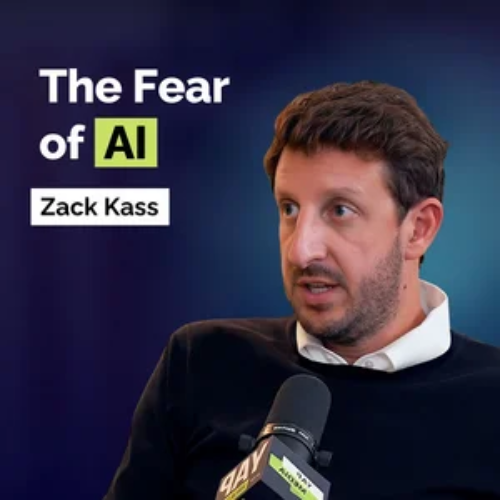
Zack Kass: Should You Be Scared of AI? Former OpenAI Leader Reveals the Truth | Artificial Intelligence | E405
Most people see artificial intelligence as a threat to humanity, but Zack Kass believes we’re worried about the wrong things. As a former leader at OpenAI, Zack has spent years studying how technological breakthroughs reshape society and why every major innovation is met with fear and resistance. In this episode, Zack explains why people are wired to fear AI, why society may be blaming the wrong forces for many of today’s problems, and how artificial intelligence could transform the future of work, education, healthcare, and human potential.
In this episode, Hala and Zack will discuss:
(00:00) Introduction
(01:00) Why Humans Are Wired to Fear AI
(13:24) The Real Barriers to Progress and Innovation
(22:39) How the U.S., Asia, and Europe Are Approaching AI
(30:10) Why We Distrust New Technology
(40:59) The Three Stages of Artificial Intelligence
(55:08) What Are AI Agents?
(1:02:47) How AI Could Change Human Connection
(1:08:45) The Future of Work and Purpose
(1:25:08) Debunking the Biggest AI Headlines
Zack Kass is an AI strategist, futurist, and the former Head of Go-to-Market at OpenAI, where he built the sales, solutions, and partnerships teams that helped launch ChatGPT to businesses worldwide. He is the USA Today bestselling author of The Next Renaissance, which explores how AI can expand human potential. Today, Zack works as a global AI advisor, consulting with Fortune 1000 companies and governments on how to responsibly deploy artificial intelligence at scale.
Sponsored By:
Indeed – Get a $75 sponsored job credit to boost your job’s visibility at Indeed.com/profiting
Shopify – Start your $1/month trial at Shopify.com/profiting.
Quo – Run your business communications the smart way. Try Quo for free, plus get 20% off your first 6 months when you go to quo.com/profiting
Remitly – Transfer money internationally across 100+ currencies with no hidden fees. Download the Remitly app or visit remitly.com to get started. Use code BUSINESS to get a $100 bonus after you send $300 or more. New customers only.
Prolon – Reset your body with Prolon’s five-day plant-based program. Go to ProlonLife.com/PROFITING for 15% off sitewide plus a $40 bonus gift when you subscribe to their 5-Day Program.
Northwest Registered Agent – Get a complete business identity with Northwest. Visit northwestregisteredagent.com/YAPFree and start using free resources to build something amazing.
Resources Mentioned:
Zack’s Website: zackkass.com
Zack’s Book, The Next Renaissance: bit.ly/ZK-TNR
The Anxious Generation by Jonathan Haidt: bit.ly/JH-TAG
Economic Possibilities for Our Grandchildren by John Maynard Keynes: bit.ly/JMK-EPOOGC
Active Deals – youngandprofiting.com/deals
Key YAP Links
Reviews – ratethispodcast.com/yap
YouTube – youtube.com/c/YoungandProfiting
Newsletter – youngandprofiting.co/newsletter
LinkedIn – linkedin.com/in/htaha/
Instagram – instagram.com/yapwithhala/
Social + Podcast Services: yapmedia.com
Transcripts – youngandprofiting.com/episodes-new
Entrepreneurship, Entrepreneurship Podcast, Business, Business Podcast, Self Improvement, Self-Improvement, Personal Development, Starting a Business, Strategy, Investing, Sales, Selling, Psychology, Productivity, Entrepreneurs, AI, Artificial Intelligence, Technology, Marketing, Negotiation, Money, Finance, Side Hustle, Startup, Mental Health, Career, Leadership, Mindset, Health, Growth Mindset, AI Marketing, Prompt, AI in Action, AI in Business, Generative AI, AI for Entrepreneurs, AI Podcast
Learn more about your ad choices. Visit megaphone.fm/adchoices
Zack Kass: [00:00:00] There is incredible negativity towards AI. Housing, healthcare, and education have gotten 280% more expensive over the last 30 years. These three things are not technological failures. They're expensive because of policy failures. We are governed by a pernicious, antisocial, geriatric group of parasites.
Hala Taha: Most people hear AI and immediately think, "What is this going to take from me?" My guest today, Zach Cass, wants us to ask a much better question: What could AI make possible?
Zack Kass: Most people are really excited for everyone else's jobs to automate, just not their own. Everyone wants stuff to arrive a little bit faster, a little bit cheaper on Amazon, without realizing it means automating the ports.
Hala Taha: I heard Elon Musk say something recently, that work one day will be more like a hobby. How do you feel about the future of work?
Zack Kass: First, the reason the future of work is such a ridiculous discussion right now is because none of the economists understand AI, and none of the technologists understand labor economics.
The second problem, and [00:01:00] no one's really talking about this, is-
Hala Taha: Why are communities pushing back against data centers? There's lots of people who are really upset about the environmental impact of AI.
Zack Kass: If you really care about the environment, the most environmentally efficient thing you can do is
Hala Taha: Zach, welcome to Young and Profiting podcast.
Zack Kass: Thanks for having me.
Hala Taha: We are just gonna jump right in. So I was reading your book, and a big premise of it is that people are scared of AI. And not just because AI is dangerous, but because we're wired to be scared of change and things that are new. So help us understand why it's our natural instinct to just be afraid of AI.
Zack Kass: That is a good question that not enough people ask about everything that they're afraid of, actually. Um, we are wired as humans, and, and the disclosure here is I'm not a behavioral psychologist, but I'm gonna tell you what a be- many behavioral psychologists would say. Most of what any [00:02:00] human believes is, uh, they are predisposed to believe.
So m- most of actually what you experience, and this is, this is a little controversial, actually comes from genetic predispositions. Your ancestors passed you a bunch of beliefs and biases that are inherent in your DNA, and then you have lived experiences that compound those things. And a lot of people actually from a very young age, their lived experiences either, you know, confirm or slightly tweak what it is they're predisposed to believe.
But of the 180 cognitive biases that we have, there are a few that are really powerful.
Hala Taha: Mm.
Zack Kass: One of them is a confirmation bias. So we often are, see things that we already believed, and they reinforce what we, what we believe. Yeah. So they confirm or reinforce our ideas. One of them is a negativity bias, and the negativity bias served us a long, long time ago, and actually to some extent can still serve some people today, especially those, like, under constant physical threat.
The negativity bias tells us to look at something as though it, you know, it can harm [00:03:00] you even if the chances are low. And the negativity bias is the thing that plagues a lot of the people who are most cynical in your life as it is, or most pessimistic. And then we have a bias that we call rosy retrospection, which is one of these really incredible biases.
We tell ourselves that the past was way better than it actually was. Mm. Yeah. And we tell ourselves these really romantic stories of a bygone time with a sense of nostalgia. And we even actually, we've now created this sepia lens that our brains view the past through. And I, I don't know if you're a '90s baby.
I was a '90s baby, and they, you know- Yeah ... all the Instagram is filled with these, like- Sort of nostalgic images and videos of what it was like as a '90s baby. And of course, what those videos do not remind us is that being a child was far more dangerous in the '90s than it was today because of kidnapping and other forms of violence, and also that the '90s themselves were plagued with all sorts of other problems that we don't experience today, but we remember them fondly.
And so we do this, and it compounds in these interesting ways. Now, [00:04:00] that in and of itself makes us afraid of change, it makes us afraid of, um, sudden movements, uh, and it generally makes us wary of things that, that feel like we can't, you know, shape them. AI presents a whole other slew of issues, and we'll get to these.
But the principal issues that I call out in the book, I think are born from a context window of anyone's most recent relationship with technology.
Hala Taha: Hmm.
Zack Kass: And so in places like the United States, and in particular in cities in the United States that have been hollowed out economically or, or spiritually, culturally, there is incredible negativity bend i-in views towards AI.
Hala Taha: Yeah.
Zack Kass: And you don't have to really try to figure out why, right? The internet and the digital economy promised to make everyone's lives better, and a lot of lives got better. But if you live in the Rust Belt or if you live in a city that was forgotten in the digital economy, you're gonna look at this with an enormous [00:05:00] amount of, of skepticism and trepidation.
Moreover, if you're a young person and you were told that the world would continue to get better, and instead you were fed, uh, unmetered pornography-
Hala Taha: Mm. ...
Zack Kass: gambling, comparison, violence, outrage, right? Jonathan Haidt wr- writes about all this in The Anxious Generation. And you observed that housing, healthcare, and education have gotten 280% more expensive over the last 30 years, you're gonna look at AI and go, "Great."
Hala Taha: Yeah. "
Zack Kass: A whole lot more of that garbage And so we sit in this incredible moment where humans have this incredibly proud relationship with technology. For so much of our history, the history of human progress has been told as the history of technology. Outside of the good guys winning the important wars, everything we celebrate is us discovering something- Mm.
Basically. You don't hate, uh, air conditioning. You don't hate electricity. You don't hate refrigeration. You don't hate antibiotics or planes, trains, and automobiles. [00:06:00] You hate your relationship with the screen, often, and you hate the fact that technology has not made housing, healthcare, and education less expensive over the last 30 years.
And so many people look at this moment with AI and they go, "Cool. The, the tech giants are gonna make my lives worse as they did for the last 30 years." And the best comparison and the reason why not everyone hates AI, you go to China, 80% of Chinese people believe that AI is going to be better for them or make their lives better.
And you don't have to do a lot of research to figure out why. They have an incredibly healthy recent relationship with technology. The average life for the average Chinese person has improved meaningfully- Mm. Over the last 30 years because of very, very explicit efforts by the CCP to diffuse the value of electricity and the internet to the benefit of the average person.
Hala Taha: Yeah.
Zack Kass: And that explains it, and it actually isn't much more complicated. And so the book basically tries to spell out why this moment is not that unlike other technological moments, and also what we need to do and reconcile the fact that the [00:07:00] kids have every right to be pissed because they're staring down the barrel of prohibitive living and addiction to some of the worst vices we've ever invented.
Hala Taha: But wouldn't you say that's recency bias if we're kind of comparing how life has transformed over the last 30 years, and when we step back, the arc of human progress has actually been exceptional?
Zack Kass: Well, now you're, you're-- You could write the forward to my book. If you, if you... I mean, yeah, totally. And also, typically a recency bias, you know, you and I would, um, we could go to a Knicks game and suddenly we're a Knicks fan.
Well, we're in Spurs territory. We could go to a Spurs game, and then suddenly we're Spurs fans. That's a recency bias. That's a recency bias most people can make sense of. At some point, you actually have to consider something a bit of a trend, and it's true that we should look at the arc of human history to actually examine which the, which is the case I make, that, that I think this will go well.
It's also true that we should acknowledge why some people have every right to be really wary of in, in this moment.
Hala Taha: Yeah.
Zack Kass: And [00:08:00] especially those who feel like they are, and I, and I say this quite, quite freely, w-w-wealthier in so many ways than all of their ancestors combined, and yet spiritually depraved And for whom hope has never felt further in, in, in grasp despite all the promises that have been made by, by all of the technology companies for the last 30 years.
That's not a recency bias. That's, that's an honest, very reasonable concern and something that we have to acknowledge as we talk about the world that, that, that is going to get better.
Hala Taha: What's up, Young and Profiterers? When you start a business, nobody warns you that you are about to become the creator, the marketer, the finance team, the customer support, and the person who's ChatGPT-ing why checkout is not working.
And that's exactly why, if you're serious about starting a business, I always say start with Shopify. Shopify has been a real business partner for me as I've grown Yap Academy and launched [00:09:00] products like my LinkedIn Secrets Masterclass. It powers millions of businesses worldwide and 10% of all e-commerce in the US.
Whether you're a household name or just getting started, they've got you covered. Because let's be real, your business should not require 17 tabs, five logins, and a minor emotional breakdown just to sell a product. Shopify lets you build a store, market your products, manage payments, track analytics, handle shipping, returns, inventory all in one place.
Shopify does this all so you don't have to do it alone. Start your business today with the industry's best business partner, Shopify, and start hearing Sign up for your $1 per month trial today at shopify.com/profiting. Go to shopify.com/profiting. That's shopify.com/profiting. So I know that you're a history major.
You went to school for history. Yeah, I guess
Zack Kass: we still... I guess
Hala Taha: I still am. I still... You still am a history major, I guess. Yeah, I
Zack Kass: have, I have a degree in, in history and computer science from, from Berkeley.
Hala Taha: So you saw AI from a different lens. [00:10:00] You saw it from a lens of history, and I was reading your book, and one of the things that you say is in the- By the
Zack Kass: way, thank you for doing that.
Hala Taha: Yeah.
Zack Kass: You didn't have to, but I appreciate you doing that.
Hala Taha: Well, I feel like it'd be a better conversation if I understood your thought, and it's a recent book. You just put it out in January, right? That's right. So basically, you say that in the late Middle Ages, people thought the world was ending. Mm-hmm.
And you said there's some similarities to what, what's going on with the release of AI. Like, people just are, are looking at it like it's, it's doomsday. But out of, you know, this, this doomsday came the Renaissance, the first Renaissance. Uh-huh. Right? So talk to us about what happened in the late Middle Ages.
Why you think it's similar to now, unless you think we're out of that phase?
Zack Kass: So you've read the chapter. The chapter is called Welcome to the Late Middle Ages, and I- it's kinda tongue in cheek. Like, I don't actually propose that we are in the late Middle Ages. What I propose is that if you had lived during the late Middle Ages, you would have had every right to think that the world was ending.
Half of the human population was [00:11:00] decimated-
Hala Taha: Mm-hmm ...
Zack Kass: by disease, and some more during the late Middle Ages. We basically stagnated on a technological progress standpoint because we started to observe the average life expectancy decline for a couple of hundred years, so people stopped inventing things because they didn't have time to actually invent stuff, and they had to simply survive.
And a lot of the people who were inventing things died while they were inventing them, so progress was halted for a couple generations. And at the end of the late Middle Ages, um, you have Gutenberg's printing press. So you have this, you have this invention that actually then sparks the Renaissance. Now, I have never met someone in all of my walk of life that tells me with a straight face they'd rather live during the late Middle Ages than now.
And actually, I've only met a few people that can confidently tell me they'd rather live at another point in history.
Hala Taha: Hmm.
Zack Kass: And I've never met a woman who actually thinks that they'd rather be alive at any other point than today- Yeah, for sure ... for all sorts of obvious reasons. Mm-hmm. Well, you say that, but a [00:12:00] lot of people are willing to tell me very straight-faced that it's, that we're, that we're fucked.
A lot of people are w- willing to tell me very seriously this is it. This is the peak of civil- civilization, or actually we peaked some time ago. People go, "Oh, I miss the '90s."
Hala Taha: Hmm. I
Zack Kass: go, "Ah, let's talk about that." But my whole argument is if you actually believe that this is a bad period of time, let me remind you how bad it once was, and also what came from that, that actually hard times do produce a bunch of incredible moments.
And I'll look at all the stuff that's, that's fundamentally broken with you and, and stare at it, and also say, "Here are all the reasons why I think a lot of these things can get a whole lot better."
Hala Taha: Hmm.
Zack Kass: And you couldn't have really done that in the late Middle Ages. You needed a lot of hope. And you know what else?
A lot of those people died without it. And I, and I say this to people, so much of our, the world we live in today with, uh, you know, truly unmetered information is you just know too much, and a lot of people have a window to the world that is actually too big. [00:13:00] Hmm. I, I really think so... The cross that, that especially the young people bear today is that we gave them access to all the horrors, all the atrocities of the world without the brain that can metabolize it.
Hala Taha: Hmm.
Zack Kass: And so, of course they graduate college thinking that the world is ending because when we graduated college, we were like... I mean, I remember exactly what I was thinking about when I graduated college, and it wasn't the world ending, right? Hmm. It was trying to find a job and, and find a girlfriend and party and, and become a man, which is probably what a male brain at 21 should be thinking about in a developed world.
Like, we, we solved a bunch of problems so that I had the, that opportunity.
Hala Taha: Yeah.
Zack Kass: And young people are, l- have lost that. So I remind everyone, if you really wanna be really despondent, let me tell you All the other times in human history where people were despondent and actually hope was very clearly on the horizon.
Hala Taha: Yeah. Well, you're actually an AI optimist. Would you say that?
Zack Kass: I've stopped using that term. I, I used to use the term because it, like, [00:14:00] told people what they should expect. And now I actually just say, I... N- now I describe myself as something entirely differently, which is I work in the arena. I build lots of stuff with AI.
I'm an advisor. I've been in over 500 boardrooms, and I- I'm at this point probably best described as an AI advisor. But I also, having studied history and computer science and having studied this technology very closely, consider myself a very accomplished and credible realist.
Hala Taha: Yeah.
Zack Kass: And it just so happens that it's very hard to refute a lot of progress that is currently being made.
Hala Taha: Well, talk to us about some of the progress, healthcare progress, education progress. Like, what are some of the things that maybe people don't know about yet that is really cool in the AI world?
Zack Kass: Well, I think before we talk about the progress in AI, whi- which we can, I think we should just talk about sort of like, we, we should set the stage for what we think, what I think actually is most broken and needs to be fixed.
Hala Taha: Sure.
Zack Kass: Because there is a really remarkable thing about the world we live in, which is the, you know, this TV screen w- was once $10,000. Mm-hmm. [00:15:00] Now it's 100 bucks.
Hala Taha: Yeah.
Zack Kass: And like, th- this is, like, a very nice dress that would've been prohibitively expensive for any of your grandparents to, to own, for example. And there are...
Almost everything in our lives that can come down in cost has, has plummeted in cost. And then there are sort of three exceptions to that: housing, healthcare, and education. And, and not only have they gotten more expensive over the last 30 years by about 280%, they've gotten worse. Mm. Right? The, the actual outcomes are, are worse.
And I have to remind everyone that these three things are not technological failures. They're not expensive because they must be. It's not that we haven't figured out how to make them cheap. They're expensive because of policy failures. Mm-hmm. They're expensive because we've chosen to make them that way.
Hala Taha: Yeah, corruption basically.
Zack Kass: Bluntly, and actually plainly, we, we are governed by a pernicious, antisocial, geriatric group of parasites. They're all really excited to watch us fight with each other and blame the [00:16:00] technologists. Now, look, I think that Mark Zuckerberg might be a public enemy at this point. Like, I'm actually
I watched the congressional hearings. I watched him and the head of Instagram tell American households that being, that a child staring at Instagram for nine hours a day doesn't actually constitute addiction. And if it is addiction, it's okay because they're learning. And I, in that moment, decided that, like, both of them could be tried in The Hague- Mm
as far as I'm concerned. Like, that's probably, uh, uh, if you profiteer when my child stares at a screen, I probably don't want you to do well, and actually I probably want you to do poorly. Um, but we should also acknowledge that on the whole, the technologists are trying really hard to move stuff forward.
Hala Taha: Yeah.
Zack Kass: And that it, it continues to be our, the politicians and the policymakers who have not. And the reason we can observe this is that that TV screen was $10,000, now it's 100 bucks thanks to the technologists.
Hala Taha: Yeah.
Zack Kass: And thanks to the technologists, you can drive across Los Angeles for [00:17:00] $15 in an autonomous vehicle Thanks to the politicians, a trip five blocks away in an ambulance might actually bankrupt you.
Hala Taha: That's crazy.
Zack Kass: The kids have every right to be pissed. I just think they're pissed with the wrong people.
Hala Taha: Hmm.
Zack Kass: In California in particular, we, you know, our, our, our governor's a hero. I don't know why, among, among so many people. I, I can't figure it out. I don't know why any of them are heroes. Like, I don't know why any politician, except those who are talking about cost of living and the ability for technology to deflate that cost- Yeah
are heroes. Because everything else is a lie. Your national policymakers are not your heroes. They ne- they will never be, and only the ones who recognize that the simplest and best way to make your life less expensive is by inventing tools to do so. Sh- every, everyone else is lying to you.
Hala Taha: Yeah.
Zack Kass: So with that table set, what I, what I basically acknowledge is that there's only so much that technology can do, right?
We've created a world where actually technology has made so much dirt cheap. You can get gas station sushi. Like, it's kinda wild. I mean, [00:18:00] truly a, a delicacy. Like, you can now go to a gas station and get half-decent sushi for, like, six bucks. Why the hell do you have to work till you're 80 to afford your parents' house?
Hala Taha: Hmm.
Zack Kass: That's housing policy. It's not because the building materials are too expensive. It's not because we haven't figured out robotics. In fairness, we haven't really done a lot with robotics, but we would've done a lot more. We would've done what China has done by now, which is how to figure- figured out how to autonomously build a lot of inf- infrastructure if we were building more infrastructure.
We built 18 million new homes in the 1980s. We built 17 million new homes in the 1990s. We built 6 million in the 2000s. Hmm. NIMBY policy. Nancy Pelosi and Chuck Schumer took power, and they said, "Let's keep it just the way it is. Let's pass a bunch of policy to our exclusive benefit, and then let's blame everyone else."
And they've shot us all in the foot, and they've, they're holding a smoking gun being like, "Who did this?"
Hala Taha: Yeah.
Zack Kass: So [00:19:00] all that being said, there are huge problems in this society that almost no amount of technology can fix. Now, th- there are some exceptions, and some of those exceptions include drug discoveries.
So I tell everyone that AI could s- could truly save itself if it can figure out how to cure cancer or neurodegenerative disease because even the policymakers can't stop that. And the conspiracy theorists will pile on. They'll say they'll, they'll stop it. They can't. If a drug manufacturer actually figures out the cure for these diseases, they will, they will sell them.
Hmm. They will, they will ship them, and you, and you cannot stand in the way of that politically speaking. Outside of that, it's actually pretty hard to think of a technology that will change the current course- Hmm ... of our cost of living, the, given the political restrictions. And I say this because we actually could observe a world where AI continues to improve at a breakneck speed, where the frontier, as it has, continues, and you can, you can show a chart, continues to improve r- logarithmically, [00:20:00] and it won't matter.
And I'm actually- Hmm ... about to publish a paper called The Diminishing Model Returns Theory, which says at some point the frontier will not matter to anyone, the next model, the next great model, because we're too busy digesting the last model or the one before it, and a lot of that digestion is gonna be political.
A lot of that digestion is gonna be ... It's not gonna be enterprise updating. It's actually gonna be the policymaker saying, "You can automate this." I wrote another paper that's very unpopular called Illegal Automation, which documents the 1.5 million jobs in the United States that you cannot legally automate.
Hala Taha: Hmm.
Zack Kass: There are 7 million in Europe, by the way. Now, when we talk about illegal automation, people go, "It's the policymakers protecting workers."
Hala Taha: Yeah.
Zack Kass: Totally fair Except they're protecting jobs to a collective detriment. Like, everyone gets their cut until you turn around and you go, "Wait a second, we've passed so much antisocial policy that..."
Do you have, do you wear glasses or contacts?
Hala Taha: I do, yeah. Okay.
Zack Kass: If you've ever wondered why your [00:21:00] contacts are so expensive, and you've ever wondered why going and getting a new eye prescription is so expensive, it's because the ophthalmologists want it that way.
Hala Taha: Mm.
Zack Kass: And they have passed incredible amounts of policy.
It's a cartel that has passed a ton of policy that makes it really hard to automate a lot of these procedures, and therefore drive down the cost. And they did it to protect their jobs, and they did it to protect their, their little unit, and then you look and you go, "Everyone else is trying to do it." And there's this collective bargaining that is actually antisocial inherently.
So all this is to say the models are getting a lot better, and they will continue to get better. There is a really upside-down world where in two years, and I, I think it's quite possible, we have exceptionally high-quality videos of Donald Trump making out with Taylor Swift and still no great drug discoveries.
Hala Taha: Mm.
Zack Kass: For what it's worth, I don't think this will be the case. For what it's worth, I think what's gonna happen is we're gonna start to, to diffuse the value of this technology to the benefit of the average person, and we're seeing it in, in education. So in, in Austin, [00:22:00] Texas, McKenzie Price, Alpha School, is building a private education system where kids can do two hours of very, very high, high quality, basically one-on-one tutoring with a machine, and then they spend the other six hours a day outside.
Hala Taha: Okay.
Zack Kass: And it's having exceptional benefit It's too expensive for most people to do, but she's proving a model, and that model, as long as the teachers unions allow it, will diffuse to a public school within two years is my bet. And we will see a massive rebound in our current degradation in literacy and motor function.
You know the average Gen Z is less likely to read, ride a bike, and swim than a millennial?
Hala Taha: Wow. I did not know that. I didn't know they were s- And
Zack Kass: so then you look and you're like, "Yeah, we did you dirty. Like, we gave you a phone and we said, 'Go hang out in your room. You don't need to do anything.' We took you out of schools during COVID and we said, 'Figure it out.'"
And they did nothing in many cases.
Hala Taha: Mm-hmm.
Zack Kass: So there is a huge bounce-back coming, and some of it is gonna be that the technology itself gets a lot better, and some of it is gonna be that the, [00:23:00] um, that the policymakers die and we elect new ones. The other thing that's gonna happen is we're gonna discover that AI isn't actually an app.
So many people stare at AI and they're like, "Oh, it's an app." No, it's, it's cognitive infrastructure. And the sooner that AI becomes invisible, the sooner that people are gonna realize its benefits. Mm-hmm. Because today you have to stare at this thing, and it actually just automates a little bit, but it, in many cases it has this insatiable appetite for more of your attention.
I mean, the really messed up thing about ChatGPT and Claude is you actually have to stare at it to use it. What we want is a more agentic world where all of the activity happens in the background, and that also is moving in a pretty interesting direction, where the infrastructure underneath will actually start to automate because we're powering it like we did with, with electricity.
Hala Taha: Young N-Profiters, I started my business as a side hustle and while I was working at HP and later Disney. And once I started landing clients and bringing in some good money, I knew it was time to go full time into entrepreneurship. But nobody warns you about all [00:24:00] the unsexy, complicated stuff you need to handle, like the paperwork it takes to start a business or having a business address that is not the same as your apartment, for example.
Luckily, that is exactly what Northwest Registered Agent is built for. They are the largest registered agent and LLC service in the United States, and they've been helping entrepreneurs launch and grow legit protected businesses for nearly 30 years. When you form with Northwest, you get a complete business identity, a business address, registered agent service, operating agreement, professional email, domain, website, phone number, and built-in privacy.
They do it all in one place, all handled in-house. And the best part, you get thousands of free guides, tools, and attorney-drafted documents to help you run your business with confidence. Don't pay hundreds or thousands of dollars for what you can get with Northwest for free. Visit northwestregisteredagent.com/yapfree and start using free resources to build something [00:25:00] amazing.
Get more with Northwest Registered Agent at northwestregisteredagent.com/yapfree. That's northwestregisteredagent.com/yapfree. So you were talking about how different regions of the world have different policies around AI. So I'd love to understand from you, like, what is the EU doing differently than the US or China and, like, who do you think has it right?
Zack Kass: Why am I confident we're gonna- we're gonna do a lot in, in, uh, drug discovery? We discovered our first antibiotic in 60 years very recently because of AI. We split HIV out of DNA very recently because of AI. Exactly one year ago last week, the first infant ever in the United States received a custom gene therapy, a single shot that cured him of a previously deadly disease, and thanks to CRISPR and AI.
So we're seeing now a rapid improvement in the, in the speed and the, the, uh, rate at which we are discovering, uh, drugs- [00:26:00] That's amazing ... and, and other things. It's not limited to bio and life sciences either. There are basically three world models right now for how to govern AI. Europe has taken a, uh, regulate first, figure it out later, uh, agenda, and the EU AI Act basically says it's very punitive policy and very aggressive policy that, that makes it pretty hard to build or, or leverage AI-
Hala Taha: Hmm
Zack Kass: um, safely as far as the government is concerned. That's having a very n- nasty economic consequence.
Hala Taha: So they're more like, like tight with it. There's more restrictions around AI and what you can build.
Zack Kass: Far more. It's actually... It's... So you, you hit the nail on the head. It's actually what you can build and what you can deploy, but it's having a particularly bad effect on what you can build.
So if you, um... They basically have decided that the model manufacturer will be liable And it sounds smart, like it sounds nice. So like we're gonna hold OpenAI and Anthropic accountable. But then you realize that it is gonna keep anyone in [00:27:00] open source from building models. Mm. It's actually gonna... It's, it's gonna make sure that OpenAI and Anthropic are the only ones.
Of course, Mistral has some, has some French special provisions, but there is no serious lab in Europe-
Hala Taha: Mm ...
Zack Kass: because everyone is now terrified to build models that, that, that do something wrong.
Hala Taha: It seems so silly because they're gonna lose out on so much money eventually.
Zack Kass: Well, Europe also did the same thing with chemical manufacturers.
And, and by the way, you can, you can make the argument that chemical manufacturers should be held responsible when they create chemicals that harm people. This was, of course, the Erin Brockovich case.
Hala Taha: Yeah.
Zack Kass: Actually, you probably wanna make the argument that people who are using the chemicals inappropriately should be held responsible because if you don't, then you actually keep anyone from experimenting with chemicals.
Hala Taha: Mm.
Zack Kass: And it's not that you wanna let people build chemicals that are bad for humans and, and the world. It's actually that you wanna make sure that people feel safe to try to experiment and create new things.
Hala Taha: Mm-hmm. Yeah.
Zack Kass: Um, so anyway, Europe has taken this very anti-uh, development approach, um, [00:28:00] and it's having, you know, the expected consequence, but Europe's been a museum for a while, so, uh, I don't think anyone there is surprised, and I don't even think Brussels is surprised.
Like, I think they've just sort of... They seem resigned to, to be, uh, you know, the world's vacation destination. Asia is broken into two categories Uh, Japan, Korea, Singapore have taken really aggressive, uh, have invested very aggressively, and you've seen in the Korean and Taiwanese stock markets in the last...
They, they've doubled in the last six months, and, and they're rip-roaring because they're trying to develop and infuse, um, or digest. Uh, they're taking a similar approach to the United States, which is very laissez-faire, and they're like, "Build. We'll figure it out."
Hala Taha: Mm-hmm.
Zack Kass: China is taking a very interesting approach.
The Chinese approach is to, um, create a very open build environment and actually to regulate the ingestion. So the CCP has taken very explicit measure to figure out how this technology will actually be infused into society-
Hala Taha: Hmm ...
Zack Kass: and which it [00:29:00] has the benefit of because it has central planning, but it also has built a ton of infrastructure to accommodate it.
So China has... I'm actually going to China in, um, in a week, and it, it'll be my 10th time in China in four years.
Hala Taha: Hmm.
Zack Kass: I'm fascinated by the country. I really like Chinese people, and the CCP has gone to aggressive measures to make sure that the average person sees the benefit of technology.
Hala Taha: When you say ingest, what do you mean?
Zack Kass: They're, they have built 45,000 miles of high-speed rail. They have built three times the amount of electrical output capacity as the United States. They have built, in the last decade, 300% more housing units than the United States. So they're building a bunch of infrastructure. Now they have a population problem, but they're building a bunch of infrastructure.
They're building roadways that are forward-compatible with autonomous vehicles.
Hala Taha: Hmm.
Zack Kass: So everything they're doing, they're trying to build for a future society, right? A state where, where people can do a whole lot more, where there's a lot more basically mobility, [00:30:00] physical, uh, um, et cetera, and, or, and, and, and probably economic.
And they are also mandating the adoption of AI in systems like schools-
Hala Taha: Hmm ...
Zack Kass: uh, although they're controlling it in systems like social media. So hospitals, if you run a hospital in China, you are basically required to make that hospital better, faster, cheaper, year over year, and if you don't, you get fired.
Hala Taha: Well, that's good.
Zack Kass: It's awesome. It would be pretty amazing if we did something similar. Mm-hmm. We'd fire every hospital administrator on Earth probably, and I- this is coming from the son of two doctors and the, and the grandson of two as well. Xi did this thing 10 years ago, I... If you have Chinese friends, th- th- they'll remember this.
He made private tutors illegal because he said all the wealthy parents are getting tutors. That means all the poor kids are getting a massive disadvantage, 'cause we know empirically the most helpful thing in a child's development is one-on-one teaching and tutoring.
Hala Taha: Mm-hmm.
Zack Kass: And the degree to which I allow [00:31:00] wealthy people to outpace poor people is going to actually compromise the fabric of society.
And so he said private tutoring is illegal, and it created this massive gray market that's actually wild, uh, in China. So, like, you literally, like-
Hala Taha: Have to, like, sneak around
Zack Kass: to get tutoring ... actually, it is, like, this incredible- That's so interesting ... like private tutors are really expensive, and they are very hush-hush, and they operate with a degree of risk and danger because you can be fined a ton of money if you're found out to be hiring or, or, or being one.
But now Xi has realized suddenly everyone can have a private tutor.
Hala Taha: Mm.
Zack Kass: And actually what they're now doing is diffusing the power of AI into one-on-one education that allows every child in China to have this, to have this benefit, w- all while making sure that Douyin and, and Baidu and, and, and their, and ByteDance and their other social medias have no violence, uh, pornography, gambling.
Now- Chinese have a very strict understanding... I mean, uh, I, I wanna be very careful before [00:32:00] I espouse how China treats their people and also the freedoms of a Chinese person.
Hala Taha: Yeah.
Zack Kass: So let me be very clear. I love living in the United States. I really wanna be American, but we, our social media looks very different than theirs.
Hala Taha: Mm-hmm.
Zack Kass: And that is what central planning looks like with, with regard to ingestion, right? So they've said to the model manufacturers, "Build open source models. We're okay not building the frontier." So they're, they're specifically saying, "We're not gonna build the best model. We're gonna build the next generation.
We're gonna make it dirt cheap, and we, the CCP, are going to help guide how it's diffused into infrastructure so that the average Chinese person sees it as a net benefit."
Hala Taha: Yeah. This reminds me of something in your book that you were talking about. Uh, it's a very useful framework, which is technological threshold versus society, societal threshold.
Zack Kass: Yeah.
Hala Taha: Tell us about that.
Zack Kass: Extra points to you. Thanks for... Okay, this is one of my favorite frameworks. I, I wish... So more people... [00:33:00] It didn't, um, it didn't catch on quite like I thought it would. Sticky IP is hard. It is what it is. But, um, a technological threshold asks the question, what can a machine do? That's all it asks.
A societal threshold asks the question, what do we want a machine to do? And they're very different things, it turns out. And the best example, and the one I draw on in the book, assuming that, you know, a lot of listeners won't read so I can spoil it, is the autonomous vehicle. Now, so much is said about the autonomous vehicle.
Hala Taha: Yeah. People hate them.
Zack Kass: Isn't that amazing, though? So, by the way, I- I'm sure you also read the book.
Hala Taha: I hate them personally.
Zack Kass: Do you?
Hala Taha: Yeah.
Zack Kass: Tell me more.
Hala Taha: Well, we have Waymos in Austin, and they're just really dumb. Like, they're just really dumb. Like, they're always about to hit people, and I know that you might say that's a, like a, a bias that I have, that I think that the, the machine is more dumb maybe, but-
Zack Kass: I'm not, I am not judging you.
I hope you don't see any, any- No, no, no, no, no ... anything on my face. I'm
Hala Taha: not gonna... Uh, but yeah. I, I don't know. I just don't, I wouldn't trust it. I, I don't trust it.
Zack Kass: Do you trust your Uber drivers? [00:34:00]
Hala Taha: No, not really. I hate Uber drivers too, but, but I guess I trust them more because if I, when I have a choice, I don't go for a Waymo, I go for Uber.
Zack Kass: You obviously grew up driving, taking taxis. Did you trust your taxi drivers?
Hala Taha: Yeah.
Zack Kass: Okay. Let's come back to this. Okay. There's a lot here. Okay. Let me, let me come back to this because to explain societal thresholds, let me quickly tell a story because I think it's worthwhile.
Hala Taha: Okay.
Zack Kass: In 1854, Elisha Otis introduces at the World's Fair a people mover.
And the people mover is a, prior to the people mover, um, we moved men, uh, people up and down mine shafts and tall buildings using ropes and pulley systems. And they were very dangerous because if the rope or pulley broke, everyone plummeted to their death basically. Yeah. And Elijah goes, "You know, we should, we could build a system that the cr- that, that, that catches the rope or pulley such that there's a fail-safe-
Hala Taha: Hmm
Zack Kass: and actually then create [00:35:00] more of a mechanized means by which we move people up and down," and it worked. Empirically it worked really well, and almost one invention, um, fundamentally changed the odds of someone who was working in a mine shaft or tall building. Hmm. And a bunch of tall building owners start buying these people movers And by 1855, a bunch of these tall building owners start calling up Otis Elevator, now aptly named, um, one of the two great elevator companies in the world, um, Sch- Schindler Electric being the other, and called Otis Elevator and said, "Hey, no one's riding, no one's riding these people movers.
Can we return them?" Mm. Some of these building owners say, "Can we return them?" Of course, they- Otis goes, "No, you cannot return these elevators," but he's got a problem now because he solved the technological threshold, he solved the empirical problem of moving people up and down the building safely, but he hasn't solved the societal threshold.
So he goes back to the drawing board, he gathers his executive team together, he goes, "How do we convince people they should ride in these elevators? 'Cause if we don't, they're, no one's gonna buy them anymore. It doesn't matter if they work."
Hala Taha: Mm-hmm.
Zack Kass: And they come up [00:36:00] with three ways they think they can convince people to ride in the elevator.
Hala Taha: And people thought it wasn't safe, that's why they weren't riding?
Zack Kass: That's exactly right. The feedback was, thank you for calling that out, the feedback was no one thinks they're safe. And actually, more importantly, people are terrified. They, they don't even understand them. The, they're these mechanical contraptions that, with steel cages on them, that are actually just terrifying-
Hala Taha: Mm
Zack Kass: in many ways, so no one wants to get in them. They go back to the drawing board and they come up with three ways they think they can convince people to ride in the elevator. The first, they put a mirror in the back of every elevator, so when you walk in you'd be distracted by your own image.
Hala Taha: Mm. Smart.
Zack Kass: Very smart. Then they put music in the elevator so that when you walk in you'd be a little entertained.
Hala Taha: Mm.
Zack Kass: The third is they put an operator in every elevator such that when you walk in you're given the sense of human agency.
Hala Taha: Mm.
Zack Kass: Someone to control a lever even though that person was not at all necessary.
And those three things work. They move the societal threshold, uh, everyone starts riding elevators. They don't make the [00:37:00] elevators safer, but everyone feels safer and more welcome, and the rest is history. Now, I tell this story and people chuckle. How could you not, right? Yeah. It's like we all ride elevators.
If you've ridden
Hala Taha: to
Zack Kass: the top of- You don't even think about it, yeah ... and if you've ridden to the top of the Empire State Building, you've ridden a ve- or, or the Burj Khalifa, you've ridden a very tall elevator.
Hala Taha: You can understand why they were scared, though. They're going in like- Totally ... a metal box and really fast.
Zack Kass: I mean, I can think of a lot of moments in history where I would not have been the first person to do something- Yeah ... that I will inevitably do.
Hala Taha: Mm-hmm.
Zack Kass: I don't need to go to the moon right now. Do, would you go to the moon right now? No. I wouldn't either. One day you and I probably will go to the moon, realistically.
I mean, probably. At, at the current rate that technology is progressing and, and the rate at which stuff diffuses. I certainly would not have been the first person to fly in a plane. I am blown away by the Wright brothers.
Hala Taha: Yeah.
Zack Kass: And frankly, anyone who flew planes early on.
Now, I don't think twice. Yeah. So I'm with you. But it does also afford us the opportunity to beg the question, what is our elevator?
Hala Taha: [00:38:00] Mm.
Zack Kass: And we have many- Yeah ... as you pointed out. We have so many, it's actually hard to count, and the reason for that is that we are moving technological fast, pr- thresholds faster than any generation prior.
The one, though, that I like to talk about is the autonomous vehicle. Now, what I'm particularly fascinated by relative to the, to all the other things people talk about, 'cause people talk about autonomous vehicles ad nauseam. The debate has gotten so stupid, in my opinion. What is most interesting, on the marquee, the most interesting thing is that the roadways for you and me are probably the most dangerous place on Earth.
I mean, that, that we will go to, that we will travel to, our demographic. Yeah. Neither of us are at meaningful risk of a cardiac event. We both live in cities where we are physically very safe, but the roads are very dangerous- Mm-hmm ... for you and me. And 45,000 people in the United States alone die on the roads every year, of which, by the way, 7,000 are children [00:39:00] And despite that, the, there is one obvious solution, the autonomous vehicle, and the obvious solution polls at about 35% approval.
35% of people are excited about autonomous vehicles. That alone blows my mind because it's not that I need someone to want an autonomous vehicle. It's not that I want someone to want taxi drivers to be out of business. It's not that I want someone to not wanna see someone driving their car. It's that I am so shocked that people don't want 45,000 pe- and by the way, 1.3 million in the Uni- in the world.
Hala Taha: Well, it goes to the point that we, we forgive ourselves, right, for, for having accidents and failures.
Zack Kass: Now, now you're getting ahead. So I went and studied this. I became fascinated by this gap. I actually don't care at all how good autonomous vehicles are. At any given moment, I don't care. I'm like, why do people hate these things that are so clearly gonna save literally 7,000 children's lives when we, when we roll them out?[00:40:00]
Okay, reason one, humans love control. We love control. To understand this, I went to Disneyland. Have you ever been to Disneyland?
Hala Taha: Yeah.
Zack Kass: Okay. I went as a kid, and then I went, I went w- with researchers, and I stared at Autopia, the ride Autopia. It's one of the original seven rides at Disneyland. It is a cement track on which children age about three through eight ride around in a go-kart, a gas-powered go-kart at about two miles an hour, and they have about this much leeway.
Hmm. So you don't actually have to turn the wheel, and the pedal is Boolean, so it's either on or off, and you can only go two miles. And it is actually a real embarrassment to Disney. It's a blight. They hate this ride. It smells bad and actually reeks of fumes. Pe- the workers complain of headaches, so they have to rotate them out.
It has very little foliage. It has no Disney branding. Um, and it's, it sounds terrible. It's like a, it's like a noise problem. Mm-hmm. And despite that The reason that they cannot change this ride, and the reason that it is only now going to go into construction after [00:41:00] 70 years in operation, is that it has been the most popular ride for children age three through eight since its inception.
Hala Taha: Mm.
Zack Kass: 1954, Autopia has been the most popular ride at Disneyland because you do not need to explain to a child how fun it is to step on a pedal and turn a wheel. There is something thrilling about controlling a machine. BMW sells it to you in every commercial. We don't know how to describe it. It is so awesome to control something that is way more powerful than us.
Getting your driver's license is equal parts thrilling because of the freedom and thrilling because of the control- Yeah ... of this machine. And as a result, you see it everywhere. People insist on controlling machines that are bad for them, harming them, killing them, killing others, m- machines that they hate using because, machines that are inefficient because they want to control these machines.
And you see this all over the place, and it is one of these problems that is actually just going to be really tricky as we try to adopt machines. Yeah. The second reason is most people have no idea how good [00:42:00] autonomous vehicles are. Technological thresholds are moving way too quickly. When I started doing this study, autonomous vehicles were actually pretty bad.
Now they're amazing. Basically, no one knows. Unless you work at one of these companies, unless you've been in a Waymo- Mm-hmm ... and even then you're like, "Maybe I got lucky."
Hala Taha: Yeah.
Zack Kass: No one has any idea that Waymos are empirically multiple standard deviations safer than most drivers, and certainly many standard deviations safer than senior drivers- Yeah
who are somehow still allowed to drive. And that's just a huge problem because now more and more peop- the technological thresholds are moving so quickly that no one has any idea what they're actually supposed to adopt. But the third reason is the one that you called out, which is that humans have an exceptional tolerance for human failure and none for machine failure.
And I stare at this all day. I stare... I watch 1.3 million people die on the roadways, and I watch Waymo swerve into the wrong lane, and there's an international outcry to shut the whole thing down. I don't not get it. It, it serves us. It's why this building will never collapse. It's why planes don't fall out of the sky.
But it will have this strange buttress, this [00:43:00] strange, like, artificial limit to what we adopt because we are so willing to watch each other fuck up-
Hala Taha: Yeah ...
Zack Kass: and we're so unwilling to watch a machine do it because we assume that it's, it's systematic and, and foundational failure. And that's just gonna present all over the place.
It's gonna present everywhere all the time, and it's gonna be why we move pretty slowly through a lot of systems that could really meaningfully improve lives because we are afraid to, you know, for that .01% mechanical failure rate.
Hala Taha: Well, since we're talking about autonomous cars, I'd love for us to spend some time on where you think the future of AI is gonna bring us.
I wanna talk about the cost, but first I actually wanna talk about the future of AI. You talk about three stages of AI in your book. Do you still align to those three stages, and how do you imagine the world to be in 10, 20 years with AI?
Zack Kass: Totally. The stages are enhanced applications, agentic or autonomous agents, and natural language operating system.
Mm-hmm. Enhanced applications is exactly what it sounds like. It's, you know, apps that we've always used now [00:44:00] supercharged with AI. It's funny because we had to go through this Magical AOL Instant Messenger, that is what ChatGPT is. We had to do it in order to bring people up to speed- Mm-hmm ... but it's not actually-
Hala Taha: We needed the interface.
Zack Kass: We needed the thing that every- that comported to the way and world in which people wanted to work.
Hala Taha: Yeah.
Zack Kass: Like
Hala Taha: it- And what we're used to already, kind of.
Zack Kass: Totally, and they're like, "Cool, it's magical, and I've been doing it for 30 years," which is why we get away with marginal productivity gains because despite all the promises of AI, because people go, "I can still...
I still log into email, I still do these things"- Yeah ... but it's scratching the surface of where we're going. Second phase is agentic AI. Agentic AI, by the way, has entered its teen sex phase. Everyone is talking about it. It is not clear who is doing it. And it turns out very few, although some people are doing it a lot.
Um, parents of teenagers m- may not like that one, but it, but it's true. And the thing about agentic AI is lots of stuff is going to change, and two things in particular are gonna change a lot that [00:45:00] I don't think people are talking about. So the autonomous agent phase, which I think begins in earnest later this year and then probably lasts the next decade-
Hala Taha: Hmm
Zack Kass: maybe, maybe more, maybe less, is going to force us to rewrite the fabric of the internet. When we built the internet, we originally built it as a, um, library. Well, a bunch of nerds built the internet, and so rightfully they were like, "A library is the optimal use- ... of this thing," 'cause that's what they were thinking about.
Mm-hmm. And so we, for a period of time, the smartest people on earth put their best ideas onto this, into this space, and it proliferated. All the universities and lots of corners of the world where smart people gathered turned the internet into this really great repository of information. And then one day a marketer probably was walking by and stared at the nerds huddled around their machines and was like, "The optimal state of that internet thing is not a library.
It's a shopping mall." And they built the browsable HTML internet And it's the first corruption of the internet, the second being social media. And it's a corruption, it's a [00:46:00] Faustian bargain that we would make 10 times out of 10. We would always, always trade world's best practices for trillions of billboards in exchange for GDP.
Hala Taha: Yep.
Zack Kass: E-commerce. I mean, you can buy anything from anyone anywhere, but it totally ruined browsable internet. It's actually totally ruined the nature of the internet, and you don't have to... I don't need to prove this. You can know this every time you go to a website.
Hala Taha: Yeah. Or in Google or wherever.
Zack Kass: Anywhere.
Yeah. I mean, obviously, present company excluded and everyone, you know, all of your listeners, your websites are great- ... but most websites are shit. And the reason I can, I know this is 'cause I log onto my bank's website once a week to get my account statement and send it to my accountant. And as soon as I log in, I'm served an ad for a credit card that I've owned for 13 years.
It's not because they're evil. You can make the arguments, whatever. It's not because they're bad designers, and it's not because they're, they're stupid. It's because everyone has a fiduciary responsibility to sell everyone everything all the time. As soon as you're with an eye shot of someone on the internet, you gotta sell them that thing.
So [00:47:00] what I realized in all this is as soon as an agent can reliably get my account statement and send it to my accountant, I am never gonna go to my bank's website again.
Hala Taha: Mm-hmm.
Zack Kass: Ever. It's not 'cause I don't like my bank. I actually do like them. It's 'cause there's nothing for me at that site. I don't wanna be there.
I don't wanna be on the internet for the most part. I want my accountant to have my account statement, and if I don't have to do anything in it, great.
Hala Taha: Yeah.
Zack Kass: And then you realize most people actually don't wanna be on most of the websites they go to. Most of the internet is not a place you wanna be. It serves some practical purpose.
You have to do a thing, and when agents can reliably achieve most of what you want on the internet, you're gonna stop browsing to most webpages. Mm. And we are going to slowly and then very suddenly rewrite the fabric of the internet. And the optimal state of the internet is not an HTML browsable internet meant for our eyes.
It's a TXT XML internet meant for our agents.
Hala Taha: Mm.
Zack Kass: And I can basically prove technically that, that the optimal state of the internet is, is a bunch of text files, and [00:48:00] that's going to be pretty amazing.
Hala Taha: That's so interesting. So no longer will, um, like, they won't be able to sell to us because it will be agents who are on getting the advertisements, and they don't need anything.
Zack Kass: Well, now you've... Okay. Hold that thought because now you've introduced the next con- the one of the consequences-
Hala Taha: Mm ...
Zack Kass: of a TXT XML internet. There are many consequences. There are tons of first and second order consequences. Uh, some of them are really good. One of the ones that's neutral and certainly strange Is that we're gonna discover pretty quickly how many preferences people actually have.
Hala Taha: Mm.
Zack Kass: So when I was writing the book, I started staring at all this automation, like all this inevitable automation. 'Cause everyone's like, "Oh, it's an economic problem." I was like, "Fuck no, it's not." You, if you actually automate everything to the hilt, the world gets way wealthier. You cannot convince me otherwise.
You can't convince an economist otherwise. Worst thing that could happen, actually, is that we stop automating things, then you live in Cuba or North Korea, which is places without technology.
Hala Taha: Mm. [00:49:00]
Zack Kass: But there's a limit to automation that actually stops serving us, and that I introduced by asking a question. I started asking people at dinner tables, "If you could automate everything in your life, where would you stop?"
Hala Taha: I wouldn't wanna automate exercise. I wouldn't want to automate, um, cooking or, you know, things I enjoy like that. I wouldn't wanna automate Any sort of experience that I enjoy doing
Zack Kass: That's a good heuristic and one that a lot of people arrive at. I- on my list, there are a few things you mentioned that I would automate, but we'll come back to that.
When I ask people this question, I realize that it actually goes to this amazing question of values and, and frankly, what it means to be human. And the list, by the way, is amazing. Like, people reflexively, the most common thing reflexively that people say is cooking, which is really incredible to me because I would automate cooking.
I, I-
Hala Taha: Yeah, now that I'm thinking about it, it's like maybe I would like sometimes to be able to automate.
Zack Kass: Well, y- Yeah ... by the way, you, you get to change your mind. Yeah. So I'm not, I'm not, I'm [00:50:00] not the genie. I'm not... It's not the last time you'll get to do this. But the next thing that people talk about is exercise, and a lot of people talk about runs on the beach.
That's one of these weird things that comes up. People talk about time with their kids. Um, w- uh, tucking their kids into bed, reading their kids stories. They don't want to automate these things. When I was asking people, it was about that time that, that s- that stroller, that AI stroller was out, or the AI rocker was out.
Hala Taha: Mm.
Zack Kass: That weird thing that rock kids to-
Hala Taha: Yeah, I remember ...
Zack Kass: sleep. Yeah. And so people were like, "I wanna do that job." Now, you say that, and then I'm like, "What if it's at 3:00 AM?" Anyway, what you realize... By the way, one of the answers that people are willing to get to pretty quickly is very crude. People, there's a lot of things that- Yeah
a lot of people agree we just shouldn't automate, and one of them is sex. And what's really fascinating is you, you realize, like, there's something very simple about the question that goes to what it means to just be human and- Mm ... and to love life. And there's a lot of things that people would not automate, and it costs nothing, which is also really exciting to think about.[00:51:00]
Uh, places, you know, it's time with friends and family and places of worship. It's a very, very common answer, which, which fills me with hope. I, to understand this better, actually tried to go look at, like, the atomic unit of automation, which I decided was people grocery shopping. The easiest way that I could explore automation- Mm-hmm
at the most atomic unit is by f- watching people shop for groceries. And I live in Santa Barbara, and there's a Bristol Farms in Santa Barbara. I don't know. Have you ever been to a Bristol Farms?
Hala Taha: No.
Zack Kass: It's a very fancy grocery store. Okay. I really like it, but it's, it's a... If you've been to it, it's silly. And I watched about 20 people in Santa Barbara walk up and down Bristol Store- Bristol Farms aisles and consider a bunch of groceries.
I didn't tell them anything, and when we got out, I asked each of these people about three groceries that almost all of them had considered or purchased: water, toothpaste, tortilla chips. And I would say to them, we'd get outside, I'd say, "Why'd you buy that [00:52:00] water or that, the toothpaste and tortilla chips?
Why'd you buy that?" And they'd say, "Well, it's my favorite." 80% of the people, "It's my favorite." Say, "How many others have you tried?" They'd say, "Uh, just that one." In Santa Barbara's Bristol Farms, there are 50 varieties of tortilla chips, over 60 varieties of toothpaste, and over 85 varieties of water.
Hala Taha: Oh my God.
Zack Kass: How could you possibly know your favorite of any of those things? Mm. Then you look at all the things we purchase, and you realize that you and I, and actually, uh, most... The average person in the developed world or in the Western world makes 125 purchase decisions a day, which is 124 more than our great-grandparents.
Hala Taha: Mm.
Zack Kass: Capitalism is awesome. It brought us abundance. Abundance brought us optionality, and optionality is properly breaking our brains. And you realize [00:53:00] in talking to people, as you start to examine the atomic purchase decisions, the simplest things in your life- Yeah ... that, that even the wealthiest people often have to decide to purchase.
Most people make purchase decisions not out of brand loyalty. They make them out of preservation for computational load.
Hala Taha: Mm.
Zack Kass: People cannot possibly consider all the things they buy, so they do it out of inertia or randomness.
Hala Taha: Yeah.
Zack Kass: And when you explore this, you realize that when the average person, or even especially the wealthy person, is offered an opportunity to let someone else or something else fill their grocery cart, they're gonna say yes.
And they're gonna say yes in large part because there are so many things to choose from and so many things to buy.
Hala Taha: Mm.
Zack Kass: And when someone says or an agent says, "Do you want me to plan you a dinner date?" You might be like, "Yeah. I don't wanna ex- I don't wanna investigate every new restaurant in Austin. Four opened last week, and they're all supposed to be amazing."
Hala Taha: Mm-hmm. "
Zack Kass: And by the way, I choose the restaurant based on menu items anyways. Why don't you know my [00:54:00] taste? Pick, pick the menu item." What about a vacation? Awesome. I would love that. Make it sunny, direct flights only. And you realize that the automation boundary, we pick these big things, but actually along the way, there is a bunch that we're gonna have to seriously consider.
Hala Taha: Mm.
Zack Kass: And rewriting the fabric of the internet makes it particularly easy for us to automate way more than we realize today. And one of the challenges, I think, of the agentic AI moment and the internet and the, the next 10 years is figuring out what we have to preserve for our own humanity and dignity and what we have to preserve for our collective humanity and dignity.
Hala Taha: Yeah.
Zack Kass: What it actually means to be alive. There is a, there is a world in which we live and simply subsist because we have automated so much, and you don't have to look that far to see some of it today. We stopped... The average parent in the developed world became very uncomfortable with their own child's discomfort and automated most of that discomfort away.
And so the, the conclusion that I draw is actually in discovering what I call [00:55:00] virtuous friction. So much of the automation boundary goes to this idea of what work serves us and what work does not.
Hala Taha: Mm.
Zack Kass: Virtuous versus vicious friction. Walking two miles for clean water is clearly vicious friction. No one should have to do that Drilling a well with your parent in your backyard to see that water can come out of the ground is virtuous.
Hala Taha: Mm.
Zack Kass: Emotional abuse of any kind, but especially of a child in high school, is terrible. Being broken up with as a high schooler, pretty good experience. Good to know what it feels like so that when you get into the real world, you can feel a sense of rejection.
Hala Taha: Mm-hmm.
Zack Kass: And you're observing a cl- you know, a generation right now, Gen Z, that have never been broken up with 'cause they don't date, and so the feeling of rejection is terrifying.
Hala Taha: Mm.
Zack Kass: All of this is gonna be presented slowly and then suddenly, and the agentic internet presents one more weird outcome, which you kinda touched on, which is there is a... I worry about these dystopian [00:56:00] outcomes that I don't think are talked about enough because they're more insidious. Like, everyone's like- Yeah
"Oh, is, are, is AI gonna kill us all?" And I go, "No."
Hala Taha: Mm. "
Zack Kass: I don't think so." And I, there's no real scientific basis to that argument. But, like, what about a world in which one company makes all of our purchase decisions?
Hala Taha: Mm.
Zack Kass: And people are like, "Yeah, that's crazy." And then it's like, yeah, Google kinda controlled most of the internet for the last 25 years.
And they did it in a black box way, right? They didn't have to tell us how the algorithm worked. They didn't have to tell us how they were serving ads. And if Google suddenly decided tomorrow, they said, "You know what? Leave it to us. We're gonna buy everything for you. We're gonna, we're gonna schedule you.
We're gonna b- buy your clothes. We're gonna get you styled," a lot of people might be like, "That's awesome."
Hala Taha: Yeah, they might do it.
Zack Kass: And-
Hala Taha: Or trust
Zack Kass: it ... and we, we should acknowledge that there's a insidious dystopia that doesn't feel dystopian because it's uncanny. It's uncannily similar to the world we live in, except that [00:57:00] we are now controlled by an even more narrow apparatus.
And by the way, there's a solution to this. Don't lose hope. There's a solution, which is an open internet, and people are working really hard for this, an open internet protocol that you sh- you should advocate for, where the internet itself operates like it does, it's an open internet, and everyone brings their own agent.
Hala Taha: Mm.
Zack Kass: So its agents are open sourced, and everyone brings their own agent, and that agent is beholden to you and operates on an open internet protocol, and you can tell your agent what you want it to do, and at the end of the day, it retains your data. It doesn't sell it to the highest bidder, and it makes decisions exclusively on your, to your benefit.
Hala Taha: I wanna kind of, like, back up a bit. I, I don't think everybody really understands what an agent is. Mm. I was talking to my friend. I was going on a walk, and he-
Zack Kass: Hence the teen sex era.
Hala Taha: Yeah. Exactly. Like, you do because you're an expert, but people listening in, they probably don't quite understand what an agent is.
I was taking a walk with my friend who started an AI company and is helping people build AI agents, and he explained it really, uh, in a really easy way to understand. He basically said an [00:58:00] agent can go from app to app to app, and you don't need a human to facilitate it, whereas, like, you know, you can use, uh, ChatGPT.
That's not, obviously, that's not an agent, but an agent can go from all different apps and, like, accomplish what a human can do. How would you explain it?
Zack Kass: It is a machine that can execute tasks and goals across browser, data lake, and application environment. It is, quite simply, in other words, a Siri that works That is the best way I know how to describe an agent to anyone.
By the way, I made that joke, Hala- ... in Chicago three months ago at a talk, and in the back- the room goes into a hush, or half the room does. In the back of the room sits Adam Cheyer, the founder of Siri.
Hala Taha: He was so pissed.
Zack Kass: He wasn't happy. Now, half the room thought it was really funny, and the other half d- like, sort of his half didn't, and he hasn't responded to any of my apology emails.[00:59:00]
In my defense, he should've built a technology that worked. And so now we can talk about Siri as a false dawn, but it's exactly that. It's a thing that can navigate systems the way that you and I navigate systems except far more seamlessly.
Hala Taha: Mm-hmm.
Zack Kass: And the major breakthrough, and if you're like, "Well, Siri sucked.
Why is this different?" Complex reasoning. So whereas Siri could only go forward and it couldn't really turn left or right, and it actually couldn't turn around at a dead end. So if it reached a place, even if it was wrong, it was like, "Cool, we're gonna do this now."
Hala Taha: Yeah.
Zack Kass: Um, so it's like always, you know, it always opened your garage door.
It always called your aunt or something. But the modern agents are capable of complex reasoning, so they actually can go side to side. They can explore this app and say, "That's not right." They can explore this app and say, "That's not right." And they can move much more freely, and that allows them to do f- really complex things on a open internet or inside of environments that you give them access to, like your email or, or other applications.
Hala Taha: Would you say that agents are going to be always, [01:00:00] like, on our screen? Or like, how do you imagine AI evolving with agents?
Zack Kass: Well, so the third phase that you alluded to or that I, I guess I wrote about in the book that you just alluded to is we call the natural language operating system. So I think, what I think happens, right now we're in this enhanced application phase, so we're still really nascent in AI.
And if you use AI ... When people say, "Do you use AI?" They literally assume that everyone has to, in order to use AI, you have to go into your device. Now, of course, most of us are beneficiaries of AI in very sort of discreet ways or, like, non-active ways where the, the grid that is powering this building runs on AI.
Like, there's a bunch of stuff that happens, autopilot in planes, right? Mm-hmm. But that doesn't actually change the fact that for most people, their, their sort of understanding of AI and the benefit to them Happens when they use it. They have to be using the app. They have to press buttons.
Hala Taha: Yeah.
Zack Kass: Um, so it's just another thing that demands our attention.
Agents will help people, especially as they work better and, [01:01:00] and start to become more self-evident, um, they will help people use AI without actually, or benefit, I should say, benefit from AI without actually using it, without actually interfacing with it.
Hala Taha: Mm. '
Zack Kass: Cause what comes next is a world ... The, the term I use, the term that's used is, is ambient compute.
And ambient compute is this, or ambient AI, is this idea of machines that ... Well, one, we're gonna go from carrying our devices, laptops and cell phones, to wearing them, watches, rings, glasses, wristwatches, et cetera, um, wallets, pens. People are always like, "Oh, that sounds dystopian." How could it get more dystopian than staring at your screen?
Hala Taha: Yeah.
Zack Kass: Like, it cannot. If you told me that my daughter in, when she grows up, in 15 years, is gonna have to stare at a screen like this in order to use a computer, I would tell you that we have regressed, like something horrible has happened, a meteor has hit the Earth or something. We cannot possibly want this world.
We were never supposed to live this [01:02:00] close to screens and- I totally agree ... and, and, and, and captured by them. They have an un- insatiable appetite for our attention. They are demons. They are destroying our lives. They're s- We are spiritually devoid because of these things. We are further from God, not closer to, because of screens.
So machines that can relieve us of the attention starvation that screens are producing, good. But also, they are going to be embedded with telemetry and audio and video sensors that actually start Sort of passively working on our behalf, which also relieves us of the need to actually constantly press buttons.
Hala Taha: Mm.
Zack Kass: And that is also to our collective benefit because so much of the value that we will get from machines will start to f- become invisible, which is exactly how the internet could and should feel. It's exactly how electricity feels, and it turns out all great technology at the limit moves into the background.
Hala Taha: Mm.
Zack Kass: Because the purpose of living is actually this-
Hala Taha: Yeah ...
Zack Kass: without, without anything else. Like, the purpose of living is [01:03:00] time with friends and family in physical community, places of worship and outside, dining room tables. That's it. That actually I can feel very confident in saying if we live for another 50,000 years, will continue to be the most important thing that humans do because it has been for the last 200,000 years, and that brings us closer to God and closer to each other.
Machines that work passively do another thing, which is that they, they, they dissolve the digital divide. So many of our friends today don't feel like they use AI because they don't feel like they know how. Mm. And these are the same people who in 20 years would feel like they had totally let missed out on economy and society.
And you see this with lots of old people. There are older people in our lives that can't use FaceTime, so they can't see their grandkids. They, they barely can use a, they, they barely can use their phone, so they show up at the airport four hours early to get their, you know, physical boarding passes. I mean, all these things Where the digital divide is pronounced because machines became so complicated to use should in fact become obsolete.
Hala Taha: Mm. [01:04:00]
Zack Kass: The ultimate achievement of AI will end up being moving to the background so that the value is actually distributed fairly evenly.
Hala Taha: Yeah.
Zack Kass: And this is the natural language operating system that I describe, and I think it arrives at some point in the next 10 to 15 years where so much of the, the stuff that we organize today actually becomes, uh, active.
Yeah.
Hala Taha: And is this what you call unmetered intelligence where it basically just becomes like electricity? Like, we don't even notice that it's there?
Zack Kass: Unmetered intelligence is a, is a theory I proposed in 2021 which proposes that at some point intelligence would behave like a resource.
Hala Taha: Mm.
Zack Kass: Water, electricity, Internet, food stuffs in the developed world.
It would go from very scarce to very abundant, and that arrives sometime between now and, and natural language operating system. We're- You could argue we're sort of there. Like, you and I can do a whole lot more than we've ever been able to. What's interesting about unmetered intelligence is it doesn't propose universal brilliance.
I'm not proposing everyone to be smart. I'm proposing that everyone will have access to brilliance in the same way [01:05:00] that literacy doesn't mean you read, in the same way the Internet doesn't mean you do research, in the same way that a gym membership doesn't mean you're fit. Unmetered intelligence doesn't mean you'll be brilliant.
It means that you and, or we and, and, and collectively and individually will have access to it, and what we do with it will define everything.
Hala Taha: Okay. Where I wanna go next is talking about the human experience, relationships, and how you think that's gonna evolve with AI. It sounds like you have a very, like, positive outlook considering that you, you believe that screens are gonna become less common or needed to get our daily actions done.
How else do you feel like it's gonna change the way that we interact with each other?
Zack Kass: Well, screens have already become less necessary to living life. They've just become more necessary, or they've become more addicting in life. But so much of my hope actually comes from watching... So this is, this is a little strange, but watching Gen Z is really hard.
I mean, honestly, like, it's actually, like, heartbreaking to watch a, an entire population that has so much opportunity and [01:06:00] feels so broken spiritually, emotionally. Um- We should never have given kids smartphones. We should n- most people shouldn't have social media, I, I believe. I, I, I'm terrified of it. The smartphone is a portal, an unmitigated portal into pornography, depravity, dereliction, violence, comparison.
The list is so long, and we, 16-year-olds don't have the ability to m- to metabolize that, and they also don't have the ability to, to know what they should spend their time on and not. You know, left to their own devices, most 16-year-olds would get terrible tattoos and, and a lot of them would get pregnant and- Mm-hmm
th- that's okay. You're a kid. You're supposed to have your parents there, and a lot of parents gave their kids phones and said, "Figure it out." Uh, you would never drop your kid off at the tattoo parlor and say, "Figure it out." We were so protective of kids in the physical world, and we were so unabashed in the digital one- Mm
and we're paying a s- a serious consequence. Many standard [01:07:00] deviation higher rates of depression and anxiety and reclusion and isolation, and e- especially in the developed world, places where kids have plenty, have it all-
Hala Taha: Yeah ...
Zack Kass: and feel like they have nothing. And I, my heart breaks. I mean, I, there's nothing else to say, and, like, I, I wanna fix it.
And the, and the cool thing, the, the promising thing I should say Is that they've raised their hand and they said, "We're not happy." They don't wanna live this way. And Gen Alpha has watched them and said, "There's no fucking way- Mm. "... we wanna look like this." Millennial parents are raising Gen Alpha very different than Gen X raised Gen Z, and Gen Alpha has basically gotten up and said, "I don't wanna be this."
And you're watching social media addiction decline. It's subtle now, and it will be pronounced soon. You're watching people return outside. Consumer confidence keeps waning. Concert tickets for Benson Boone keep getting more expensive. People wanna go outside.
Hala Taha: [01:08:00] Yeah.
Zack Kass: Like, people don't like drinking, so bars are struggling, but parks are exploding.
Museum attendance, all-time highs in a lot of towns. Local theater, all-time highs. Broadway, roaring back. Physical world is on fire right now- Yeah ... in a really good way, and it doesn't actually take a genius to figure out why. E- even though consumers are like, "I'm worried about my savings," even though they're, they're, they're s- they're taking on more credit card debt than they ought to, they're also saying, "I want to be wi- with other people.
I wanna be doing real things." Mm-hmm. And Gen Alpha in particular like shopping physically. So all these mall experiences, I mean, like Rick Caruso built The Grove in LA and all, and, you know, the, these really cool mall experiences. They've become like cultural touchstones in ways that we never expected because Gen Alpha's like, "I wanna be with my parents, physically touching all this stuff."
Hala Taha: Mm.
Zack Kass: It took us thousands of years to figure out that women shouldn't smoke while they were, smoke and drink while they were pregnant. Thousands of years. Oh, my God. Okay? All of our, [01:09:00] basically everyone in our, in our lineage smoked and drank while they were pregnant, that who had access to tobacco, nicotine, and alcohol, except for our moms.
Like, truly except for our moms. Who were like, people were like, "Hey, don't do this." It took us 20 years to figure out that device addiction was really bad. That's super promising. So you can look at this and say, "Wow, the poison proliferated really quickly." It did, because of the internet. And the pollution is bad.
It is. But also, you have to find a lot of hope and promise in the fact that the next generation watching this is like, "No, no, no, no, no. I don't want that. I, I want my soul and spirit." They are willing to admit we sacrificed the soul and spirit of Gen Z at the altar of a digital display, and they're like, "Don't do that to me And so what I propose now is we're just graduating problems.
It's not that they won't have experience of their own. Of course they will, and every generation inevitably does. But the fact that each generation can now observe and, and counter-correct is pretty impressive. [01:10:00]
Hala Taha: Yeah.
Zack Kass: And so all of this boils down to something that I have believed since I was a child, I mean, I was born with a predisposition to loving time with humans, I could sit here with you for a long time, which is that the most wonderful thing that we can do on this earth is spend time with friends and family in physical community, places of worship, and the dining room table, ideally outside.
Hala Taha: Mm-hmm.
Zack Kass: That's it.
Hala Taha: Yeah.
Zack Kass: It's why we're here. It brings us closer to God. It brings us closer to each other. It makes us happy. It explains why when you go to Costa Rica, people are so happy despite having absolutely nothing, or Bhutan. It is a very simple heuristic that makes sense to the world. It explains why the wealthiest people are often not the happiest, and in many cases, often sometimes the most miserable, because they are the most devoid of this time.
Yep. And if you use this heuristic to explore the purpose of technology, then eventually you will either believe that technology is gonna destroy us, or you realize that we w- we have and will continue to figure out that the purpose of technology is to free us to do this.
Hala Taha: Hmm.
Zack Kass: Which I believe. [01:11:00]
Hala Taha: Yeah.
Zack Kass: And so I'm very optimistic for our ability to figure out time and time again to reconnect to what I call our hap- our happiness function, to reconnect to this idea that the purpose of technology is to free us, all the awful vicious friction, so that we can spend time doing the virtuous.
Hala Taha: Well, a lot of us like to spend time working. A lot of people who are listening to this show are very successful entrepreneurs who really identify with their work, and love to work in general. Um, and I heard Elon Musk say something recently where he was saying that work one day will be more like a hobby.
It'll be like gardening. You can choose to work. You can choose not to work. How do you feel about the future of work?
Zack Kass: One, I don't like to make a habit of disagreeing with Elon. It's not a, it's, it's, um, it's not a, it's not a good investment strategy. I also, I tend to agree with a lot of what he says. I disagree with this point, but I don't disagree with it for the reason he is making the statement.
So first, the reason the future of work is such a ridiculous discussion right now is [01:12:00] because- None of the economists understand AI, and none of the technologists understand labor economics. So, like, technologists are like, Dario is like, uh, "Claude is gonna be able to do everything, so all jobs are gonna go away."
And it's like, okay. Uh, and every economist is like, "Let me explain to you how labor works." And of course, the labor economists go, "AI wasn't good when I wrote this paper six months ago." And so this is ... And, and of course, then all the technologists have to go, "Buddy, you are very out of date."
Hala Taha: Mm.
Zack Kass: That's the first problem.
The second problem, and no one's really talking about this, but it's important to talk about, is political protection. Illegal automation protects 1.5 million jobs in the US, 7 million in Europe, and is the reason that it is very hard to actually accurately predict which job is gonna automate.
Hala Taha: Wait, so this illegal automation, you brought it up before.
[01:13:00] I've l- I've interviewed every AI expert, and nobody has ever brought this up. I've never heard of this phrase before.
Zack Kass: With respect, technologists, AI experts, are narrowly, often narrowly brilliant people It is why so many conversations that relate to AI are so devoid of m- any material nuance because technologists were never actually in a great position to opine on, for example, the meaning of life.
Hala Taha: Hmm.
Zack Kass: And especially the AI safety folks. But most technologists don't live lives that you or I find appealing. They're obsessed with work in ways that I don't think is very becoming, and they are often spiritually devoid, bluntly. Um, I always say, I always joke, if someone has bad personal hygiene, I don't give a shit what they think about the future of humanity.
Like, I assume safely that if you can't be bothered to take care of yourself today, [01:14:00] you can't possibly imagine what the future of humans c- can do because obviously you couldn't- Can't even
Hala Taha: take care of yourself.
Zack Kass: Exactly.
Hala Taha: Yeah.
Zack Kass: Illegal automation is bluntly and very simply political protection. It explains why your contact lenses are expensive.
It explains why... I mean, if you've, have you ever hosted an event?
Hala Taha: Yeah.
Zack Kass: You have to set up in a certain way, and you have to hire a certain group of people- Yeah, get insurance and this and that ... and you're like, "Can't we just, can't I carry this in?" No, no, no. Someone has to carry this in for you. Literally, unions have made it illegal to automate the, you know, dropping off things inside of a warehouse- Mm-hmm
because they have to be the ones who take it in there. It's protection for their work. And the list of this stuff is long. It's also why the asymmetry of stuff that can automate is really wonky. You look, for example, you're like, wait a second. Why is it that, um, that w- you [01:15:00] can go into a doctor's office and th- you can, you know, do a bunch of stuff on an iPad, and you can, you know, register and do all these things.
But as soon as you get into the OR, there are nine people in there Oh, the hospital has ensured that there have to be all those people in there, in large part so that they can bill those people.
Hala Taha: Yeah.
Zack Kass: And the life is filled with this stuff. When people are like, "Software engineers are gonna automate first," I go, "Yeah, that actually might be true."
But it's not because cloud code is great. Cloud code is good.
Hala Taha: It's 'cause we're allowed to do it. It's new jobs. It's
Zack Kass: because- Yeah ... they don't have a union.
Hala Taha: Yeah. It's all the intellectual jobs, like lawyers.
Zack Kass: Well, lawyers are gonna make damn sure that they cannot be automated. Are you kidding? They write the policy.
Hala Taha: Yeah.
Zack Kass: Like, I tell everyone, "There's no way law gets automated."
Hala Taha: But I feel like it is already.
Zack Kass: You may get to do work that doesn't require a lawyer. I can [01:16:00] guarantee you, if the lawyers feel threatened existentially, you are going to see an exceptional amount of policy get written- Mm ... by lawyers to protect themselves.
The reason that software engineers are a decent bet, and I don't even think they're, it's right, I'll- uh, for reasons I can explain, is that software engineers don't have a labor union. They never organized, because they, they literally, we invented software engineering, and they got rich overnight, and no one ever bothered to be like, "We should unionize.
We should have- Mm ... we should have nation- national associations." There's-
Hala Taha: So now is the time, I guess, to start to do that if we, if we
Zack Kass: want. Maybe, and I've seen some grumblings. But the other thing I'll say is even if they do unionize, you'd have to be a very brave politician to drag Jenny and Scott, two Microsoft engineers who make $500,000 a year, down congressional steps and tell the American people that these jobs must be protected.
No one is gonna have sympathy. Truck drivers have a lot of sympathy. Congress will [01:17:00] certainly say, "We cannot let these truck drivers lose their jobs. These are very important jobs that feed families." Fine. Need I remind you how many people they kill?
Hala Taha: Hmm.
Zack Kass: And by the way, I'm not s- I don't wanna sit here and moralize every job.
I just wanna point out that- Political protection is the reason that there is so much asymmetry in jobs that do exist and jobs that don't when technology can, can solve them. The third reason is new work. You and I, this moment would not have made sense to someone 50 years ago
Hala Taha: Yeah.
Zack Kass: Let alone maybe even 30 years ago.
And m- most jobs that exist in modern economies were very recently invented. Um, we have no humility for that. We have no backward humility. We celebrate constantly that our ances- that we don't do work that our ancestors did- Mm-hmm ... without actually acknowledging that inevitably our kids will do work that we don't do.
Hala Taha: Yeah.
Zack Kass: Because we are so sure that [01:18:00] these machines are gonna do everything, and I can bet that's not true.
Hala Taha: Mm.
Zack Kass: And the fourth reason is quite simply that the future of work matters a whole lot less than the future of living. I actually am kind of exhausted talking about the future of work because we live in a moment where even if you design the perfect job, even if you design all the perfect jobs, everyone in the economy is gonna have a job.
You're still looking at a world where the average college grad needs to work until they're 80 just to afford their parents' house. Mm. What difference does it make? If we keep talking about the future of work, then we play into the politicians' hands because then they can protect work and they can say, "We saved you.
We did it." Shut the fuck up. Just make shit cheap. Housing, healthcare, and education, we can do it technologically. Allow us to do it. And any discussion by a policymaker about anything other than allowing technology to diffuse to the benefit of the average person is annoying and a [01:19:00] distraction. And they're gonna talk about how they're saving jobs, and I'm like, "That's fine, but if everyone's gotta work that job until kingdom come, three of them, just so that they can survive financially a catastrophic cardiac, uh, uh, event, you've failed."
Hala Taha: Yeah.
Zack Kass: Right? By the way, the last reason is identity displacement, and I talk about this in the book, and we don't have to talk about this a bunch right now. I am sure that job displacement is gonna have a profound economic impact, a good one.
Hala Taha: Yeah.
Zack Kass: Like, I'm, I'm willing to bet that. And that'll sound callous until I remind you that we are all descendants of people whose jobs were automated to our collective economic benefit, and we never think twice about them.
The reason that everything is so cheap is that we automated most of our ancestors out of work. And you wander now, the ... You realize that most people wander the earth average asking, "When is this good or service gonna be better, faster, or cheaper?" Without realizing what they're asking is, when is a human gonna be extricated from the manufacturing of this good or service?
Mm. [01:20:00] Which we don't do because we're jerks. We do because we are rational economic actors conditioned to believe the world should get better, faster, cheaper all the time. And it occurs to one, most people are really excited for everyone else's jobs to automate, just not their own.
Hala Taha: Mm-hmm.
Zack Kass: Everyone wants stuff to, to arrive a little bit faster, a little bit cheaper on Amazon without realizing it means automating the ports.
And the longshoremen who run the ports want their taxes to be free, not realizing that it means, or maybe realizing that it means automating the accountants. And the accountants really w- and the list goes on.
Hala Taha: Yeah.
Zack Kass: The hardest part in all this, I don't think is gonna be managing the economic spoils. It's going to be figuring out how to manage the emotional cost of our work changing so frequently and so much.
Because where I do think Elon is right, that work w- can become voluntary, I don't think it simply becomes a means of pleasure. I think it will have to be, or I think it will have to serve as a means of [01:21:00] purpose.
Hala Taha: Hmm.
Zack Kass: And until we have a spiritual awakening, until we reconnect with God, which I think is coming, I really think people are gonna need work to find out why they're here.
Hala Taha: Yeah.
Zack Kass: And two of the six most common last names in the United States are Miller and Smith because we named ourselves after our jobs for thousands of years.
Hala Taha: Mm-hmm.
Zack Kass: So as work changes frequently and a lot, even if th- the fun- the economic spoils are amazing, and even if we continue to toil for money, a lot of people are gonna be like, "I don't know what I am anymore.
I had this career path, I studied this thing, I had this credential, I had..." You know, first question every adult asks another adult: "What do you do?"
Hala Taha: Mm-hmm.
Zack Kass: It's a mark of status. If we, if that fra- if that ladder fractures, it's gonna be really weird.
Hala Taha: Yeah.
Zack Kass: And th- that to me is like, there's no other way to say it.
We need to, we need to acknowledge that, that this is gonna be really tough, and that it is an emotional crisis we are facing, a spiritual [01:22:00] crisis. Last thing on this. I'm not the first person to say this. Not only am I not the first person, John Maynard Keynes said this in 1930. He was traveling the world, uh, the father of modern macroeconomics, traveling the world, talking about how everything was getting better, and people were like, "John, you're a little aloof.
I mean, lit- people are literally dying in the streets of starvation."
Hala Taha: What was the time period?
Zack Kass: 1930. 1929, he's traveling Europe, giving this lecture series, and people are like, "You're tone deaf, bud." And then he goes home and he doubles down. He writes this paper, The Economic Possibilities for our Grandchildren, in which he writes, and I quote, "I must now disembarrass myself to take flight into a future that I will not live to see, one in which humans may have solved the economic problem and be faced with something more profound The father of modern macroeconomics proposing that at some point we would clothe, care for, feed, house everyone, and then humans would face our greatest struggle.
Hala Taha: Mm-hmm.
Zack Kass: To anyone who will listen, I really believe that we have been in the midst of a [01:23:00] spiritual battle for a while. We bought all the stuff we thought we would ever want and then some, and we're not happier. We are actually less happy in the developed world than we have been in quite some time, and it is plain to see at this point that we need to reconnect with what it actually means to be human.
And I think on the other side of this, whenever it, wh- whatever this is, is a reckoning for humans with, with our actual purpose that we have distracted ourselves from for quite some time now. On that note, by the way, there's this thing called an adaptability trap. Uh, everyone now, right now thinks they have to be adaptable, and so I did this fun study.
It was a fast one. I asked about 100 people to describe their least favorite friend, and it's one of these experiments that, like, I knew what I was looking for, and so I got some confirmation bias, but it actually turned out. So think about your least favorite friend in your mind, and think about a couple...
So not your enemy, but someone you love who you just don't like very much.
Hala Taha: [01:24:00] Okay.
Zack Kass: Now, if you are like about 70% of the population, the person that you are imagining is either very unreliable or exceptionally hard to pin down on any idea. And for many people, their least favorite friend, about 70% of the population fits some category of a sycophant or an infinitely adaptable person.
They say all the things that they want someone to think- Hmm ... they believe or they think someone wants them to say. They are desperate for a- approval. They are desperate for likability, and this moment serves those people really well. Yeah. You know this. I, I can think of the, I mean, unfortunately, I can think of the same person when I go to this place, and they love AI because it allows them to, like, be lots of stuff, and they're constantly talking about all the things they're doing and the new businesses they're starting or the crazy idea that they have.
These are the people who post on LinkedIn the most in- [01:25:00] trite sounding AI slop garbage that gets a bunch of likes 'cause people are like, "Oh, that sounds smart," and then they get a bunch of approval from it. You love this person, but you hate them, and you hate the fact that they don't stand for anything.
And there has never been I think a more interesting time to stand for something that is unpopular. And in particular, especially among the younger p- population that are so e- eager to do group think, so eager to tell each other how much they hate a group that's unpopular, how much they love a thing that's popular, right?
Yeah. Everything's performative. There is so much value now in believing in, in a set of mission, vision, and values, and talking about them, especially when it doesn't serve you, obviously, in a public sphere. Because your ability to achieve those things has never been better. So your ability to prove a group wrong has actually never been greater, and it's never been a better time to be contrarian.
It's never been a better time to have a big idea that doesn't sound good.
Hala Taha: Mm. [01:26:00]
Zack Kass: And so I tell everyone, adaptability is actually this weird trap. It's this infinite adaptability trap that's super fucking annoying. And I'm like, "No, no, no, stand for something. Stand for something, especially if it's, you know, unpopular, and then be adaptable to how you get there."
Hala Taha: Mm.
Zack Kass: Be adaptable to the tools you use. Be adaptable to the technology you adopt. Be adaptable to the, to the time that it might take. But pick a castle on the hill. Describe a world that you wanna live in, and then work really hard to achieve it.
Hala Taha: I totally agree. I feel like focus is so important. Being an expert, I think, in this world where you can learn a- anything, like high level, right?
Actually knowing and going deep because you'll know more than the AI.
Zack Kass: And it is deeply rewarding, it turns out.
Hala Taha: Yeah.
Zack Kass: Like, it's mastery, we do not teach kids a sense of mastery in high school. We ... Mile wide, inch deep- Yep ... is the American high school experience. Fill your resume, look awesome, accomplish this, you know, effectively nothing.
And unless, by the way, you're an elite athlete or an elite musician in high school, you never taste [01:27:00] mastery.
Hala Taha: Mm-hmm.
Zack Kass: So we graduate all these people that have never really actually worked hard on a very specific thing, and we put them into a world where they can be general experts.
Hala Taha: Mm-hmm.
Zack Kass: And I'm like, it's never been a better time to get really good at a thing.
Hala Taha: Yep, every s- really, really successful person right now is just good at one thing.
Zack Kass: And they usually got really good at something before that. They usually, like, figured out, like, windsurfing or an instrument or a sport. Something taught them how to taste mastery so that they had some, you know, pattern-matching muscle memory- Mm-hmm
for what it feels like to, to work really hard at something.
Hala Taha: Yeah. I wanna end this conversation with headlines. I felt like this would be a really great way to just, like, bring up any sort of ideas, anything new that you wanna talk about. Um, and basically these are, like, big trends happening in AI. These are real headlines, okay?
Okay. All right. So the first headline is Challenger says AI isn't a jobpocalypse yet, but companies are citing it the most when announcing [01:28:00] layoffs. So basically, they're saying that companies are using AI as an excuse for layoffs, and it's not really the AI automating jobs.
Zack Kass: W- w- as of time of recording, the job numbers, I think, come out on Monday next week for last month.
Early estimates suggest we will have added the American economy 100,000 jobs, way over our forecast at the outset of the month. And a lot of people are starting to realize that maybe AI is not going to eliminate jobs the way we thought, and actually it may start adding jobs- Mm ... pretty soon, as it has in AI and other fields.
Hala Taha: Especially in the US, I think, because-
Zack Kass: Especially in the US ...
Hala Taha: because, like, I find myself- Europe is
Zack Kass: not doing great.
Hala Taha: Well, just like this might be... I don't know if you've ever thought about this, but so I've got a team of 60, and I have a lot of- Wow ... international employees. And, uh, a lot of my employees are in Nigeria, the Philippines, India.
And now I'm, like, when I'm do- thinking about new hires, I'm like, "Well, I want a US person," [01:29:00] because before it, it would've been advantageous to kind of hire internationally. But now a US person can do the work of five people, and it makes more sense to hire a US person. So for me, I'm actually hiring more people in the US for the first time in five years.
Zack Kass: I generally think most labor numbers are gonna look good except for in economies really uniquely exposed to, like, customer service. But even that, it seems like customer service numbers are still actually net growing. Will Guidara, who ran Eleven Madison, when he onboarded, um, OpenTable to s- to... Oh, Eleven Madison was the first three Michelin star restaurant to, to move reservations online.
He took all of his reservationists and said, "I want you to call every single person and learn about them once they make the reservation."
Hala Taha: Hmm. "
Zack Kass: Figure out why they're coming, and then we're gonna do something special when they come to the restaurant." AI washing is an inevitable outcome. Uh, you know, Jack Dorsey spooked everyone when he announced that Block was gonna fire, I don't know, 5,000 or [01:30:00] 10,000 of its employees and because of AI.
And I kinda wanna remind people that it, the smartest thing that Jack Dorsey could do if he thinks his company has overhired is to blame a technology-
Hala Taha: Mm-hmm ...
Zack Kass: that he could not have predicted well as the reason that he overhired. Because traditionally, layoffs were met with You know, an inquisition. The board would call the CEO and say, "Why did you hire 5 to 10,000 too many people?"
Now Jack Dorsey can say, "Well, I... This thing happened, and who could have predicted how good AI would be? We have to redesign the company around this." When actually you might be willing to make the argument that Block should never have grown to 30,000 employees, which it did during COVID at a time where hiring was considered a mark of success.
And literally, companies were being rewarded in the public markets for adding headcount because headcount was relatively cheap. We had closed offices, and everyone was sewing- going so long on software, you just wanted to [01:31:00] show heft. And so he did the rational economic thing during COVID. He, he hired a bunch of people.
Now he's gonna do the rational economic thing and say, "I hired too many people," but he's not gonna say that he did it because of a failure of planning. That would be beneath him. He's gonna say he did it because AI-
Hala Taha: Mm. -
Zack Kass: has now... He's laying these people off. They've done good work, but AI has compelled him to do this.
Now, I obviously don't work at Block. I haven't looked at the filings. I can't make an accurate assessment. It seems pretty clear that Mark did the same thing at Meta. They hired way too many people. He's probably exhausted by the number of people. It's well-known that Mark, uh, is pretty exhausted by all of the people inside of Meta- -and the culture that he built, uh, and probably is relished at this moment to say AI changed the game when, in fact, it's probably just mismanagement.
Hala Taha: So interesting. Okay, next one. AI-generated work slop is destroying productivity. So [01:32:00] essentially, a lot of articles are talking about how AI can save us time, but it's actually just giving more work to the person you're delivering that asset to, that a lot of managers are, are receiving AI work slop.
Zack Kass: Someone made this argument the other day that, that it is actually immoral or amoral to send someone AI-generated work Because you are potentially making them review you... It costs you nothing to create a bunch of work for someone else. Like, the, the argument which I liked is that it is equivalent to smashing a plate in someone's home and walking out.
Right? You've created a mess that they have to clean up. Yeah. Or, like decorating someone's home and l- for a party they never asked for, right? And I, I tend to agree. Like, I, I agree. I also have a slightly weird take on this, which is I think most work is [01:33:00] bullshit. I think most emails are bullshit. I think most things that people write are shit, and like, I don't love my book.
I mean, I, I, I like my book. I'm super glad I wrote it. I'm proud of the fact that it exists. I wrote it to find conviction and clarity in a bunch of ideas, and I wrote it to, to serve as counter-narrative to prevailing... I mean, I wrote it as a reasonable argument to, to make that, that constructive, uh, uh, uh, responsibility is a, is a reasonable alternative to ambient doom.
And there are a bunch of chapters I'm like, "Ah, I wish I had written this better." The amount of shit that people have been producing for, since long before AI is actually quite ridiculous, and AI is simply shining a light on the fact that people are very comfortable producing garbage work.
Hala Taha: Mm.
Zack Kass: Like, I think the only difference now is that the cost to actually producing the work has gone to zero, not that people are inclined to produce it.
Hala Taha: Yeah.
Zack Kass: There's a sense of aesthetic that some people have. There is a sense of propriety that some people [01:34:00] have when they produce work, and there's a sense that some people are devoid of. And AI is simply shining a light on the people who were slop cannons before because now they are high-performance slop cannons.
Hala Taha: It's so true. It's, uh, I love this idea that you had in your book about the intellectual K-curve.
Zack Kass: Yeah.
Hala Taha: Share that with us. It was really good.
Zack Kass: Yeah, I mean, it basically argues that, like, if you were gonna do really well before AI, you're probably gonna do really well now, and if you weren't gonna do anything before AI, you're probably gonna do even less now.
And my whole argument is like, actually, we should celebrate this. As, as... Like, this is, people are gonna get maybe a little angry here, but I'm like, we've created a world of economic abundance where if you want to do absolutely nothing, you can actually do it. Like, consider the fact that we crawled out of caves once, where if you did nothing, you were, like, left for dead by the village or, or the village died 'cause you needed to do something.
Where for most of human history, people had kids 'cause the kids needed to work, and then we graduated to a place where kids didn't have to work anymore. And for a little period of time, basically when you and I were in high school, and our [01:35:00] parents People did jobs to learn a sense of responsibility, and we blew straight through that chapter.
Parents said to their kids in the developed world, "You don't need to work anymore."
Hala Taha: Hmm.
Zack Kass: And a lot of kids did nothing. E- everyone accredits the current cognitive decline of Gen Z with AI, to AI, and I'm like, "No." It predates to 2012 when we gave kids phones. It becomes pronounced in 2015 when the average high schooler in the developed world stopped having a summer job.
And then it pronounces again in 2020 when we take kids out of the physical school and make classrooms on- online.
Hala Taha: Hmm.
Zack Kass: And I'm like, look, this is an economic condition, not a technological one. We gave kids the choice to do anything, and they, a lot of them did nothing.
Hala Taha: Yeah.
Zack Kass: And what you observe also is a world where kids who wanna do a lot are doing a lot more than ever Gen Z, while it appears on average less smart than millennials, has a near standard deviation higher occurrence of savant.
So we're watching Gen Z come out of the woodwork around the world with arts, [01:36:00] sciences, culture, sport, over performance against expected average like we couldn't have imagined. And the third fastest two-miler in the world is a high schooler in the United States, rural United States, who taught herself to run on YouTube.
Jacob Collier, this g- multi Grammy Award-winning artist, taught himself to play like every instrument on YouTube, right? More chess masters under the age of 20 now than above, above the age of 50. Like, you're watching... Or under the t- age of 25 than above the age of 50. You're watching a world where if you want to do nothing, you can do nothing.
Hala Taha: Mm-hmm.
Zack Kass: You can order DoorDash, you can doom scroll all day, you can subsist, and you can blame others that you are doing this, but it is your choice.
Hala Taha: Yeah.
Zack Kass: It is an economic outcome that actually I think is worth celebrating. We've created a world where there's so much freedom you can do nothing and get away with it.
And also, if you wanna do a bunch, you can do it.
Hala Taha: Mm.
Zack Kass: And this K curve is pronounced not by how wealthy your parents are, not by, by where you go to college, not even by where you grow up, but by how badly you want it, whatever it is.
Hala Taha: Yeah.
Zack Kass: I think that's kind of amazing. Yeah,
Hala Taha: it [01:37:00] is.
Zack Kass: I also think we should quickly redesign schools and childhood education.
Like, I, I think one of the detriments in the developed world and, and, and in Asia for that matter in particular, is that we've created, we've made school a place where you graduate gates of knowledge. You have to know a thing, and then you can get to the next grade, when in fact the purpose of childhood development and, and childhood education is probably not knowing a bunch of facts.
It's gaining the ability to explore more ideas on your own. And this idea of, um, designing a world that inspires agency, designing a world that inspires personal responsibility, designing a world and childhood development that inspires morality so that we are graduating people who see the world as a place of beauty and wonder, who wanna make the world a better place, and are really eager to figure out what they are capable of, instead of insisting as a society that kids know a set of facts which are obviously gonna become commoditized anyways.
Hala Taha: Okay, last headline for you. Why are communities pushing back [01:38:00] against data centers? So this is about the environment. There's lots of people who are really upset about the environmental impact of AI.
Zack Kass: This is... I don't know if I... It... I guess there are gonna be listeners who stuck around who are like, "That guy's ideas are interesting."
Then there are gonna be listeners who stuck around and are like, "I hate this guy." "What awful thing is he gonna say next?" Here you go. This is, this is the if you hated me already, you're gonna hate me even more now. The most popular question... I, I speak, when I travel now, I, I speak a lot. Um, the most popular question I get asked by, by a girl in high school.
The boys ask weird questions. The girls are all really smart. The question is particularly interesting if it gets asked in California because in California, for whatever reason, there... A- and broadly in the US, but in particular in California, there's obsession with water consumption. You've probably heard this.
Hala Taha: Yeah.
Zack Kass: So the question sometimes will be framed with what about AI's consumption of water? Now, in California, my retort is really simple. What do you think is California's number one source of water consumption? What do you think the answer is, by the way?
Hala Taha: Showering? [01:39:00]
Zack Kass: No.
Hala Taha: Cows.
Zack Kass: Cows are number two. Beef is two.
Almonds.
Hala Taha: Almonds?
Zack Kass: Almonds are one. And almonds are a distant one. I mean, they are so far out in the front. And by the way, and this is fodder for your, for people listening who don't live in California or hate California. I love California. I, I'm, I'm raised and live in California. It is a very corrupt state, and it's more corrupt than people realize.
And actually, if they realized how corrupt it is, they would, it would get even more flack. It is a deeply corrupt state, and the corruption is actually embedded in the state's water rights. To understand the history of California corruption, you need to understand the history of our water rights, which are owned by a few families who got tax subsidies passed for almond farmers so that they can sell water to these farmers at a premium, and the farmers can make money on their almonds, right?
And it's the, basically they figured out how to get their highest per dollar, uh, gallon returns. It's fucked up Now, we don't talk about it for all sorts of reasons. In part, we don't talk about it, I [01:40:00] actually think, 'cause it's just not convenient. People love almonds. They're like, "Ah, tell me something else.
I hate data centers. Let's talk about that." People love almonds, and they like eating beef, right? The vegans will talk about beef, but they don't even like talking about almonds. They're like, "Ah, this, I don't know where this, I don't wanna slot this one." And because the corruption is so embedded, because it's so old, you know, there are people like, "Why don't I know this?"
Well, people make documentaries. People talk about it. I talk about it. But it serves Gavin that it's not in the headlines, and it serves the politicians, and so we, we live our lives with about s- I think it's, like, 67% of our water going to almonds. Some ridiculous amount of our well water going to almonds.
That's
Hala Taha: crazy.
Zack Kass: And it's fucked up. Now, the third, by the way, on that list is golf courses.
Hala Taha: Hmm.
Zack Kass: Golf courses, and this is where I say to, I say to the girls, "Did you, did your dad golf?" And of course, they're sheepish, and I don't like putting them on the spot, but I'm like, "Look, I say these things 'cause I wanna remind you that, that there are lots of things in your life that you do that are very energy inefficient, and you do them anyways 'cause they're convenient.
And your dad, your dad doesn't wanna hear you talk about [01:41:00] hating golf. He wants to golf. He wants to have a nice day, and frankly, d- don't bother him about it, I guess. But, like, the reason that you're telling me about is 'cause you wanna moralize something. You wanna perform to your peers. It's convenient," I say, "to talk about AI and water consumption because it sounds good to the people around you.
You look moral. You found a position that, that people can celebrate." People, by the way, sometimes they'll, they'll, they'll ask these questions, and, and they'll sit down, and their teammates will, will go into applause, or their, their classmates will go into applause.
Hala Taha: Yeah.
Zack Kass: And they don't even look at me for the answer.
Half these girls will sometimes look at their friends like, "I got him." And then I have to wait for them to look at me. I'm like, "I, I wanna answer this question, but you gotta look at me. I don't, like, I don't wanna let you just perform."
Hala Taha: Mm-hmm.
Zack Kass: It gets better. So then I say, "Okay, fine. So we agree. Where do you think data centers ranks on water consumption?"
Data centers ranks in California number 11, of which AI consumes about 10%. Now, I don't like whataboutism. I'm not gonna [01:42:00] sit here and say we should consume the amount of water we do, we should be far more efficient with water. But I wanna remind you that there's a bunch of stuff on that list that we could talk about that would be- Yeah
really helpful.
Hala Taha: So- That aren't gonna bring as much benefit as AI will.
Zack Kass: Ah. Well, let me get to that in a second. So I go, but then there's the energy problem, which you pointed out, 'cause the environment also, you know, there are other costs besides water, one of them is energy, carbon emissions, and land, frankly.
So then I say, do you know how much... And by the way, I'll ask you this. Do you know how much energy data centers in the United States take up?
Hala Taha: Uh, maybe 20%, 10%.
Zack Kass: 3%.
Hala Taha: Hmm. I- Man, it's so lopsided on the internet. You'd think that it's data centers is number one- Because
Zack Kass: people want- ... 90%. There are plenty of cases to make against AI.
I mean, I will, I, I will rattle them off. They are making gambling more addictive, they are making pornography more addictive, they are stealing the souls and spirit of people. I mean, w- like, the work that people ha- the work that mothers have done [01:43:00] in school districts to fight meta to create safe places for kids is God's work.
I don't know any other way to say it. They are, they are... We are rescuing children from crippling addiction, and th- we should talk about that all the time. We, we should talk about the rapid secularization of the United States. We, we, we found God in the worst place, on the screen, and that is... W- we, we should talk about that.
We can talk about autonomous warfare. I mean, I, that, that's, that is definitely a discussion worth having. The environment is where I'm like, "Man, there is a ton of work we could do." I wouldn't start with data centers.
Hala Taha: Hmm.
Zack Kass: I mean, I would start with subsidies for corn, I'd go to subsidies for meat. And, and, a- and by the way, and you said this earlier, we are building right now in data centers.
It's true, we're building infrastructure to power videos of Donald Trump and Taylor Swift [01:44:00] making out. I agree. We are also building the future of m- m- medical discovery infrastructure- Mm-hmm ... and education infrastructure. I mean, we're... Data centers are gonna power a lot of the stuff that people, that give people access to way better living.
They're also creating a ton of jobs . And whereas farming no longer creates jobs, and farming cannot cure any diseases, and it ca- it's not gonna give us a major breakthrough, AI can. Mm. And the last thing I'll say is this, and this is super important If we're serious about the environment, and I think most people who ask this question and who say this shit are not.
I do not think they are serious about the environment. And I realize that the present, there may be present company excluded. Like, there might be someone right now who is like, "I care a ton about the environment." And by the way, the most, this is fucked up. If you really care about the environment, the most environmentally efficient thing you can do is not have kids, sit inside all day, and just be.
Like, just be quiet. And the next most efficient thing you can do if you have to do something is [01:45:00] actually just scroll your device. As soon as you go outside or if you live in, if as soon as you start driving places, flying places, you are way more carbon inefficient than if you were just sitting inside on your phone.
Hala Taha: Mm.
Zack Kass: I hate that argument. I hate, I hate the person who says that. I fucking hate that. Don't listen to me. But just acknowledge that, like, living is carbon inefficient.
Hala Taha: Yeah.
Zack Kass: And, like, that's just the function of it. What really bothers me is there are incredibly interesting solutions that we could be discussing, like building way more livable, walkable communities.
If we actually built town centers with protected bike lanes and sidewalks and dense housing which would solve home affordability, people would stop driving so much.
Hala Taha: Mm.
Zack Kass: And the same person who is like, "We can't build any more data centers," is like, "Oh, and also we can't build any more homes. Housing density will ruin the fabric of my neighborhood."
Hala Taha: Mm.
Zack Kass: Fuck you.
Hala Taha: Yeah.
Zack Kass: Actually, fuck you, because you have moralized one behavior, and then you've made it impossible for us to solve it in any [01:46:00] other means except that which serves your worldview and this very, very specific way of living. No data centers and also no housing And dense urban centers or dense town centers, six stories, the way Paris has designed their cities, are super environmentally efficient.
If people can walk and ride their bike to places of worship, to, to where they work, to where they eat, to where they play, the world will, and the United States especially, will consume way, way less energy, and we will bring our carbon emissions down overnight. And this is my final crusade. We talked earlier about the national politicians.
They are no one's heroes. They cannot be our heroes, sorry, but your local politicians can be. Your local politicians can actually be the gateway to resurrecting and rejuvenating the United States from the inside out. We can build dense city centers. We can rebuild. We can build parks where we built parking lots.
We can build diners where we built drive-throughs. We can actually move [01:47:00] highways. We can rebuild schools. We can rebuild town centers, and we can actually rejuvenate the United States from the inside out in a very economically efficient way and a very environmentally efficient way.
Hala Taha: Hmm.
Zack Kass: Building spaces that exist in Europe where people can walk to everything.
Hala Taha: Yeah.
Zack Kass: That is actually how we will meaningfully reduce our carbon footprints very quickly, and it's possible thanks to very effective local policy, and it's proving possible. But you have to care a lot about your local politicians. You have to, you have to hold them accountable. You have to elect people that are capable, and you have to hold them really accountable, and you have to un-elect them when they don't.
Mm-hmm. But protected bike lanes and sidewalks are very easy to build. They do not require enormous bills, right? They can, they can be done in a year.
Hala Taha: Hmm.
Zack Kass: And they can totally rewire fabric of communities.
Hala Taha: I love that. Have you ever thought about getting into politics?
Zack Kass: No. I am really excited about, about this work.
I think I can make... I think I'm also very eager, I will say, I've thought, I, I have thought about it, and I'm... One, I would [01:48:00] never put my wife and, and family through it The vitriol alone would be pretty tough. I don't have the stomach for it, but also, I kinda wanna prove that you don't need to be in politics to make a change.
Mm-hmm. Like, I actually don't wanna... I think I wanna be able to try to inspire people without- You
Hala Taha: are inspiring people, for sure ... without, without
Zack Kass: being a policymaker. Yeah. Mm-hmm. Um, I think it's way more effective.
Hala Taha: This has been such an awesome conversation. So I end my show with two questions I ask all of my guests.
You can be fast with them. What is one actionable thing our Young and Profiters can do today to become more profitable tomorrow?
Zack Kass: The only piece of advice I consistently give any young person, and young is relative, that I speak to is fixate on problems you can solve.
Hala Taha: Hmm.
Zack Kass: I love my wife for so many reasons.
She is a truly remarkable, amazing woman. One of the reasons that I adore her so much is she does not concern herself with problems that she cannot fix. She doesn't watch the news. She doesn't watch TV. She doesn't really know what's going on in the world, and I used to. At very early in my life, I would have seen it as a mark of someone who [01:49:00] was aloof or, worse, dumb.
Now, I see it as a mark of an elevated person who cares so much about the community that she can care for, that she can fix, and not at all about the stuff that she cannot.
Hala Taha: Hmm.
Zack Kass: It makes her... She has high agency. She has exceptional empathy for the things around her because it's not lost on things away from her, and it's taught her that she can make a huge impact.
If you are young, you wanna learn how to make a change? Go make a change. Go fix a thing that you can actually fix. Don't fixate on stuff that you cannot. Don't perform for the purposes of your friends and family. Go solve a problem in your backyard, and you'll learn really quickly the value of agency and the fact that you can make a huge impact.
Hala Taha: And what would you say your secret to profiting in life is?
Zack Kass: I have made a lot of hard decisions in service of My time with friends and family. And one of the reasons that I live in Santa Barbara and no longer work at OpenAI is optimizing for time with my parents, uh, when I didn't know how much I would have left.
I tell everyone, [01:50:00] I have a lot of creds in AI. I, I'm a, I'm a serious AI thinker that, that whose ideas are taken seriously by, by business leaders. But I think the coolest and best cred that I have now is I'm a dad. Mm. And I can confidently say that I would give up all of my money to build a better future for my daughter.
Hala Taha: Mm.
Zack Kass: And that has made me really successful. Like, that I, I am certain, that belief, it has allowed me to make decisions that I think others wouldn't have made, and basically build a life that feels richer than ... I, I just could not have imagined living this life when I was a kid.
Hala Taha: That's beautiful. Well, Zach, thank you so much for this conversation.
It was so inspiring, entertaining, educational. Thank you so much for your time and joining us on Young and Profiting podcast.
Zack Kass: Thanks for having me.
Hala Taha: Yeah, fam, this conversation with Zach really gave us a bigger way to think about AI. [01:51:00] Because it's easy to look at AI and immediately go to fear. Is it coming for my job?
Is it gonna replace creativity? Is it gonna make human less human? But Zach reminded us that fear is often how humans react to change, especially when a new technology feels bigger than our ability to control it. And yet, when you zoom out, so much of human progress has come from moments exactly like this.
The printing press, electricity, the internet, and now AI. Every major shift has forced us to ask not just what a machine can do, but what we actually want that machine to do. And that question matters so much for us entrepreneurs, because the goal is not to automate everything just because we can. Zach's idea of virtuous friction really stuck with me.
Some friction drains us, slows us down, and keeps people stuck. That's the kind of friction we should absolutely use technology to remove. But some friction shapes us. It builds resilience, creativity, relationships, and purpose. That's the kind of [01:52:00] friction that we need to protect. That's the human experience that we need to protect.
AI agents may soon handle our emails, book our trips, compare our options, and move through the internet for us. That may sound convenient, and in many ways it will be. But it also means we have to get very clear on our values. What decisions do we wanna hand off? What work still gives us meaning? What parts of business, leadership, and life should stay deeply human?
And maybe that's the real message of this episode. AI is not just about the future of work, it's about the future of living. It can help us build faster, learn faster, and solve problems that once felt impossible. But if we use it well, it should not pull us deeper into screens. It should free us to spend more time doing the things that actually make us feel alive, like building, creating, connecting, serving, and being present with the people that we love.
So do not sit on the sidelines of this shift. Learn the tools, experiment with them, bring them into your business, but [01:53:00] as you do, remember that the goal is not to become more machine-like. The goal is to become more fully, unapologetically human. And if this episode made you think differently about AI, share it with somebody who's still scared of it.
Maybe this conversation helps them move from fear to curiosity. Thanks for listening to Young and Profiting Podcast. Every time you follow, subscribe, share the show, or leave us a five-star review, you'll help us reach more people who are trying to learn, grow, and build something meaningful. You can watch this episode on YouTube or Spotify Video, and come say hi to me on Instagram @yapwithhala or LinkedIn by searching Hala Taha.
Until next time, this is your host, Hala Taha, AKA The Podcast Princess, signing off
Episode Transcription
Enter your name and email address below and I'll send you periodic updates about the podcast.

